
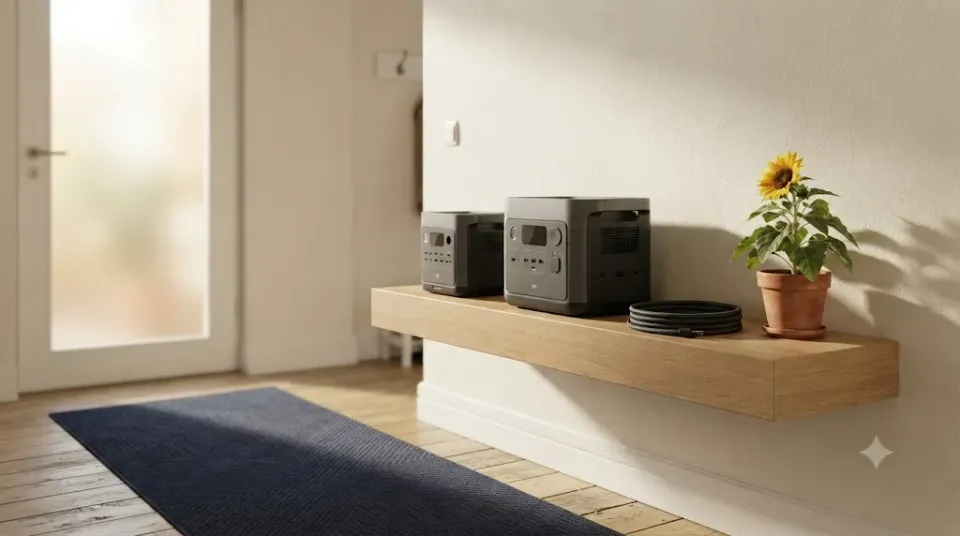
Two power stations sit side by side on a shelf. Same 1,000 Wh capacity, same sockets, similar price. One will still hold about 80 percent of its charge after eight years of daily solar use. The other gets there in about two. The difference is not the brand or the screen. It is the battery chemistry inside. Most portable units use one of two lithium types: LiFePO4 or NMC. This comparison puts them side by side, does the money maths, and ends with a clear pick for each kind of reader.
Side by side: LiFePO4 vs NMC at a glance
| LiFePO4 (LFP) | NMC | |
|---|---|---|
| Typical cycle life to about 80 % capacity | About 3,000 to 6,000 cycles | About 500 to 1,500 cycles |
| Energy per kilogram | Lower, so heavier for the same Wh | Higher, so lighter |
| Thermal stability | High; needs much higher temperatures before thermal runaway, and reacts less violently | Lower; more sensitive to heat and damage |
| Cobalt and nickel | None | Yes |
| Cold charging | Should not charge below 0 °C unless the unit heats the cells | Also limited below 0 °C |
| Where you find it | Most current power stations, home and balcony batteries | Electric cars, laptops, phones, older or very light power stations |
| Cost per kWh over its life | Low, thanks to long cycle life | Higher if cycled often |
| Best for | Daily solar cycling, home backup, long ownership | Ultralight portability with rare use |
The cycle figures are typical ranges from manufacturer data. Real life depends on temperature, how deep you discharge and how fast you charge. Always check the rating for the specific unit - and check what percentage it is quoted to, because some makers quote 70 or even 50 percent instead of 80.
The two chemistries in plain words
Both are lithium-ion batteries. Lithium moves between two sides of the cell as it charges and discharges. What differs is the material on the positive side, called the cathode.
LiFePO4 (lithium iron phosphate, often shortened to LFP) uses iron and phosphate. Its atoms sit in a very stable structure that holds on to its oxygen tightly, even when hot. That is the root of its long life and its calm behaviour under stress.
NMC (lithium nickel manganese cobalt oxide) uses a mix of those three metals. It packs more energy into each kilogram, which is why it powers most electric cars, laptops and phones. The trade-off is a structure that wears faster with each cycle and releases oxygen more readily when overheated.
Both are safe when well built and managed by a good BMS (battery management system - the electronics that watch voltage, current and temperature and cut off before trouble). The chemistry decides how much margin you have when something does go wrong.
A cycle means one full charge and discharge. Using half the battery twice counts as one cycle. So a unit you top up from 50 to 100 percent every day does about half a cycle a day.
Lifespan: what cycles mean in years
Here is where chemistry turns into time. Take three ways of using a power station:
| How you use it | Cycles per year | NMC rated 800 cycles | LiFePO4 rated 3,000 cycles |
|---|---|---|---|
| Daily solar storage, full cycle | about 365 | about 2 years to 80 % | about 8 years to 80 % |
| Daily, half cycle (50 % each day) | about 180 | about 4 to 5 years | about 16 years (age will matter first) |
| Weekend camping, 20 trips a year | about 20 to 40 | 20+ years from cycling alone | decades from cycling alone |
| Power-cut backup, kept charged | a handful | Ageing from storage dominates | Ageing from storage dominates |
Two things stand out. For daily use, the gap is enormous - four times or more. For occasional use, neither chemistry wears out from cycling within a reasonable lifetime. Then calendar ageing (the slow loss of capacity just from time, heat and being kept full) takes over, and the electronics, sockets and fan may give up before the cells do.
Reaching 80 percent is not the end. A unit at 80 percent still works; it just holds less. A 1,000 Wh unit at 80 percent health delivers about 650 Wh from its sockets after losses, instead of about 810 Wh when new.
Anker SOLIX C1000
A 1 kWh class LiFePO4 station suited to daily solar cycling, home backup and van trips. It weighs over 10 kg, which is the price of the long-life chemistry at this size.
Check price on Amazon Ad - affiliate link. Prices change; check the listing.The money: cost per kWh stored
Price per Wh on the shelf is the wrong comparison for a battery you will cycle. The right one is cost per kWh delivered over its life.
Imagine two 1,000 Wh units. The NMC one costs 500 euros and is rated for 800 cycles. The LiFePO4 one costs 700 euros and is rated for 3,000 cycles. Each cycle delivers roughly 0.8 kWh to your devices after losses.
- NMC: 800 cycles x 0.8 kWh = 640 kWh. 500 € / 640 kWh = about 78 ct per kWh.
- LiFePO4: 3,000 cycles x 0.8 kWh = 2,400 kWh. 700 € / 2,400 kWh = about 29 ct per kWh.
These are simplified figures - they treat capacity as constant until 80 percent and ignore the unit's other parts. But the gap is real. For daily cycling, the LiFePO4 unit costs well under half as much per kWh, despite the higher price tag.
That matters most if you store solar. With grid power at around 37 ct/kWh, a battery that costs 78 ct for every kWh it stores can never pay its way. One at 29 ct per kWh, filled with solar surplus that would otherwise go to the grid unpaid, at least comes close over its life. If you are thinking about storing balcony solar, check first how much surplus you really have: Sunslot shows your balcony's output hour by hour against your base load, so you can see how many days a year a battery would actually fill. Our balcony battery guide does the full savings maths.
For weekend use, flip the logic. At 20 cycles a year, neither unit gets close to its cycle limit in ten years. Cost per kWh barely matters; purchase price, weight and features do.
Safety: what actually happens when things go wrong
All lithium batteries store a lot of energy, so treat them with respect. The difference between the two chemistries shows up when a cell is abused - crushed, punctured, overcharged or overheated.
The key term is thermal runaway: a chain reaction in which a cell overheats, breaks down, releases more heat and heats its neighbours. Once started, it is very hard to stop.
A 2023 study from the Karlsruhe Institute of Technology (KIT) heated and punctured cylindrical cells of different chemistries under controlled conditions. Its findings line up with what the industry has seen for years:
- LFP cells reacted later and at much higher temperatures. Thermal runaway in the LFP cells started between about 250 and 300 °C, compared with roughly 190 to 270 °C for the nickel-based cells tested.
- LFP peaks were lower. Maximum temperatures in the LFP cells were about 100 degrees lower than in NMC and NCA cells.
- Under nail penetration, LFP cells did not go into thermal runaway at all in that test series, staying around 130 °C.
- NMC had the earliest onset of self-heating among the cells tested, and vented first.
The authors concluded that LFP cells are considerably safer under abuse. That is one big reason LiFePO4 has become the standard for batteries that live inside the home.
None of this makes an NMC unit dangerous in normal use. Millions of laptops and cars use NMC safely every day, protected by good cell design and a BMS. It means that if something does fail, a LiFePO4 unit gives you more margin and a less violent event.
Weight and size: where NMC still wins
NMC packs more energy into each kilogram. In portable units that can mean noticeably less weight for the same capacity, though the case, inverter and electronics add a fixed amount either way.
For a unit you carry on a hike, to a festival or up a mountain hut path, a few kilograms less can matter. For a unit that sits in a hallway as power-cut backup, or by your balcony door storing solar, weight matters much less than lifespan and safety.
That said, the gap has narrowed. LiFePO4 units have become more compact, and small LiFePO4 stations in the 300 Wh class now weigh only a few kilos. The days when "light" automatically meant "NMC" are mostly over. Many makers have moved their whole range to LiFePO4.
Cold, heat and storage: how each behaves
Cold
Neither chemistry likes being charged below freezing. Charging lithium cells below 0 °C can cause lasting damage, and LiFePO4 is particularly sensitive. Some LiFePO4 units have built-in heaters that warm the cells before charging. Without one, a good BMS simply refuses to charge until the cells are warm enough. Discharging in the cold works, but you get less capacity until the unit warms up.
Practical advice: in winter camping or a cold van, bring the unit inside the sleeping area or warm it before charging from solar in the morning.
Heat
Both chemistries age faster when hot. A unit left in a parked car in July can see temperatures well above what any maker recommends. Keep it out of direct sun and away from heaters, whatever is inside.
Storage
For long storage, leave the battery at around 50 to 60 percent and top it up every few months. Both chemistries age faster when kept full and hot, or left completely empty. For power-cut backup, many people keep the unit fuller - that is a fair trade-off between readiness and ageing. Some units let you set a charge limit, such as 80 percent, which helps.
Jackery Explorer 300 Plus
A small LiFePO4 unit of a few kilos for hikers and campers who want long life without much weight. Its small capacity and inverter suit phones, cameras and laptops, not fridges.
Check price on Amazon Ad - affiliate link. Prices change; check the listing.How to read the spec sheet in two minutes
Adverts lead with capacity and watts. The chemistry details are usually further down. Here is what to look for, line by line, and what a good answer looks like.
| Spec line | What it tells you | What to look for |
|---|---|---|
| Cell chemistry | LiFePO4 / LFP or NMC / "lithium-ion" | LiFePO4 or LFP stated clearly; "lithium-ion" alone often means NMC |
| Cycle life | How many full cycles to a stated capacity | A number and a percentage, for example "3,000 cycles to 80 %" |
| Charging temperature | The range in which the unit will charge | Usually 0 to 40 or 45 °C; cell heating if you need winter charging |
| Storage temperature | Where it can sit long term | A range that matches your cupboard, car or garage |
| Weight | What you carry | Compare Wh per kg between models of the same chemistry |
| Warranty | How long the maker stands behind it | Many LiFePO4 units carry several years; a long warranty backs up the cycle claim |
| Charge limit setting | Whether you can stop charging below 100 % | Useful for backup units that sit charged for months |
A quick sanity check on weight: divide capacity by weight. A 1,056 Wh unit weighing about 12.9 kg gives roughly 82 Wh per kg for the whole box, including inverter and case. Compare that number between models before you assume a lighter unit is a different chemistry - sometimes it just has a smaller inverter or fewer sockets.
If the cycle life is missing entirely, or the only claim is "long life," ask the seller in writing. A maker confident in its cells puts the number on the page. Keep the reply - it helps if the unit fades early and you need to claim under warranty.
Three example buyers
These are example households, not real people, to show how the comparison plays out.
Lena's balcony battery in Nuremberg
Lena has a two-panel balcony kit and wants to catch some midday surplus for the evening with a portable power station. She expects to cycle it most days from April to September - around 180 days a year. A LiFePO4 unit rated for 3,000 cycles would take well over a decade to reach its limit. An NMC unit rated for 800 would be worn after about four summers. Clear choice: LiFePO4. Before she buys, she runs her balcony through Sunslot to check her typical surplus, so she does not pay for capacity she cannot fill.
Kai's hiking kit in the Allgäu
Kai wants a small unit for multi-day hikes between huts, charging a camera, a phone and a headlamp. He uses it perhaps 15 times a year and carries it on his back. Here weight is the main factor and cycling barely matters. If he finds a lighter NMC model that fits his needs, it is a reasonable choice. But he finds a 300 Wh class LiFePO4 unit at only a little more weight - and takes the longer life as a bonus.
The Schmidts' power-cut backup in Essen
An example family keeps a 1 kWh class unit in the hallway cupboard for power cuts and the occasional camping weekend. It sees maybe 10 to 20 cycles a year. Either chemistry would last for cycles. They choose LiFePO4 for the safety margin, because it will sit inside the flat, often charging, for years. Calendar ageing will decide its lifespan, so they set an 80 percent charge limit and check it every few months.
Verdict by reader type
| If you... | Choose | Why |
|---|---|---|
| Store balcony solar most days | LiFePO4 | Thousands of cycles; far lower cost per kWh stored |
| Keep a unit at home for power cuts | LiFePO4 | Better safety margin for a battery that lives and charges indoors |
| Camp or travel in a van regularly | LiFePO4 | Frequent cycling, long ownership, weight less critical in a vehicle |
| Hike and carry the unit on your back, rare use | Either - compare weights | Weight matters most; small LiFePO4 units are now light enough for many |
| Want the longest-lasting unit for your money | LiFePO4 | Longer cycle life, no cobalt or nickel |
| Already own an NMC unit that works | Keep using it | No reason to replace a healthy unit; follow the storage advice |
Common mistakes and safety rules
- Comparing only price per Wh. For a battery you cycle often, price per kWh over its life is the number that counts.
- Ignoring the "to what percentage" in cycle claims. 3,000 cycles to 80 percent and 3,000 cycles to 50 percent are very different promises.
- Charging below freezing. Let the unit warm up first unless it has cell heating.
- Storing it full in a hot place. The fastest way to age any lithium battery.
- Assuming LiFePO4 means "can't burn." It is far more tolerant, not immune. Treat every lithium battery with care.

Whatever the chemistry:
- Keep it out of direct sun and away from heaters. Do not leave it in a hot car in summer.
- Charge it on a hard surface, not on a bed or sofa, with space around the vents.
- Use the supplied charger or a solar input within the stated limits. See pairing panels with a power station.
- Stop using a unit that is swollen, damaged or smells odd. Take it to a proper collection point, not the household bin.
- Tell your insurer if you use a battery to store solar. See insurance and liability.
Next, get the size right with our size guide, and if you are still deciding whether you need one at all, start with what a power station is.
BLUETTI AC180
A 1 kWh class LiFePO4 unit that suits a hallway power-cut kit or regular camping. Check its cold-charging and charge-limit settings against how you plan to store it.
Check price on Amazon Ad - affiliate link. Prices change; check the listing.Battery chemistry questions
Is LiFePO4 safer than NMC?
Yes, under abuse. In laboratory tests, LiFePO4 cells went into thermal runaway at much higher temperatures and reached lower peak temperatures than NMC cells. Both are safe in normal use when well built and managed by a good BMS.
How many years does a LiFePO4 power station last?
From cycling alone, often a decade or more. A unit rated for 3,000 cycles reaches about 80 percent capacity after roughly 8 years of one full cycle a day. With lighter use, calendar ageing and the electronics usually decide its lifespan.
Why are LiFePO4 power stations heavier?
LiFePO4 stores less energy per kilogram than NMC, so you need more cell material for the same capacity. The gap has narrowed, and small LiFePO4 units are now only slightly heavier than older NMC ones.
Can I charge a LiFePO4 power station in winter?
Not below 0 °C, unless the unit has cell heating. Bring it to room temperature first. Discharging in the cold works, but you get less capacity until it warms up.
How do I know which chemistry a power station uses?
Check the spec sheet for "LiFePO4" or "LFP" versus "NMC" or "lithium-ion." If it only says "lithium-ion," ask the seller - most makers that use LiFePO4 advertise it clearly.