This is general information, not legal advice. Rules change, so check the current wording before you rely on it.
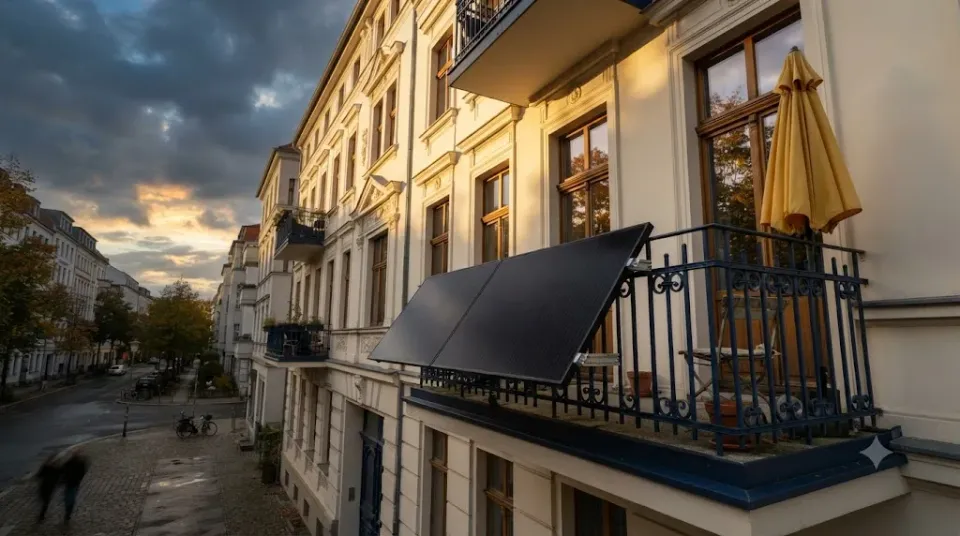
Picture an autumn night with gusts of 70 km/h. A panel on the fourth floor pulls loose and lands on a parked car. The car repair is 3,800 euros. The panel is 120 euros. Who pays which bill? In Germany the answer is usually reassuring: two policies most households already have cover both. But "usually" hides a few traps - storm definitions, payout caps, and the word every insurer loves, "grossly negligent." Below are the questions people actually ask, each answered straight in the first line.
Do I need a special insurance policy for balcony solar?
No. For a plug-in balcony system, a special photovoltaic policy is not needed. The German insurers' association GDV says this explicitly. Two everyday policies do the work:
| Policy | The question it answers | Typical example |
|---|---|---|
| Hausratversicherung (household contents insurance) | What if my system is damaged? | Hail cracks a panel; lightning surge kills the inverter; the kit is stolen |
| Private Haftpflichtversicherung (personal liability insurance) | What if my system damages someone else? | A panel falls onto a car; an inverter fault causes a fire that damages the building |
| Wohngebäudeversicherung (building insurance) | What if the building itself is damaged? | Usually the landlord's or owners' association's policy; for owners it can matter if the system is firmly bolted to the house |
If you have both contents and liability insurance, you most likely already have the basics. If you only have one of them, liability is the one to get first. A cracked panel costs you a hundred euros or two. Damage to someone else's car, facade or health can cost thousands.
It also helps to know what the system is worth to you per year, because that is what a long repair wait costs. A typical two-panel kit on a south railing might make around 600 kWh a year. If you use 40 percent of that yourself at 37 ct/kWh, that is 600 x 0.40 x 0.37 = about 89 euros a year, or roughly 7 euros a month. A broken inverter in May costs you more than one in December, because summer is when most of the energy arrives. Run your own balcony through Sunslot to see your monthly output - it tells you how much a few weeks of downtime would really cost, and whether a small deductible is worth claiming at all. Our payback maths explains the formula.
Is my balcony system automatically covered by my contents insurance?
If your contents policy is recent, very likely yes. If it is older, ask. The GDV added balcony solar systems to its model conditions (template policy terms that individual insurers often base their own contracts on) for household contents insurance at the end of 2023. Since then, contents insurance typically covers the system against:
- storm and hail,
- fire,
- theft,
- overvoltage from lightning.
If a repair is possible, the insurer pays for it. If not, it pays the replacement value (Neuwert, the cost of buying the same kit new).
Two catches. First, model conditions are a template, not a law. Your insurer may use its own wording. Second, older contracts were written before balcony systems were on anyone's mind. The GDV advises checking with your insurer whether your contract has been switched to the newer terms. A two-line email gets you the answer.
What does "storm" actually mean in my policy?
In most German contents and building policies, a storm starts at wind force 8 on the Beaufort scale, which is at least 62 km/h. The ADAC explains it this way in its storm-damage guide. A gust of force 7 (around 50 km/h) usually does not count, even if it tears your panel loose. Hail is treated separately and does not need a minimum wind speed.
That has a practical consequence. A badly fixed panel can come loose in an ordinary blustery afternoon long before force 8. The insurer may then argue it was not a storm at all, but a mounting failure. In that case the contents policy may not pay for your panel - and if the panel hit something, your liability policy becomes the key question.
Also watch for Außenversicherung (outdoor cover) rules. Some contents policies treat things outside the flat - garden furniture, grills, items on a balcony - under separate terms. They may cap the amount or require the item to be secured against storm. A properly bolted solar mount usually meets "secured." A panel cable-tied to a railing may not.
Who pays if a panel falls and damages a car or hurts someone?
Your personal liability insurance normally pays. That is exactly what it is for: personal injury and property damage you cause to others by accident. The GDV gives the falling panel on a parked car as its own example.
The person who owns and runs the system is generally the one responsible. If you are a tenant, that is you, not your landlord. That is why landlords sometimes ask for proof of liability insurance before they agree - a reasonable request. See our landlord letter.
Here is a worked example with the night from the intro:
| Damage | Cost | Usually paid by |
|---|---|---|
| Dent and scratched paint on the neighbour's car | 3,800 € | Your personal liability insurance |
| Your broken panel | 120 € | Your contents insurance, if the storm definition is met and no exclusion applies |
| Cracked railing paint where the mount pulled away | 250 € | Liability insurance (damage to the landlord's property), subject to the terms |
| Your deductible (Selbstbeteiligung), if your policy has one | for example 150 € | You |
The numbers are illustrative. The point is the split: the expensive part lands on liability, and liability insurance in Germany is cheap and widely held.
Can my insurer refuse to pay if I mounted the panels badly?
It depends on which policy. This is the part most articles get wrong.
Contents insurance: payouts can be cut
For your own property, German insurance law (§ 81 of the Insurance Contract Act, VVG) lets an insurer reduce the payout if you caused the damage through gross negligence (grobe Fahrlässigkeit - ignoring a risk that anyone would have seen). The cut must match how serious the fault was. A cut to zero is only possible in exceptional cases. Some policies contain a clause waiving this defence, fully or up to a limit. That clause is worth looking for.
Liability insurance: gross negligence is usually covered
For damage to others, the law works differently. Under § 103 VVG, a liability insurer is freed from paying only if you caused the damage intentionally and unlawfully. Gross negligence alone does not, by law, let a liability insurer walk away. The injured person gets paid.
That does not make sloppy mounting risk-free. Policies have duties (Obliegenheiten) such as reporting changes and following safety rules, and breaking those can still cause trouble. Trade sites warn that insurers may cut or refuse payouts for gross negligence during installation. So the honest summary: your liability cover is robust, your contents cover less so, and a proper mount protects both.
What counts as careless? Courts decide case by case, but examples that would worry any adjuster:
- Panels held only by cable ties or bungee cords.
- A mount not designed for your railing shape or panel size.
- Ignoring a visibly loose bracket for weeks.
- Panels hanging far out over a pavement or car park with no secure fixing.
Wera Click-Torque A 5
A small torque wrench for tightening mounting bolts to the value in the manual, which is good evidence of careful installation. It covers low torque values; check that your mount's figures fall in its range.
Check price on Amazon Ad - affiliate link. Prices change; check the listing.How do I mount the panels so the insurer has nothing to argue about?
Use a mount made for your situation, follow the instructions, and document it. That is the whole recipe. The biggest real risk with balcony solar is mechanical, not electrical: a panel is a large flat sail, often over 20 kg, several floors up.
The product norm DIN VDE V 0126-95, in force since December 2025, now requires manufacturers to state which surfaces their mounts suit. The consumer advice centres add that systems must be designed for the loads at the installation site and secured against falling, wind and snow. In practice:
- Pick a mount rated for your railing type and panel size. Round tube, square rail, masonry parapet and glass each need different hardware. Our railing mounting guide goes through them.
- Keep panels inside the railing or at railing height where possible, rather than hanging out over the street.
- Tighten bolts to the torque in the manual. A small torque wrench takes the guesswork out.
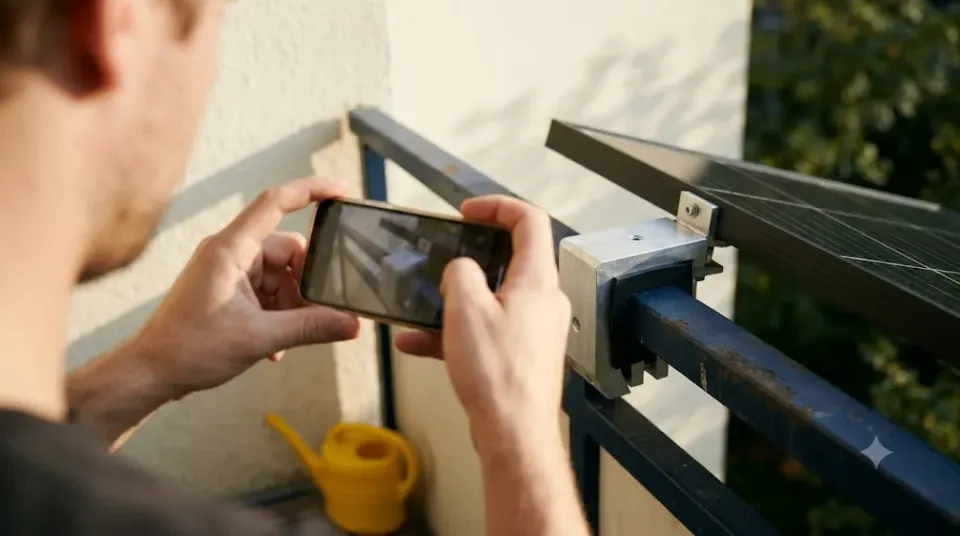
- Photograph everything. Each bracket, the bolts, the finished panel from inside and outside. Date-stamped photos are your best evidence that it was done properly.
- Keep the manual and receipt with your insurance papers.
- Check twice a year: before the autumn storms and after winter. Wiggle each panel, look for rust or movement, retighten.
Think of it as building your evidence file on day one. If a claim ever happens, you hand over photos, the manual and your inspection notes. Adjusters stop arguing quickly when they see that.
Do I have to tell my insurer, and what should I write?
Yes, tell both insurers - contents and liability - as soon as the system is running. The GDV advises informing your insurers without delay when you put a balcony system into use. Many add it at no extra cost. Without notice, you risk being left with the bill if something happens.
A short email is enough. Here is one you can copy:
Subject: Balkonkraftwerk - policy number [123456]
Dear Sir or Madam,
I would like to inform you that since [date] I have been operating a plug-in solar device (Balkonkraftwerk) at my address [address]. It consists of [2] panels with a total of [860] Wp and an inverter limited to 800 W. It is mounted on the balcony railing with the manufacturer's mounting system. The approximate value is [450] euros. The system is registered in the Marktstammdatenregister.
Please confirm in writing that the system is covered under my policy, and tell me whether any limits, conditions or a surcharge apply.
Kind regards, [name]
Send the same email to both insurers, even if they are the same company - contents and liability are often separate contracts. Keep the replies with your purchase receipt and your register confirmation.
When the reply comes, look for three things: any cap per claim for this kind of item, any rule about items mounted outside, and whether a gross-negligence waiver applies.
Does it matter whether I rent or own?
Yes, mainly for building insurance and permission. The core cover - contents for your kit, liability for others - is the same.
Tenants
- You need consent before mounting. Since October 2024 your landlord should normally allow it and cannot refuse without a good reason. See asking your landlord.
- Offer proof of liability insurance in your request. It answers the landlord's biggest worry before they raise it.
- The building is the landlord's policy. If your panel damages the facade, your liability insurer usually deals with the landlord's claim.
Flat owners in an owners' association
- The association may set conditions on how and where you mount. Follow them; that also protects you in an insurance case.
- Tell the association's building insurer through the property manager if the system is fixed to common property.
House owners
- Check your building insurance. If the system is firmly bolted to the house, some insurers see it as part of the building and cover it under Wohngebäude rather than contents. Ask which policy applies so it does not fall between the two.
What happens in three typical claims?
These are example households, not real cases. The outcomes depend on your exact policy, but they show how the pieces fit.
The hailstorm in Munich
An example couple in Munich have two glass panels on a south railing. A July hailstorm cracks one. They photograph the damage, note the date, and report it to their contents insurer with the receipt. Hail is a named risk, the panel cannot be repaired, and the insurer pays the replacement value minus their deductible. Total effort: one evening.
The loose bracket in Hamburg
An example renter in Hamburg mounted his panels with a cheap universal clamp that did not fit his square railing. Over a windy week - gusts of force 6 to 7, never a storm by the policy definition - one panel works loose and drops onto a bicycle below. His liability insurer pays the bicycle owner. His contents insurer declines the claim for his own panel, because there was no storm and the damage came from the mount. Lesson: the right mount is cheaper than one lost panel.
The inverter fault in Dresden
An example owner in Dresden has an inverter fail and scorch the wall behind it. The fire brigade is not needed, but the render needs repair. Fire is covered: the owners' building insurance handles the facade, and the inverter itself falls under her contents policy. Because she had registered the system, told her insurers and kept the manual, the claim goes through without questions.
Loctite 243
Medium-strength threadlocker that helps stop vibration loosening bolts on a railing mount. Only use it where the mount manual allows, as some makers specify their own locking parts.
Check price on Amazon Ad - affiliate link. Prices change; check the listing.What about portable power stations and balcony batteries?
A portable power station is usually household contents like any other device. If it is damaged by fire, a power surge or theft, your contents insurance applies. If it causes damage to others - say, a fire that spreads to a neighbour's flat - your liability insurance applies.
Where insurers become cautious is how you use and store it. Check the maker's instructions on charging indoors, keep it away from heaters and direct sun, and charge it on a hard surface with space around the vents. A unit that is swollen or damaged should not be used. These are not just safety tips - ignoring clear manufacturer warnings is the kind of thing that can count as careless.
Battery chemistry matters here too. LiFePO4 cells (lithium iron phosphate) are much harder to push into overheating than NMC cells (nickel manganese cobalt). That is one reason LiFePO4 has become standard for batteries that live inside the home. See LiFePO4 vs NMC.
If you add a battery to your balcony system, mention it in your insurance email too. Note that the product norm DIN VDE V 0126-95 does not yet cover combinations with storage; separate rules are planned. See does a balcony system need a battery?
What should I do right now?
Five steps, about one hour in total:
- Find your contents and liability policies and check the date and terms. Look for "Balkonkraftwerk," "Steckersolargerät" or "Photovoltaik."
- Send the email above to both insurers.
- Photograph your mounting and save it with the manual and receipt.
- Register the system within one month of switching it on. See registration.
- Put a reminder in your calendar for an autumn and a spring check.
None of this affects how much power you make. But it decides whether a bad night costs you a deductible or a few thousand euros. If you are still planning the system itself, start with Germany's 800 W rules, then check how much your balcony will really produce in Sunslot - it is worth knowing what the system earns before you decide how much protection to put around it.
Ei Electronics Ei650
A 10-year smoke alarm for the room where a power station or battery charges. It warns you early; it does not replace following the maker's charging instructions.
Check price on Amazon Ad - affiliate link. Prices change; check the listing.More insurance questions
Does balcony solar make my insurance more expensive?
Often not. Many insurers add a balcony system to existing contents and liability policies at no extra cost, especially under newer terms. Ask in writing so you have the answer on record.
Is a panel cracked by hail covered?
Usually yes, under household contents insurance. Hail is a named risk and does not need a minimum wind speed. Check whether your policy caps payouts for items mounted outside.
What if a panel comes loose in wind below storm force?
Your contents insurance may not pay for your own panel, because storm cover usually starts at wind force 8. If the panel damages something else, your personal liability insurance normally steps in.
Do I need to tell my insurer if I move the system to a new flat?
Yes. Your address is part of your policy. Send the same short email with the new address and mounting details, and register the change in the Marktstammdatenregister too.
Is my power station covered if it is stolen from my car?
That depends on your contents policy. Theft from a car is often limited or excluded. Check the terms for "Diebstahl aus Kfz" before you leave a unit in a parked car.