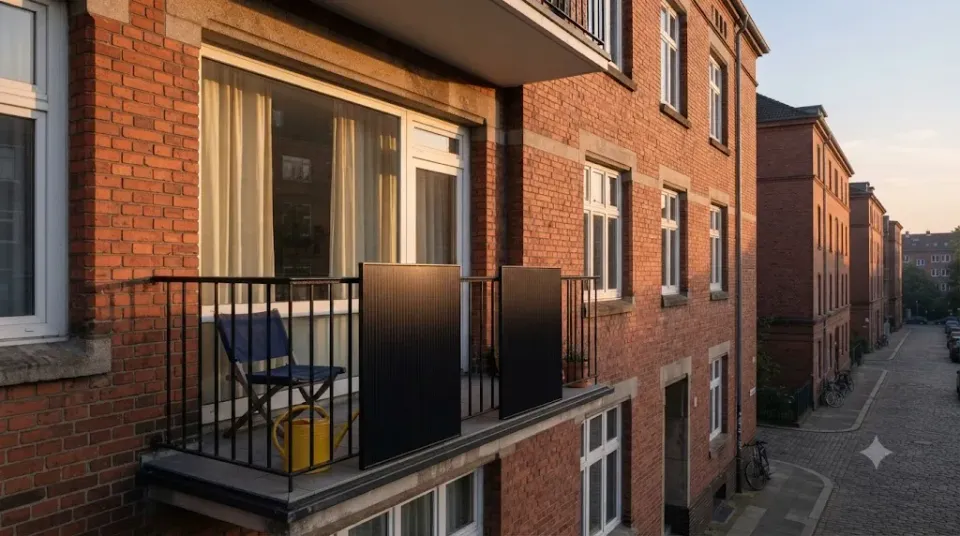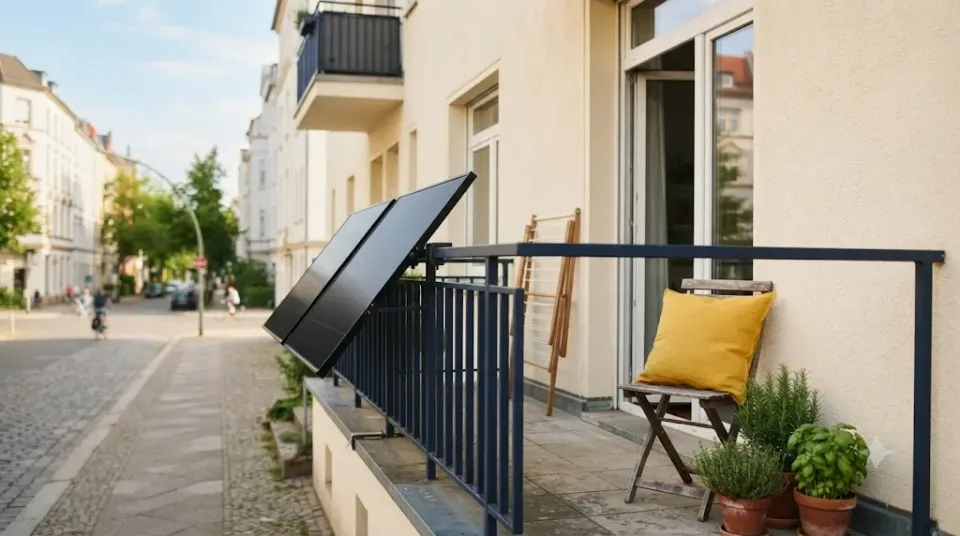

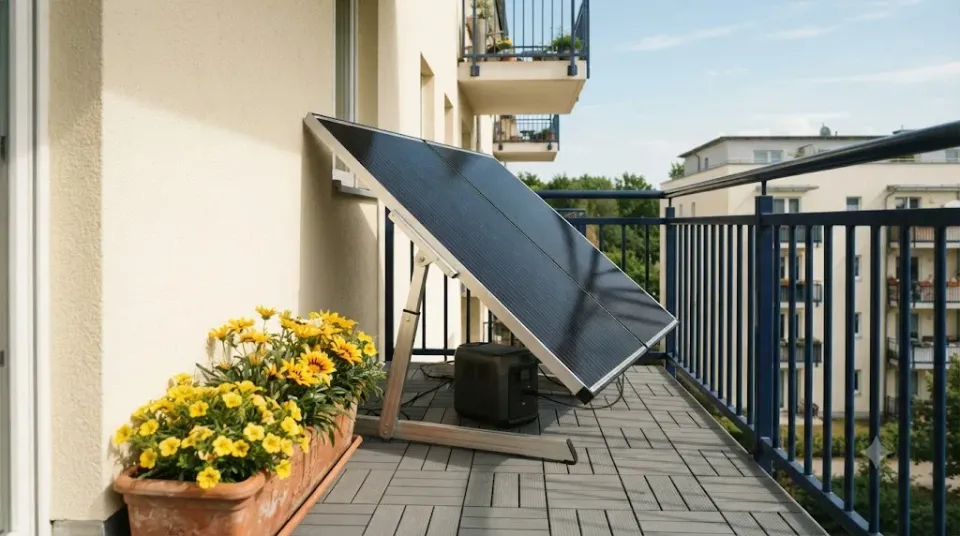
Here is a number most battery adverts leave out. In a typical German flat, adding a balcony battery saves roughly 75 euros a year on top of what the panels already save. The battery part of the kit costs around 500 to 700 euros more. That is about eight years to earn back the battery alone, before you count any loss of capacity over time. For some households the sum looks much better. For others it never works. The difference is not the brand you pick. It is how much of your sunshine you already use.
So the short answer is: no, a balcony system works perfectly well without a battery. Your panels feed power into your sockets, and your appliances use it straight away. A battery helps you keep more of that power for the evening. This guide helps you decide whether that is worth the money for your flat, with "if this, then that" paths, a decision table and what I would buy in each case.
First, what happens without a battery
During the day, your balcony system covers part of what your flat is using at that moment. If the panels make 400 W and the flat uses 150 W, the 150 W stays at home and the other 250 W flows out to the grid. In Germany that exported power is generally not paid for. Balcony systems do not get a feed-in tariff (payment per kWh sent to the grid), so it is effectively a gift to the network.
The share you use yourself is called self-consumption. For a typical balcony system in a typical household, studies and calculators put it somewhere around 30 to 60 percent, depending on direction, size and habits. Our article on self-consumption goes deeper, and your base load explains the 24/7 watts that soak up most of it.
That export share is the only thing a battery can work with. If you export 60 percent of a sunny day, a battery has plenty to store. If you export 20 percent, it sits half-empty most evenings, and you have paid for capacity you never use.
What a battery adds, and what it costs
A battery stores the midday surplus and releases it in the evening, when the panels are idle but you are cooking, watching TV and charging things. That can lift your self-consumption to something like 70 to 90 percent. You lose a little on the way: charging and discharging typically wastes about 10 to 15 percent of the energy.
There are two main types for balcony use:
- DC-coupled (the battery sits between the panels and the inverter). Simple, efficient, and common in newer kits. The panel power goes into the battery as direct current, so there is one conversion fewer.
- AC-coupled (the battery connects on the mains side with its own inverter). More flexible, because you can add it to a system you already own, often a bit less efficient.
Either way, the 800 W limit still applies to what the system feeds into your home. And note that Germany's product standard for plug-in solar devices, DIN VDE V 0126-95, does not yet cover combinations with batteries. Separate rules are planned, so check what the maker says about compliance. This is general information, not legal advice.
Many batteries also work best with a smart meter reader or a smart plug that tells them how much your flat is drawing right now. Without that, the battery has to guess and usually feeds a fixed amount in the evening. With it, it can match your actual base load, so less of the stored power leaks out to the grid at night.
The money, worked through
Prices change, but in 2026 a basic 800 W kit without storage typically costs around 250 to 500 euros, and a set with storage around 800 to 1,200 euros. So the battery adds roughly 500 to 700 euros. Here is what that buys, using illustrative figures and an electricity price of 37 ct/kWh, close to the BDEW average for new household contracts in August 2026.
| Assumption | Without battery | With battery |
|---|---|---|
| Annual yield | 750 kWh | 750 kWh |
| Self-consumption | 40 % = 300 kWh | 75 % less 10 % losses = about 505 kWh |
| Electricity price | 37 ct/kWh | 37 ct/kWh |
| Saving per year | about 111 € | about 187 € |
| Extra saving from battery | - | about 76 € a year |
| Payback on the battery part (600 € extra) | - | about 8 years |
The point of the table is the last line. The panels pay back quickly. The battery on its own pays back slowly, and only if it lasts long enough. Many balcony batteries use LiFePO4 (lithium iron phosphate) cells rated for several thousand cycles, which over roughly one cycle a day in the sunny half of the year means many years of use. Warranties are often around ten years. But eight years is still a long time to wait.
Three example households, three answers
Now the same sum for three example flats (hypothetical, but realistic). Same 750 kWh panel yield, same 37 ct, same 600 euro battery premium.
| Out all day | Mixed | Home office | |
|---|---|---|---|
| Self-consumption without battery | 30 % = 225 kWh | 40 % = 300 kWh | 55 % = 412 kWh |
| Self-consumption with battery, after losses | about 500 kWh | about 505 kWh | about 530 kWh |
| Extra kWh used | about 275 kWh | about 205 kWh | about 118 kWh |
| Extra saving per year | about 102 € | about 76 € | about 44 € |
| Battery payback | about 6 years | about 8 years | about 14 years |
See the pattern? The person who is out all day gains most, because they export most. The person working from home already uses most of the sun at lunch, so the battery has little left to store. Fourteen years is longer than many battery warranties.
Your own figures may be quite different. A sunny south balcony and a household that is out all day gives the battery more to do. An east-facing balcony and someone working from home gives it less. Sunslot estimates your hour-by-hour output and shows how much you would use yourself versus export, which is exactly the number you need here. If the export share is small, a battery has little to store.
Anker SOLIX Solarbank 2 E1600 Pro
A 1.6 kWh LiFePO4 balcony battery that sits between panels and inverter and can catch midday surplus. It only pays back if you regularly export a lot, and it is not a backup supply for power cuts.
Check price on Amazon Ad - affiliate link. Prices change; check the listing.The decision paths: if this, then that
Work down these paths. Stop at the first one that fits you.
If you do not own a balcony system yet
Then buy the panels and the inverter first, without a battery. Live with it for three to six months, read the app, and see how much you export. If you are sure you are out every weekday and the balcony faces south, a kit with a battery-ready inverter or an add-on option keeps the door open without paying for storage now.
If you already have a system and export less than about 35 percent of your yield
Then skip the battery. The maths will not work. Spend the effort on your base load and on timing appliances instead. That costs nothing.
If you export 50 percent or more on most sunny days
Then a battery is worth a closer look. Check whether your current inverter can take a DC-coupled battery, or whether you need an AC-coupled one. Size it to your evening use, not to the biggest number in the shop.
If you have more than 800 W of panels
Then a battery has a second job. The law allows up to 2,000 Wp of panels behind an 800 W inverter, and on bright summer middays the inverter caps the output. That clipped energy is lost unless a DC-coupled battery catches it first. If you have, say, 1,600 Wp on a south balcony, a battery can store energy that would otherwise never exist for you. That improves the sum. Our article on Germany's 800 W rules explains the two limits.
If what you really want is backup in a power cut
Then be careful. Many balcony batteries do not power your sockets in a grid outage. A normal plug-in system switches off when the grid fails, for safety. A portable power station is often the simpler choice for that, and our 48-hour power cut plan shows how to size one.
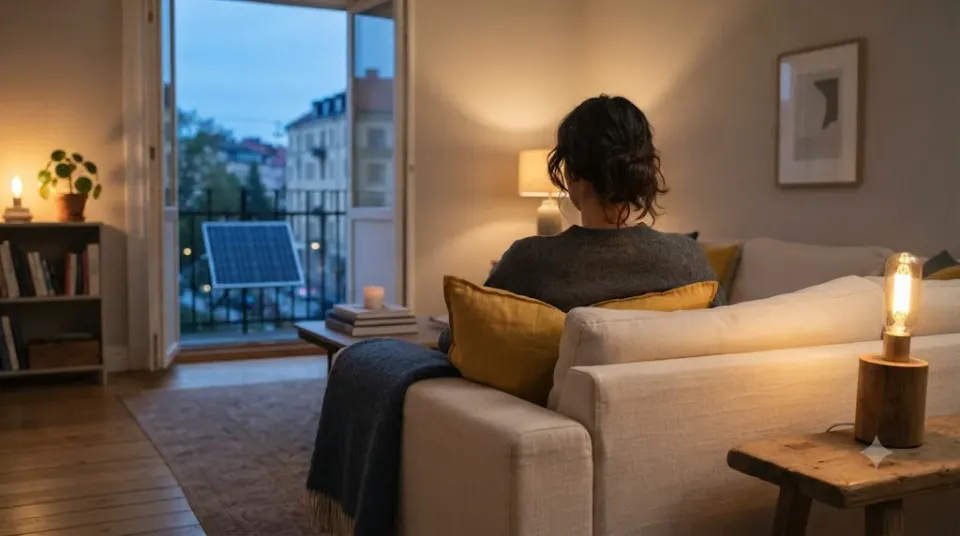
If you value evening independence more than the strict payback
Then that is a fair reason, as long as you know what you are paying for. Some people simply like seeing their evening TV run on their own sun. Just do not let an advert tell you it is the cheaper option when your numbers say otherwise.
The decision table
All the paths in one place. Find your row.
| Your situation | Export share | Battery? | Why |
|---|---|---|---|
| New to balcony solar | unknown | Not yet | Measure for a few months first |
| Home office, east or west balcony | under 35 % | No | Little surplus to store |
| Mixed habits, south balcony | 40 - 55 % | Maybe | Payback around 7 - 9 years; shift loads first |
| Out all day, south balcony | over 55 % | Likely yes | Large daily surplus |
| More than 800 Wp, south | high at midday | Yes, DC-coupled | Catches clipped energy too |
| Want outage backup | any | Power station instead | Most balcony batteries do not back up sockets |
| Renting, may move in 2 years | any | Portable or skip | Payback longer than your stay |
How to measure your export share
You need one number: what share of your yearly yield leaves the flat unused. Here are three ways to get it, from easiest to most precise.
- Estimate it before you buy. Put your balcony direction, tilt, shade and city into Sunslot, add your daily routine, and read the self-use share. Export is everything else. Look especially at a summer weekday: if the curve sits far above your base load from 10:00 to 16:00, that gap is what a battery could store.
- Read your meter. A modern digital meter has a separate register for energy fed into the grid, often labelled 2.8.0. Compare it with what your inverter app says you produced over the same weeks. Fed-in divided by produced is your export share.
- Use a smart plug on the inverter plus a meter reader. A smart plug with energy measurement on the inverter's cable shows production. An optical reader on the meter shows the flow both ways. Together, they give you an hour-by-hour picture. Our article on reading your output walks through the options.
Measure across at least one sunny month and one grey one. A single July week makes almost any battery look good.
Shelly Plus Plug S
A smart plug with energy measurement that shows what your inverter really produces, so you can work out your export share before buying storage. Check it is rated for your inverter's current.
Check price on Amazon Ad - affiliate link. Prices change; check the listing.Sizing: how much battery is enough?
If the paths above point to "yes", the next mistake is buying too much. A balcony battery should be sized to two things: how much surplus you have on a typical sunny day, and how much your flat uses in the evening and night.
A worked sizing example
Take an example flat: Jonas, alone in a one-bedroom flat in Stuttgart, out from 8:00 to 18:00, 800 W south-facing system, base load about 90 W.
- Summer sunny day: panels make about 4 kWh. During the day, his base load uses about 0.9 kWh of it (90 W x 10 hours). Surplus: about 3 kWh.
- Evening and night: from 18:00 to 8:00, base load 90 W x 14 hours = about 1.3 kWh, plus cooking, TV and laptop of about 0.8 kWh. Total about 2.1 kWh.
- So on a summer day he could store 3 kWh but only needs about 2.1 kWh overnight. A battery of about 1.6 to 2 kWh covers his evenings on most sunny days. A bigger one would sit part-full.
- In spring and autumn, his surplus shrinks to 1 to 2 kWh, so a 1.6 kWh battery fills on fewer days but is still used well.
- From November to February, the surplus is often close to zero. The battery mostly sleeps. That is normal, and it is why the yearly saving is smaller than "one full cycle a day" suggests.
For most single flats, around 1.5 to 2 kWh is the sensible size. A family with a higher evening use and more than 800 Wp of panels may justify more, but rarely a lot more.
Will the battery last long enough to pay back?
A payback of eight years only counts if the battery is still working well in year eight. Here is a rough check with numbers you can redo.
Say the battery does about one full cycle a day from April to September and very little in the darker months. That is roughly 180 to 220 full cycles a year. Over ten years, around 2,000 cycles. LiFePO4 cells are commonly rated for several thousand cycles before they drop to about 70 to 80 percent of their original capacity. So in cycle terms, a decent LiFePO4 battery has headroom.
Age matters too, not only cycles. Batteries lose capacity slowly even when used gently, and heat speeds that up. A battery on a south balcony behind dark panels in July gets warm. Look for units that list an operating temperature range and stand in the shade, or keep the battery indoors if the design allows it.
Two practical points follow. First, read the warranty for what it actually promises: a number of years, a remaining capacity (for example 70 percent) or a total energy throughput. Second, do the payback sum with a little loss built in. If the battery loses about 2 percent of its useful capacity per year, the middle household's 76 euro saving shrinks toward about 63 euros by year ten, and payback stretches by around half a year. Not dramatic, but worth knowing.
If you rent and may move
A fixed balcony battery can usually move with you, just like the panels. But if your next flat faces north or has no balcony, it becomes a box in the cellar. If you expect to move within two or three years, a payback of eight years is hard to justify. Either skip the battery or choose a portable power station that keeps its value wherever you live.
Battery buying mistakes
- Buying the battery before measuring. You cannot know your export share until you have lived with the panels.
- Counting 365 full cycles a year. In winter a balcony battery often barely fills. Real cycle counts are much lower.
- Ignoring losses. 10 to 15 percent of stored energy disappears on the round trip. Leave it out and the sum looks better than it is.
- Assuming backup. Most balcony batteries switch off with the grid. Check before you rely on it.
- Oversizing. A 4 kWh battery for a flat that uses 2 kWh overnight costs more and saves no more.
- Forgetting the cheap fixes. Shifting the dishwasher and washing machine into sunny hours often captures a big chunk of the battery's value for free.
What I would buy
Speaking as the neighbour who gets asked this over the fence every summer:
- Most flats: a good 800 W kit without a battery, plus a smart plug with energy measurement. Shift loads for a few months, then decide.
- Out all day, south balcony, export clearly over half: a DC-coupled balcony battery of about 1.5 to 2 kWh, with a meter reader so it can match your night-time base load.
- More than 800 Wp of panels: a DC-coupled battery is the strongest case, because it also catches midday energy the inverter would clip.
- Mainly worried about power cuts: a portable LiFePO4 power station instead of a balcony battery. It moves with you and works when the grid does not.
Zendure SolarFlow 800 Pro
A balcony storage system with a built-in 800 W inverter and expandable battery, suited to households that are out all day. Expensive relative to the panels, so run the payback first.
Check price on Amazon Ad - affiliate link. Prices change; check the listing.The verdict
Start without a battery. Live with the system for a few months, read your monitoring app, and see how much you export. If you regularly send a lot to the grid, a battery becomes worth a closer look. If you already use most of it, you have saved yourself several hundred euros. For the full picture on the panels themselves, see payback maths.
Battery questions
Does a balcony solar system work without a battery?
Yes. The panels feed power into your sockets and your appliances use it at once. A battery only stores the share you would otherwise export, so it is an optional extra, not a requirement.
How long does a balcony battery take to pay back?
In our middle example it saves about 76 € a year for a 600 € premium, so about eight years. Someone out all day may see around six years; someone working from home can see 14 years or more.
Will a balcony battery keep my lights on in a power cut?
Usually not. Most balcony systems, with or without a battery, switch off when the grid fails. If backup matters to you, check the product specifically, or use a portable power station.
What size battery does a balcony system need?
Size it to your evening and night use and your typical sunny-day surplus. For most single flats that lands around 1.5 to 2 kWh. Bigger batteries often sit part-full.
Are balcony batteries covered by the new VDE norm?
Not yet. DIN VDE V 0126-95 covers plug-in solar devices but not combinations with batteries. Separate rules are planned, so check what the maker says about compliance. This is not legal advice.