

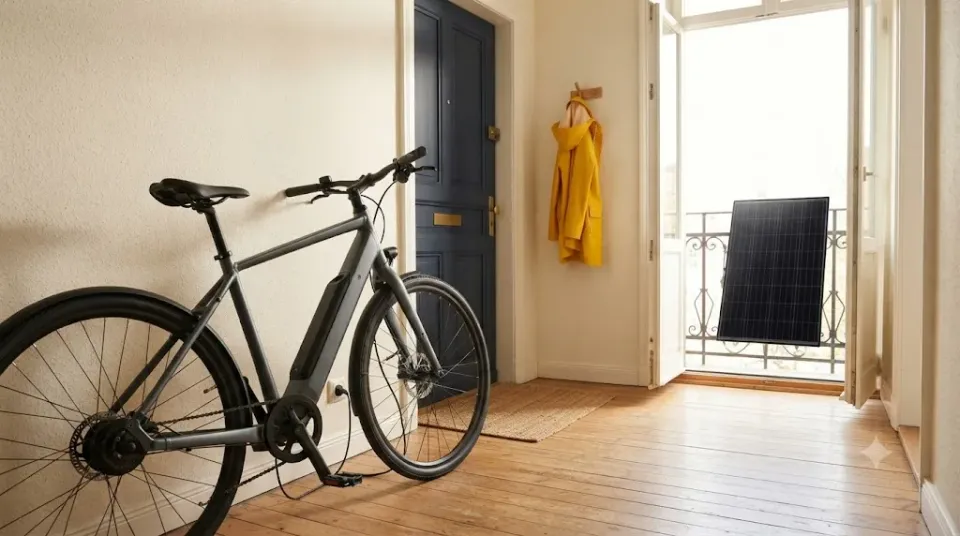
Short version: you probably do not need a battery yet. You need your machines to run while the sun is out. Longer version comes with numbers, because the gap between those two choices is bigger than most people think.
Here is the frustrating bit of balcony solar. A south kit sends only about 3 percent of its year's output into the hours after 18:00. That is exactly when most households cook, wash, watch TV and charge things. So a lot of midday power flows out to the grid unpaid, and the evening runs on bought electricity.
A battery is the obvious fix. It stores midday sun and releases it in the evening. But there is a cheaper move that works the other way round: bring the evening work to the midday sun.
We ran an example household through the Sunslot model. Berlin, 2 x 430 Wp facing south (about 844 kWh a year), base load 150 W, a daily dishwasher and three washes a week, all run in the evening.
| Setup | Solar used at home per year | Extra vs start |
|---|---|---|
| Start: machines in the evening | about 426 kWh | - |
| Add a 1 kWh battery, change nothing else | about 571 kWh | +145 kWh |
| No battery, machines moved to midday | about 601 kWh | +175 kWh |
| Add a 2 kWh battery, machines still in the evening | about 688 kWh | +262 kWh |
A bigger battery still wins in raw kWh. But a balcony battery costs several hundred euros, often more than the panels. A delay-start button costs nothing. At the 2026 average of about 37 ct/kWh, 175 kWh is worth about 65 euros a year, every year, with no hardware.
So the order is clear. First move the work to the sun. Then charge your existing batteries at lunchtime. Then, if you are choosing panels, think about pointing one west. Only after all three does storage start to make real sense.
That is the headline. The questions people ask next are the useful part, so let us go through them.
Which machines can I actually move to midday?
Anything that does not care what time it runs, as long as it is done by the time you need it. In most flats that is a short list, but it is a powerful one.
| Machine | Energy per run | How to move it |
|---|---|---|
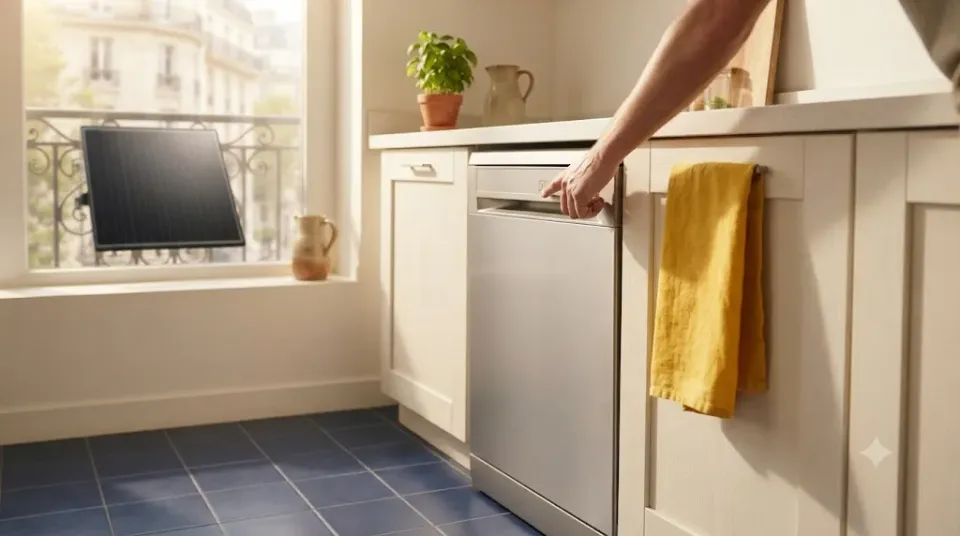
| Dishwasher, eco programme | about 0.7 to 1 kWh | load after breakfast, delay-start to finish by mid-afternoon |
| Washing machine, 40 °C | about 0.5 to 1 kWh | same, or run it on weekend mornings |
| Heat-pump dryer | about 1 to 1.5 kWh | moderate power over two to three hours, a near-perfect solar match |
| Dehumidifier | about 0.2 to 0.3 kWh per hour | timer plug, run it 11:00 to 15:00 |
| Bread maker, slow cooker | about 0.3 to 1 kWh | start in the morning, ready for dinner |
The eco programmes are your friend here. They take longer but draw less power at once, mostly because they heat the water more gently. That means more of their energy fits under your solar curve instead of spiking above it.
What about safety, running a machine while you are out? It is a fair worry. Many people only use delay-start when someone is home, or on weekends and home-office days. That still captures a good part of the gain. A water stop valve (Aquastop) on the washing machine hose is a sensible extra if you do run it unattended.
Our full guide to which appliances to run in the sun goes through every common machine with timings.
What is the best time to start them?
For a south-facing kit, start between 10:00 and 12:00. That puts the heating phase, the hungry part, right under the midday peak.
Most dishwashers and washing machines draw their big power in the first 20 to 40 minutes, when they heat the water. A heating element can pull around 2,000 W. Your 800 W kit cannot cover all of that, but it covers a good share, and it covers the rest of the cycle almost completely.
The timing shifts with the direction your panels face:
| Panels face | Best start window | Why |
|---|---|---|
| South | 10:00 to 12:00 | peak is around 13:00 |
| East | 08:00 to 10:00 | peak is mid-morning |
| West | 13:00 to 15:00 | peak is mid-afternoon |
| East-west split | 10:00 to 14:00 | a flatter, wider curve |
Two common slips. Starting a three-hour eco programme at 15:00 on a south kit means it finishes as the sun fades. And starting the dishwasher and washing machine at the same moment means both heat at once, pulling around 4,000 W. Your panels cover a fifth of that. Start them an hour or two apart.
A worked example makes it concrete. Say your kit makes about 600 W at 11:30 on a clear June day, and your flat's base load takes 150 W of that. You have roughly 450 W spare. The dishwasher starts at 11:00, heats for 30 minutes at about 2,000 W, then washes and dries at around 100 to 200 W for two hours. During heating, your panels cover maybe a quarter of the draw. During the rest of the cycle, they cover all of it with room left over. Start the washing machine at 13:00, after the dishwasher has finished heating, and its heating phase lands on the same spare 450 W. Two machines, one sunny day, and most of their energy came off your balcony.
Not sure where your peak really sits? Sunslot shows your hour-by-hour curve for your direction, tilt and city, and marks the best window to start a machine.
Shelly Plug S Gen3
Switches chargers on at 11:00 and off at 15:00 automatically, and shows what they draw. Needs Wi-Fi and the Shelly app for scheduling.
Check price on Amazon Ad - affiliate link. Prices change; check the listing.What if nobody is home during the day?
Then the batteries you already own become your storage. This is the most overlooked trick in balcony solar.
Think about everything in your flat that charges: laptops, phones, an e-bike, a cordless vacuum, power banks, tool batteries, an electric toothbrush. All of them can fill at midday and run all evening.
| Device | Typical charge | Equals evening use of |
|---|---|---|
| E-bike battery | about 500 to 750 Wh | a full day's riding |
| Laptop | about 50 to 100 Wh | a whole evening of work or films |
| Cordless vacuum | about 50 to 100 Wh | a cleaning session |
| Power bank, 20,000 mAh | about 74 Wh | four or five phone charges |
The e-bike is the big one. Charge it at 13:00 instead of 21:00 and, if you ride most days, you move roughly 100 to 200 kWh a year into your solar hours. That alone is close to the gain from a small battery.
The catch: you are not home to plug things in at noon. That is what a smart plug with a schedule is for. Leave the e-bike charger plugged into a smart plug, set it to switch on at 11:00 and off at 15:00, and it charges on your sun while you are at work. Most chargers stop on their own when full, so the off time is just a backstop.
If you work from home even one or two days a week, those are your machine days. Stack the washing, the dishwasher and the vacuum charge on those days. We looked at what happens to unused midday output in where your solar goes while you are at work.
You have a south kit, work 9 to 5 and own an e-bike. You have 0 euros to spend. What do you do first?
Delay-start is free and, in the model, adds more self-used solar than a 1 kWh battery. Turning a south kit west costs output and only pays if you cannot shift anything, and a battery is the last step, after the free fixes have taken the easy surplus.
Should I point a panel west instead?
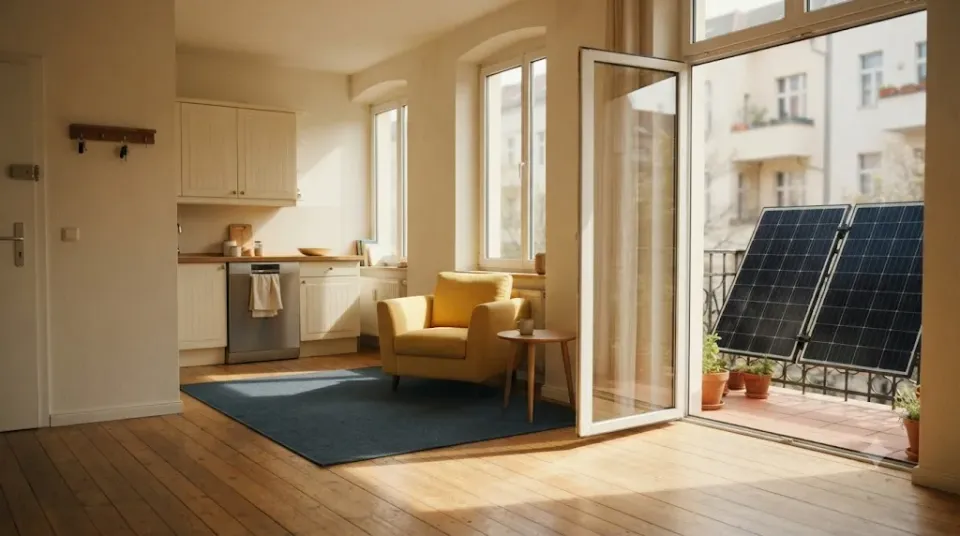
If you can choose, it is worth thinking about. A west-facing panel shifts output into the late afternoon and early evening, exactly when an out-all-day household gets home.
In the Sunslot model for Berlin, same 2 x 430 Wp kit:
| Direction | Year output | Share after 18:00 | Used at home (example household) |
|---|---|---|---|
| South | about 844 kWh | about 3 % | about 426 kWh |
| West | about 693 kWh | about 9 % | about 423 kWh |
Read that last column twice. West makes about 150 kWh less in a year. But for a household that is out until 17:00 and runs everything in the evening, the self-used amount is almost identical. The extra midday output from south mostly went to the grid anyway.
A neat middle path is one panel south and one west. Most microinverters (the small box that turns panel power into household power) have two separate inputs, so each panel can face a different way. You get a broader curve that starts strong at midday and still gives something at 18:00.
Honest caveat: if you are home in the day or already shift your machines, south wins clearly. West only pays when your use is stuck in the evening. Read more in south, east-west or flat.
How much is all this worth in euros?
Let us add it up for the example Berlin household, using 37 ct/kWh, the BDEW average for new household contracts in 2026.
| Move | Extra self-used kWh a year | Worth per year | Cost |
|---|---|---|---|
| Machines to midday | about 175 kWh | about 65 euros | 0 |
| E-bike and laptop on a midday timer | about 50 to 150 kWh (if not already counted) | about 20 to 55 euros | a smart plug |
| 1 kWh balcony battery | about 145 kWh | about 54 euros | several hundred euros |
The gains do not simply add up, by the way. Once your machines run at midday, there is less surplus left for a battery or a timer to catch. That is the key point. Every free fix you do first makes a battery less valuable later, because it eats the same surplus.
Worked example: if the household shifts its machines and still sends, say, 200 kWh a year to the grid, a 1 kWh battery might now only add 80 to 100 kWh. At 37 ct, that is 30 to 37 euros a year. A battery costing 500 euros would take well over a decade to pay back, close to its own lifetime. Our payback maths guide runs these numbers in more detail.
Brennenstuhl PM 231 E
A plug-in energy meter to see what one dishwasher or washing run really uses, so you know what you are shifting. No app or timer, display only.
Check price on Amazon Ad - affiliate link. Prices change; check the listing.So when does a battery make sense?
When the free fixes are done and you still have a real evening gap. Here is a simple test.
- You already shifted the movable loads, and on sunny days your app still shows hundreds of watts going to the grid for hours.
- Your evening and night base load is high. A home server, an aquarium, a second fridge, a network cabinet. Anything that runs at 18:00 and at 03:00 is what a battery feeds best.
- You want some backup in a power cut. Note that most balcony batteries need a separate emergency socket for this, and many cannot do it at all. Check before you buy.
- You enjoy the tech and accept a long payback. That is a fair reason too, as long as you know it.
One more thing to know. Charging and discharging a battery loses about 10 percent of the energy. A load shifted to midday loses nothing. That is another reason the free fixes come first.
Our full guide, does a balcony system need a battery?, works through payback with current prices and sizes.
Which fix suits my household?
Match the first move to how you actually live.
| Your situation | Best first move | Then |
|---|---|---|
| Home during the day | Shift the machines | schedule chargers |
| Out 9 to 5, own an e-bike | Midday timer for the chargers | shift machines on home days |
| Out all day, choosing panels now | One panel west | timers for chargers |
| Home office two days a week | Batch machines on those days | timer for the e-bike |
| Already doing all of this | Measure the surplus for a month | then look at storage |
Anker SOLIX Solarbank 3 E2700 Pro
A 2.7 kWh balcony battery for after you have moved the movable loads. It costs more than a basic kit itself, so do the free fixes first.
Check price on Amazon Ad - affiliate link. Prices change; check the listing.What people get wrong
- Buying a battery first. It catches the surplus that free fixes would have caught, at a high price.
- Stacking machines. Two heating elements at once pull around 4,000 W. Start them apart.
- Starting too late. A long eco cycle started at 15:00 on a south kit misses most of the sun.
- Running things just to "use" the solar. A heater on at noon on purpose costs more than it saves. Only shift what you would have run anyway.
- Judging by one cloudy week. Look at a month of sunny and grey days together before deciding anything.
Your next step
- Find the delay-start button on your dishwasher and washing machine this week, and try one midday run on a sunny day. Watch your app while it heats.
- Put the e-bike and laptop chargers on a smart plug set to 11:00 to 15:00. Then check your self-use share in Sunslot to see how much more of your output you could keep.
- Read self-consumption: using your own sun first and does a balcony system need a battery? before you spend anything on storage.
