

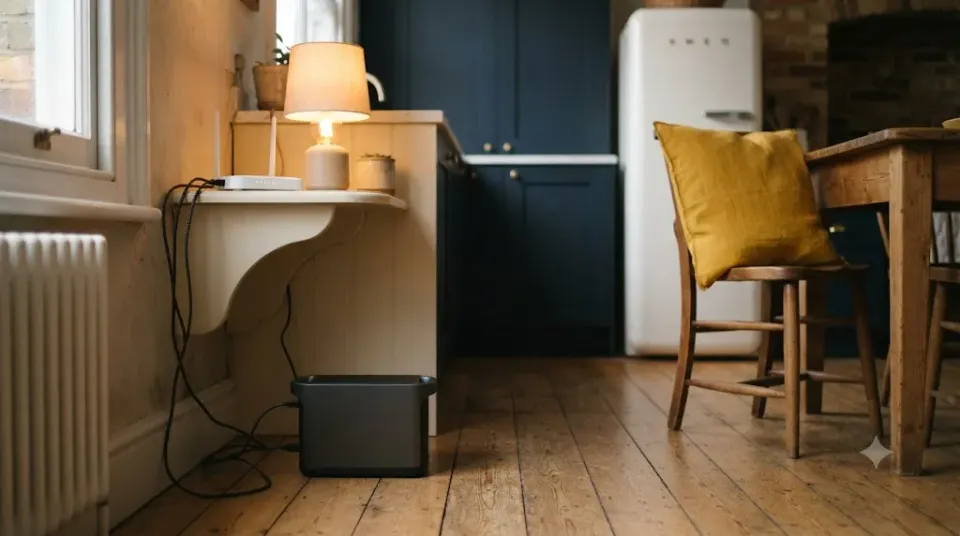
Short version: a 1 kWh power station runs small things for days and big heat appliances for minutes. Longer version is more interesting, because the spec sheet number and the number you actually get are two different things.
Start with one honest figure. A power station sold as 1,000 Wh (watt-hours, the amount of energy it stores) does not hand you 1,000 Wh at the 230 V socket. The inverter (the part that turns battery power into mains power) eats roughly 10 to 15 percent, and cold weather or an older battery takes a bit more. So plan with about 850 Wh at the AC socket.
After that, every runtime is the same sum: 850 divided by the device's watts gives you hours. Here are ten everyday things, ranked from longest to shortest.
| # | Device | Typical draw | Runtime from about 850 Wh |
|---|---|---|---|
| 1 | Phone charge | about 15 Wh per charge | about 50 charges |
| 2 | LED lamp | about 8 W | about 100 hours |
| 3 | Wi-Fi router | about 10 W | about 85 hours (3.5 days) |
| 4 | Desk fan | about 30 W | about 28 hours |
| 5 | CPAP, no humidifier | about 30 to 60 W | about 14 to 28 hours |
| 6 | Laptop | about 50 W | about 17 hours |
| 7 | Modern fridge | about 0.35 to 0.7 kWh a day | about 1 to 2 days |
| 8 | LED TV, 43 inch | about 60 W | about 14 hours |
| 9 | Microwave | about 1,000 W | about 50 minutes |
| 10 | Kettle | about 2,000 W | about 25 minutes |
The pattern is simple. Anything that makes light, moves data or charges a battery barely dents 1 kWh. Anything that makes heat drains it fast. A kettle uses in five minutes what a router uses in a day and a half.
These are typical figures, so treat them as a starting point. Your own fridge or TV can be half or double these numbers. A cheap plug-in energy meter tells you the truth in a day, and then the table becomes yours.
That is the answer most people need. But the follow-up questions are where people usually trip up, so here they are, one by one.
Why do I only get about 850 Wh out of a 1,000 Wh box?
Because energy changes form twice on its way to your plug, and each change costs a little.
The battery inside stores power as low-voltage direct current. Your fridge wants 230 V alternating current. The inverter does that conversion, and it runs warm while doing it. That warmth is lost energy. Good inverters lose around 10 percent at a healthy load. At very small loads, like a single 8 W lamp, the loss is proportionally bigger, because the inverter needs some power just to stay switched on.
Three more things nibble at the figure:
- Cold. Below about 5 °C, lithium batteries deliver less. A unit stored in an unheated garage in January can come up noticeably short.
- Age. LiFePO4 batteries (lithium iron phosphate, the chemistry in most current mid-size units) lose capacity slowly, but they do lose it. After a few thousand cycles you might have 80 percent left.
- Reserve. Some units keep a few percent back to protect the cells, so 0 percent on the display is not quite empty.
The good news: USB-C and 12 V outputs skip the 230 V inverter entirely. Charge a laptop over USB-C and you get much closer to the full 1,000 Wh. It is the easiest free gain there is. Our sizing guide uses a simple rule for the same reason: divide what you need by 0.8 before you shop.
Anker SOLIX C1000 Gen 2
1,024 Wh LiFePO4 with a 2,000 W inverter, so it can even run a kettle briefly. At about 11 kg it is portable but not light.
Check price on Amazon Ad - affiliate link. Prices change; check the listing.Can a 1 kWh power station run my fridge through a power cut?
Yes, for about a day, often longer. This is the question I hear most, and the answer is better than people expect.
A fridge does not run all the time. Its compressor switches on, cools for a while at maybe 60 to 120 W, then rests. Over 24 hours a modern A to D rated fridge uses roughly 0.35 to 0.7 kWh. An older fridge-freezer from the 2000s can use 1 kWh or more a day, and that one would empty the box in under a day.
| Fridge type | Typical use per day | Runtime from 850 Wh |
|---|---|---|
| Small modern fridge, no freezer | about 0.3 kWh | about 2.5 to 3 days |
| Modern fridge-freezer | about 0.5 to 0.7 kWh | about 1.2 to 1.7 days |
| Older fridge-freezer | about 1 to 1.2 kWh | about 17 to 20 hours |
One detail matters more than the battery size: surge power. When a compressor starts, it pulls two to three times its running power for a moment. Most 1 kWh units handle that fine, but check the surge rating on the spec sheet, especially with an old fridge.
And a trick that stretches it a lot: you do not have to keep the fridge plugged in all the time. A closed fridge stays cold for about four hours on its own. Run it for an hour, unplug it for two or three, and keep the door shut. Many people get two days out of 1 kWh this way. A full freezer, kept closed, holds for up to about two days without any power at all.
We ran a whole example flat through a full day without power in the 24-hour power cut test, fridge included.
Will it boil a kettle or run a microwave?
Only if the inverter is big enough. This is the bit spec sheets make easy to miss.
Battery size (watt-hours) tells you how long. Inverter size (watts) tells you how much at once. A 2,000 W kettle needs an inverter that can deliver 2,000 W continuously. A 1 kWh box with a 1,500 W inverter will simply switch off the moment you press the kettle button. Nothing breaks. It just will not work.
| Appliance | Typical power | Inverter you need |
|---|---|---|
| Kettle | about 2,000 to 3,000 W | 2,000 W or more (and a lower-power kettle helps) |
| Microwave | about 1,000 to 1,300 W from the wall | 1,500 W is usually enough |
| Hair dryer | about 1,200 to 2,200 W | check the label, use the low setting |
| Toaster | about 800 to 1,200 W | 1,200 W or more |
If it does work, the battery drains fast. Heating 1 litre of water from tap temperature to boiling needs about 0.1 kWh, plus a bit lost to the kettle body. So 850 Wh boils roughly 7 to 8 litres in total. That is a lot of tea, but not much else.
Some units have a "power lift" or "surge mode" that runs heating appliances above the inverter rating by letting the voltage sag. A kettle then boils, just more slowly. Handy, but it does not create extra energy. The battery still empties at the same rate per litre.
If you want the deeper comparison of what a small power source can and cannot carry, kettle vs fridge walks through it with balcony solar too.
A power cut starts at 18:00 and you have a full 1 kWh power station. What do you plug in first?
The fridge protects the most value, food that would otherwise spoil, and running it in blocks keeps it cold on a fraction of the battery. A kettle can drain a fifth of the box in five minutes, and plugging in everything at once is how people run out by midnight.
How long will it last on a camping weekend?
About two days without recharging, if you are sensible. Longer with a solar panel.
Here is a typical weekend for two people with a car and a tent:
| Device | Use per day | Energy per day |
|---|---|---|
| 12 V compressor cool box | runs on and off all day | about 400 Wh |
| LED string lights and a lantern | about 5 hours | about 60 Wh |
| Two phones and a camera | one charge each | about 50 Wh |
| Total | about 510 Wh |
Notice the cool box runs on 12 V. That skips the inverter, so you get closer to the full 1,000 Wh. Two days fits, with a little room to spare.
Add a portable solar panel and the picture changes. A 200 W folding panel, set up facing the sun, might bring in roughly 0.5 to 0.8 kWh on a good summer day in Germany. Much less on a cloudy day, and very little in winter. That can be enough to keep a weekend going indefinitely in July. It will not keep up in October.
What drains a camping battery fastest? An electric coffee machine, a hair dryer, or a small heater on a cold night. Leave those at home or plan for them separately. Our guide to power for camping and campervans has three full setups with numbers.
Jackery Explorer 1000 v2
1,070 Wh LiFePO4 with a 1,500 W inverter, a straightforward choice for outages and camping. Cannot run 2,000 W appliances like most kettles.
Check price on Amazon Ad - affiliate link. Prices change; check the listing.Can my balcony solar refill it?
Yes, while the grid is up. Not during a power cut. People mix these two up all the time.
On a normal sunny day, your balcony kit feeds power into your home wiring. If the power station is charging from a wall socket at the same time, it soaks up that solar first. Set the charge rate to about 300 to 400 W, roughly what a south kit makes for much of a summer day, and you fill the box mostly from your own panels instead of the grid.
Worked example: on a typical June day, a south-facing 2 x 430 W kit makes 300 W or more for about six and a half hours. At a 350 W charge rate, the power station fills from empty in about three hours. Start at 11:00 and it is full by early afternoon. Try that in December and it takes days, because the kit only makes about 0.55 kWh on an average December day.
During a power cut it is different. Your balcony inverter switches itself off when the grid goes down. That is a safety rule, so that no power flows back into lines that an engineer might be working on. Your panels sit idle, and the wall socket gives nothing.
To charge during an outage you need panels plugged straight into the power station's solar input. Our guide to pairing panels with a power station explains the volts and amps so you do not plug in the wrong thing.
Want to know your best charging window? Sunslot shows your balcony's hour-by-hour output, so you can see exactly when the 300 W line is crossed and for how long.
Is 1 kWh the right size, or should I go bigger?
For most flats, 1 kWh is the sweet spot. But it depends on what you actually want it for.
| If you mostly want | Size that fits | Why |
|---|---|---|
| Phones, lights and router for a few hours | about 250 to 500 Wh | light, cheap, fits in a cupboard |
| Fridge plus basics for a day, or a camping weekend | about 1 kWh | the most versatile size |
| 48 hours of basics, or a van trip | about 1.5 to 2 kWh | room for a fridge and a laptop for two days |
| Home office through a long outage | 2 kWh or more, plus solar input | monitors and laptops add up |
Weight is the hidden cost of going bigger. A 1 kWh LiFePO4 unit weighs around 11 to 13 kg. You can carry it down to the car. A 2 kWh unit is often 20 kg or more, which is a two-hand lift and not fun on stairs.
My honest view: if you live in a flat and mainly worry about a power cut, 1 kWh covers the realistic case. Most outages in Germany are short. Germany has one of the most reliable grids in Europe, with average interruption times of roughly 12 minutes per customer per year in recent years. A long outage is rare, which is exactly why a mid-size box you also use for camping makes more sense than a huge one that sits in a cupboard.
Chemistry matters as much as size. LiFePO4 handles thousands of charge cycles and is now standard in most mid-size units. Older NMC (nickel manganese cobalt) packs are lighter but age faster. See LiFePO4 vs NMC before you buy.
EcoFlow RIVER 3 Plus
A 286 Wh unit for phones, lights and a router - about a quarter of the runtimes above. Not big enough to carry a fridge for long.
Check price on Amazon Ad - affiliate link. Prices change; check the listing.How do I stretch the same battery further?
Five habits, ranked by how much they save.
- Switch the AC output off when nothing needs it. An idle inverter can draw 10 to 20 W on its own. Leave it on overnight with nothing plugged in and you lose up to a fifth of the battery in a day. For most owners this is the single biggest waste.
- Use USB-C and 12 V wherever you can. Phones, laptops, LED lamps, cool boxes. Skipping the inverter can stretch the same battery by 10 percent or more.
- Run the fridge in blocks. One hour on, two or three off, door shut. It roughly halves the fridge's share of the battery.
- Keep the unit warm. Store and use it indoors in winter. A cold battery gives less, and most units will not charge below about 0 °C.
- Avoid heat. Kettles, toasters, hair dryers and heaters are the battery killers. Boil water once into a vacuum flask instead of three times.
Here is how that adds up on a 24-hour power cut at home:
| Load | Careless | Careful |
|---|---|---|
| Fridge | about 450 Wh (on all day) | about 250 Wh (in blocks) |
| Router, 12 hours | about 120 Wh | about 120 Wh |
| Two lamps, 5 hours | about 80 Wh | about 80 Wh |
| Laptop, 3 hours | about 150 Wh on AC | about 130 Wh on USB-C |
| Idle inverter overnight | about 120 Wh | 0 Wh (switched off) |
| Total | about 920 Wh - over budget | about 580 Wh - lots of room |
Same box, same day, one runs out and one does not. That is why the habits matter more than an extra few hundred watt-hours.

What people get wrong
- Using the box size as the runtime. 1,000 Wh on the label is about 850 Wh at the socket. Plan with the smaller number.
- Ignoring the inverter rating. A huge battery with a small inverter still cannot run a kettle.
- Leaving the AC output on. The idle draw quietly drains a fifth of the battery a day.
- Expecting balcony solar to charge it in a power cut. The balcony inverter switches off with the grid. You need panels plugged straight into the power station.
- Storing it empty in a cold garage. Keep it indoors at about 50 to 80 percent, and top it up every few months, so it is ready when you need it.
- Guessing appliance power. Measure your three most important devices once. It takes a day and removes all the guesswork. For medical devices like CPAP, ask the maker for real figures with and without the humidifier, which can double the draw.
Your next step
- Write down the three things you would most want running in a power cut, and look up or measure their watts. Divide 850 by each number. That is your personal runtime table.
- If you have a balcony kit, check your hourly output in Sunslot to see how fast a sunny day could refill 1 kWh.
- Then read how big a power station you need and the 48-hour power cut plan for a flat before you buy.