

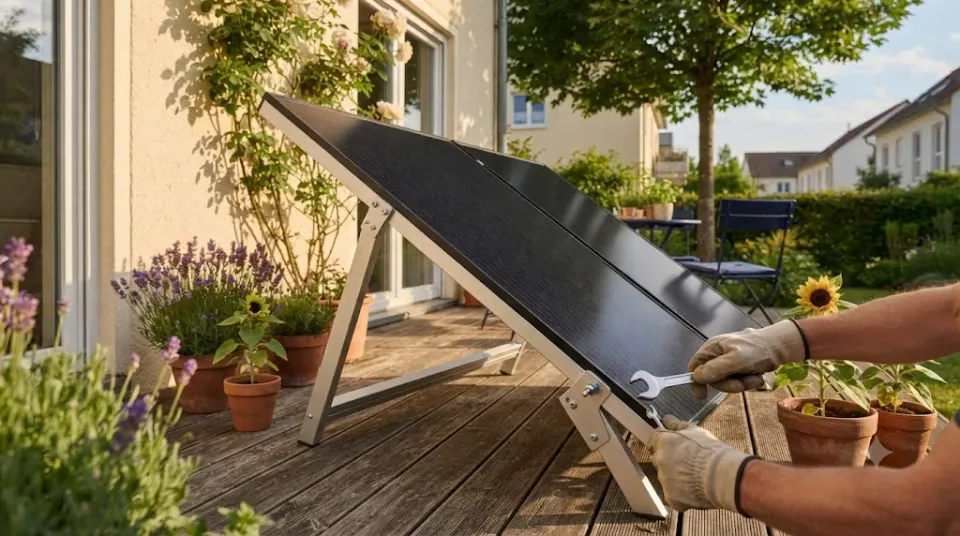
Short version: yes, you are losing a fair bit, and a modest tilt gets most of it back. Longer version matters more here than usual, because on a third floor the safety and landlord questions decide whether you should do it at all.
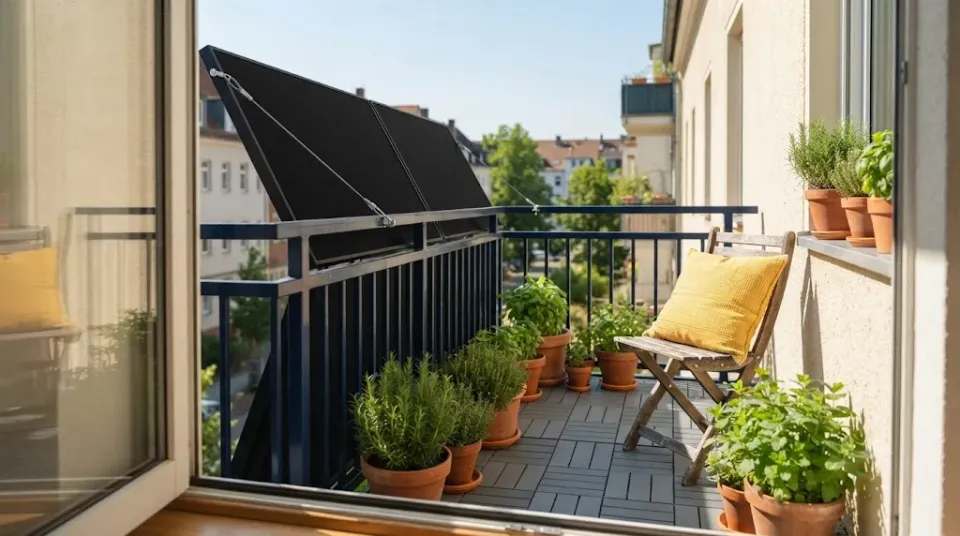
Most balcony kits in Germany hang straight down on the railing at 90 degrees. It is simple, tidy, and landlords like it. It also costs output.
In the Sunslot model, a vertical south-facing 2 x 430 Wp kit in Berlin makes about 589 kWh a year. Tilt the same panels to 70 degrees and it makes about 733 kWh. That is 24 percent more, from a bracket.
| Tilt | Year output | vs vertical | June | December |
|---|---|---|---|---|
| 90 degrees (vertical) | about 589 kWh | - | about 61 kWh | about 17 kWh |
| 80 degrees | about 667 kWh | +13 % | about 73 kWh | about 18 kWh |
| 70 degrees | about 733 kWh | +24 % | about 84 kWh | about 19 kWh |
| 60 degrees | about 785 kWh | +33 % | about 94 kWh | about 19 kWh |
| 35 degrees | about 844 kWh | +43 % | about 112 kWh | about 17 kWh |
Look at the June and December columns. Vertical panels do fine in winter, when the low sun hits them nearly head-on. In summer the sun is high overhead and catches a vertical panel at a glancing angle. That is where the loss sits. Even 10 degrees of tilt makes a visible difference: 80 degrees already adds about 13 percent.
The first 20 degrees away from vertical are the most valuable. Going further helps less per degree, and on a railing it also gets harder to do safely.
So is it worth it? For an unshaded south or south-west railing, tilt is usually the cheapest extra kWh you can buy. A bracket costs tens of euros. But on an upper floor, a tilted panel catches wind, and a panel that sticks out over the street is exactly what landlords worry about. The realistic option for most renters is a modest tilt with a bracket made for balcony railings, ideally one that leans the panels inward over the balcony floor so nothing projects outside.
That is the core answer. The follow-up questions decide whether it works on your balcony, so here they are.
Why does a vertical panel lose so much in summer?
Because a panel makes the most power when the sun hits it straight on, and a vertical panel faces the horizon, not the summer sky.
In Berlin, the noon sun stands about 61 degrees above the horizon in late June. A vertical panel meets that light at a steep angle, so the same sunlight is spread across more glass and less of it gets absorbed. A good share also bounces off. In December the noon sun is only about 14 degrees up, nearly level, so the vertical panel faces it almost head-on.
That gives a simple rule of thumb:
- Vertical is close to ideal for winter, poor for summer.
- Around 30 to 40 degrees is the best year-round angle in Germany.
- Around 60 to 70 degrees is a realistic compromise on a railing, getting most of the summer back.
Since roughly three quarters of a year's output comes from April to September, the summer loss is the one that counts. A vertical kit in June peaks at only about 380 to 400 W, against 600 W or more for a tilted one. If your summer curve looks oddly flat, that is the reason. We showed how the best hours stack up in the 7 hours that make most of your output.
Avoltik Balkonkraftwerk Halterung
An aluminium bracket with adjustable tilt, best suited to flat roofs, terraces and the ground. On a railing, check that it is rated for that use and for the wind at your height.
Check price on Amazon Ad - affiliate link. Prices change; check the listing.How much is the extra output worth in euros?
Less than the kWh figure suggests, because not all extra summer power is used at home. But still a clear gain.
More summer output also means more surplus at noon. In the model, the vertical kit had about 348 kWh a year used at home and the 35 degree kit about 425 kWh. The 70 degree version lands somewhere between, very roughly 60 kWh more used a year than vertical.
| Setup | Extra made a year | Extra used at home | Worth at 37 ct/kWh |
|---|---|---|---|
| 90 to 80 degrees | about 78 kWh | about 30 to 35 kWh | about 11 to 13 euros |
| 90 to 70 degrees | about 144 kWh | about 55 to 65 kWh | about 20 to 25 euros |
| 90 to 70 degrees, plus machines at midday | about 144 kWh | about 80 to 100 kWh | about 30 to 37 euros |
The last row is the interesting one. Tilt adds output mostly at summer noon, which is exactly when a working household is out. Pair it with delay-start on the dishwasher and washing machine and you keep far more of the gain. Our evening problem quick read shows how much that shift alone is worth.
A bracket at a few tens of euros pays for itself in one to three summers. After that, it is pure gain for the life of the kit.
Want your own number? Sunslot lets you drag the tilt from 90 to 60 degrees for your city and direction, and shows the change in savings and payback, not just in kWh.
Is it safe to tilt panels on a railing?
It can be, with the right bracket and a sound railing. It can also be a bad idea. This is the question to take most seriously.
A tilted panel catches wind like a sail. A 2 m² panel at an angle on a third-floor railing in a winter storm takes real force. A vertical panel tucked against the bars catches much less.
- Use a bracket made for railing mounting at an angle. Many cheap tilt stands are designed for flat roofs, terraces and gardens. On a railing you want one that says it is for balcony railings, states the railing sizes it fits, and gives a wind or load rating. The product standard for plug-in solar, DIN VDE V 0126-95, expects mounting systems to state which surfaces they are suitable for.
- Check the railing itself. Thin, old or wobbly railings may not take the extra leverage. If it moves when you push it, do not hang a tilted panel from it. Ask a professional if in doubt.
- Keep the tilt modest on upper floors. 10 to 20 degrees out from vertical is often the realistic limit on a railing. It already captures a good share of the gain.
- Secure everything twice. Many installers add a steel safety cable from panel frame to railing, so a failed clamp cannot drop a panel onto the street.
Our step-by-step guide to mounting panels on a railing safely covers clamps, torque and safety cables.
Third floor, south railing, panels hanging vertically, rented flat. What would you do?
A railing-rated bracket at a modest tilt gets back most of the summer loss, about 24 percent more output, while keeping wind load manageable. Leaning inward means nothing projects over the street, which makes a landlord's yes far more likely. A flat-roof stand on a high railing is a wind risk, and seasonal adjustment means leaning over a railing for very little gain.
Will my landlord allow it?
Often yes, if you make it easy to say yes. Since the 2024 reform, tenants in Germany have a legal claim to a plug-in solar device, and a landlord can only refuse on reasonable grounds. But a landlord can still have a say in how it is mounted.
A panel that sticks out over the street, the pavement or a neighbour's balcony is the classic sticking point. So shape your request around what worries them.
- Offer the inward-leaning option first. Some brackets let the panel lean inward over your balcony floor. Nothing projects outside the railing line. It uses some floor space, but it is often the easiest version to get approved.
- Name the bracket and its rating. A product name and a wind rating reassure far more than "a bracket from the internet".
- Mention the safety cable. It answers the "what if it falls" question before it is asked.
- Get it in writing. An email reply counts. Keep it with your registration papers.
Our landlord guide has a letter you can copy, and the 5-minute landlord request quick read has the short version.
This is general information, not legal advice. Your lease, the building's owners' association and local rules for listed buildings can all add conditions.
Shelly Plug S Gen3
Logs output before and after you change the tilt, so you see the real difference rather than a guess. Rated for normal household loads only.
Check price on Amazon Ad - affiliate link. Prices change; check the listing.How does tilt compare with other upgrades?
For a vertical, unshaded kit, it usually wins on kWh per euro. Here is the honest ranking.
| Upgrade | Typical extra output | Notes |
|---|---|---|
| Fixing heavy midday shade | up to +50 % if badly shaded | do this first if it applies; see shade on a balcony |
| Tilt from 90 to 70 degrees | about +24 % | bracket only; safety and consent matter |
| Bigger panels within the limits | depends on what you have | 2 x 430 to 2 x 480 Wp is about +12 % at best |
| Bifacial panels on a balcony | about +3 to 5 % | needs open space and a light floor behind; see bifacial panels |
| Moving machines to midday | 0 kWh more made, a lot more used | free; see running appliances in the sun |
Two things to notice. Shade beats everything: a tilted panel in shade is still in shade. And moving your machines to midday makes no extra kWh at all, but it makes the kWh you already have far more valuable. The best combination for a vertical kit is tilt plus timing.
What did tilting do for an example household?
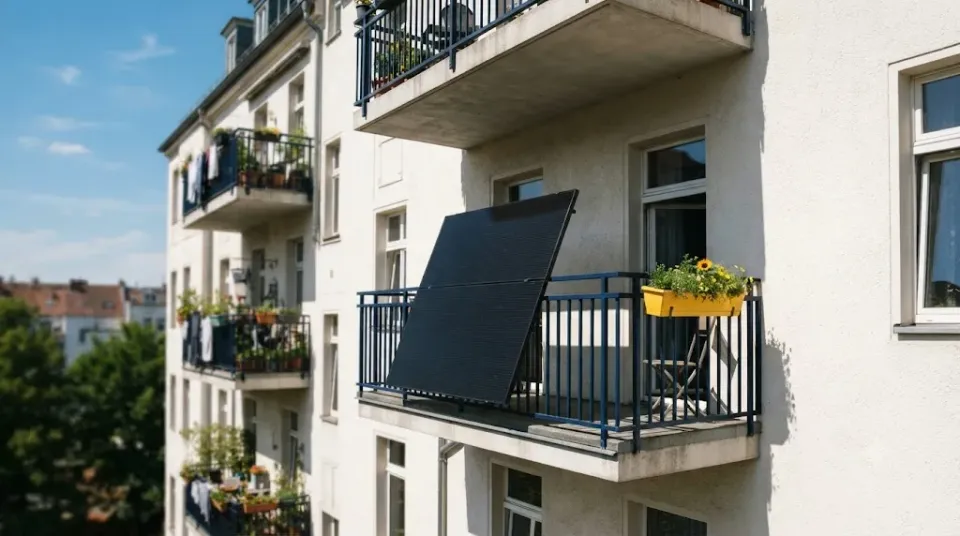
Here is an example household, hypothetical but typical. Jonas rents a third-floor flat in Leipzig with a south railing and 2 x 430 Wp hanging vertically. His app shows about 600 kWh in his first year, and summer looks oddly flat, with June peaks around 380 W.
- Step 1: he checks at 13:00 on a sunny day that nothing shades the panels. The balcony above has only a small overhang, so the panels are clear.
- Step 2: he asks his landlord about a railing bracket that leans the panels inward over the balcony floor at about 70 degrees, with a safety cable. Nothing projects outside. The landlord agrees by email.
- Step 3: the model suggests about +24 percent, so roughly 740 kWh, with most of the gain from April to September. June peaks rise to around 500 W.
- Step 4: he already runs his washing machine at noon on home-office days, so a good share of the extra summer power gets used.
Cost: a bracket, a safety cable and an afternoon. Gain: on the order of 20 to 30 euros a year, every year. Not dramatic. But nothing else he could buy adds this much output for the money.
He sets it once and leaves it. Adjusting the angle every season adds a little in theory, but it means leaning over a railing on the third floor four times a year. Not worth it.
When does tilting not help?
- Midday shade from an overhang. Tilting the panel outward may push it into the shade of the balcony above, or out of it. Check at 13:00 on a sunny summer day before you buy anything.
- East or west railings. They gain less from tilt than south ones, because the morning or evening sun is low anyway. Check in Sunslot first.
- Winter-first goals. If you mainly care about winter output, vertical is already close to the best. See winter in numbers.
- Already at 30 to 40 degrees. You are near the optimum. Spend effort on timing your appliances instead.
- A wobbly railing or no consent. Then the answer is simply no. A vertical kit still pays for itself, just more slowly.
Not sure? Try 90, 70 and 35 degrees in Sunslot with your balcony's direction and shade before buying any bracket.
Bosch Professional GIM 60
A digital inclination level that shows the exact panel angle, handy for setting a bracket to 70 degrees and checking it after storms. More tool than most people need for one job.
Check price on Amazon Ad - affiliate link. Prices change; check the listing.What people get wrong
- Buying a flat-roof stand for a railing. Check the bracket is made and rated for railing mounting.
- Tilting too far on a high floor. A modest tilt gets a good share of the gain with far less wind load.
- Skipping the safety cable. It costs a few euros and removes the worst-case risk.
- Tilting into shade. Check the noon shadow of the balcony above first.
- Expecting winter gains. Almost all the extra comes from April to September.
- Not asking. A tilted panel that annoys the landlord can end up taken down. A short email first saves that.
Your next step
- On a sunny day at 13:00, check whether anything shades your panels, and give the railing a firm push to see if it moves.
- Put your balcony into Sunslot and compare 90, 80 and 70 degrees, so you know what the bracket is worth in euros.
- Read mounting panels on a railing safely and how to get your landlord's yes, then send a short request with the bracket you have in mind.