


Short answer: the fridge, by a wide margin. Over a year the quiet fridge in the corner gets roughly three times more of your balcony power than the kettle ever can. The reason comes down to one idea about watts, and once it clicks you will know where your solar goes for every appliance in the flat.
The kettle feels like the obvious candidate. It is loud, it is powerful, and it is the appliance most people picture when they think "electricity". But a balcony kit can only give an appliance what it is making at that exact moment.
A 2,200 W kettle switched on at 13:00 on a clear June day, when a typical 2 x 430 Wp south kit makes about 640 W, gets 640 W from your panels and 1,560 W from the grid. That is about 29 percent solar, at the very best moment of the very best month. On an average June day with about 420 W at the peak, it drops to about 19 percent. And most people boil water at breakfast and dinner, when the panels give close to nothing.
The fridge is the opposite shape. Its compressor draws about 80 to 120 W while it runs, then rests. Averaged over a day a modern fridge uses roughly 15 to 30 W. That small load fits easily inside your solar output from about 08:00 to 18:00 on most days from March to October, so your panels cover all of it during those hours, every day, without anyone pressing a button.
Put numbers on a year. A kettle doing two to four boils a day uses about 75 to 150 kWh. Realistically your panels cover maybe 10 to 15 kWh of that, and around 30 kWh only if you did every boil at peak sun. A fridge uses about 130 to 260 kWh a year, and in the Sunslot model a south kit in Berlin covers about 46 percent of a fridge-sized steady load. For a fridge using 175 kWh, that is about 81 kWh of solar. Roughly three times the kettle's best case, and five or more times its realistic case.
The rule behind it: the smaller and longer a load is, the more of it your panels pay for. A 2,000 W spike gets a slice. A 100 W load gets all of it.
So should you change anything? Not for the kettle. Boil when you want tea. The appliances worth timing are the ones with long, moderate tails: the dishwasher, the washing machine, the dryer, chargers. Those are where a delay-start button turns into real euros.
Why does a 2,000 W kettle use less power than a 100 W fridge?
Because watts and kWh measure different things. Watts are how hard an appliance pulls at a moment. Kilowatt-hours are how much it uses in total. Power times time.
| Kettle | Modern fridge | |
|---|---|---|
| Power while running | 2,000 to 3,000 W | about 80 to 120 W |
| How long it runs | about 3 minutes a boil | on and off all day |
| Energy per use or day | about 0.1 kWh per litre | about 0.35 to 0.7 kWh a day |
| Energy per year | about 75 to 150 kWh | about 130 to 260 kWh |
A quick mental check: 2,000 W for 3 minutes is 2,000 x 0.05 hours = 100 Wh, or 0.1 kWh. A fridge averaging 20 W for 24 hours is 480 Wh, nearly 0.5 kWh. One boil against one day of cooling, and the fridge has used five times as much.
If the units still feel slippery, our units guide sorts them out in five minutes. It is the single most useful thing to understand before buying a kit or a power station.
How much of each one do my panels actually cover?
Here is the same comparison worked through for a realistic year, with a south kit in Berlin and power at about 37 ct/kWh (the BDEW's 2026 household average).
| Kettle, 3 boils a day | Fridge, 175 kWh a year | |
|---|---|---|
| Yearly use | about 110 kWh | about 175 kWh |
| Covered by solar, realistic | about 10 to 15 kWh | about 81 kWh |
| Covered by solar, best case | about 30 kWh | about 81 kWh |
| Worth per year | about 4 to 11 euros | about 30 euros |
| Effort needed | change your tea times | none |
Why not more than 46 percent for the fridge? Because about half of every day is dark, and on grey winter days the panels may not cover even 20 W for long. The fridge gets everything the panels can give during daylight, and the night is simply out of reach without a battery.
Try Sunslot with your own base load to see the number for your flat. The fridge, router and standby together are usually the biggest single block of solar you use.
How does the rest of my kitchen rank?
The same logic sorts everything. Here is how much of each appliance's energy a south kit typically covers at midday on an average June day, with about 420 W available and about 150 W already going to the base load.
| Appliance | Typical draw | Solar share at noon |
|---|---|---|
| Laptop | about 60 W | 100 % |
| E-bike charger | about 150 W | close to 100 % |
| Dehumidifier | about 200 W | close to 100 % |
| Induction hob, simmering | about 300 to 500 W | about 60 to 90 % |
| Toaster | about 900 W | about 30 % |
| Microwave | about 1,000 W | about 25 % |
| Kettle | about 2,200 W | about 12 % |
And the ranking by how much of your yearly solar each type of load typically soaks up:
- Always-on base load. Fridge, freezer, router, standby. Covered in every sunny hour. See your base load.
- Long moderate loads. Laptop, e-bike charging, dehumidifier, heat-pump dryer.
- Machines with a long tail. Dishwasher and washing machine: a short heating spike, then an hour or more at low power.
- Cooking. Oven holding temperature and a hob on low, partly covered.
- Short spikes. Kettle, toaster, hair dryer. A small slice at best.
Brennenstuhl Primera-Line PM 231 E
Plug the fridge in through it for 48 hours and read its true kWh on the display. No app, so no history graphs.
Check price on Amazon Ad - affiliate link. Prices change; check the listing.You want more value from your kit without buying anything. What would you change first?
A daily dishwasher moved into the sunny window keeps about 110 kWh more at home a year in the Sunslot model, worth far more than any kettle timing. The kettle and toaster are short spikes that get only a slice. Unplugging the fridge saves nothing useful and risks your food.
Should I boil the kettle at noon anyway?
If you are home and the sun is out, sure. It costs nothing to do. But do not change your routine for it. The gain from a perfectly timed kettle is a few euros a year at most.
Moving the dishwasher to midday is worth far more. In the Sunslot model, shifting a daily dishwasher and three washes a week into the sunny window adds about 175 kWh of self-use a year. At 37 ct/kWh that is roughly 65 euros, against 4 to 11 euros for the kettle. Same effort, one delay-start button.
Two kettle habits that do save something, solar or not:
- Boil only what you need. One mug is about 0.25 litres. Filling the kettle to a litre for one tea uses four times the energy.
- Descale it. Limescale on the element slows heating and wastes a little each time, especially in hard-water areas.
A smaller 1,200 W travel kettle would get a bigger solar share in percent, but it takes almost twice as long and uses the same energy per litre. It is not worth buying for solar. The self-consumption guide explains which habits do move the needle.
What if my fridge is old?
Then it may be the most interesting appliance in your home, for a different reason. An old fridge or a second freezer in the cellar can draw 50 to 100 W on average around the clock. That is 440 to 880 kWh a year. Solar will cover part of it during the day, but replacing it often saves more than the whole balcony kit does.
| Appliance | Typical yearly use | Cost at 37 ct |
|---|---|---|
| Modern fridge, energy label D or better | about 100 to 180 kWh | about 37 to 67 euros |
| Fridge-freezer, 10 to 15 years old | about 250 to 400 kWh | about 93 to 148 euros |
| Old chest freezer in a warm cellar | about 400 to 700 kWh | about 148 to 260 euros |
The only way to know is to measure. Put a plug-in energy meter between the fridge and the socket for 48 hours, read the kWh, divide by two and multiply by 365. If the number is above 300 kWh, take a hard look at a replacement.
Shelly Plug S Gen3
Logs a device's power over days in an app, handy for catching an old fridge or freezer that never rests. Needs Wi-Fi and a little setup.
Check price on Amazon Ad - affiliate link. Prices change; check the listing.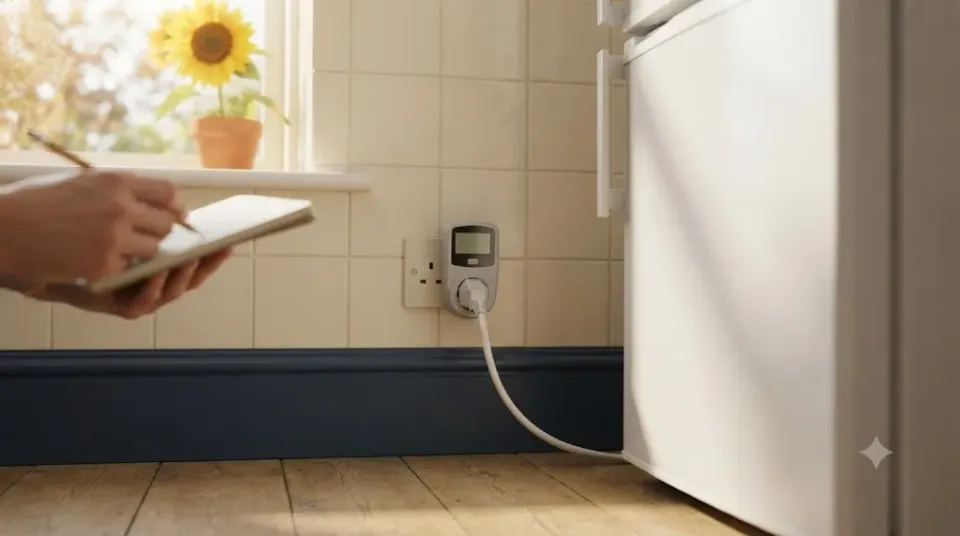
What else in my flat behaves like the fridge?
Quite a lot, and together these loads usually matter more than any single appliance. Anything small that runs for many hours a day sits comfortably inside your solar output and gets covered in every sunny hour. Walk round your flat and you will find most of them.
| Always-on or long-running load | Typical draw | Per year |
|---|---|---|
| Router and modem | about 8 to 15 W | about 70 to 130 kWh |
| Freezer, modern | about 15 to 25 W average | about 130 to 220 kWh |
| TV, sound bar and console on standby | about 5 to 20 W | about 45 to 175 kWh |
| Aquarium pump and heater | about 20 to 60 W | about 175 to 525 kWh |
| Home office PC left on | about 30 to 80 W | varies a lot |
Add up a typical flat and the base load lands somewhere between 80 and 200 W. That is the block your panels serve first, before anything you consciously switch on. It is also why a kit pays off even for people who are out all day and never time a single machine: the base load quietly takes its share every sunny hour.
There is a flip side. Shrinking the base load saves money around the clock, including the night, where solar cannot help. A switchable power strip for the TV corner, or a router that powers down Wi-Fi overnight, often saves 30 to 80 kWh a year with no comfort lost. Measure first, then decide.

Which one can solar run in a power cut?
Neither, and this surprises a lot of people. A balcony microinverter switches off within a fraction of a second when the grid fails. It is designed to, so it never feeds power into a line that workers think is dead. While the grid is down, your panels sit there making nothing usable.
If backup matters to you, that is a job for a portable power station charged in advance. Here is what a 1 kWh unit does with each appliance:
| Appliance | Runtime on a 1 kWh station |
|---|---|
| Modern fridge, about 0.5 kWh a day | roughly 1.5 to 2 days |
| Kettle at 2,200 W | about 20 to 25 minutes, if the station can supply 2,200 W at all |
Many smaller power stations cannot start a full-size kettle anyway, because their outlet limit is lower than the kettle's draw. A fridge, on the other hand, is one of the easiest things to keep running. Keep the door shut and a full fridge holds its temperature for hours even with no power. Our power station sizing guide has the full list, and the 48-hour power cut plan walks through a real outage.
Anker SOLIX C1000 Gen 2
A 1,024 Wh LiFePO4 power station that can keep a modern fridge running for roughly one and a half to two days in a power cut. Heavy at around 11 kg, and it must be charged before the outage, since a balcony inverter switches off with the grid.
Check price on Amazon Ad - affiliate link. Prices change; check the listing.What people get wrong
- "The kettle trips the solar." No. Panels and grid work together. The kettle takes what the panels give and the rest from the grid.
- "A bigger kit would carry it." Not in Germany. The 800 W inverter limit means no legal balcony kit fully carries a 2,000 W kettle.
- "High watts means high bills." Time matters as much as power. Small loads that never stop add up.
- "Solar keeps the fridge cold in a blackout." The inverter switches off with the grid.
- "Timing the kettle is the big win." Timing the dishwasher is worth about six times more.
Your next step
- See what your base load gets. Open Sunslot, add your base load and the dishwasher, and see which moves your self-use share.
- Measure your fridge for 48 hours with a plug-in meter, especially if it is over ten years old.
- Read the two guides behind this. Base load myths and which appliances to run in the sun.