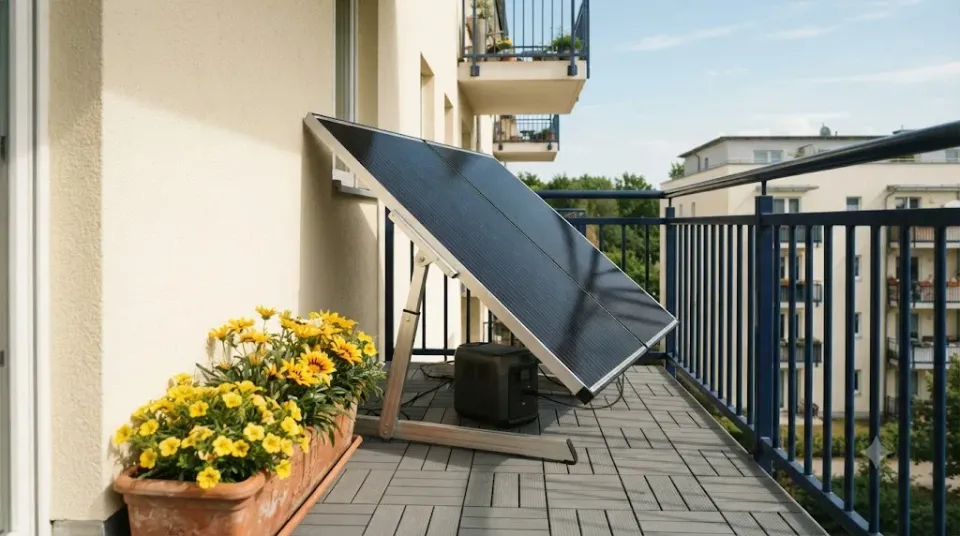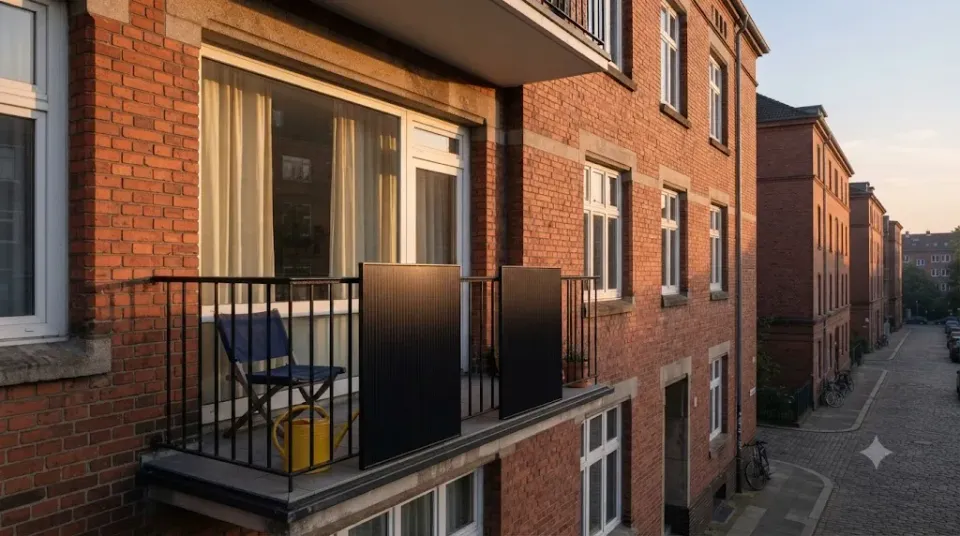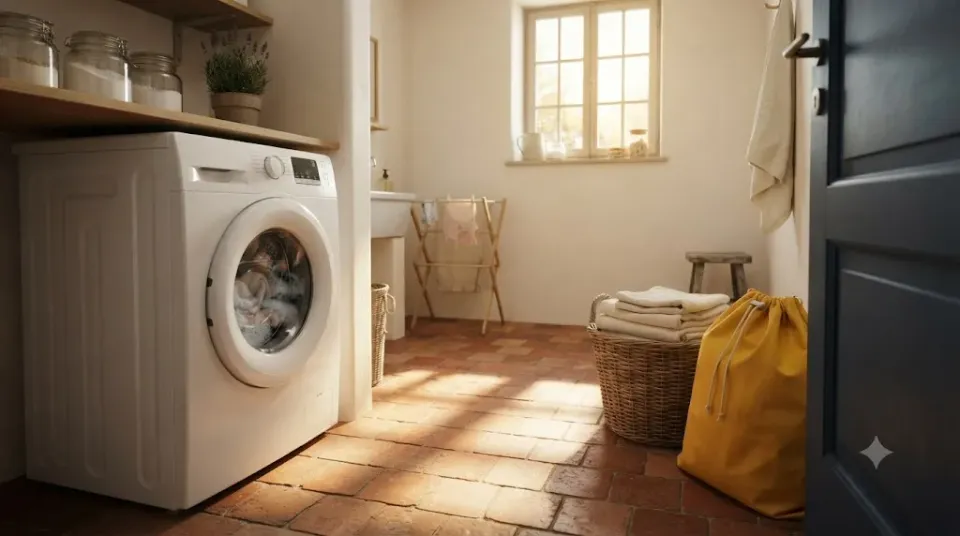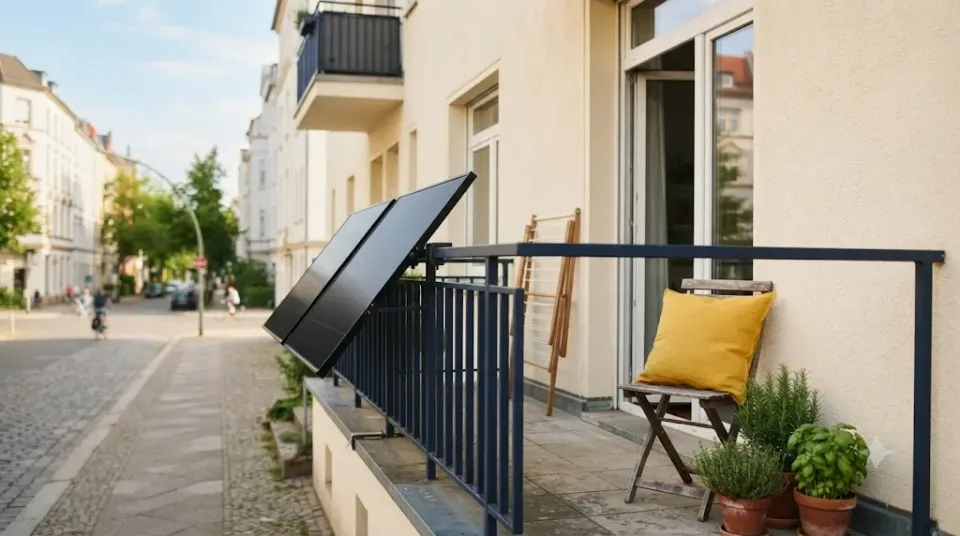
Two flats in the same street can buy the same 800 W balcony kit and save very different amounts. One saves around 85 € a year. The other saves almost twice that. The panels are identical. The difference is self-consumption (the share of your solar power you use at home, at the moment it is made). In this article we follow three example households - clearly made up, but built from typical German numbers - and watch what happens to their savings when they change a few habits.
Why does this matter so much? Because in Germany a balcony system generally earns nothing for the power it sends to the grid. There is no feed-in payment. Every kilowatt-hour (kWh, the unit on your electricity bill) your flat uses directly is a kWh you do not buy. Every kWh that leaves the flat is simply gone. So the question is not only "how much do my panels make?" but "how much of it do I actually use?"
How the power flows, and the three example households
Electricity takes the shortest path. When your panels produce power, it goes first to whatever is running in your flat at that moment. Only what is left over passes back through your meter to the grid. You do not switch anything. It just happens.
Picture a sunny weekday at noon. The panels make 500 W. The fridge, router and a few standby devices use 120 W. The other 380 W leaves the flat. Now picture the same hour with the washing machine heating water: the flat needs about 1,500 W, the panels supply 500 W of it, and nothing leaves. Same sun, very different value.
A note on meters before we start. A modern digital meter or smart meter will not run backwards. Older Ferraris meters (the type with a spinning disc) without a backstop could, and they are being replaced. Our article on the monitoring app and meter explains what you will see on yours.
Here are our three example households. All three use an electricity price of 37 ct/kWh, close to the BDEW average for new household contracts in August 2026. All three have an 800 W system with two panels.
| Example household | Where and which way | Yearly solar yield (estimate) | Daytime pattern |
|---|---|---|---|
| Jonas, single | Leipzig, south balcony, 3rd floor | about 780 kWh | Out 7:30 to 18:00 on weekdays |
| Mira and Tom, couple | Cologne, panels split east and west | about 650 kWh | Mira works from home three days a week |
| The Webers, family of four | Munich, south-west garden fence | about 760 kWh | Someone home most days, two school children |
The yields are illustrative. A south-facing 800 W system in Germany often makes somewhere around 700 to 850 kWh a year in good conditions, and east-west setups typically make less in total. Your own figure depends on tilt, shade and city. Our article on how much power balcony solar makes goes deeper.
Jonas: out all day, and the export problem
Jonas leaves at 7:30 and gets home at 6. His flat is efficient. His base load (the power the flat draws around the clock) is about 60 W: a modern fridge, the router, a few chargers. On a sunny summer weekday his panels produce up to around 600 to 700 W at midday. His flat uses 60 W of that. Most of the rest leaves.
Over a year, an example household like Jonas lands at roughly 30 percent self-consumption. Here is the maths:
- Yield: 780 kWh
- Used at home: 30 % of 780 = 234 kWh
- Saving: 234 kWh x 0.37 € = about 87 € a year
That is not bad. But two thirds of his solar power goes to the grid for nothing. Jonas cannot work from home, so what can he change?
What Jonas changed
- Delay timers. His dishwasher and washing machine both have a "start in X hours" button. He loads them in the morning and sets them to start at around 11:00. They run while he is at work. One dishwasher run a day on eco uses roughly 0.8 to 1 kWh. A good share of that now comes from the panels.
- Weekend jobs at midday. He moved ironing, vacuuming and a second wash to Saturday and Sunday late morning, instead of Sunday evening.
- Charging. His laptop, e-bike battery and cordless drill now charge on weekends around lunchtime, not overnight.
Result in this example: self-consumption rises from about 30 to about 40 percent.
- Used at home: 40 % of 780 = 312 kWh
- Saving: 312 x 0.37 € = about 115 € a year
- Gain: about 29 € a year, for pressing a timer button
Before Jonas set his timers, he used Sunslot to check his actual hours. His balcony has a building opposite that blocks low sun until about 10:30 in spring and autumn. Starting the dishwasher at 9:00 would have put the heating phase in shade. Put your own balcony in and you will see exactly when that kind of dip happens.
Mira and Tom: the east-west advantage
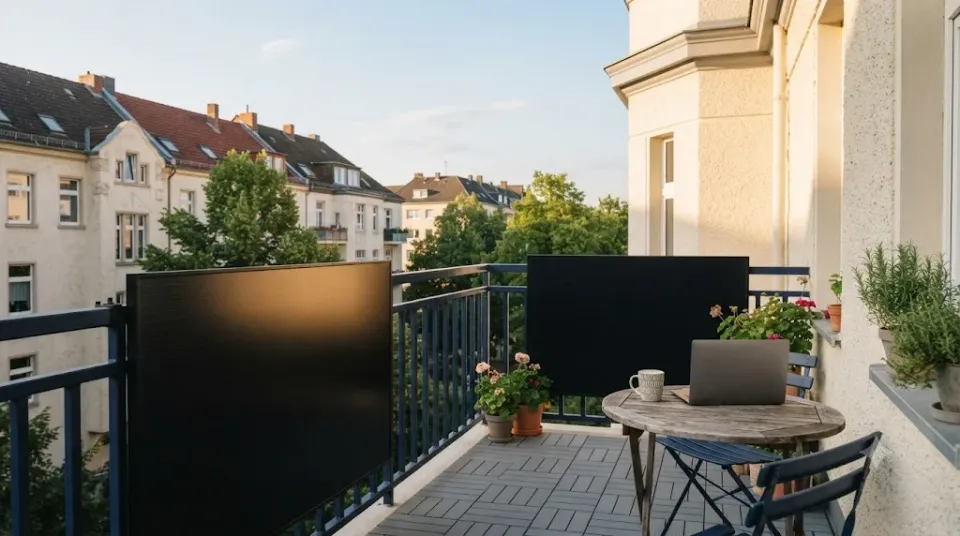
Mira and Tom live in a Cologne flat with a corner balcony. One panel faces east, the other west. In total this setup makes less than a south-facing one, about 650 kWh a year in this example. But it spreads production across the day. The east panel starts in the morning, the west panel carries on into the early evening. There is no huge midday peak to waste.
Mira works from home three days a week. Laptop, monitor, kettle, a lunch cooked on the hob. Their base load is about 110 W, a bit higher than Jonas because of a second fridge for drinks and a TV box that never fully sleeps.
Starting point in this example: about 45 percent self-consumption.
- Used at home: 45 % of 650 = about 293 kWh
- Saving: 293 x 0.37 € = about 108 € a year
Notice something. Mira and Tom's panels make 130 kWh less than Jonas's, but they already save more. That is self-consumption at work. Our east-west vs south article explains why a flatter curve is often easier to use.
What Mira and Tom changed
- Laundry on home-office days. East panel in the morning, so Mira starts the washing machine at about 9:30 on eco 40. The heating phase overlaps with the morning output.
- Dishwasher after lunch. Started at 14:00 on eco, when the west panel is ramping up.
- The drinks fridge. They measured it with a plug-in energy meter. It drew about 0.7 kWh a day. They switched it off for winter. That is not self-consumption, it is waste reduction - but it also means their solar no longer has to cover a fridge they barely use.
- Heat pump dryer in the afternoon. Their dryer draws about 600 to 900 W for two hours. On a sunny afternoon the west panel covers a good part of it.
Result in this example: self-consumption rises from about 45 to about 58 percent.
- Used at home: 58 % of 650 = about 377 kWh
- Saving: 377 x 0.37 € = about 140 € a year
- Gain: about 32 € a year, plus whatever the drinks fridge saved on its own
Shelly Plug S Gen3
A Wi-Fi smart plug with power metering that shows live watts and kWh per appliance in an app, ideal for learning what your washing machine or dishwasher really draws. Its maximum load is lower than a wall socket, so check the rating before using it on heaters, kettles or other high-draw appliances.
Check price on Amazon Ad - affiliate link. Prices change; check the listing.The Webers: a family that already does well
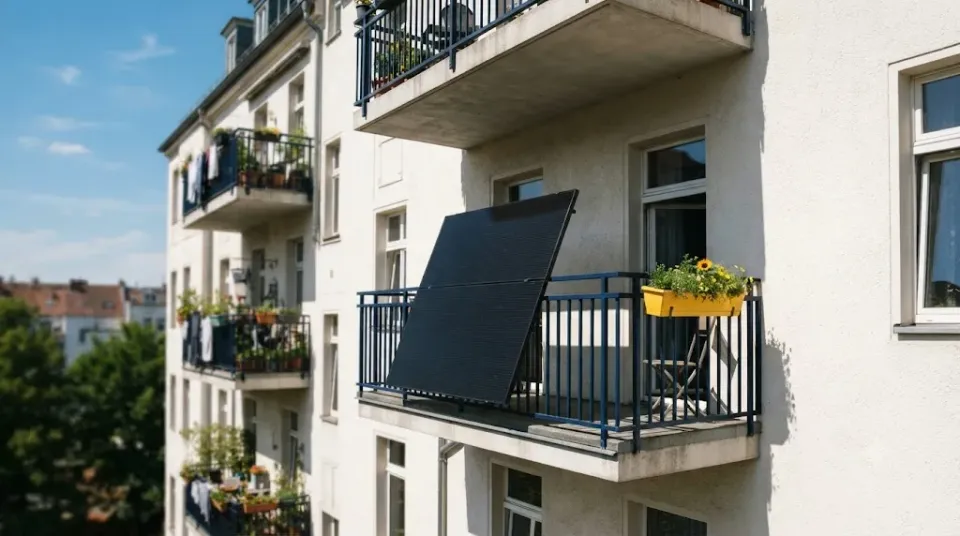
The Webers have two school children, a lot of laundry and someone at home most days. Their panels hang on a south-west garden fence in Munich. Yield in this example: about 760 kWh a year. Base load: about 140 W, including a freezer in the cellar and a small aquarium.
Families like this tend to use a lot of daytime power without trying. Starting point in this example: about 55 percent.
- Used at home: 55 % of 760 = 418 kWh
- Saving: 418 x 0.37 € = about 155 € a year
The Webers can still improve, but each extra point gets harder. Most of their big appliances already run during the day. They did three things:
- One appliance at a time. They used to start the dishwasher and washing machine together after breakfast. Two heating phases at once can draw 4,000 W, far more than 800 W of panels. Most of that came from the grid. Now the washing machine starts at 10:30 and the dishwasher at 12:30.
- Afternoon slot for the dryer. South-west panels peak a bit later, roughly 13:00 to 16:00 in summer. The dryer moved there.
- The children's tablets and the e-bike. All charged after school, around 14:00 to 16:00, instead of at bedtime.
Result in this example: from about 55 to about 64 percent.
- Used at home: 64 % of 760 = about 486 kWh
- Saving: 486 x 0.37 € = about 180 € a year
- Gain: about 25 € a year
What each percentage point is worth
Here is the simple rule behind all three stories. Take your yearly yield, multiply by 1 percent, multiply by your electricity price. That is what one point of self-consumption is worth to you.
| Example household | Yield | Value of 1 point | Before | After | Yearly saving before / after |
|---|---|---|---|---|---|
| Jonas | 780 kWh | about 2.90 € | 30 % | 40 % | about 87 € / 115 € |
| Mira and Tom | 650 kWh | about 2.40 € | 45 % | 58 % | about 108 € / 140 € |
| The Webers | 760 kWh | about 2.80 € | 55 % | 64 % | about 155 € / 180 € |
For a typical 750 kWh system at 37 ct, every 10 percentage points = 75 kWh used at home = about 28 € a year. Going from 35 to 55 percent therefore adds about 55 € a year. On a basic kit that costs a few hundred euros, that can take a year or more off the payback. The full calculation is in payback maths.
Typical ranges look like this. They are rough, and your household can sit outside them.
| Household type (illustrative) | Likely self-consumption | Why |
|---|---|---|
| Single person, out all day, low base load | around 25 - 35 % | Little runs at midday |
| Couple, one working from home | around 40 - 55 % | Laptop, kettle, lunch cooking |
| Family, appliances timed to the sun | around 55 - 70 % | Laundry and dishwasher at midday |
The five levers, ranked by what they did
Looking back at our three households, here is what moved the needle, from most to least effective for a typical flat.
- Timing the big appliances. Dishwasher, washing machine and dryer use a lot of energy per run. Started late morning or early afternoon on sunny days, one at a time, they soak up a big share of midday output. This was the biggest single lever in all three examples. Our guide on which appliances to run in the sun has a full table of typical draws.
- Knowing your real hours. "Around midday" is a rough rule. Shade from a neighbouring building, a tree or a balcony above can shift your best window by two hours. Sunslot estimates hour-by-hour output for your balcony direction, tilt, shade and city, shows how much you would use yourself versus export, and tells you which hours suit which appliance.
- Midday charging. E-bike batteries, laptops, power banks, cordless tools and a portable power station all draw small, steady loads that fit inside your solar supply.
- Watching the live numbers. The inverter app shows production in real time. A metering smart plug on the washing machine shows consumption. Seeing both side by side teaches you what fits within a week.
- Storage, last. A battery can lift self-consumption a lot. But it costs more than the panels did. The next section runs the numbers.
Shelly Pro 3EM
A three-phase energy meter for the fuse box that shows whole-flat consumption and export in real time, the cleanest way to see your true self-consumption. It must be installed in the distribution board by an electrician, so it suits owners more than most tenants.
Check price on Amazon Ad - affiliate link. Prices change; check the listing.The battery question, through the Webers' numbers
The Webers asked the obvious next question: should we add a battery? A balcony battery stores midday surplus and releases it in the evening, when the family cooks and watches TV.
Here is a rough sketch with stated assumptions. In 2026, basic 800 W kits without storage typically cost around 250 to 500 euros, and sets with storage around 800 to 1,200 euros. So storage adds very roughly 500 to 700 euros. Assume a battery of around 1.6 kWh lifts the Webers from 64 to about 85 percent self-consumption in the sunnier half of the year and less in winter. Call it an average of about 80 percent across the year.
- Extra self-used: (80 % - 64 %) x 760 kWh = about 122 kWh
- Minus storage losses: batteries lose some energy charging and discharging. Say 10 percent: about 110 kWh
- Extra saving: 110 x 0.37 € = about 41 € a year
- Payback on 600 € extra: about 15 years
That is a long time, possibly longer than the battery lasts. The picture gets better if you have a larger panel array feeding the battery, or a big evening load, or if electricity prices rise. It gets worse in a flat with a low evening load. For most households starting out, the honest answer is: buy the panels first, change your habits, and decide on storage after a year of real data. Read does a balcony system need a battery? for the full picture.
Anker SOLIX Solarbank 2 E1600 Pro
A 1.6 kWh balcony battery that stores midday surplus for the evening and can be extended later. Worth it mainly with a larger panel array or big evening use; for most first-time buyers the payback is slow, so measure for a year first.
Check price on Amazon Ad - affiliate link. Prices change; check the listing.Mistakes that quietly cost self-consumption
None of our households got everything right first time. These are the common ones.
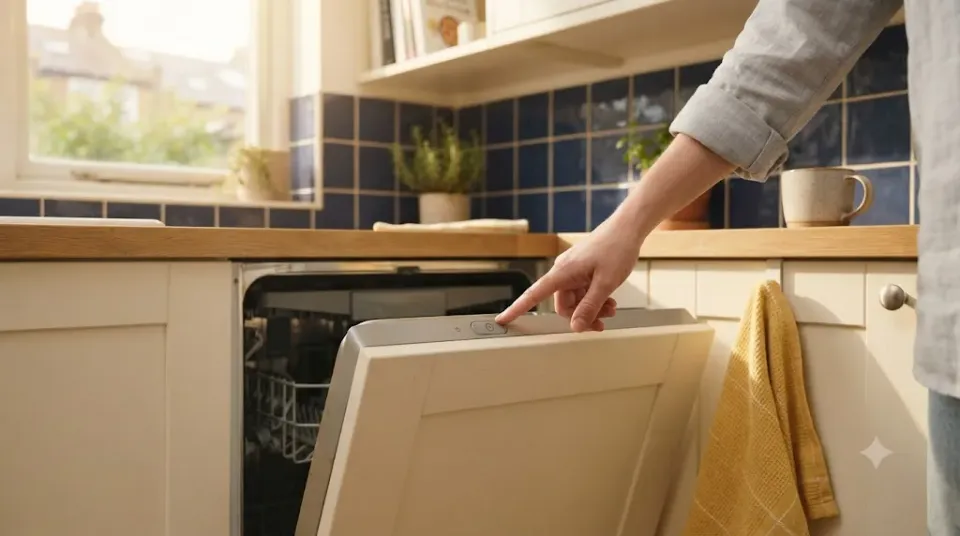
- Running everything at once. Starting the washing machine, dishwasher and oven together on a sunny morning means most of the power still comes from the grid. Stagger them.
- Using the quick programme. Short hot programmes pull high power for a short time. The eco programme runs longer at lower temperature, uses less energy overall and fits more of it inside your solar supply.
- Trusting the window, not the data. A bright sky with thin cloud can still mean modest output. Check the app before starting a big job.
- Ignoring the base load. An old second fridge or freezer can draw 0.5 to 1.5 kWh a day. Your solar covers part of it during the day, but the cheapest kWh is the one you do not use. Our article on your base load shows how to find these.
- Forgetting winter. In December, output on a German balcony is a fraction of summer output. Midday timing still helps on bright days, but do not expect summer results. See winter, snow and heat.
- Buying a battery to fix a habit. If your dishwasher runs at 21:00 because nobody thought to set the timer, a 600 € battery is an expensive solution to a free problem.
What I'd do in your shoes
If you already have a balcony system, or you are about to install one, here is the order I would work in.
- Week one: watch. Open your inverter app at different times of day. Note when output climbs past 300 W and when it drops below. That is your working window.
- Week two: measure one appliance. Put a metering plug on the washing machine or dishwasher. See how long the heating phase lasts and how many watts it pulls the rest of the time.
- Week three: move one job. Pick the dishwasher. Set the timer so it starts inside your window. Do this every sunny day for a month.
- Month two: add the second job. Laundry, one hour or two after the dishwasher, never together.
- After a year: decide on storage. Look at your real export. If you are still sending most of your summer output away and you have a big evening load, the battery maths may work for you. If not, enjoy the savings you already have.
If you have not bought yet, run your own flat through Sunslot first. It shows the split between what you would use and what you would export, and the payback that follows. Then read the buying checklist before you order.
Self-use questions
What is a good self-consumption rate for a balcony system?
For a typical 800 W system, somewhere around 30 to 60 percent is normal. A single person out all day tends to sit at the low end, a family with timed appliances at the high end. Anything above 50 percent without a battery is a good result.
Do I get paid for the power I export?
Generally, no. Balcony systems in Germany usually receive no feed-in payment. Power you do not use at the moment it is made flows to the grid unpaid. That is why self-consumption matters so much.
Is east-west worse than south?
It makes less in total but spreads output across the day. A larger share often gets used at home, so the saving can be close to a south system or even higher, as with Mira and Tom in our example.
How do I find out my own self-consumption?
The cleanest way is a whole-home energy meter or a smart meter that records exports. Without one, compare your inverter's yearly yield with the drop in your grid consumption after installation. Sunslot gives you a good estimate before you buy.
Will a battery double my savings?
Rarely. In our Webers example it adds about 41 € a year for roughly 600 € extra, a payback of around 15 years. It can make sense with a larger array or big evening loads, but habit changes come first.