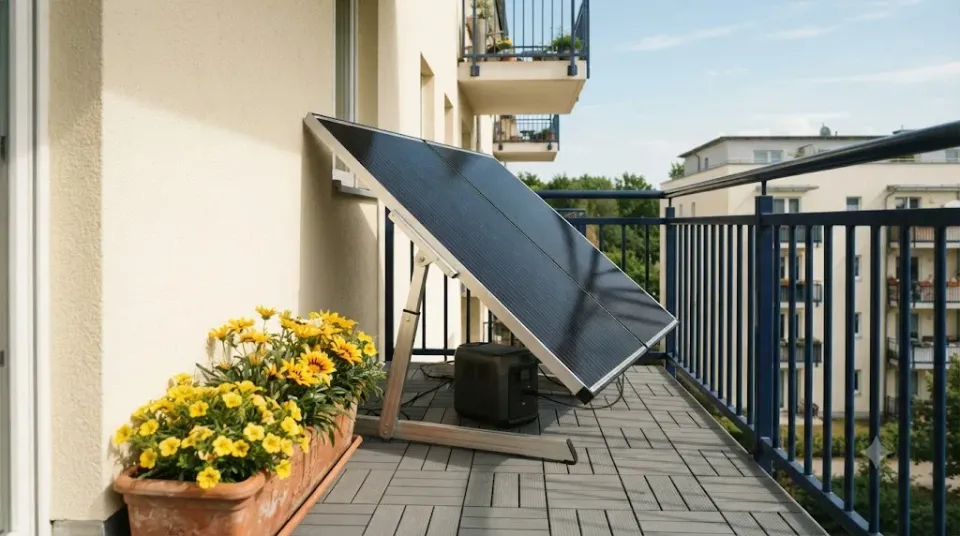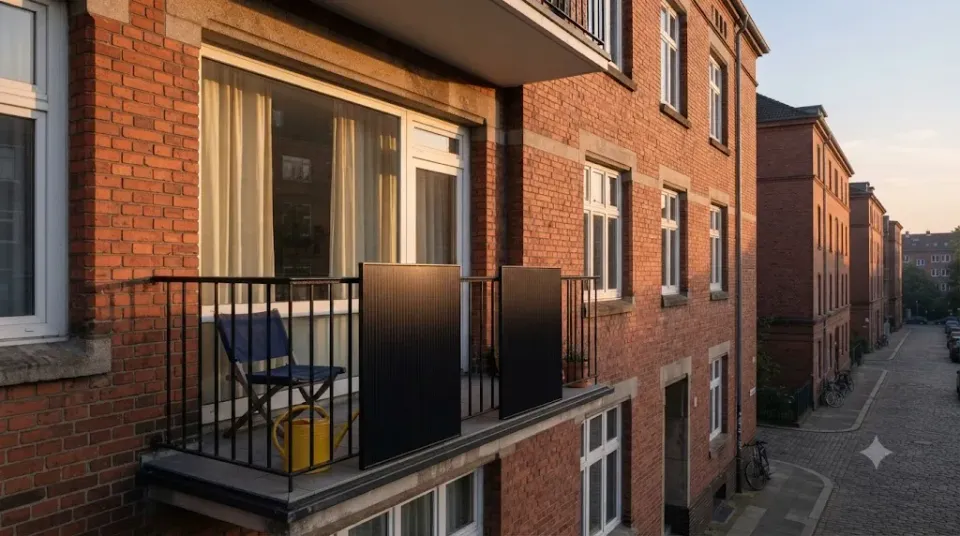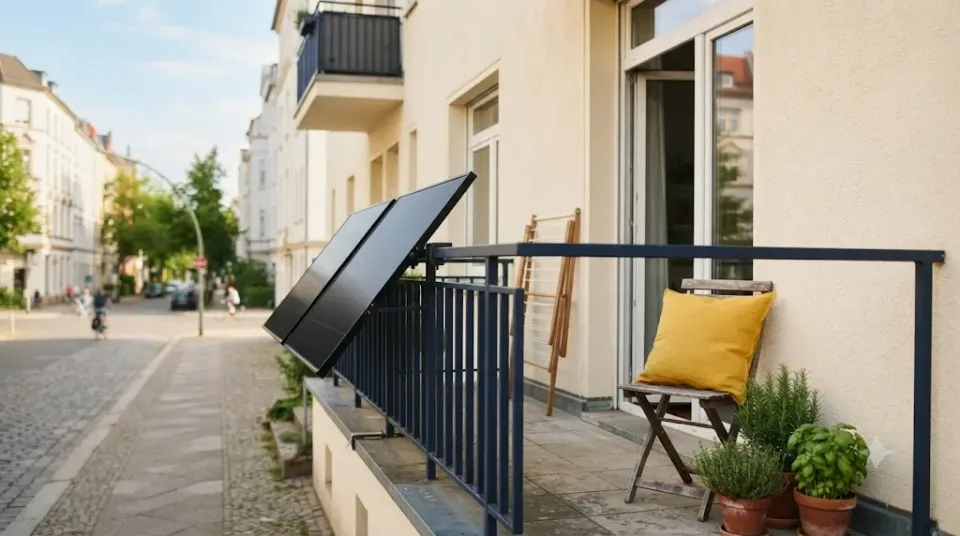
The most common balcony solar regret is not a bad panel. It is the wrong kit for the place: two big panels that do not fit the railing, a "2,000 W set" that needs a socket you do not have, or a 600 € battery bought for a flat that is empty all day. Each of those can be avoided in half an hour of checking before you click order. This guide gives you the twelve checks, then turns them into simple "if this, then that" paths so you end up with one clear answer for your balcony.
Prices, rules and standards here reflect Germany in late 2026. Rules content is a practical summary, not legal advice. When in doubt, check with your landlord, owners' association or grid operator.
Start here: the four questions that decide everything
Before looking at any product, answer these four. Every later decision flows from them.
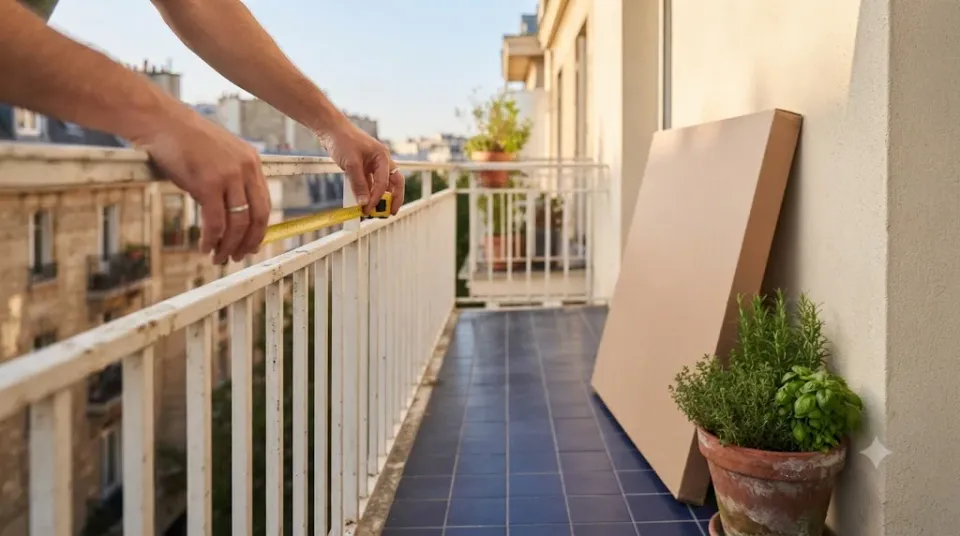
- Where can panels go? Railing, wall, flat roof, garden or terrace. And how much space: measure width and height.
- Which way does it face, and when is it shaded? South, east, west, a split, or north. Note when buildings, trees or the balcony above block the sun.
- Who is home in daylight? Nobody on weekdays, someone some days, someone most days.
- Do you rent or own? Tenants and flat owners need consent for anything on the balcony or facade.
Write the four answers down. You will use them in the decision table further down.
If you want numbers rather than guesses for question 2, put your balcony into Sunslot. It estimates hour-by-hour output for your direction, tilt, shade and city, shows how much you would use yourself versus export, and gives a payback estimate. Ten minutes there can save you from buying for the wrong balcony.
The twelve checks
Here is the full checklist in one table. The sections below explain each group and what to do if a check fails.
| # | Check | Pass if | If it fails |
|---|---|---|---|
| 1 | Inverter output | Datasheet says 800 W or 800 VA max | Do not buy, or confirm it is limited to 800 W |
| 2 | Panel total vs plug | Up to 960 W of panels with a Schuko plug | Larger arrays need a special feed-in socket |
| 3 | Consent | Landlord or owners' association has agreed | Ask first - they cannot refuse without good reason |
| 4 | Registration | You know how to register in the Marktstammdatenregister | Five minutes online, free |
| 5 | Panel size | Panels physically fit your space | Choose smaller panels or one panel |
| 6 | Mount | Made for your railing, wall or roof, rated for your site | Pick a different mount or location |
| 7 | Cable and socket | Cable reaches a fixed wall socket directly | Order a longer cable; no power strips |
| 8 | Monitoring | App or display shows live output | Add a metering smart plug |
| 9 | Warranty and support | Clear terms and an EU contact | Pick a seller with clear support |
| 10 | Direction and shade | You know your sunny hours | Estimate hour by hour before buying |
| 11 | The maths | Payback in a sensible number of years | Rethink size, direction or price |
| 12 | Battery | You know whether you need one | Start without, decide after a year |
Rules and paperwork (checks 1 - 4)
1. The inverter is limited to 800 W. In Germany a plug-in system may feed up to 800 W into your home. The panels can be rated higher, but the microinverter (the box that turns the panels' DC power into 230 V AC for your sockets) must cap the output. Check that the datasheet says 800 W or 800 VA, and that it meets the current German grid requirements. Some older inverters were sold at 600 W with an update to 800 W - fine, as long as the update is officially supported. See Germany 800 W rules.
2. The panel total fits your plug type. The product standard DIN VDE V 0126-95 has applied since 1 December 2025. It allows a normal Schuko plug (the standard German wall plug) for systems with up to 960 W of panels, as long as the plug, an isolating switch or the inverter has the required protection features. Larger panel totals, up to 2,000 W, are meant for a special feed-in socket, often called Wieland. The standard also asks for a connection cable of at least 5 m and rules out plugging into a power strip. Ask the seller which category the kit falls into. Our Schuko vs Wieland article explains the difference.
3. You can mount it where you live. Since 2024, balcony solar counts as a privileged measure in German tenancy and condominium law. A landlord or owners' association can no longer refuse without a good reason, but you still need to ask, and they can set reasonable conditions on mounting. See landlord permission.
4. You know how to register. Balcony systems must be registered in the Marktstammdatenregister, the federal energy register run by the Bundesnetzagentur. It is free and takes a few minutes. A separate notice to the grid operator is no longer needed. See registration.
Hardware (checks 5 - 9)
5. Panel size fits your balcony. Standard panels are often around 1.7 m by 1.1 m and can weigh around 20 kg or more. A typical railing of 3 m width fits two in landscape only if the height works. Measure twice. Smaller and lighter panels exist and suit narrow balconies.
6. The mount suits your situation. Railing, wall, flat roof or ground stand each need a different mount. Under the new standard, manufacturers must say which situations their mounts are made for, and mounts must handle the wind and snow loads you can expect at your site. High floors and exposed corners need more care. See balcony railing mounts and flat roof and garden mounts.
7. Cable length reaches a suitable socket. Measure from the panel to an outdoor or nearby socket. Plug the system straight into a fixed wall socket on a circuit that is in good condition. Never use an extension reel or a power strip.
8. There is a monitoring app or display. Seeing live production is how you learn when to run appliances. See monitoring app and meter.
9. Warranty and support are clear. Panels commonly carry long product and performance warranties, inverters usually shorter ones. Check who handles a claim and whether there is a German or EU contact.
Hoymiles HMS-800W-2T
An 800 W microinverter with two separate inputs and built-in Wi-Fi, a good fit for east-west splits or replacing an inverter in a self-assembled kit. It comes without panels or mount, so it suits people who are comfortable building their own set.
Check price on Amazon Ad - affiliate link. Prices change; check the listing.Your balcony and your habits (checks 10 - 12)
10. Direction and shade are realistic. A south balcony with clear sky and a north balcony behind a tree are very different investments. See east-west vs south and shading.
11. You have run the maths. Estimate yield and how much you would use yourself, then put it into payback maths. A quick version follows below.
12. You know whether you need a battery. Most people should start without one. Read does a balcony system need a battery? before paying several hundred euros more.
The decision paths
Now use your four answers. Follow the path that matches you.
If you rent
Then ask for consent first, in writing, with a photo or sketch of where the panels will go. Choose a railing mount that clamps on without drilling, so the balcony can be returned to its original state. Prefer a kit with a Schuko plug that stays within 960 W of panels, so you need no electrical work. Keep the receipts and the mount instructions to show your landlord.
If you own a flat in a building
Then you need the owners' association's consent for anything on the facade or railing. Bring the topic to the next owners' meeting, or ask the property manager how to request it. The same mounting logic applies: tidy, secure, reversible.
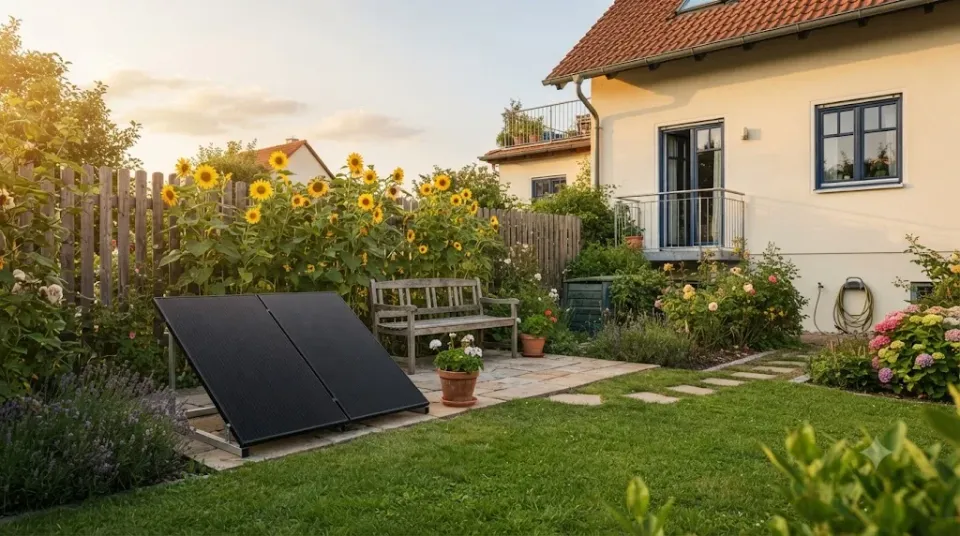
If you have a garden, terrace or flat roof
Then you have more freedom on angle and direction. A ground or flat-roof stand at around 20 to 35 degrees facing south usually gives the most output. Weigh the stand down properly or fix it as the manufacturer says. Check that the cable route to a socket is safe and does not create a trip hazard.
If you face south with little shade
Then a standard two-panel 800 W kit is the obvious choice. You will get a big midday peak, so plan to time your appliances. See which appliances to run in the sun.
If you face east or west, or have a corner
Then consider splitting the panels, one each way, on an inverter with two separate inputs (MPPTs - the circuits that get the best out of each panel). Total output is lower, but it is spread over the day and easier to use.
If you face north or are heavily shaded
Then run the numbers before you buy. North balconies often produce around half of a south balcony. A steep or vertical panel facing north catches mostly diffuse light. It can still pay back, but slowly. If the maths says ten years or more, a small kit or a power station with a folding panel may suit you better.
If nobody is home in daylight
Then your self-consumption (the share of solar you use yourself) will be lower. Start with no battery. Use delay timers on the dishwasher and washing machine. An east-west split can help. See self-consumption.
If you want backup power in a cut
Then know this first: a standard grid-tied inverter switches off when the grid goes down. Your balcony system will not keep the lights on. For backup you need a system that is built for it, or a portable power station. See a 48-hour power cut plan.
The decision table
| Your situation | Panels | Inverter | Mount | Battery |
|---|---|---|---|---|
| Tenant, south railing, out all day | 2 panels, total up to 960 W | 800 W, Schuko | Railing clamps, no drilling | No - use timers |
| Tenant, east-west corner, works from home | 2 panels, one each way | 800 W, two inputs | Railing clamps | No |
| Owner, garden, family home all day | 2 panels, tilted south | 800 W | Ground stand | Maybe after a year of data |
| Larger array, high evening use | Up to 2,000 W of panels | 800 W output | Roof or ground stand | Often yes, if maths works |
| North balcony, shaded | 1 - 2 panels, steep | 800 W or smaller | Railing or wall | No |
| Mainly wants outage backup | Folding panel | Built into power station | Portable | Power station instead |
Quick maths before you pay
Here is the five-minute payback check. Use your own numbers where you have them.
- Yield. A south-facing 800 W system in Germany often makes around 700 to 850 kWh a year in good conditions. East-west less, north much less. Take 750 kWh as a rough start.
- Self-consumption. Out all day: about 30 %. One person home some days: about 45 %. Family with timed appliances: about 60 %.
- Used at home: 750 x 45 % = about 338 kWh.
- Saving: 338 x 0.37 € (close to the 2026 average price for new household contracts) = about 125 € a year.
- Payback: a 400 € kit / 125 € = about 3.2 years.
Now the same household with a 1,000 € kit including storage, raising self-consumption to say 70 %: 750 x 70 % = 525 kWh, minus about 10 % storage losses on the extra = about 506 kWh, x 0.37 € = about 187 € a year. Payback: about 5.3 years. Longer, and that assumes the battery lifts self-consumption that much in your flat. For many flats it lifts it less.
For the full method, including how electricity price changes affect the result, see payback maths. To see your own hour-by-hour split before deciding, try Sunslot.
Price check and offer red flags
As a rough guide for 2026, a basic 800 W kit without storage typically costs around 250 to 500 euros, and sets with storage around 800 to 1,200 euros. Very cheap offers can mean small panels, a weak mount or an inverter that is not certified for Germany. Very expensive ones should explain what the extra buys.
| If the offer says | Ask |
|---|---|
| "2,000 W system" | Is that panel power? What is the inverter output, and which plug is required? |
| "Saves up to X € a year" | What yield, self-consumption share and electricity price is that based on? |
| "No registration needed" | Registration in the Marktstammdatenregister is required in Germany. |
| "Works in a power cut" | Standard grid-tied inverters switch off in an outage. What exactly keeps running? |
| "Plug into any socket or strip" | The system must go into a fixed wall socket, never a power strip. |
| "Inverter 1,000 W, throttle it yourself" | Is it officially limited to 800 W and certified for German grid rules? |
Anker SOLIX RS40P Balkonkraftwerk
A two-panel set with an 800 W microinverter and app monitoring, a straightforward start for a south or south-west spot. Check the panel size against your railing and that the included mounting suits your balcony before ordering.
Check price on Amazon Ad - affiliate link. Prices change; check the listing.Common buying mistakes
- Measuring the balcony after the panels arrive. Two 1.7 m panels on a 2.8 m railing in portrait may stick out above the rail. Measure first.
- Buying the biggest panel total. Extra panel watts help in mornings, evenings and winter, but the inverter caps output at 800 W at midday. And above 960 W of panels, a Schuko plug is no longer the standard route. See how much power balcony solar makes.
- Buying a battery on day one. Without a year of your own data, you are guessing whether it pays.
- Forgetting the cable route. A window or door that has to stay ajar for the cable is a draught and a safety risk. Plan for an outdoor socket or a proper cable pass-through.
- Skipping consent. Even though refusal now needs a good reason, mounting without asking can still cause trouble. Ask first.
- Not telling the insurer. It is usually covered, but check. See insurance for balcony solar.
Brennenstuhl Primera-Line PM 231 E
A simple plug-in energy meter with a display - no app, no Wi-Fi, just plug in and read watts and kWh. Great for finding standby hogs; the limitation is that you have to read it on the spot rather than see history on your phone.
Check price on Amazon Ad - affiliate link. Prices change; check the listing.What I'd buy
If I were setting up a typical rented flat with a south or south-west railing, here is my order of purchase:
- A plug-in energy meter first, to measure my base load and my main appliances. Cheap, and it tells me how much of the solar I will actually use. See your base load.
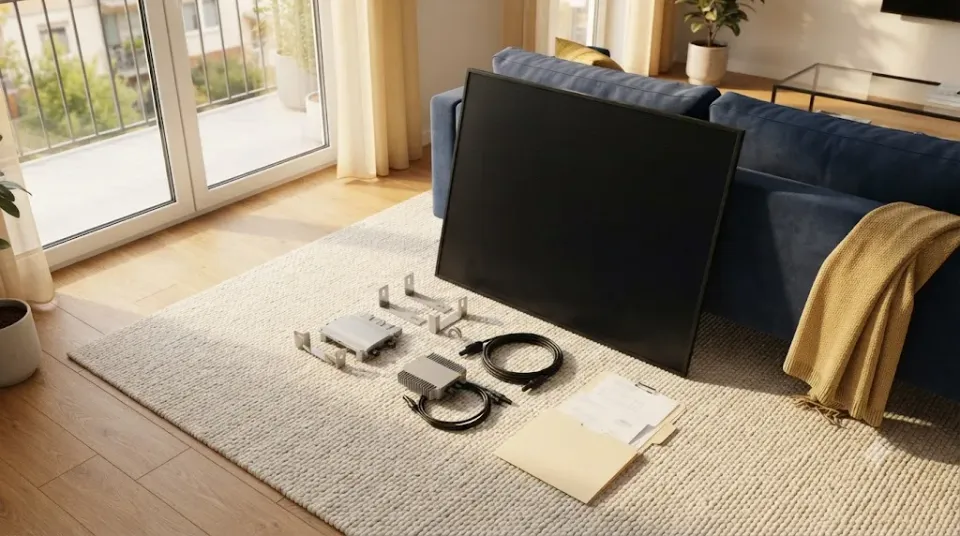
- A two-panel kit with up to 960 W of panels, an 800 W microinverter from an established maker with a working app, a Schuko plug and a railing mount made for my railing type.
- Nothing else for a year. I would set delay timers, watch the app and learn my hours.
- Then decide on storage, with real numbers.
For an east-west corner, the same, but with an inverter that has two inputs and the panels split. For a garden, the same, with a ground stand at a good angle. For a north balcony, I would run the numbers very carefully first, and might choose a power station instead.
Tick all twelve checks and you will order the right kit. If you are still unsure where to start, what is plug-in solar and setup step by step cover the basics.
Buying questions
Can I plug a balcony system into a normal socket?
Yes, in Germany, if the system follows DIN VDE V 0126-95: up to 800 W inverter output, up to 960 W of panels, and the required protection features. It must go into a fixed wall socket, not a power strip.
Do I need an electrician?
Not for a standard Schuko-plug kit. You should still be sure the socket and circuit are in good condition. Larger systems using a special feed-in socket need that socket installed by an electrician.
How much should a good 800 W kit cost?
As a rough 2026 guide, around 250 to 500 euros without storage and around 800 to 1,200 euros with storage. Very cheap offers deserve a close look at the inverter certification and the mount.
Is a battery worth it from the start?
For most flats, no. It costs more than the panels and pays back slowly unless you have big evening use or a larger array. Start without and decide after a year of data.
What if my landlord says no?
Since 2024 they need a good reason to refuse. They can set reasonable conditions on how and where it is mounted. Ask in writing, offer a reversible mount, and read our landlord permission guide. This is not legal advice.