

This is general information, not legal advice. Rules change, so check the current wording before you rely on it.
Ask three neighbours what is allowed on a German balcony and you will get three answers: 600 W, 800 W and "up to 2,000 watts". All three come from real rules, at different times or for different things. That confusion costs people money. Some buy too little panel. Some buy a 2,000 Wp kit that their household plug is not allowed to carry.
The Solarpaket I (a package of changes to energy law that took effect in May 2024) raised the limit and cut most of the paperwork. A product norm followed in December 2025. And as of November 2026, politicians are discussing the next round. Below are the questions people most often ask about the rules, each answered in the first sentence, then explained.
How much power am I allowed to feed in from my balcony?
Up to 800 W from the inverter. That is the limit for a simplified plug-in system in Germany today.
The figure applies to your microinverter (the box that turns the panels' direct current into household alternating current). It may push at most 800 W into your home wiring at any moment. Before May 2024 the limit was 600 W, which is why older kits and older articles still mention 600.
To put 800 W in context: a kettle draws around 2,000 W, a fridge averages well under 100 W, and a router about 10 W. So 800 W will not run your whole kitchen, but it comfortably covers the steady background load of most flats for much of a sunny day.
The 800 W is a cap on the flow, not on the energy. Your system can make several kilowatt-hours on a good day. It just never delivers more than 800 W at any one instant. Many inverters are adjustable and ship set to 800 W. If you bought an older 600 W kit, check whether the maker offers an update. Our guide to watts and watt-hours explains the difference between the cap and the daily total.
Then why do kits come with 1,000 Wp or more of panels?
Because energy law allows up to 2,000 Wp of panels on a plug-in system, and extra panels fill the 800 W cap for more hours of the day.
There are two separate limits, and people mix them up all the time:
| Limit | What it caps | Number |
|---|---|---|
| Inverter limit | What flows into your home wiring | 800 W |
| Panel limit in energy law | Total rated panel power | 2,000 Wp |
| Panel limit on a normal household plug (product norm) | Total rated panel power with a Schuko plug | 960 Wp |
Wp (watt-peak) is a panel's output under standard test light. Panels rarely reach it. Low sun, haze, heat and angle all keep them below their rating most of the day. So a system with 960 Wp of panels behind an 800 W inverter reaches the cap more often, especially in the morning, the evening and on cloudy days. The inverter simply cuts off anything above 800 W at noon.
Here is an example. Two 400 Wp panels (800 Wp) on a south railing might peak at 650 W on a clear spring day. Two 480 Wp panels (960 Wp) in the same spot might touch 780 W. Over a year, the bigger pair can make noticeably more, even though the inverter never passes more than 800 W. Read how much power balcony solar makes for what that looks like over twelve months.
Can I plug it into a normal socket?
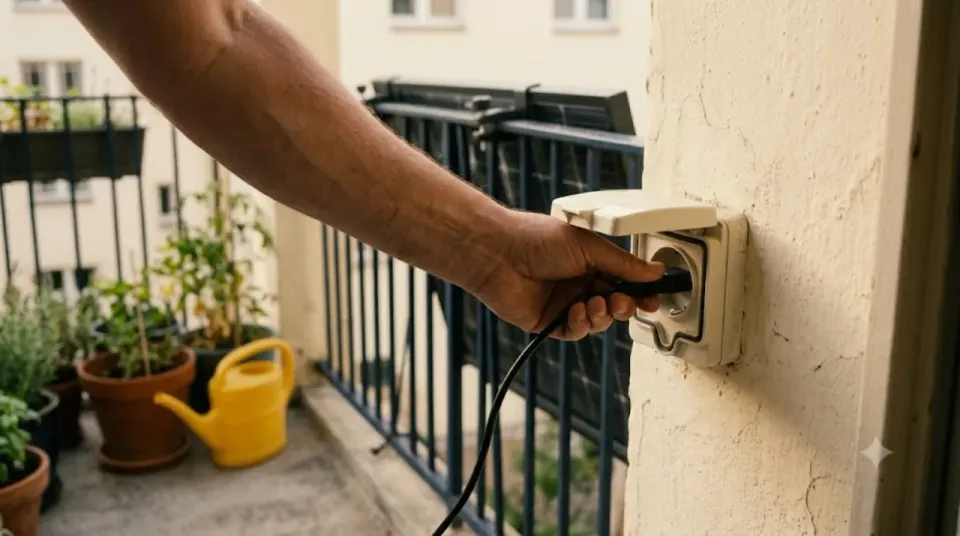
Yes, a normal household plug (Schuko) is allowed under the product norm, with limits and extra safety features.
Since December 2025 there is a product norm for plug-in solar devices: DIN VDE V 0126-95. A norm is a technical standard that manufacturers build to. It sets safety rules for the whole kit, not just the inverter. According to consumer advice centres and trade press, the main points are:
| Connection | Max. panel power | Inverter feed-in |
|---|---|---|
| Normal household plug (Schuko) | 960 Wp | 800 W |
| Special energy plug (for example under DIN VDE V 0628-1) or fixed connection | 2,000 Wp | 800 W |
For the household plug, the kit needs extra protection against touching live pins. That can be a protective cover, an internal disconnect switch or a suitable inverter design. The connection cable must come from the manufacturer and be at least 5 metres long. Multi-socket strips are not allowed. Mounting systems must state which surfaces they suit.
A court in Hamburg also backed the standard plug. In December 2025 the Amtsgericht Hamburg-Wandsbek (case 714 C 160/25, not yet final when reported) ruled for a tenant and expressly allowed the inverter to be connected through a standard socket, with reference to the new norm. We cover the plug question in detail in Schuko or Wieland.
Hoymiles HMS-800W-2T
A widely used two-input microinverter set to the 800 W limit, suited to two panels on a balcony. It is a component, so you still need panels, a cable and mount that together meet the current norm.
Check price on Amazon Ad - affiliate link. Prices change; check the listing.Is the VDE norm a law? Do I have to replace my old kit?
No, the norm is not itself a law, and existing systems that met the rules when installed generally do not need to be changed.
A norm is the reference that manufacturers, courts and insurers look to when they ask "was this done properly?" That gives it real weight. If something goes wrong, a kit built to the current norm is much easier to defend than one that is not. But nobody will knock on your door to inspect a system you installed in 2023.
Two practical points:
- When you buy new, look for the norm. Ask the seller whether the kit is built to DIN VDE V 0126-95. A reputable seller will say so on the product page or data sheet.
- Batteries are not covered yet. The norm covers plug-in devices without storage. Work on rules for systems with batteries was not finished when the norm was published. Batteries are not banned, but check what the maker documents on safety. See our battery guide.
What paperwork do I need?
One online entry in the Marktstammdatenregister within one month of switching on. Nothing else.
Before 2024 you had to register in two places. Now there is one:
- Register in the Marktstammdatenregister (MaStR, the federal register of power plants, run by the Bundesnetzagentur). The form for plug-in devices is short.
- No separate notice to the grid operator. The register passes your entry on.
- Do it within one month of the commissioning date (the day the system first feeds power).
The form asks for the basics: where the system is, the commissioning date, the total panel power in Wp, the inverter power in W, your meter number, and battery capacity only if you have one. Have the data sheets open and it takes about ten minutes. "Commissioning" means the system is installed and feeds power for real. A quick test on the balcony floor does not start the clock.
Registration is free. Ignore any service that wants money to do it for you. Not registering counts as an administrative offence, and fines are possible in theory, though authorities have so far focused on getting systems listed rather than punishing late owners. Our registration guide walks through the form step by step.
My flat has an old meter with a spinning disc. Do I have to wait?
No. You may start straight away, and the grid operator swaps the meter when it is due.
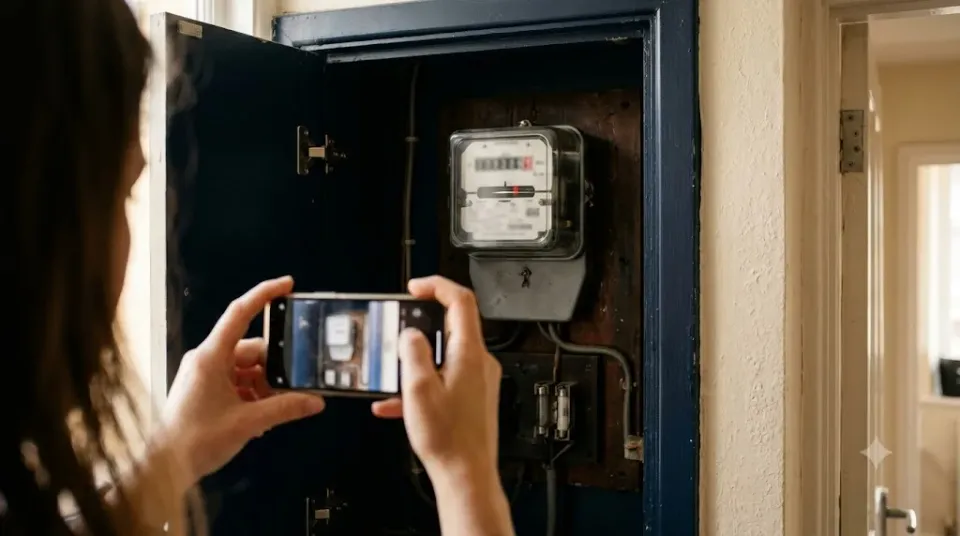
Many flats still have a Ferraris meter (the old meter with a spinning disc). Some of these turn backwards when you feed power in. Before 2024 that was a reason to wait, sometimes months, for a new meter before plugging in.
Now an old meter is tolerated for a transition period. The grid operator replaces it when it is due, usually with a modern or smart meter, and you should not have to pay for the swap. Do not try to profit from a backwards-running meter on purpose. The tolerance is there to remove a waiting time, not to create a loophole.
Will I get paid for the power I send into the grid?
Normally no. Surplus from a plug-in system flows into the grid unpaid, so the value is in using the power yourself.
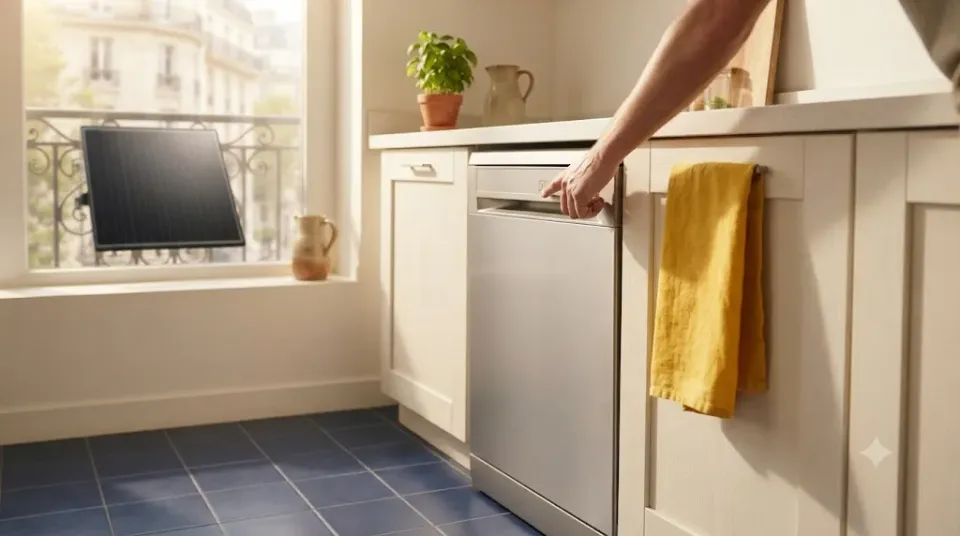
This surprises many first-time buyers. A plug-in system is set up for self-use. Whatever your home does not use at that moment goes out to the grid, and you do not receive a feed-in payment for it.
The draft of the next energy law reform, reported in July 2026, keeps it that way. According to that reporting, plug-in devices stay outside the new solar support, and remain exempt from the smart meter and control-box duty and from the 60 percent feed-in limit introduced for new rooftop systems by the 2025 "Solarspitzengesetz" (the law on midday solar peaks).
So the maths that matters is self-use. Say your system makes 700 kWh a year and you use 60 percent of it yourself. That is 420 kWh. At 35 cents per kWh you save about 147 euros a year. Raise self-use to 75 percent and you save about 184 euros, from the same panels. Our guide to self-consumption shows how to get there, and Sunslot estimates your self-use share hour by hour for your own balcony direction, tilt and city - put in your base load and see how much of the noon peak you actually catch.
Shelly Plug S Gen3
Shows what your system actually feeds, so you can check self-use and timing before thinking about more panels. It measures one socket only, not the whole home.
Check price on Amazon Ad - affiliate link. Prices change; check the listing.I rent. Does my landlord have to agree?
You still need consent, but since October 2024 you have a legal claim to it, and refusals need a real reason.
Since 17 October 2024, plug-in solar counts as a privileged measure under § 554 BGB for tenants and § 20 WEG for flat owners in an owners' association. The landlord can set reasonable conditions on how it is done, such as where and how it is mounted. A general dislike is usually not enough to refuse.
The courts are filling in the detail. In December 2024 the Amtsgericht Köln (208 C 460/23, appealed) sided with a landlord where a tenant had mounted panels on the outside of the balcony without consent and without showing a safe installation. In December 2025 the Amtsgericht Hamburg-Wandsbek sided with a tenant and called blanket liability worries insufficient. In January 2026 Vonovia, Germany's largest landlord, agreed in court to a tenant's balcony system in Aachen after he sued with the backing of Deutsche Umwelthilfe. The pattern: ask first, show a safe mount, and you are in a strong position. Our landlord letter gives you a request to copy.
Is the 800 W limit going up to 1,000 W?
Not as of November 2026. It has been floated, but nothing has been decided.
In late October 2026, trade press reported an internal paper from the CDU/CSU parliamentary group that considers raising the inverter limit from 800 W to 1,000 W as part of the energy law reform. It is an idea, not a bill. Critics point out that a change could clash with an EU grid rule, and that it would also need changes to other law and to safety standards.
What this means for you: buy for today's rules. A good 800 W inverter with 960 Wp of panels on a normal plug is the safe choice now. If the rules change, many current inverters can be reconfigured by the maker, but do not count on it and do not set an inverter above the legal limit yourself.
What is still my responsibility?
Safe mounting, sound wiring, consent if you rent, and any local building rules.
The law makes it easier, not automatic. Here is the checklist I would work through before plugging in:
| Point | What to do | Read more |
|---|---|---|
| Consent | Written yes from landlord or owners' association | Landlord letter |
| Mounting | Rated brackets, secure in a storm, nothing sticking out over the street | Railing mounting |
| Wiring | Outdoor socket in good condition; if the circuit is old or you are unsure what else runs on it, ask an electrician | Setup guide |
| Plug and cable | Manufacturer cable, no multi-socket strip, no extension reels | Schuko or Wieland |
| Insurance | Tell your liability and household insurers | Insurance and liability |
| Registration | MaStR within one month | Registration guide |
| Local rules | Listed buildings and some local design rules can still apply | Ask your town's building office |
A panel that falls is a liability case, and that is the one risk to take seriously. Use brackets rated for your panel size and weight, check them after storms, and do not hang anything over a pavement unless it is fixed beyond doubt.
What if your kit does not meet the rules, say an inverter set to 1,000 W or a 1,200 Wp array on a Schuko plug? Nothing happens automatically. But three things get harder. Your insurer may question a claim if a fire or a falling panel can be traced to a setup outside the norm. Your landlord gains a real reason to refuse or demand removal. And your grid operator can ask you to bring it into line. None of that is worth a few extra kilowatt-hours a year.
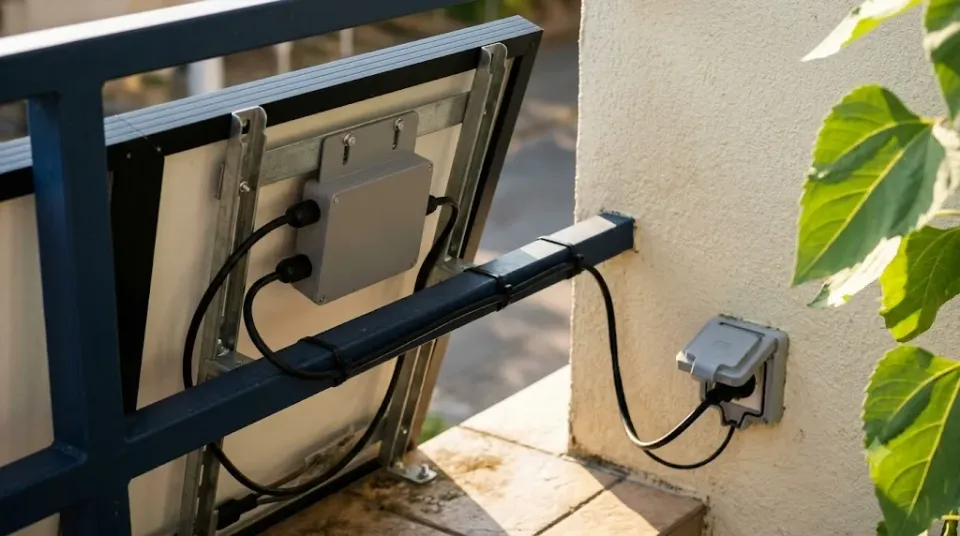
Here is a worked example. Tom in Hanover has a 600 W kit from 2022 with two 380 Wp panels. Under today's rules he may raise the inverter to 800 W if the maker supports it, which can add useful output on bright days. He may also swap to two 480 Wp panels (960 Wp) and stay on his Schuko plug. What he should not do is add a third panel on the same plug, which would put him at 1,440 Wp and over the 960 Wp household-plug limit. If he wants three panels, he needs the special energy plug or a fixed connection by an electrician. Whatever he changes, he updates his register entry.
bitShake SmartMeterReader
An infrared reader that clips onto many modern meters and shows what your home draws and sends out. It does not work with old spinning-disc meters, so check your meter type first.
Check price on Amazon Ad - affiliate link. Prices change; check the listing.What would I buy today?
A kit with an 800 W inverter, 800 to 960 Wp of panels, a Schuko plug and a manufacturer cable of at least 5 metres, sold as built to DIN VDE V 0126-95.
That combination fits the current norm for a normal plug, needs no electrician for the connection in most homes, and gets the most out of the 800 W cap without crossing any line. I would add a smart plug or meter reader to see what I actually use, and I would spend ten minutes on registration the day I plug in.
If you want more than 960 Wp, for example on an east-west split or a weak north-east balcony, the special energy plug or a fixed connection by an electrician lets you go up to 2,000 Wp. Do the sums first. On many balconies the extra panels mostly add output in hours when the inverter is already full. Sunslot shows the hour-by-hour curve for your setup, so you can see whether a third panel fills a real gap or just clips at noon. Then work through our buying checklist.
More rule questions
Can I set my inverter above 800 W if it allows it?
No. For a simplified plug-in system the feed-in must stay at 800 W or below. An inverter set higher no longer counts as a plug-in device under the simplified rules.
Do I need an electrician?
For a kit with a normal household plug, usually not for the connection itself. You do need sound wiring. If your circuits are old, or you want a fixed connection or the special energy plug, use an electrician.
Can I connect two balcony kits?
Only if the total stays within the limits: 800 W of inverter feed-in for the household and the panel limits above. Two separate 800 W kits would exceed the cap.
Does my kit need to be registered if I only use it a few months a year?
Yes. Any system that feeds into your home wiring needs a register entry, however much you use it. A portable power station that never connects to your home wiring does not.
Do these rules apply in Austria, Switzerland or elsewhere in the EU?
No. Everything here is German law and a German norm. Austria, Switzerland, the Netherlands and others set their own power limits, plug rules and paperwork, and the details change. Check your national energy regulator and grid operator before you buy, and do not assume a kit sold for Germany meets the rules at home.
Where do I check the current rules?
The Bundesnetzagentur for registration, your local consumer advice centre for plain-language guidance, and the maker's data sheet for what your kit complies with. Rules have moved quickly, so check before you buy.