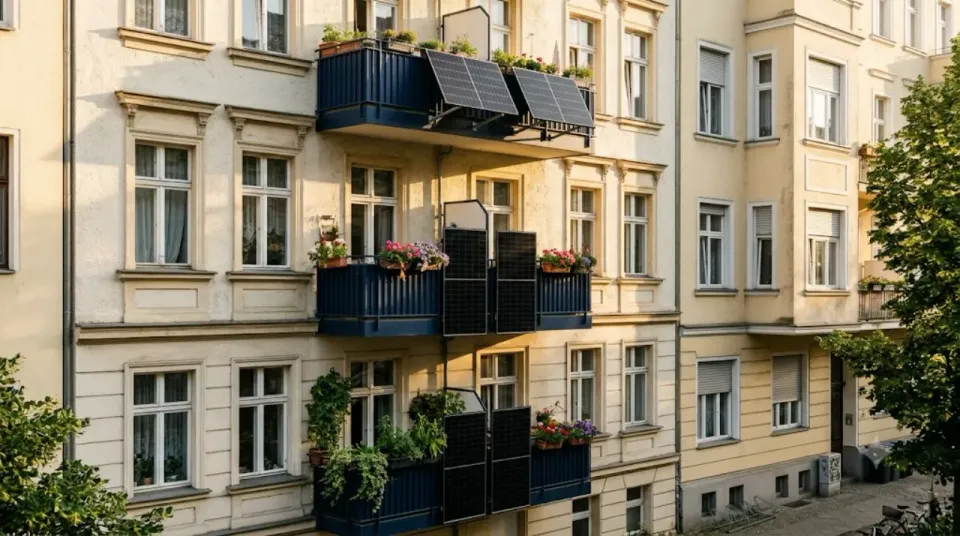

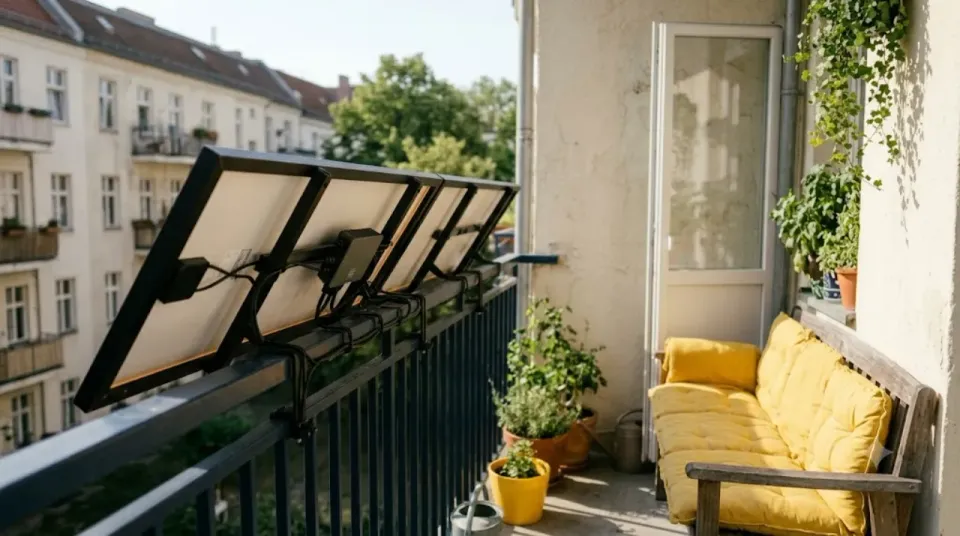
The panels get all the attention, but the part that decides whether your balcony kit is legal, safe and productive is a box about the size of a hardback book. Pick the wrong one and you can lose a fifth of your output to one shaded panel, fail the German rules, or end up with a kit stuck at 600 W. Pick the right one and it quietly squeezes the most out of every hour of light for ten years or more. This article answers the questions people ask about the microinverter, plainly and with numbers.
What is a microinverter, in one sentence?
A microinverter is the small box behind your panels that turns their direct current into the alternating current your sockets use, tunes the panels for maximum output, and switches everything off when the grid goes down.
"Micro" simply means it serves one to four panels, mounted right beside them. A rooftop system usually has one big central inverter in the cellar for 20 or more panels. A balcony kit uses a small one outdoors. It is usually grey or black, sealed against weather, and has two kinds of connection: short DC cables with click-together plugs (MC4 connectors, the standard solar plug) for the panels, and one AC cable that ends in the plug for your socket.
It does three jobs in one box. The next three questions take them one at a time.
Why can't the panels just plug straight into a socket?
Because panels make a different kind of electricity from the kind in your sockets. Solar panels produce direct current (DC, current that flows in one direction, like from a battery). Your home runs on alternating current (AC, current that switches direction 50 times a second in Europe) at about 230 volts.
The inverter's first job is conversion. It takes the panels' DC - typically 30 to 45 volts per panel - and builds a clean AC wave that matches your grid's voltage and rhythm exactly. It has to match precisely, because its power mixes with grid power in your wiring. If it were even slightly out of step, it could not feed in.
Conversion is not perfectly efficient. A good microinverter loses a few percent as heat. On a kit that makes 700 kWh a year, every percentage point of efficiency is about 7 kWh. That is real but small, which is why efficiency matters less than the features further down.
What does MPPT mean, and why should I care?
MPPT (maximum power point tracking) is the inverter constantly adjusting how it draws power from each panel, so the panel gives the most it can at that moment. You should care because it is the difference between a shaded panel costing you a little and costing you a lot.
Here is the idea. A panel's output depends on the voltage and current the inverter asks of it. There is one best combination for the current light and temperature, and it moves all day as clouds pass and the panel warms up. The inverter hunts for that point many times a second.
Many balcony inverters have two MPPT inputs, one per panel. That means each panel is tuned on its own. With only one shared input, the two panels are tuned together, and the weaker one drags the stronger one down.
A worked example on an example household's balcony in Dresden: two 430 Wp panels, south-west, at 14:00 on a clear spring day. The neighbour's balcony divider throws a hard shadow across the bottom of the left panel, which switches off one or two of its three cell groups (panels have bypass diodes, small switches that let current skip a shaded group).
| Left panel (shaded) | Right panel (sunny) | Total at 14:00 | |
|---|---|---|---|
| Two MPPT inputs | about 170 W | about 340 W | about 510 W |
| One shared input, rough picture | about 170 W | pulled down to about 230 W | about 400 W |
The exact loss with a shared input depends on how the panels are wired and how clever the inverter is, so treat the second row as illustrative. But the direction is reliable: separate tracking keeps a shadow on one panel from spreading to the other. For panels facing different ways - one east, one west - separate inputs are close to essential. More in Shade on a balcony and South, east-west or flat.
Hoymiles HMS-800W-2T
An 800 W microinverter with two MPPT inputs and built-in Wi-Fi, widely used in German balcony kits. Its app works best with a stable Wi-Fi signal on the balcony, so check reception first.
Check price on Amazon Ad - affiliate link. Prices change; check the listing.Why does my kit switch off in a power cut?
Because the inverter is required to. Its third job is protection, and it is the reason a plain balcony kit cannot power your flat in a blackout.
The inverter watches the grid's voltage and frequency all the time. If the grid fails or drifts outside its normal range, the inverter disconnects within a fraction of a second. This is called grid and system protection (in German, NA-Schutz). In Germany, inverters must meet the grid connection rule VDE-AR-N 4105, which sets out how this protection behaves.
There are two good reasons for it:
- Engineers' safety. When a line is down for repair, nobody wants a balcony kit pushing 230 V back into it.
- Your safety at the plug. When you pull the plug of a solar inverter, the bare pins must never carry voltage. The inverter sees the grid disappear and stops.
If you want power during an outage, you need a battery with its own sockets, like a portable power station. Some combined systems offer an emergency socket, but read the specifications closely. Our 48-hour power cut plan covers the practical side.
Why is the limit 800 W, and is it the panels or the inverter?
It is the inverter. In Germany a plug-in solar system may feed at most 800 W into your home wiring, and that limit applies to the inverter's AC output - not to the panels. This is general information, not legal advice; rules change, so check the current wording before you rely on it.
The history in brief:
- Before May 2024: the limit was 600 W.
- May 2024: the Solarpaket I (a package of changes to energy law) raised it to 800 W and allowed up to 2,000 Wp of panels behind it.
- 1 December 2025: the product norm DIN VDE V 0126-95 began to apply. It is built around the same 800 VA (volt-amperes, which for a balcony inverter you can read as watts). It allows a normal household plug for up to 960 Wp of panels, with extra protection against touching live pins; above that, a special energy socket fitted by an electrician.
Why a cap at all? A normal German socket circuit is protected by a 16 A breaker. Your appliances draw from the breaker side; the inverter feeds in from the far end. At 800 W - about 3.5 A at 230 V - the extra current stays within what a circuit in good condition can carry safely. The full set of rules is in The 800 W rules explained.
So the inverter is the part that has to say 800 W (or 800 VA) on its datasheet. Panels can be larger.
My inverter says 600 W. Can I raise it to 800 W?
Often yes, if the maker allows it. Many inverters sold before 2024 were capped at 600 W by software, not by hardware. Several makers offer a firmware update or an app setting that unlocks 800 W.
How to do it properly:
- Check the maker's own instructions for your exact model. Use only official updates and apps. Third-party hacks can void the warranty and the certificate.
- Check the certificate. The model should be listed as compliant with VDE-AR-N 4105 at 800 W (or 800 VA).
- Change the setting in the official app.
- Update your Marktstammdatenregister entry (the federal register of power plants) with the new inverter power. See Registering your system.
Is it worth it? It depends on your panels. With 2 x 430 Wp facing south and tilted, a 600 W cap trims the top off many summer middays. A rough example: the panels could give 650 to 690 W for about three hours on maybe 60 clear days a year. That is roughly 50 to 90 W x 3 h x 60 days = about 9 to 16 kWh lost to the cap - worth a few euros a year. For panels hanging vertical or facing east or west, which rarely reach 600 W, the gain is smaller still. If the update is free and official, do it; just do not expect a big jump.
Why would anyone put 1,600 Wp of panels behind an 800 W inverter?
Because panels almost never deliver their rating, and extra panel area fills the inverter for more hours of the day. On a German balcony, panels are often warm, at an angle or in hazy light.
Here is a rough picture of one south-facing setup on a clear summer day:
| Time | 860 Wp could give | Inverter passes on | 1,720 Wp could give | Inverter passes on |
|---|---|---|---|---|
| 08:00 | about 150 W | about 150 W | about 300 W | about 300 W |
| 10:00 | about 450 W | about 450 W | about 900 W | 800 W |
| 13:00 | about 680 W | about 680 W | about 1,360 W | 800 W |
| 16:00 | about 380 W | about 380 W | about 760 W | about 760 W |
| 18:00 | about 150 W | about 150 W | about 300 W | about 300 W |
With 860 Wp, the cap barely bites. With 1,720 Wp, the inverter trims the midday peak - this is called clipping - but the morning, late afternoon and every cloudy day roughly double. On a dull day, when 860 Wp gives 150 W, 1,720 Wp gives about 300 W, all of it passed on.
So the gain is real but smaller than the label suggests. Doubling the panels does not double the yearly yield; on a south balcony it might add something like a third to a half, depending on clipping. On east, west or vertical setups, where panels rarely get near the cap, the gain is closer to proportional.
The trade-offs:
- Cost, weight and space. Glass panels often weigh 20 kg or more each.
- The plug. Above 960 Wp, the current norm calls for a special energy socket installed by an electrician instead of a household plug. See Schuko or Wieland?
- Inverter input limits. Each input has a maximum DC voltage and current. Four panels on a two-input inverter means two panels per input, which only works if the datasheet allows it.
APsystems EZ1-M
An 800 W two-input microinverter with high input current per channel, which suits larger modern panels. Local monitoring works via Bluetooth and Wi-Fi, but check the input limits against your panels' datasheet.
Check price on Amazon Ad - affiliate link. Prices change; check the listing.What should I look for when buying a microinverter?
Five things matter. Here they are with what good looks like.
| Feature | What good looks like | Why |
|---|---|---|
| Output and compliance | 800 W / 800 VA, VDE-AR-N 4105 certificate; for new kits, a reference to DIN VDE V 0126-95 | Legal limit and grid safety in Germany |
| MPPT inputs | Two, one per panel | Shade or different directions do not drag both panels down |
| Input limits | Max DC voltage and current per input comfortably above your panels' figures | Protects the inverter and your warranty |
| Monitoring | Wi-Fi or Bluetooth app, ideally with a local option | You can see output, spot shade and check the 800 W setting |
| Weather and warranty | IP67 or similar (sealed against dust and water); ten years or more | It lives outdoors for a decade or longer |
A worked check on input limits: your panel datasheet says open-circuit voltage (Voc, the voltage with nothing connected) is 38 V and short-circuit current (Isc, the most current it can push) is 14 A. Your inverter says max input voltage 60 V and max input current 20 A per input. One panel per input: 38 V is under 60 V, 14 A is under 20 A. Fine. Remember that a panel's voltage rises on cold, bright winter mornings, so leave some margin on the voltage side.
What matters less than people think: a percentage point of peak efficiency, the colour of the housing, and the brand name on its own. A well-known maker helps with app support and spare parts, but a certificate and two inputs matter more.
What about kits with a battery built in?
They still contain an inverter, but it sits inside the battery unit and does more jobs. In these systems the panels usually charge the battery first through its own solar input, and the battery unit then feeds your home through an inverter limited to 800 W. Some models put a separate microinverter after the battery instead.
For you, three points change. First, the same 800 W feed-in limit applies to what goes into your wiring. Second, the battery is registered as its own unit in the Marktstammdatenregister. Third, the product norm DIN VDE V 0126-95 does not yet cover systems with batteries, so check the maker's documents and certificates with extra care. Whether a battery pays off at all is a separate question - our article Does a balcony system need a battery? works through the maths, and for most households the answer is not yet.
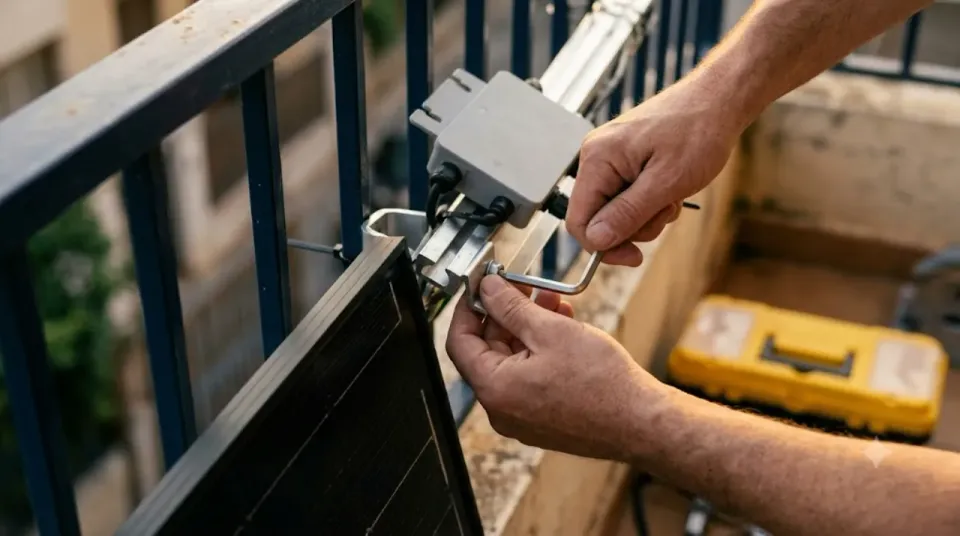
Where should I mount it?
In the shade, out of direct rain if possible, and where you can reach it. Behind one of the panels is ideal.
- Heat. Inverters lose a little efficiency when hot and tend to last longer when kept cool. A spot behind a panel, on the shady side of the railing, works well.
- Airflow. Leave a few centimetres around it. Do not wrap it in a bag or box it in.
- Cable lengths. The DC cables to the panels are usually short. Plan the position before you tighten the panel brackets.
- Fixing. Use the mounting holes and screws or clamps provided. An inverter hanging by its cables is a common, avoidable fault.
- Wi-Fi range. If you want app monitoring, check the signal on the balcony before you mount it. A metal railing and a thick wall can block it.
Our full walk-through is in Setting up a plug-in solar kit, step by step and Mounting panels on a balcony railing safely.
Shelly Plug S Gen3
A metering smart plug that logs consumption of an appliance and works locally without a cloud account. It is an indoor plug, so it is not for an outdoor balcony socket, and it must never be combined with a socket strip.
Check price on Amazon Ad - affiliate link. Prices change; check the listing.How do I know my inverter is working properly?
Check its app on a sunny day and compare the curve with what you expect. A healthy inverter shows a smooth hill on a clear day and a jagged line on a cloudy one.
Warning signs, and what they usually mean:
- Flat top at 600 W: the inverter is still capped at 600 W. See the firmware question above.
- One input much lower than the other every day: shade on that panel, a loose MC4 connector, or a panel fault. Compare at the same hour on a few clear days.
- Output stops for a few minutes, then restarts: often the grid protection reacting to voltage swings. Occasional is normal. Frequent drop-outs on a sunny day are worth an electrician's look at the circuit.
- Nothing at all: check the plug, the breaker for that circuit and the DC connectors before anything else.
To check the AC side independently of the inverter's own app, a smart plug with energy metering between socket and inverter shows exactly what reaches your wiring. Use one rated for continuous load and placed where the norm allows, and never add a socket strip. More in Reading your output.
Once a year, compare the year's total in the app with the estimate you made before buying. If you plan a change - more panels, a tilt bracket, a second input - put the new setup into Sunslot first and see whether the extra hours land where you can use them.
Anker SOLIX RS40P Balkonkraftwerk
A full two-panel kit with an 800 W-capable microinverter, so you buy one box instead of matching parts. Check that the included mount suits your railing, and that the version you order carries current German certificates.
Check price on Amazon Ad - affiliate link. Prices change; check the listing.Inverter questions
Do I need a microinverter for a balcony solar kit?
Yes. Panels make DC and your sockets need AC, and the inverter also provides the grid protection the rules require. Every plug-in kit includes one, sometimes built into a combined battery unit.
Can one microinverter run four panels?
Some can, usually two panels per input, if the datasheet's voltage and current limits allow it. In Germany the panels may total up to 2,000 Wp, but above 960 Wp the current norm calls for a special energy socket instead of a household plug.
How long does a microinverter last?
Warranties of ten years or more are common, and many units are expected to run longer. Keeping the inverter shaded and well ventilated helps, because heat is the main enemy of electronics.
Is 800 W the same as 800 VA?
For a balcony inverter, you can treat them as the same. VA (volt-amperes) is the unit the product norm uses; for the inverter's purposes it equals watts closely enough.
Does the inverter use power at night?
Very little. Most microinverters go to sleep when the panels stop producing and draw only a tiny amount, if anything, from the grid overnight. Check your model's datasheet for its night consumption.