Ask anyone which way solar panels should face and they will say south. They are right about the yearly total - and often wrong about the money. A south-facing kit can make 20% more energy than an east-west one and still save about the same in euros, because half its midday peak flows out to the grid while nobody is home. The best direction is the one that matches when your home uses power. This comparison puts south, east-west, single east or west, vertical and flat setups side by side, then gives a clear verdict for each type of household.
The whole comparison in one table
Here are typical figures for Germany, all for the same common kit of 2 x 430 Wp panels (Wp is watt-peak, a panel's output under standard lab sunlight). The reference is the ideal: facing south, tilted about 30 degrees (tilt is the angle from flat), no shade. That ideal makes roughly 950 to 1,100 kWh per kWp (kilowatt-peak, 1,000 W of panel rating) a year, so about 820 to 950 kWh for this kit.
| Setup | Share of ideal yield | Yearly yield, 860 Wp | When it produces | Typical self-use without battery | Best for |
|---|---|---|---|---|---|
| South, 30 degrees | 100% | about 820-950 kWh | Tall peak 10:00-15:00 | lower, often 30-45% | Someone home at midday |
| South-east / south-west, 30 degrees | about 95% | about 780-900 kWh | Peak shifted 1-2 hours earlier or later | similar to south, slightly better fit | Most households |
| East-west split, 30 degrees | about 80-85% | about 660-800 kWh | Long, flat day from early morning to evening | higher, often 45-60% | Out at work, steady base load |
| Single east or west, 30 degrees | about 80-85% | about 660-800 kWh | Morning only, or afternoon and evening only | depends on routine | Early risers (east) or after-work households (west) |
| South, vertical on a railing | about 70% | about 570-670 kWh | Flatter peak, relatively strong in winter | moderate | Railings where tilt is not allowed |
| East or west, vertical | often around 50% | about 410-480 kWh | Short morning or evening window | moderate to high, small amounts | When it is the only option |
| Flat roof, low tilt 10-15 degrees, south | about 90-95% | about 740-900 kWh | Strong summer, weaker winter | similar to south | Garages, sheds, flat roofs |
| North, 30 degrees | about 50-60% | about 410-570 kWh | Weak, mostly summer | - | Avoid if you have any other spot |
Self-consumption (the share of solar power you use at the moment it is made) depends heavily on your household, so treat that column as a guide to direction of travel, not a promise. The yield figures assume no shade; shade can cut any row, and it often matters more than direction. See Shade on a balcony.
Three things stand out. Small deviations from south cost very little. Tilt matters about as much as direction. And east-west trades total yield for a longer day.
Round 1: south against east-west, hour by hour
The table hides the most important difference: the shape of the day. Here is a rough picture of output on a clear summer day for 2 x 430 Wp:
| Time | Both panels south | One east, one west |
|---|---|---|
| 07:00 | about 60 W | about 150 W |
| 10:00 | about 450 W | about 380 W |
| 13:00 | about 680 W | about 450 W |
| 17:00 | about 250 W | about 330 W |
| 19:00 | about 40 W | about 120 W |
South makes a tall hill. East-west makes a long, low plateau. If nobody is home from 9:00 to 17:00, most of the south hill flows to the grid, unpaid in Germany. The east-west plateau covers breakfast, the fridge and router all day, and the first part of the evening.
An inverter with two MPPT inputs (separate tuning for each panel) is a must for east-west. With one shared input, the panel in shade would drag down the one in sun for half the day. See What the microinverter does.
Hoymiles HMS-800W-2T
An 800 W microinverter with two MPPT inputs and built-in Wi-Fi, widely used in German balcony kits. Its app works best with a stable Wi-Fi signal on the balcony, so check reception first.
Check price on Amazon Ad - affiliate link. Prices change; check the listing.Round 2: the money, worked out for one example household
Let us run the numbers. Take an example household: Markus and Sophie, a couple in Frankfurt, both out 8:00 to 17:30 on weekdays, base load (the power the flat draws around the clock) about 110 W. They can mount their kit either way on a corner terrace. Price: 37 ct per kWh, close to the BDEW average for new household contracts in 2026.
| South, 30 degrees | East-west, 30 degrees | |
|---|---|---|
| Yearly yield | about 880 kWh | about 730 kWh |
| Self-consumption share | about 35% | about 45% |
| kWh used at home | 880 x 0.35 = 308 kWh | 730 x 0.45 = 329 kWh |
| Saving per year at 37 ct | about 114 EUR | about 122 EUR |
For Markus and Sophie, the setup that makes 17% less energy saves slightly more money. The exact shares are illustrative - your routine sets them - but the pattern is common for households out during the day.
Now flip it. Take an example household where Sophie works from home and they run the dishwasher and washing machine at midday. South self-use rises to about 55%: 880 x 0.55 = 484 kWh, about 179 EUR. East-west rises to about 60%: 730 x 0.60 = 438 kWh, about 162 EUR. Now south wins by about 17 EUR a year, because the midday peak has somewhere to go.
The lesson: the direction that wins depends on your day, not on the compass. Our full method is in Payback maths and Self-consumption explained.
Round 3: vertical railing against tilted
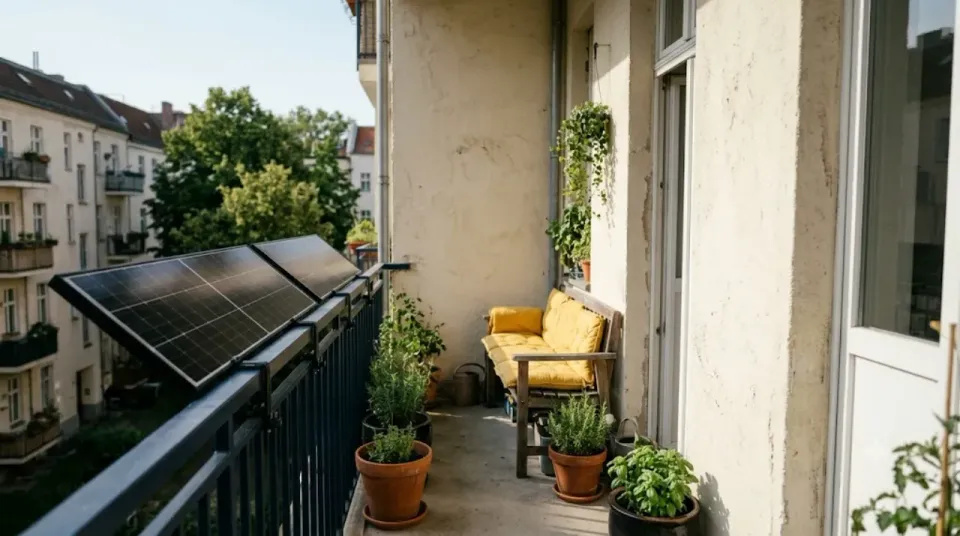
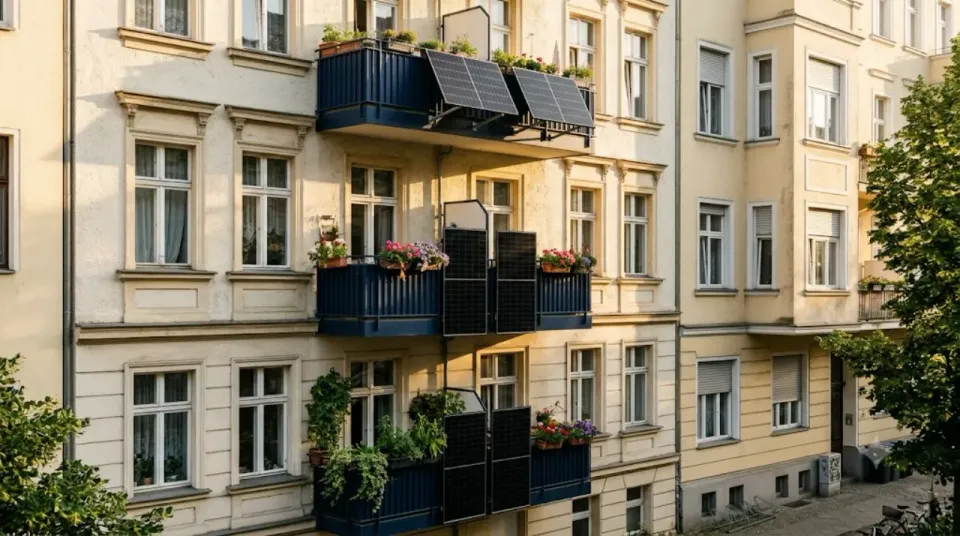
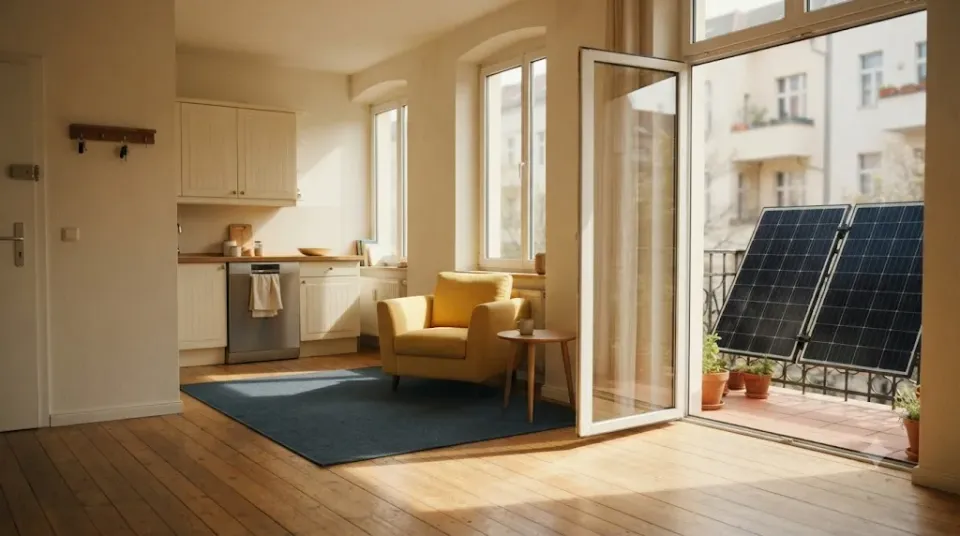
Most rented balconies give you a railing, and panels hung on a railing usually sit vertical. That costs a lot: a south panel at 90 degrees makes about 70% of the ideal, and an east or west panel at 90 degrees often only about half.
But vertical has two honest advantages:
- Winter. The low winter sun hits a vertical panel more squarely, so vertical does relatively better from November to February. Snow also slides off.
- Simplicity. A flat mount against the railing catches less wind, sits inside the railing line and is easier to get approved by a landlord.
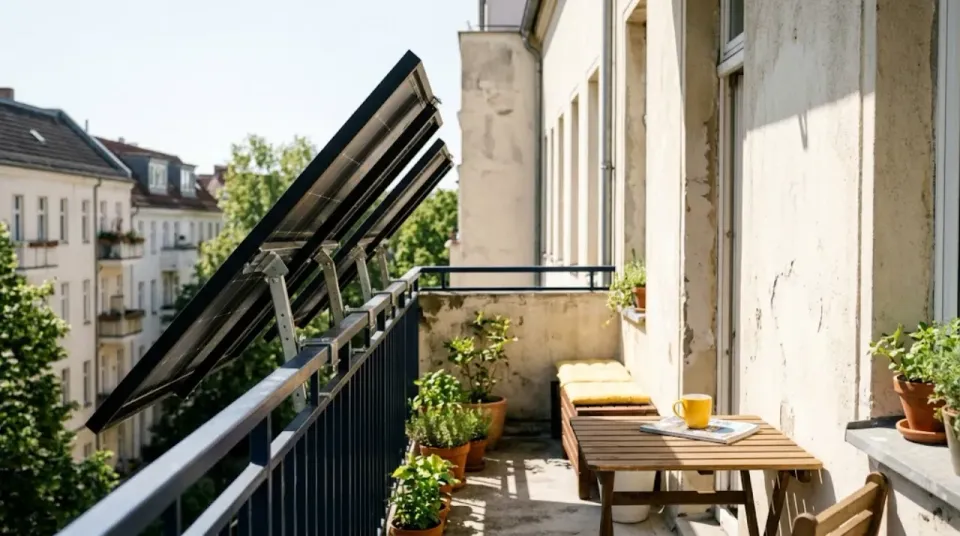
A tilting bracket that angles panels out by 20 to 35 degrees can recover much of the loss. For a south balcony, going from vertical (about 70%) to about 30 degrees (100%) means roughly 0.86 kWp x 1,000 kWh x 0.30 = about 260 kWh more a year in a mid-German city. At 40% self-use and 37 ct, that is about 38 EUR a year from one bracket.
The catch is wind load and safety. A tilted panel acts like a sail. Use a bracket made for your railing type, rated for wind, with every bolt tightened, and get your landlord's consent for the exact mount. Details in Mounting panels on a balcony railing safely.
Round 4: flat roofs and gardens, where you choose the angle
On a flat garage roof, a shed or in a garden, you pick the direction and tilt. Here the comparison shifts again.
| Layout | Yield vs ideal | Wind and ballast | Space | Notes |
|---|---|---|---|---|
| South at 30 degrees | 100% | High wind load, more ballast | Needs gap behind to avoid shading a second row | Best total |
| South at 10-15 degrees | about 90-95% | Lower wind load | Rows can sit closer | Loses a little in winter, fine in summer |
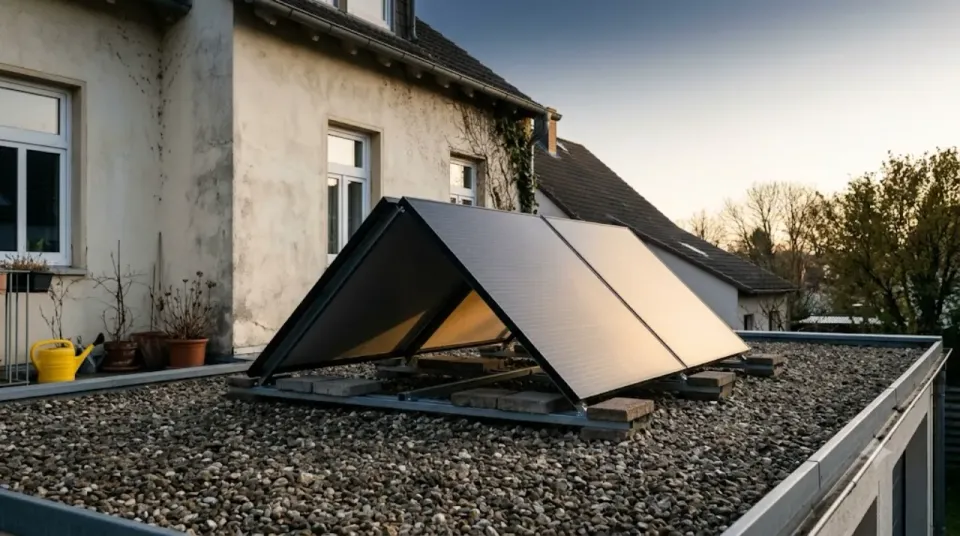
| East-west "tent" at 10-15 degrees | about 80-85% | Low, panels brace each other | Very compact | Long, flat day; popular on small roofs |
| Completely flat (0 degrees) | - | Lowest | Compact | Not recommended: rain does not run off, dirt and leaves collect |
The east-west tent - two panels leaning back to back - is a neat answer for small flat roofs. It sits low against wind, needs less ballast, and spreads production across the day. Mounting details are in Flat roof, garden or wall.
A practical note: on a roof or terrace, ballast and fixing are your responsibility. Do not rely on a few paving slabs on a windy roof, and never drill into a roof membrane without knowing what you are doing.
APsystems EZ1-M
An 800 W two-input microinverter with high input current per channel, which suits larger modern panels. Local monitoring works via Bluetooth and Wi-Fi, but check the input limits against your panels' datasheet.
Check price on Amazon Ad - affiliate link. Prices change; check the listing.Round 5: winter, summer and the shape of the year
Direction and tilt also change how the year splits. Roughly:
- South at 30 degrees: the biggest summer, a decent winter.
- Low tilt (10-15 degrees): a strong summer, a weaker winter - the low sun hits the panels at a shallow angle.
- Vertical: a weaker summer, a relatively good winter - the year is flatter.
- East-west: longer summer days, but very little in winter, when the sun rises in the south-east and sets in the south-west and stays low.
Whatever you choose, November to January brings only a small share of the year - often well under a tenth. Do not choose a layout for winter unless you have a specific reason, such as a power station you want to keep topped up year round. See Winter, snow and heatwaves.
Round 6: more panels, or a better direction?
Since May 2024, a German plug-in system may have up to 2,000 Wp of panels behind its 800 W inverter. That opens a third option: if your balcony faces east or west, add panels instead of fighting the compass. This is general information, not legal advice; check the current rules before you change your system.
Here is why it works better on east-west than on south. A south-facing 860 Wp kit already touches the 800 W cap on the best middays, so doubling it mostly adds clipping (the inverter capping output) at noon plus some extra in the mornings and evenings. An east-west kit rarely gets near the cap, because each panel only faces the sun for half the day. Add a second pair and almost every extra watt passes through.
| Setup | Panels | Rough yearly yield | Notes |
|---|---|---|---|
| South, 30 degrees | 860 Wp | about 880 kWh | Household plug possible |
| East-west, 30 degrees | 860 Wp | about 730 kWh | Household plug possible |
| East-west, 30 degrees | 1,720 Wp | roughly 1,300-1,400 kWh | Some clipping on summer days; special energy socket needed |
The doubled east-west figure is a rough estimate - the exact clipping depends on your inverter, city and shade - but the pattern holds. There are two costs. Above 960 Wp, the product norm DIN VDE V 0126-95 (in force since December 2025) calls for a special energy socket fitted by an electrician instead of a household plug. And four panels need space, weight capacity and a mount for each. Each inverter input also has voltage and current limits, so two panels per input only works if the datasheet allows it. See Schuko or Wieland? and What the microinverter does.
For a garden fence, a long terrace or a flat garage roof, this is often the smartest upgrade. For a typical rented balcony with room for two panels, it is not an option - and that is fine.
A note on where you live
All the shares in this article are typical for Germany. Two regional points matter.
North against south Germany. The ideal yield runs from about 950 kWh per kWp in the north to about 1,100 in the south. That shifts every row of the table by about 15%, but it does not change the order. South still wins on total, east-west still wins on spread. A Hamburg east-west kit and a Munich east-west kit have the same shape of day; the Munich one is just a little taller.
Other countries. The physics is the same everywhere in central Europe, but the rules are not. Feed-in limits, plug rules and registration differ between countries, so check your national rules before buying. Our German rules guide covers Germany only.
The verdict, by household type
Here is what I would choose, assuming you have the choice and similar shade either way.
Home office, small children or retired - someone in at midday. Go south or south-west at about 30 degrees. Your midday load soaks up the peak, and the bigger total turns into the biggest saving. South-west shifts the peak towards lunch and early afternoon, which often suits real life best.
Out at work all day, steady base load. Go east-west. You give up some kWh but use more of what you make: breakfast, the fridge all day, and the first hours after work. Make sure the inverter has two MPPT inputs.
Out at work, home by 16:00 or 17:00. Go west or south-west. The afternoon output lands on cooking, laptops and the evening wash.
Early risers, shift workers, home in the mornings. East is fine, and an east-only balcony is nothing to apologise for.
Rented balcony, no tilt allowed. Go vertical on the sunniest side and accept roughly 70% (south) or about 50% (east or west). Then lift your self-use with timers. A vertical kit still pays back, just more slowly.
Flat roof or garden with little space. Go for an east-west tent at low tilt. Compact, low wind load, long day.
Only a north side. Look for any other spot first - a south wall, a garden fence, a shed roof. If north is truly the only option, run the numbers carefully before buying.
Anker SOLIX RS40P Balkonkraftwerk
A full two-panel kit with an 800 W-capable microinverter, so you buy one box instead of matching parts. Check that the included mount suits your railing, and that the version you order carries current German certificates.
Check price on Amazon Ad - affiliate link. Prices change; check the listing.How to decide in ten minutes
- Find your direction. Stand with your back to the wall, facing out, and use a compass app on your phone. Note the reading.
- Check shade. Take a photo from the panel position every two hours on a sunny day. Shade often matters more than direction - a south balcony in the shadow of the building opposite can make less than an open west one.
- Note when your home uses power. Mostly midday, mostly mornings and evenings, or spread out? A week with an energy meter on the fridge, and a look at your meter at night, tells you your base load.
- Check what is allowed. Tilt brackets, flat-roof frames and wall mounts need your landlord's or owners' association's consent. Since October 2024 they can only refuse for a good reason, but you must ask first. This is general information, not legal advice; see Renting? How to ask your landlord.
- Compare two options for your city. Put both into Sunslot and compare self-use and savings, not just the yearly kWh.
- Pick, mount, measure. After a summer of real data, adjust the tilt or move a panel if the curve tells you to.
Common mistakes when choosing a direction
- Chasing the biggest kWh number. Unused midday power earns nothing in Germany. Savings come from what you use.
- Ignoring tilt. A perfect south direction hung vertical still loses about 30%.
- Splitting directions on one MPPT input. East and west panels on a shared input fight each other half the day.
- Laying panels flat to avoid wind. Dirt and water collect. Use at least 10 degrees.
- Checking shade only in June. In winter, shadows from the building opposite reach much further.
- Tilting without a rated bracket. A tilted panel catches wind. Use a mount made for your railing and approved for the load.
If you take one thing away: south is not a rule, it is one option. Match your panels to your day, keep them out of hard shade, and tilt them if you safely can. Then use the hours you get. Our guide to running appliances in the sun shows how.
Shelly Plug S Gen3
A metering smart plug that logs consumption of an appliance and works locally without a cloud account. It is an indoor plug, so it is not for an outdoor balcony socket, and it must never be combined with a socket strip.
Check price on Amazon Ad - affiliate link. Prices change; check the listing.Direction questions
Is east-west better than south for balcony solar?
For total energy, no - east-west makes about 80 to 85% of an ideal south setup. For savings, it can be equal or better if you are out during the day, because more of its output lands in the morning and evening when you use it.
How much do I lose with panels hanging vertical on a railing?
Roughly 30% on a south balcony compared with a 30-degree tilt, and often around half on an east or west balcony. Vertical panels do relatively better in winter and shed snow easily.
What is the best tilt angle for solar panels in Germany?
About 30 degrees gives the biggest yearly total for south-facing panels. Low tilts of 10 to 15 degrees lose only a little and cut wind load on flat roofs. Avoid 0 degrees, because rain and dirt collect.
Can I put one panel east and one west on the same inverter?
Yes, if the inverter has two MPPT inputs, one per panel. Each panel is then tuned on its own. With a single shared input, the shaded panel would drag down the sunny one for much of the day.
Is a north-facing balcony worth it?
Rarely. North at 30 degrees gives about 50 to 60% of the ideal, and north and vertical much less. Look for any other spot first, and run the numbers for your own balcony before buying.