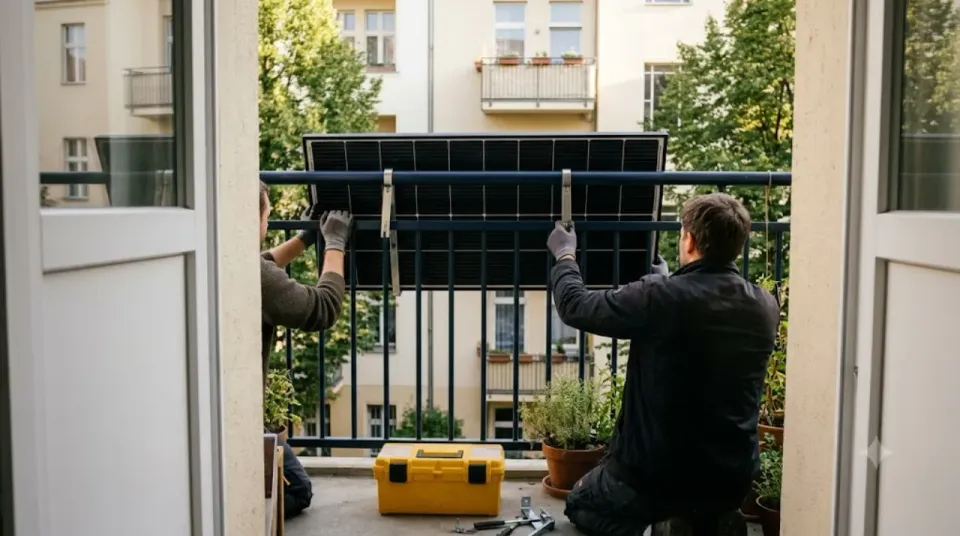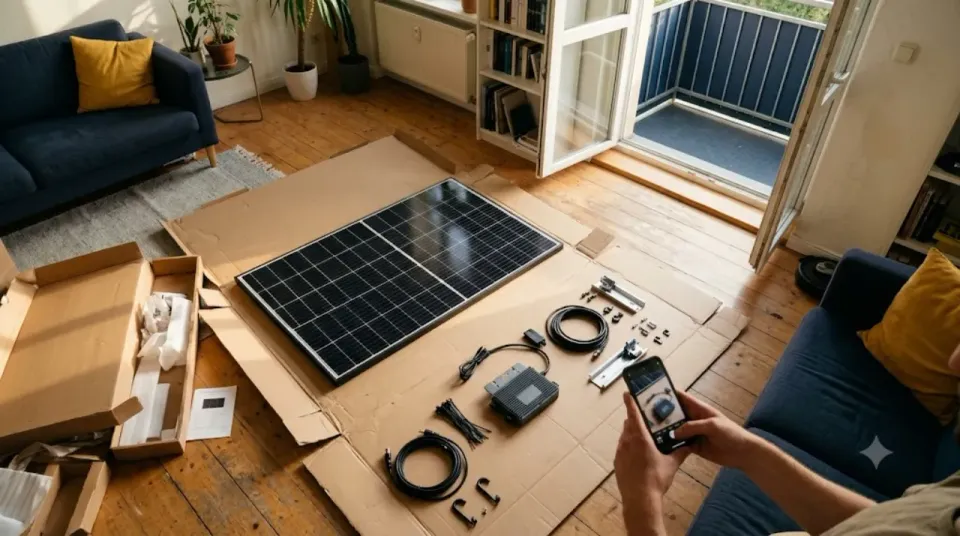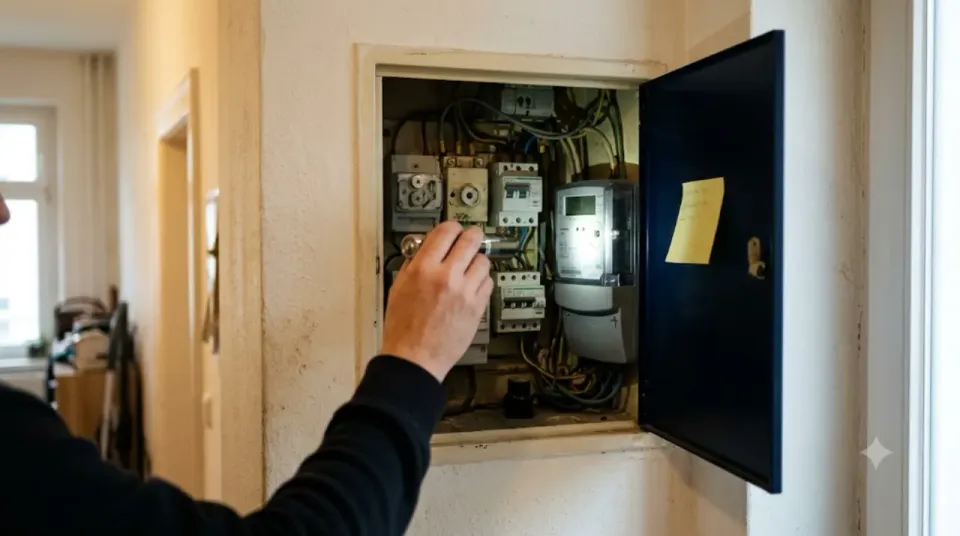

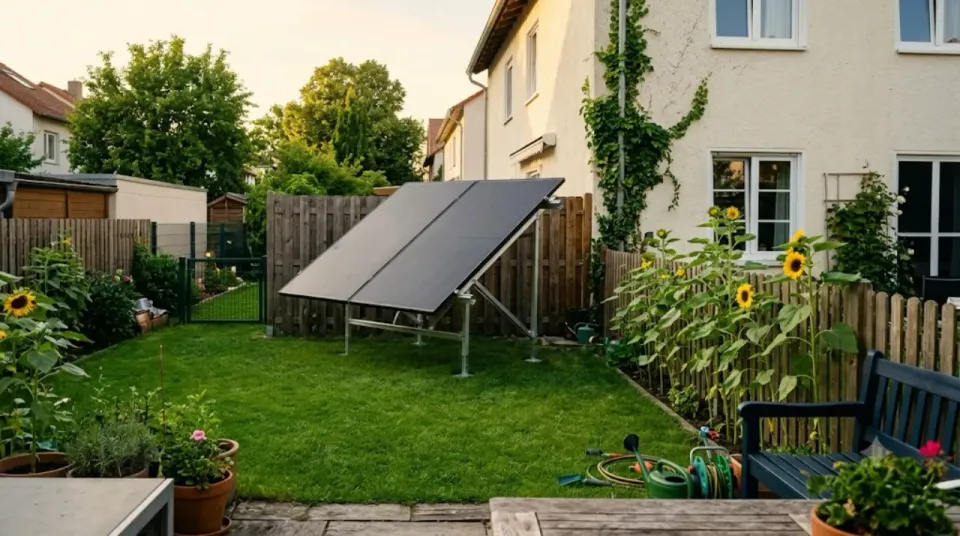
The same two panels that make about 600 kWh a year hanging straight down a south railing can make 800 to 950 kWh on a garden stand a few metres away. That is roughly a third more power from the same money - just by putting the kit somewhere else. Yet most people never consider anything but the balcony. If yours is shady, faces north, or your landlord said no, a flat roof, a garden, a shed or a sunny wall may not be a compromise at all. It may be the better spot.
This is a decision guide. It walks you through which place fits your home, what each one needs, and what I would buy. The rules stay the same wherever the panels sit: up to 800 W from the inverter, up to 2,000 Wp of panels, and registration in the Marktstammdatenregister. What changes is how you mount the panels and how you get the power to a socket.
Start here: which place fits your home?
Answer these questions in order. Stop at the first "yes" that also passes the shade check in the next section.
- If you have a garden with a south, south-east or south-west corner that gets sun from mid-morning to late afternoon, then a ground stand is usually your best yield per euro. Go to "Gardens".
- If you have a flat garage, carport or extension roof that you own or may use, then a ballasted flat-roof mount is often the sunniest, least shaded spot. Go to "Flat roofs".
- If you have a solid shed or summer house with an open sky, then a shed roof is easy to reach and low-risk. Go to "Sheds".
- If you have a south, east or west wall of solid masonry with no shade, then a wall mount works and stays clean. Go to "Walls".
- If none of these apply, then the balcony is still your best bet - see Mounting panels on a balcony railing - or look at a small power station with a panel for specific uses instead (What a portable power station is).
Two filters apply to every path. First, do you own the place, or do you have the owner's consent? A garden or roof system on a building you do not own still needs it. Second, can you get the power to a suitable socket without a cable through a closing window or a chain of extension leads? If not, plan the socket first.
The yield picture, side by side
Here is how the options compare for a typical 860 Wp kit in Germany, using the rule of thumb of about 950 to 1,100 kWh per kWp (kilowatt-peak, 1,000 watts of panel rating) a year for the ideal: facing south, tilted about 30 degrees, no shade.
| Place and layout | Share of ideal | Approx. kWh a year (860 Wp) | Mounting effort |
|---|---|---|---|
| Garden stand, south, 30 degrees | 100% | about 820-950 | Medium; needs anchoring |
| Flat roof, south, 10-15 degrees | about 90-95% | about 750-900 | Medium; ballast and roof check |
| Flat roof, east-west tent, 10 degrees | about 80-85% | about 660-800 | Medium; less ballast |
| Shed roof, south, existing pitch | about 85-100% | about 700-950 | Low to medium |
| Wall, south, vertical | about 70% | about 570-670 | Medium to high; solid masonry needed |
| Wall, east or west, vertical | about 50% | about 410-480 | Medium to high |
The flat-roof percentages for low tilt are typical figures; a 10 to 15 degree tilt loses a little winter yield compared with 30 degrees but needs much less ballast. The 800 W inverter limit trims a little off bright summer middays, but over a year that loss is small.
Totals are only half the story, though. What you save depends on how much of the power you use yourself. An east-west roof makes less, but spreads it over breakfast and early evening. Put each option into Sunslot with your city and see the hour-by-hour curve and self-use share - a garden stand that peaks while you are at work may save less than an east-west roof that covers your mornings.
The shade check every spot must pass
A garden is only better than a balcony if it is sunnier. Before you choose, do a simple check:
- Stand where the panels would go at 10:00, 13:00 and 16:00 on a sunny day and note what blocks the sky to the south, east and west.
- Measure the big obstacles. A hedge, a house or a tree blocks low sun at an angle you can work out: divide its height above the panels by its distance. A ratio of 1 : 2 blocks the sun below about 27 degrees, which in most of Germany means much of November to January even at midday.
- Think five years ahead. Young trees and hedges grow. A fruit tree that is harmless now may shade the panels at 15:00 in a few summers.
The details, with worked examples, are in Shade on a balcony - the same physics applies in a garden.
Solarway Balkonkraftwerk Halterung für 2 Solarmodule
An aluminium mount with adjustable tilt for balcony, facade or flat roof, useful when a tilt clears a shadow. Check the clamp range fits your railing and stay within the stated angle and wind limits.
Check price on Amazon Ad - affiliate link. Prices change; check the listing.Gardens: ground stands
A garden gives you the most freedom: due south, around 30 degrees, no slab above you, and easy cleaning. A typical 2 x 430 W kit placed like this can make roughly 800 to 950 kWh a year.
What it needs
- Anchoring. Ground screws, concrete footings or heavy ballast. A free-standing frame on a lawn with nothing holding it is a kite waiting for a storm.
- Height. Raise the bottom edge at least 30 to 50 cm off the ground so grass, plants and snow do not shade the lowest cells.
- Safe edges. Children and pets should not be able to pull cables or climb the frame. Panel corners at head height for a child are worth avoiding.
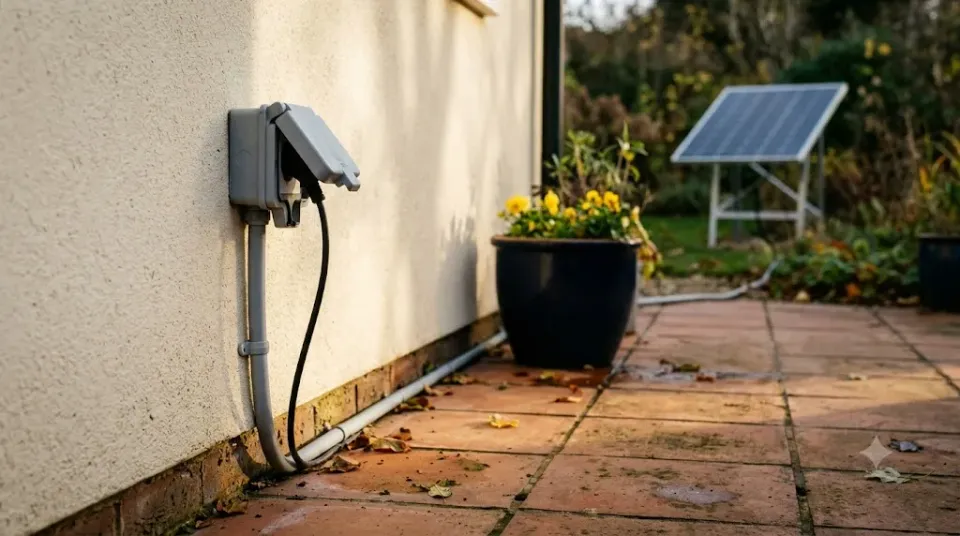
- A cable route that cannot be tripped over or cut by a lawn mower. A protective conduit along a fence or under a path is ideal.
Anchoring options compared
| Anchor | Good for | Trade-off |
|---|---|---|
| Ground screws | Lawns and soft soil; quick, removable | Need soil without big stones; may need a long lever to turn |
| Concrete footings | Permanent spot; very stable | Hard to move later; digging and curing time |
| Ballast (slabs, kerbstones) | Patios and paved areas; renters | Heavy to carry; follow the ballast table |
Example: the Becker family's garden in Kassel
An example household: the Beckers have a terraced house with a narrow south-facing garden and a north-facing balcony upstairs. The balcony would have made perhaps 400 kWh a year. Instead they set a two-panel stand at 30 degrees near the back fence, on four ground screws, raised 50 cm.
- Estimated yield: about 850 kWh a year.
- Self-use: with a home office and the washing machine moved to midday, about 55%.
- Saving: 850 x 0.55 = about 470 kWh x 0.37 EUR = about 174 EUR a year.
- On the balcony it would have been roughly 400 x 0.65 = 260 kWh x 0.37 EUR = about 96 EUR a year.
The cost of moving to the garden: a ground stand, a 10-metre outdoor cable run in conduit, and a weatherproof socket fitted by an electrician on the terrace wall. It paid for itself in about two years compared with the balcony option.
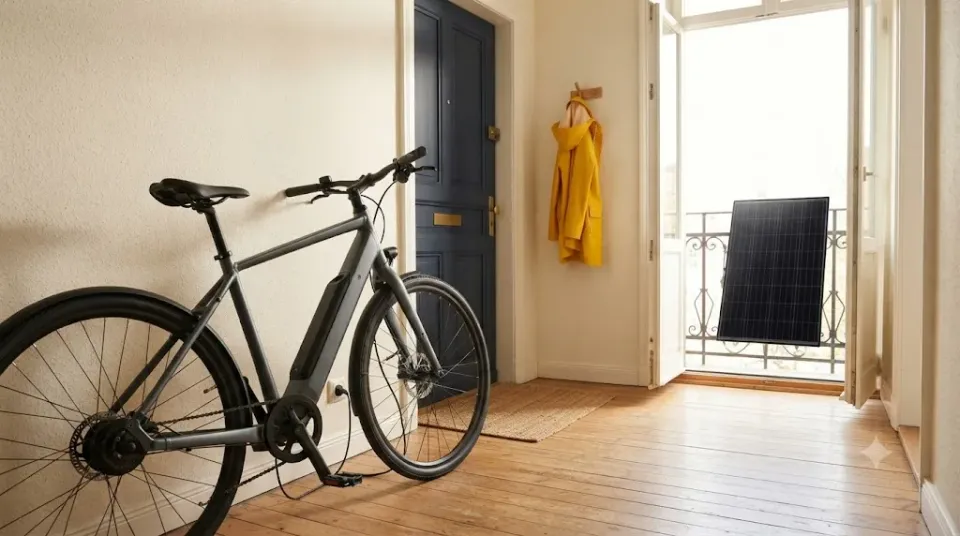
Flat roofs: garage, carport, extension
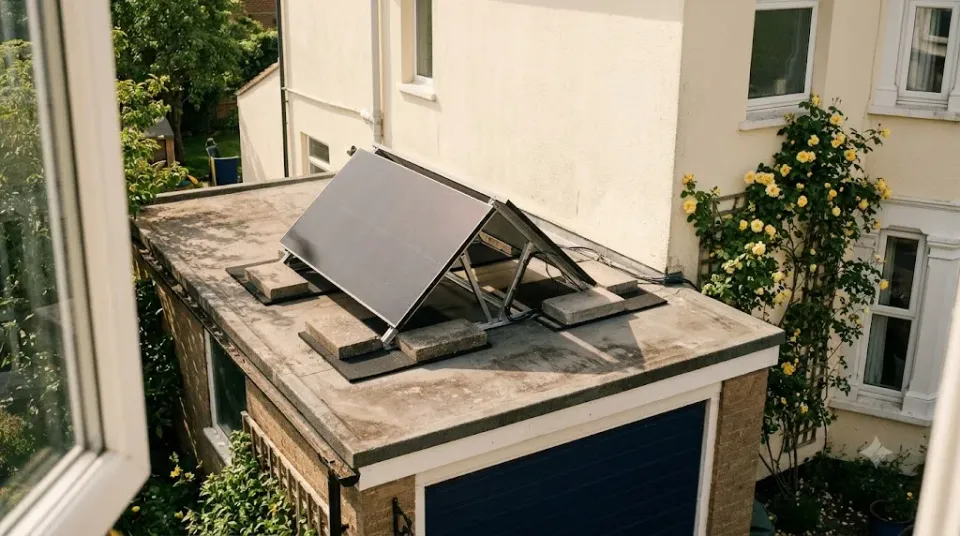
A flat roof is often the sunniest, least shaded spot you have. Mounts here usually do not drill into the roof. Instead they use ballast (weights such as concrete slabs) to hold the frame down, because a hole in a flat-roof membrane is an invitation for leaks.
- Low tilt wins. Around 10 to 15 degrees catches far less wind than 30 degrees, so it needs less ballast. You lose a little winter yield but gain stability.
- East-west "tent" layouts - two panels leaning back to back - are popular on small roofs. They spread output over the day and sit low against the wind. See South, east-west or flat.
- Check the roof can carry it. Panels plus ballast can add well over 100 kg. A garage or carport roof, especially a light steel or timber one, may not be built for that. Ask the owner or a builder if you are unsure.
- Follow the ballast table in the mount instructions. It depends on wind zone, building height and distance from the roof edge. Panels near edges and corners need more weight.
- Protect the roof surface with rubber mats under the frame so the ballast does not wear through the membrane.
- Keep drains and gutters clear. Never place ballast over a roof drain or where water collects.
Roof type decision table
| Roof | Likely verdict | Why |
|---|---|---|
| Concrete garage or extension roof | Good | Usually carries ballast well; check membrane and drains |
| Prefab steel garage | Check first | Thin roof sheets may dent or flex under ballast |
| Timber carport with bitumen sheets | Check first | Load capacity varies a lot; ask the maker or a builder |
| Polycarbonate or glass carport | No | Not built for point loads or ballast |
| Green roof | Specialist mount | Needs a system made for green roofs; ask a professional |
Example: Sophie's garage roof in Freiburg
An example household: Sophie owns a semi-detached house with a concrete double garage beside it. Her balcony faces north-east. The garage roof has open sky in every direction, but it is small and the edge is only a few metres from the street.
- Layout: an east-west tent at 10 degrees, two panels back to back. Low profile, so her ballast table asked for less weight than a south layout at 15 degrees would have.
- Yield: about 80-85% of the ideal. In sunny Freiburg, near the top of the German range, that is roughly 0.86 kWp x 1,100 kWh x 0.82 = about 775 kWh a year.
- Self-use: the east panel covers breakfast, the west panel covers the hour after she gets home. About 60%.
- Saving: 775 x 0.6 = 465 kWh x 0.37 EUR = about 172 EUR a year.
- Socket: the inverter sits on the garage roof edge in the shade of a panel; a single AC cable runs down the garage wall to an outdoor socket an electrician fitted next to the garage door.
She kept the frame 1.5 metres back from the roof edge, which both cut the ballast needed and made the roof safer to walk on.
Walls and sheds
House walls
Walls work well if they face roughly south, east or west and are not shaded. Vertical panels make roughly 70% of an ideally tilted south panel when facing south, and less on east or west walls. That sounds poor, but vertical panels do relatively well in winter, when the low sun hits them squarely, and they stay clean and snow-free.
- Solid masonry only. Wall mounts must be fixed into brick or concrete with anchors made for that material - not into insulation or render alone.
- External insulation (ETICS, the insulated render systems common on renovated houses) needs special mounting systems that bridge the insulation. Ask a professional.
- Owner's consent is needed for any facade work on a rented or shared building.
Garden sheds and summer houses
Sheds are handy because they are low and easy to reach. Check the roof structure is solid, and screw into rafters, not just the roof boards. A lightweight shed may need a ground stand next to it instead. Use roofing screws with sealing washers, and fit the mount so water still runs freely off the roof.
AVM FRITZ!DECT 210
A splash-proof IP44 smart plug that measures energy, suited to a garden or terrace socket. It needs a FRITZ!Box with DECT to work, so it only suits homes that already have one.
Check price on Amazon Ad - affiliate link. Prices change; check the listing.Getting the power to a socket
This is the part that needs most thought away from a balcony. You have two options.
| Option | How | Watch out for |
|---|---|---|
| Longer DC cables | Inverter sits near the socket; the panel cables run further | Use proper solar cable with matching connectors (usually MC4); keep runs as short as sensible |
| Longer AC cable | Inverter sits by the panels; one AC cable runs to the socket | Use one continuous cable of the right type and length; no cable reels or plug-in extension chains |
The socket itself must suit outdoor use if it is outside - a weatherproof outdoor socket, ideally on its own circuit and protected by an RCD (residual current device, the safety switch that trips on earth faults). If you do not have one, a registered electrician can fit one. This is often the best money you spend on a garden system.
Then the plug. Under the product standard DIN VDE V 0126-95, which applies since December 2025, a normal household (Schuko) plug is allowed up to 960 Wp of panels, with the extra touch protection the standard requires, and the connection cable from the maker must be at least 5 metres long. Above 960 Wp, a special feed-in plug or a fixed connection is needed. Multi-socket strips are not allowed. See Schuko or Wieland?
Which option for which place?
- If the panels are within a few metres of the socket, then keep the standard AC cable and mount the inverter by the panels.
- If the panels are far from the house, then either have an electrician fit an outdoor socket near the panels, or run solar DC cable in conduit to an inverter near the house. Do not join AC cables to make up the length.
- If a path or lawn lies in between, then protect the cable in a conduit; buried runs should follow the rules for underground cable, which is a job for an electrician.
The decision table
Here is everything above in one place.
| If your situation is... | Then choose... | Key condition |
|---|---|---|
| Sunny garden, own house | Ground stand, south, 30 degrees | Proper anchoring; outdoor socket |
| Sunny garden, tenant | Ballasted stand, no digging | Landlord's consent; ballast table |
| Solid flat roof, little space | East-west tent at 10 degrees | Roof load check; mats under ballast |
| Solid flat roof, room to spare | South, 10-15 degrees | Spacing so rows do not shade each other |
| Light carport or prefab garage | Garden stand beside it, or ask a builder | Do not guess roof capacity |
| Sunny solid wall, no garden | Vertical wall mount | Solid masonry; ETICS needs a specialist |
| Shed with open sky | Shed roof mount | Screw into rafters; sealed screws |
| Everything shaded | Reconsider; maybe a power station for specific uses | Do the payback maths first |
One more rule: the limits apply to your connection as a whole, not per kit. Two kits in the garden still share one 800 W inverter limit. When in doubt, check the current rules with your Verbraucherzentrale. This is general information, not legal advice.
Common mistakes away from the balcony
- A loose frame on the lawn. No anchoring means it will move in the first storm.
- Panels too close to the ground. Grass and snow shade the bottom cells all season.
- Ballast guessed, not calculated. Edge and corner zones need more weight than the middle of the roof.
- Drilling into a flat roof to "make it secure". It usually makes it leak.
- Extension-cable chains to reach a socket. Not allowed, and a real fire risk.
- Forgetting the hedge. It grows 30 cm a year whether you plan for it or not.
- Using brochure yield. Use your real direction, tilt and shade, then run payback maths.
Bosch Zamo Laser-Entfernungsmesser
Handy for measuring the distance to a building or tree so you can work out the shadow angle. It measures distance only, not height, so count floors for that.
Check price on Amazon Ad - affiliate link. Prices change; check the listing.What I'd buy
For a sunny garden: an adjustable ground stand for two panels, set to about 30 degrees, on ground screws or a ballast set, plus an electrician-fitted outdoor socket. For a solid flat roof: a low-tilt ballasted mount, east-west if space is tight, with rubber mats and the maker's ballast table followed to the letter. For a wall: a mount system rated for masonry, fitted by someone who knows the wall. In every case, an 800 W inverter with two MPPT inputs, so each panel is tuned on its own. And before any of it, ten minutes in Sunslot comparing the garden, the roof and the balcony side by side.
Roof, garden and wall questions
Is a garden stand better than a balcony?
Usually, if the garden spot is sunny. A south-facing stand at 30 degrees can make roughly a third more than vertical panels on a south railing, because tilt matters about as much as direction.
Do I need to drill into a flat roof?
Usually not. Most flat-roof mounts use ballast instead, which avoids leaks. The amount of ballast depends on wind zone, building height and edge distance, so follow the maker's table.
Can I use an extension cable to reach a socket?
Not a chain of plug-in extensions or a cable reel. Use one continuous cable of the right type and length, longer DC solar cable, or have an electrician fit an outdoor socket near the panels.
Can I mount panels on a wall with external insulation?
Only with special mounting systems that bridge the insulation and anchor into the masonry behind it. Ask a professional; render and insulation alone cannot carry the load.
Do the 800 W rules apply in the garden too?
Yes. The 800 W inverter limit, the 2,000 Wp panel limit and registration in the Marktstammdatenregister apply wherever the panels sit, and they apply to your connection as a whole.