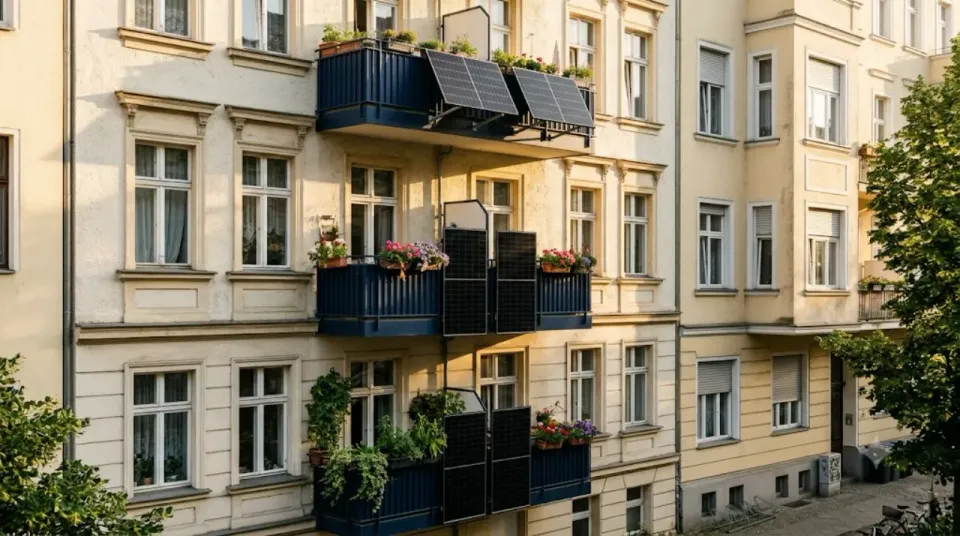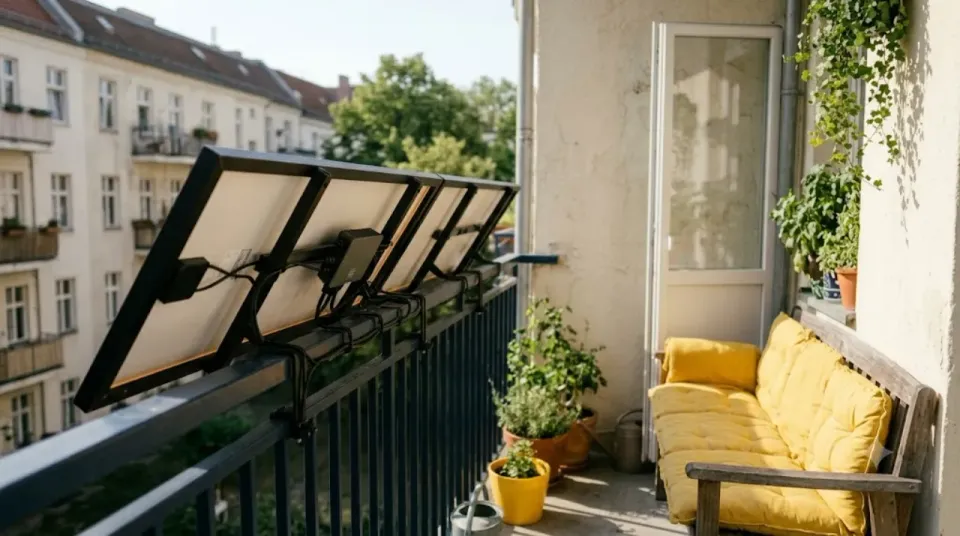


Here is a number that surprises most people: the fridge, the router and the little standby lights in an ordinary German flat draw power every hour of every day, and together they often cost well over 100 euros a year. A pair of solar panels hung on your balcony railing, plugged into a socket like a lamp, can cover a good part of that while the sun is up. No roofer, no scaffold, no loan. This article answers the questions people actually ask before they buy one - honestly, with the numbers shown.
What exactly is plug-in solar?
Plug-in solar is a small solar power system that you connect to your home through a normal socket. You hang one to four panels on a balcony, a terrace, a garden wall or a shed roof, connect them to a small converter box, and plug that box into the wall. While the sun shines, part of the power your flat uses comes from your own panels instead of the grid.
In German it has two common names: Balkonkraftwerk (balcony power plant) and Steckersolargerät (plug-in solar device - the term used in the law and the technical norm). In English you will see balcony solar, plug-in PV, mini solar or plug-and-play solar. They all mean the same thing.
A typical kit has four parts. None of them is exotic:
- Solar panels (also called modules). Usually one or two, each rated around 400 to 450 Wp (watt-peak, the output under standard lab sunlight). A very common kit is 2 x 430 Wp, so 860 Wp in total.
- A microinverter (a small box that turns the panels' direct current into the alternating current your sockets use). In Germany it may feed in at most 800 W. We explain it in detail in What the microinverter does.
- A mounting kit - hooks or clamps for a railing, a frame for a flat roof, or brackets for a wall.
- An AC cable with a plug on the end. Either a normal household plug (Schuko) or a special feed-in plug (often called Wieland).
Some kits add a battery, but the basic idea works fine without one. A plug-in kit is not a scaled-down rooftop system with a contract and an installer. It is closer to a large appliance that happens to make electricity instead of using it.
How does the power get from my balcony to my fridge?
It flows into your home wiring and goes straight to whatever is switched on - you never have to point it at a particular appliance. This is the part most people get wrong, so here it is slowly.
The inverter does not charge anything, and it does not only power the socket it is plugged into. It pushes current into the circuit. Electricity always takes the shortest path, so it is used by whatever in your flat is drawing power at that moment. Only what is left over passes back through your meter to the grid.
Let us follow an example household for one sunny Saturday in May: a couple in a two-room flat in Hanover, with 2 x 430 Wp panels on a south-west railing.
| Time | Panels make | Flat uses | From the balcony | To the grid | From the grid |
|---|---|---|---|---|---|
| 08:00 | 120 W | 180 W (fridge, router, coffee machine standby) | 120 W | 0 W | 60 W |
| 11:00 | 420 W | 2,200 W (washing machine heating water) | 420 W | 0 W | 1,780 W |
| 14:00 | 560 W | 150 W (base load only, they are out) | 150 W | 410 W | 0 W |
| 17:00 | 380 W | 450 W (laptop, TV, oven preheating) | 380 W | 0 W | 70 W |
| 21:00 | 0 W | 300 W | 0 W | 0 W | 300 W |
Three things to notice. First, nothing had to be switched - the panels simply covered what they could. Second, at 14:00 most of the balcony power left the flat because nobody was home. In Germany you are normally not paid for that surplus. Third, the kettle or washing machine does not "overload" the panels. The panels cover their share and the grid supplies the rest, quietly.
That is why plug-in solar works best against your base load - the steady power your home draws around the clock - and why it pays to run the washing machine in the sunny hours instead of at night. The share of your solar power you use yourself is called self-consumption, and it is the single most important number for your savings. More in Self-consumption explained.
Anker SOLIX RS40P Balkonkraftwerk
A full two-panel kit with an 800 W-capable microinverter, so you buy one box instead of matching parts. Check that the included mount suits your railing, and that the version you order carries current German certificates.
Check price on Amazon Ad - affiliate link. Prices change; check the listing.How much electricity will it make on my balcony?
A typical two-panel kit in Germany makes roughly 400 to 900 kWh (kilowatt-hours, the unit on your electricity bill) a year. That range is wide on purpose. Where you land depends far more on your balcony than on the kit.
The rule of thumb: an ideally placed system in Germany - facing south, tilted about 30 degrees, no shade - makes about 950 to 1,100 kWh per year for every kWp (kilowatt-peak, 1,000 watts of panel rating). An 860 Wp kit in that perfect spot would make roughly 820 to 950 kWh. Real balconies are rarely perfect:
| Your setup | Share of the ideal | 2 x 430 Wp, per year |
|---|---|---|
| South, tilted 30 degrees, no shade | 100% | about 820-950 kWh |
| South-east or south-west, 30 degrees | about 95% | about 780-900 kWh |
| East or west, 30 degrees | about 80-85% | about 660-800 kWh |
| South, hanging vertical on a railing | about 70% | about 570-670 kWh |
| North, 30 degrees | about 50-60% | about 410-570 kWh |
An east- or west-facing panel hanging straight down a railing often lands around half of the ideal. Then subtract shade from the balcony above, a tree or the building opposite. Shade is hourly and seasonal, not one fixed percentage - see Shade on a balcony.
Most of the energy also arrives in summer. A south-facing kit can make 4 to 5 kWh on a clear June day and often under 1 kWh on a clear December day. Our article How much power does a balcony kit really make? follows three example households through a whole year.
Will it actually save me money?
Usually yes, and a basic kit typically pays for itself within a few years - but only the power you use yourself saves money. Here is the maths, with every number on the table.
The formula has three steps:
- Yearly yield - how many kWh your panels make.
- Times your self-consumption share - the part you use at the moment it is made. Without a battery, typical households land somewhere around 30 to 60%.
- Times your electricity price - the working price per kWh on your bill. The BDEW (German energy industry association) put the average for new household contracts at about 37 ct per kWh in 2026.
Worked example for the Hanover couple: their south-west railing makes about 650 kWh a year. They are out on weekdays, so they use about 40% of it. 650 x 0.40 = 260 kWh. 260 x 0.37 EUR = about 96 EUR a year. Their kit cost 380 EUR, so 380 / 96 = about 4 years to pay back.
Now an example household where someone works from home: same kit, same balcony, but 55% self-consumption. 650 x 0.55 = 358 kWh. 358 x 0.37 = about 132 EUR a year. Payback: about 2.9 years. Same hardware, more than a year faster, purely because of habits.
| Case | Yield | Self-use | Saving per year | Payback on a 380 EUR kit |
|---|---|---|---|---|
| Shaded east railing, out all day | 450 kWh | 30% | about 50 EUR | about 7.6 years |
| South-west railing, out on weekdays | 650 kWh | 40% | about 96 EUR | about 4 years |
| South-west railing, home office | 650 kWh | 55% | about 132 EUR | about 2.9 years |
| Open south terrace, tilted, family at home | 850 kWh | 55% | about 173 EUR | about 2.2 years |
Use your own price from your bill, not the average. Leave out the monthly base charge, because solar does not change it. And remember the kit keeps working after payback: panels commonly carry long performance warranties and often last 20 years or more. Our full payback maths article lets you redo this for your own flat.
Does it keep the lights on in a power cut?
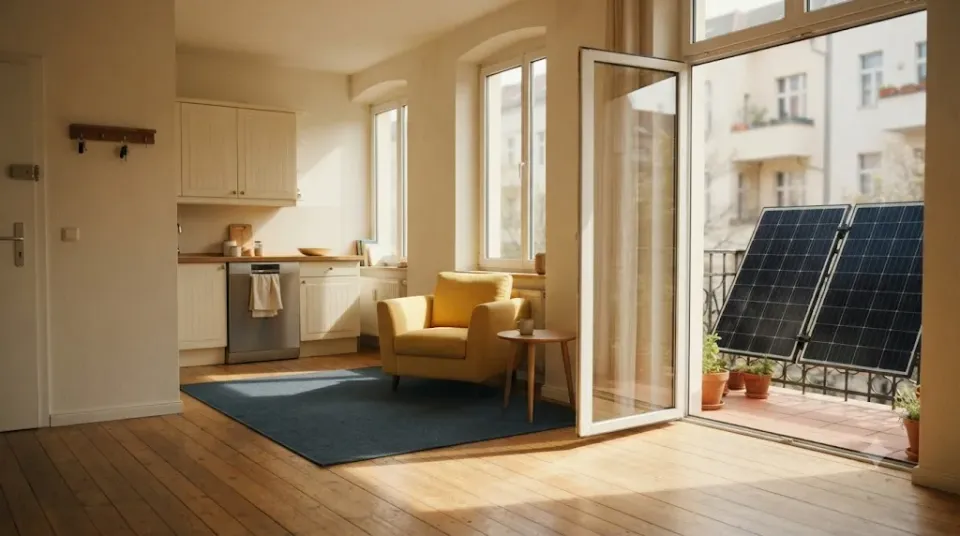
No. A plain balcony kit switches itself off the moment the grid goes down. This surprises a lot of people, so it is worth understanding why.
Every approved microinverter has a built-in safety cut-off called grid and system protection (in German, NA-Schutz). It watches the grid voltage and frequency constantly. If the grid fails, the inverter stops feeding within a fraction of a second. That way it can never push current into a line that an engineer believes is dead, and it can never put voltage on the bare pins of its own plug once you pull it out.
So during a blackout, your panels sit in the sun doing nothing. If you want power in an outage, that is the job of a portable power station - a battery box with its own sockets, which you can charge from the grid, from a car, or from a separate solar panel. Some combined systems can do both jobs, but they cost more and need careful reading of the specifications. For a realistic plan, see A 48-hour power cut plan for a flat.
Brennenstuhl Primera-Line Energiemessgerät PM 231 E
A simple plug-in meter to find what your fridge, router and standby really draw before you buy panels. It has no app, so you read the display by hand and note the numbers yourself.
Check price on Amazon Ad - affiliate link. Prices change; check the listing.Is it safe to plug into a normal socket?
Yes, if you use a kit built to the current German product norm, its own cable, and a socket in good condition. The details matter, so here they are.
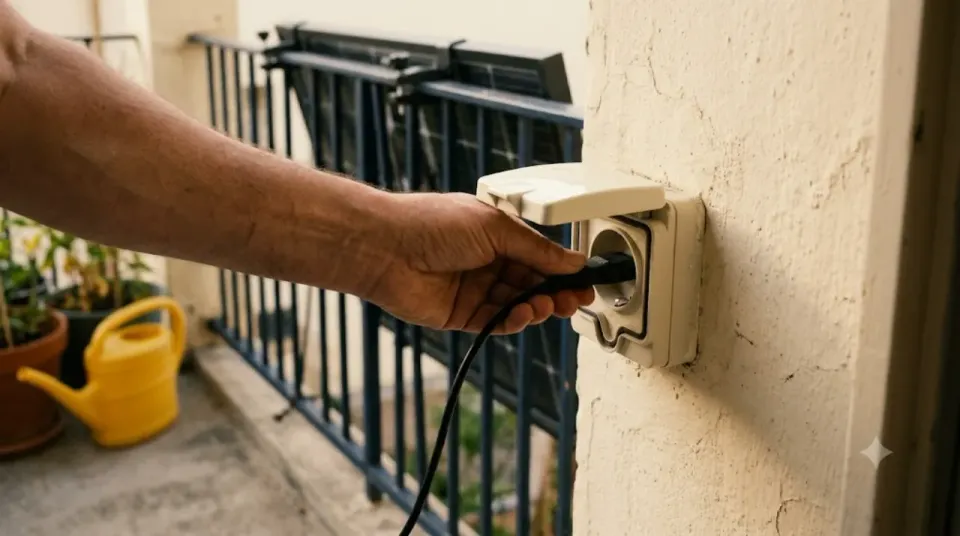
The product norm DIN VDE V 0126-95 has applied since 1 December 2025. It is the first technical standard written specifically for plug-in solar devices. According to the consumer advice centres and the trade press, it allows a normal household plug (Schuko) for systems up to 960 Wp of panels, provided the device has extra protection against touching live pins - for example a cover over the pins, a disconnect switch in the plug, or an inverter design with extra internal protection. Above 960 Wp, and up to 2,000 Wp, you need a special energy plug and socket fitted by an electrician. The 800 W feed-in limit is the same either way. Full details in Schuko or Wieland?
Why is 800 W fine on an ordinary circuit? A normal socket circuit in Germany is protected by a 16 A circuit breaker. Your appliances draw from the breaker side, and the solar feeds in from the other end. With at most 800 W (about 3.5 A at 230 V) coming in from the balcony, the wiring stays within safe limits on a circuit in good condition. That is the reasoning behind the cap.
The common mistakes, from an electrician's point of view:
- Using a multi-socket strip or an extension cable. The norm does not allow them. The manufacturer's cable must be at least 5 metres long, so you should not need one.
- Plugging into a tired old circuit. If the sockets are loose, scorched or the house wiring is very old, have an electrician check the circuit first. It usually takes about half an hour.
- Sharing a circuit with a big heater. On sound modern wiring this is fine. On old wiring, avoid it until it has been checked.
- Weak mounting. Electrically, a kit is low risk. A panel falling from the third floor is not. Mounting is where the real safety work lies - see Mounting panels on a balcony railing safely.
- Opening the inverter or rewiring the plug. Never. Use the parts as supplied.
What are the rules in Germany?
Since 2024 they are short and friendly: up to 800 W of inverter output, up to 2,000 Wp of panels, one online registration, and a legal claim to your landlord's consent. This is general information, not legal advice. Rules change, so check the current wording before you rely on it.
Size. The Solarpaket I (a package of changes to energy law) came into force in May 2024. It raised the inverter limit for plug-in systems from 600 W to 800 W and set the panel limit at 2,000 Wp. Read The 800 W rules explained for the full picture.
Registration. You register the system in the Marktstammdatenregister (the federal register of power plants, run by the Bundesnetzagentur) within one month of switching it on. The form for plug-in devices is short and free. For systems without a battery you no longer need to notify your grid operator separately - the register passes your entry on. Step by step in Registering your system.
Your meter. Many flats still have an old Ferraris meter (the kind with a spinning disc). You may start straight away. The grid operator swaps the meter when it is due, and you should not have to pay for it. Do not try to profit from a meter that runs backwards - the tolerance exists to remove a waiting time, not to create a loophole.
Renters and flat owners. Since 17 October 2024, plug-in solar is a privileged measure under § 554 BGB (tenants) and § 20 WEG (owners' associations). You still need consent and must ask first, but a landlord can only refuse with a good reason, such as safety or a listed building. We give you a letter to copy in Renting? How to ask your landlord.
Insurance. Tell your personal liability and household insurers. Most policies cover a properly mounted kit, but they like to know. See Insurance and liability.
Who is it a good fit for, and who should skip it?
It suits most people with a reasonably sunny outdoor spot and a daytime base load. It does not suit everyone, and an honest answer saves you money.
A strong fit:
- A south, south-east or south-west balcony with at least four or five hours of direct sun on a summer day.
- Someone at home in the day - home office, small children, retirement.
- A household with a solid base load: a big fridge-freezer, a gaming PC on standby, an aquarium, a network of smart devices.
- Renters who move every few years. The kit comes with you.
Still worth it, with planning:
- East or west balconies. Less total, but the output arrives at breakfast or after work, which often suits real life. Compare in South, east-west or flat.
- Households out all day who are willing to put the dishwasher and washing machine on a delay timer.
Probably skip, or find another spot:
- A north balcony behind trees or a building, with under three hours of direct summer sun. Look at a garden, a shed roof or a south wall first - see Flat roof, garden or wall.
- A very small flat with a tiny base load where nobody is home in the day. Your savings may be only 40 or 50 euros a year, which still pays back, but slowly.
- Anyone whose main goal is blackout power. Buy a power station instead.
What I would do in your shoes: measure first, buy second. Plug a cheap energy meter into your fridge and router socket for a week. If your base load sits around 100 to 200 W, a two-panel kit will find a home for a good share of its output. If it sits at 40 W, think about timing your bigger appliances before you think about panels.
EcoFlow RIVER 2 Pro
A 768 Wh LiFePO4 power station that keeps a router, lights and a fridge going for hours when the grid is down - the job a balcony kit cannot do. Its 800 W output will not run a kettle or other heating appliances.
Check price on Amazon Ad - affiliate link. Prices change; check the listing.What should I check before I buy?
Five things matter far more than the panel brand: the spot, the inverter, the plug, the mount and your permission. Here is the short list. The long one is in our buying checklist.
| Check | What good looks like | Why it matters |
|---|---|---|
| Sun on the spot | 4+ hours of direct summer sun, little hard shade | Direction and shade move yield by 30-50% |
| Inverter | 800 W output, meets VDE-AR-N 4105, two MPPT inputs | Legal limit, grid safety, each panel tuned on its own |
| Plug and panels | Schuko kit at or under 960 Wp, built to DIN VDE V 0126-95 | Keeps you inside the current norm without an electrician |
| Mount | Made for your railing or surface, rated for wind, no loose parts | Falling panels are the real risk |
| Weight and size | Panels you can lift safely, fit inside your railing line | Glass panels often weigh 20 kg or more each |
| Permission | Written consent from landlord or owners' association | Silence is not consent |
| Monitoring | Inverter app or local readout | You will want to see what it does |
Two panels of around 400 to 450 Wp each fit neatly under the 960 Wp household-plug limit. That is the sweet spot for most rented balconies. If you have more space, such as a garden fence or a flat garage roof, larger setups make sense with a proper energy socket. Before you order, run your balcony through Sunslot once with one panel and once with two, and compare the hourly curve against when you actually use power. Then follow our setup guide on the day it arrives.
One last honest word. A plug-in kit will not replace your electricity contract, and it will not make much in December. What it does well is quiet and steady: it shaves the daytime part of your bill, every sunny day, for many years, from a spot you were not using anyway.
Shelly Plug S Gen3
A metering smart plug that logs consumption of an appliance and works locally without a cloud account. It is an indoor plug, so it is not for an outdoor balcony socket, and it must never be combined with a socket strip.
Check price on Amazon Ad - affiliate link. Prices change; check the listing.Still unsure? Quick answers
Do I need an electrician to install plug-in solar?
Not for a standard kit with a household plug at or under 960 Wp built to the current norm. You mount it, plug it in and register it. You do need an electrician for a special energy socket, for larger panel setups, or if your wiring is old or you are unsure about the circuit.
Can I take it with me when I move?
Yes, that is one of its biggest advantages. Unplug it, take it down, and update the location in the Marktstammdatenregister. Check the new balcony's direction and shade before you hang it up again, and ask the new landlord first.
Does it work on cloudy days?
Yes, but much less. Panels respond to diffuse light, so on a grey summer day a two-panel kit often makes 1 to 2 kWh instead of 4 to 5. Your fridge and router still get a share; big appliances mostly run from the grid.
Will my meter run backwards?
A modern digital or smart meter will not. Some old Ferraris meters without a backstop could, and they are being replaced when due. You may use your kit before the swap, but do not try to profit from it.
Do I need a battery?
Most households do not. A battery raises how much solar you use yourself, but it usually costs more than the panels and stretches payback. Start without one and read Does a balcony system need a battery? once you have a summer of real data.