
The Wi-Fi router in your hallway costs more to run each year than your 2,000 W kettle. It sounds wrong, but it is just maths: the kettle runs for minutes, the router never stops. Most expensive mistakes with balcony solar and power stations come from mixing up two ideas - how hard something works right now, and how much work it does over time. This guide walks you through the three units you need - watts, watt-hours and kilowatt-hours - in seven steps, with real numbers at each one. By the end you will read any datasheet, bill or power station label without help.
Step 1: Learn the one picture that explains everything
Think of a car. A watt (W) is like the speedometer: it shows how fast energy is flowing right now. A watt-hour (Wh) is like the trip counter: it shows how much energy has flowed over time. A kilowatt-hour (kWh) is simply 1,000 Wh - the unit your supplier bills you in.
A kettle running at 2,000 W is doing 2,000 W while it is on. Switch it off and it is doing 0 W. Run something at 100 W for one hour and it has used 100 Wh. Run it for ten hours and it has used 1,000 Wh, which is 1 kWh.
The link between them is one line of maths:
power (W) x time (hours) = energy (Wh)
Everything else in this guide is that line, applied. If you remember nothing else, remember this: watts are speed, watt-hours are distance. A fast car that drives for two minutes covers less ground than a slow one that drives all day.
Step 2: Convert minutes and kilowatts without a calculator
Most mistakes happen in the conversions, not the idea. Three habits fix almost all of them.
- Turn minutes into hours. Divide by 60. 30 minutes = 0.5 h. 15 minutes = 0.25 h. 3 minutes = 0.05 h. 90 minutes = 1.5 h.
- Turn Wh into kWh. Divide by 1,000. 400 Wh = 0.4 kWh. 2,500 Wh = 2.5 kWh.
- Turn kW into W. Multiply by 1,000. A 2.2 kW oven is 2,200 W.
Then one more step turns energy into money: kWh x your price = cost. The BDEW (German energy industry association) put the average price for new household contracts at about 37 ct per kWh in 2026, and that is a useful number to keep in your head. For your own sums, use the working price per kWh on your bill.
Worked example: a 1,200 W hair dryer used for 10 minutes. 10 minutes = 0.167 h. 1,200 W x 0.167 h = 200 Wh = 0.2 kWh. 0.2 x 0.37 EUR = about 7.4 ct. Done.
Where volts and amps fit in
You will also meet two other units on labels and cables. They are worth one paragraph each, because they explain the limits on sockets and solar inputs.
Volts (V) measure electrical pressure - how hard the electricity pushes. German household sockets run at about 230 V. Amps (A) measure current - how much electricity flows through the wire. The link is another one-liner: volts x amps = watts.
That line explains a lot. A normal German socket circuit is protected by a 16 A circuit breaker, so it is designed for about 230 V x 16 A = 3,680 W in total. A balcony inverter feeding 800 W adds about 800 / 230 = 3.5 A to that circuit from the other end. That is why the 800 W cap keeps the wiring within safe limits on a circuit in good condition - see Germany's 800 W rules.
On the solar side, panels work at much lower DC voltages, typically 30 to 45 V per panel. A 430 Wp panel at about 32 V under load pushes roughly 13 A. Microinverters and power stations list a maximum input voltage and current for each solar input. Stay inside both, or you risk the warranty and the hardware. Matching panels to a power station is covered in Pairing panels with a power station.
A quick worked example: a power station has a solar input rated 12 to 60 V and up to 13 A. Two 430 Wp panels wired in series give roughly 64 to 75 V - too high. The same panels in parallel stay at about 32 to 37 V but double the current to about 26 A - more than the input is rated for. Many stations simply cap what they draw, wasting panel power, but check the manual, because some makers do not allow it. Too much voltage is the dangerous one; it can damage the input outright. One panel alone fits neatly. The datasheet decides, not the shop photo.
Step 3: Work out what your appliances really cost
Now apply the line to everyday life. Here are common appliances with typical power figures and typical use. Your models will differ a little; the method will not.
| Appliance | Power while on | Use per day | Energy per day | Per year | Cost per year at 37 ct |
|---|---|---|---|---|---|
| Kettle | 2,000 W | 6 minutes (0.1 h) | 200 Wh | 73 kWh | about 27 EUR |
| Wi-Fi router | 10 W | 24 hours | 240 Wh | 88 kWh | about 32 EUR |
| Laptop | 50 W | 8 hours | 400 Wh | 146 kWh | about 54 EUR |
| LED bulb | 8 W | 5 hours | 40 Wh | 15 kWh | about 5 EUR |
| TV on standby | 1 W | 20 hours | 20 Wh | 7 kWh | about 3 EUR |
| Old second fridge in the cellar | averages about 40 W | 24 hours | 960 Wh | 350 kWh | about 130 EUR |
Two lessons jump out. The router, with the smallest power number apart from the bulb, beats the kettle over a year because it never stops. And that old cellar fridge is the most expensive item on the list, which is why it is often the first thing worth replacing or unplugging.
A fridge is a special case. Its compressor switches on and off, drawing maybe 80 to 120 W when running and almost nothing between cycles. So the label figure "while on" overstates it, and the right number is the average over a day. That is exactly why measuring beats guessing.
Brennenstuhl Primera-Line Energiemessgerät PM 231 E
A simple plug-in meter to find what your fridge, router and standby really draw before you buy panels. It has no app, so you read the display by hand and note the numbers yourself.
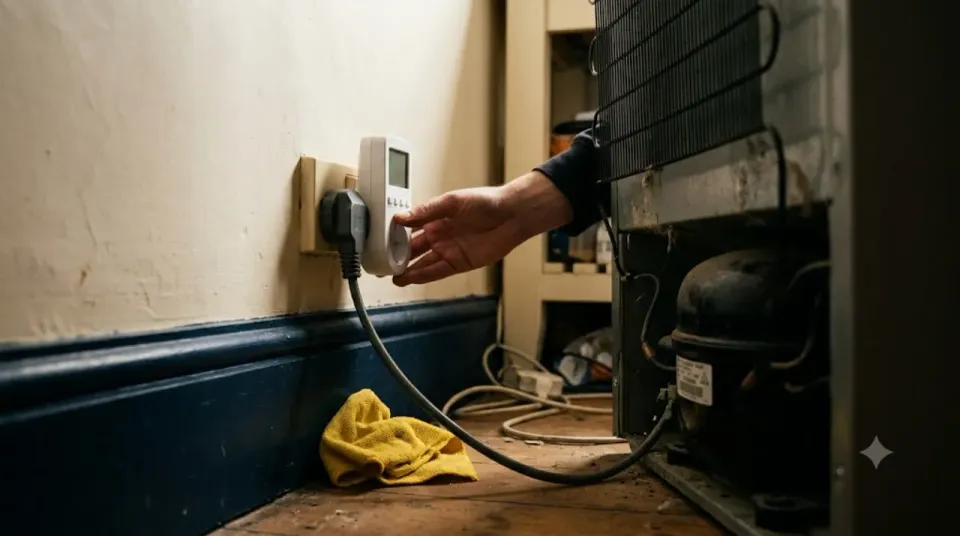
Check price on Amazon Ad - affiliate link. Prices change; check the listing.To measure, plug an energy meter between the socket and the appliance, leave it for at least 24 hours (a week is better for a fridge), and read the kWh figure. Divide by the number of days and multiply by 365. That is your real yearly use. Multiply by your price for the real cost.
Step 4: Find your base load, the watts that never sleep
Your base load is the power your home draws around the clock, even when nobody is doing anything: fridge, router, smart speakers, standby lights, a gaming PC that never fully switches off. It is measured in watts, because it is a steady speed.
Here is the useful trick: a steady 1 W, all year, is about 8.8 kWh. That is 1 W x 8,760 hours. At 37 ct, every watt of base load costs about 3.2 EUR a year.
So:
- A base load of 50 W = 438 kWh a year = about 162 EUR.
- A base load of 100 W = 876 kWh a year = about 324 EUR.
- A base load of 200 W = 1,752 kWh a year = about 648 EUR.
To find yours, look at your meter late at night when everything is "off". A modern digital meter often shows the current power directly. With an older meter, note the kWh reading before bed and again in the morning, then divide by the hours in between: 0.9 kWh over 9 hours = 0.1 kWh per hour = 100 W.
Why does this matter for solar? Because base load is exactly what a balcony kit is good at covering. It is there every sunny hour, no habit change needed. Our full guide is Your base load.
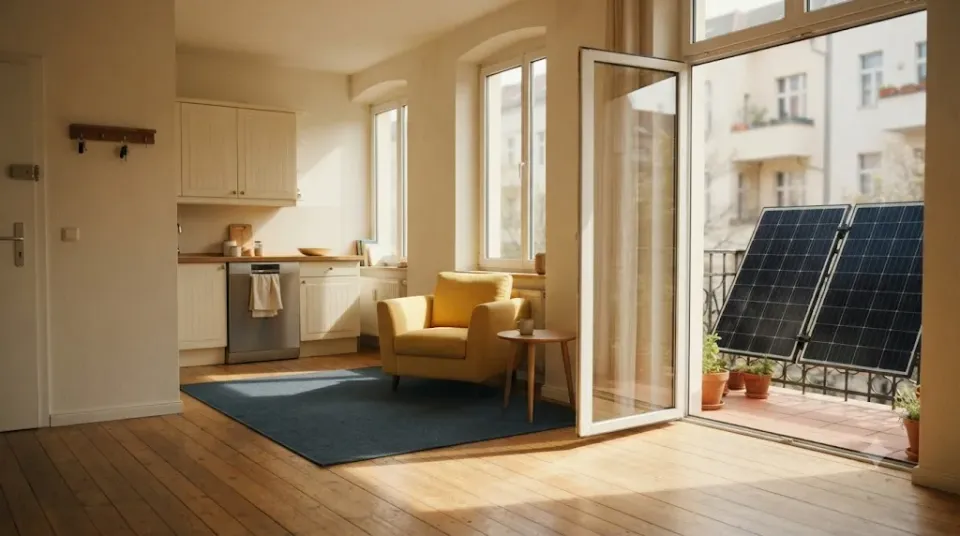
Step 5: Read a solar kit's numbers the right way
Solar adds one more label: Wp (watt-peak). It is a panel's output under standard test conditions - strong light of 1,000 W per square metre at a cell temperature of 25 degrees. Real sunlight on a German balcony rarely matches that, so treat Wp as a size rating, like the top speed in a car brochure.
A balcony kit carries two power numbers and one energy number. They are not the same thing:
| Label | Unit | Example | What it means |
|---|---|---|---|
| Panel rating | Wp | 2 x 430 Wp = 860 Wp | Size of the panels. In Germany up to 2,000 Wp is allowed |
| Inverter output | W (or VA) | 800 W | The most the kit can push into your sockets at any moment. 800 W is the German limit |
| Yearly yield | kWh per year | 400 to 900 kWh | What actually arrives over a year. The number that decides savings |
VA (volt-ampere) appears on some inverter datasheets and in the product norm DIN VDE V 0126-95, which has applied since December 2025. For a balcony inverter you can read 800 VA as 800 W.
Now apply the line. On a clear June day a south-facing 860 Wp kit might deliver roughly this:
- About 100 W average from 6:00 to 9:00 (3 hours) = 300 Wh
- About 500 W average from 9:00 to 12:00 (3 hours) = 1,500 Wh
- About 640 W average from 12:00 to 15:00 (3 hours) = 1,920 Wh
- About 300 W average from 15:00 to 18:00 (3 hours) = 900 Wh
- About 60 W average from 18:00 to 20:00 (2 hours) = 120 Wh
Total: about 4,740 Wh, or 4.7 kWh. That matches the typical 4 to 5 kWh for a clear June day. On a clear December day, the same kit often makes under 1 kWh. Over a whole year, a typical 860 Wp kit in Germany lands somewhere between about 400 and 900 kWh depending on direction and shade - see How much power does a kit really make?
Notice what "800 W" does not mean. It does not mean your kit makes 800 W all day, and it certainly does not mean 800 Wh per hour of daylight. It is a ceiling. Most hours sit well below it. Why bigger panels behind a fixed 800 W inverter can still make sense is in What the microinverter does.
To see this hour-by-hour shape for your own balcony, try Sunslot. It draws the watts for each hour and adds them up to watt-hours for the day and the year, so you can see the speed and the distance side by side.
Shelly Plug S Gen3
A metering smart plug that logs consumption of an appliance and works locally without a cloud account. It is an indoor plug, so it is not for an outdoor balcony socket, and it must never be combined with a socket strip.
Check price on Amazon Ad - affiliate link. Prices change; check the listing.Step 6: Read a power station or battery label
Power stations and batteries also carry two numbers. Mixing them up is the most common buying mistake.
- Capacity in Wh - how much energy it stores. The fuel tank. Example: 768 Wh or 1,024 Wh.
- Output in W - how much power it can deliver at once. The engine. Example: 800 W continuous, sometimes with a higher short "surge" figure for motors starting up.
To estimate run time, divide capacity by load, then take off 10 to 15% for conversion losses (the inverter inside turns battery DC into household AC, and that costs a little).
| Load | Power | 768 Wh unit (x 0.85 usable) | 1,024 Wh unit (x 0.85 usable) |
|---|---|---|---|
| Router | 10 W | about 65 hours | about 87 hours |
| Laptop | 50 W | about 13 hours | about 17 hours |
| Fridge (average) | 60 W | about 11 hours | about 14.5 hours |
| Kettle | 2,000 W | too much for an 800 W output | about 26 minutes, if output allows |
The maths for the fridge, larger unit: 1,024 Wh x 0.85 = 870 Wh usable. 870 / 60 W = 14.5 hours.
The kettle row shows why both numbers matter. The tank (Wh) might be big enough for a few cups, but if the engine (W) is rated below the kettle's 2,000 W, it will not run at all. Always check output in W against your biggest appliance, then check capacity in Wh against how long you need it. Our power station size guide walks through this for a whole list of appliances, and LiFePO4 vs NMC explains why battery chemistry affects how many years that tank lasts.
EcoFlow RIVER 2 Pro
A 768 Wh LiFePO4 power station that keeps a router, lights and a fridge going for hours when the grid is down - the job a balcony kit cannot do. Its 800 W output will not run a kettle or other heating appliances.
Check price on Amazon Ad - affiliate link. Prices change; check the listing.Step 7: Put it together and check your savings maths
Now you can check any savings claim yourself. Here is an example household: Lena in a one-bedroom flat in Leipzig with a south-west balcony kit.
- Yearly yield (kWh): her inverter app shows 640 kWh in the first full year.
- Base load (W): she measured 90 W at night.
- Self-consumption (the share of solar she uses at the moment it is made): her panels make more than 90 W for very roughly 1,700 hours a year. In each of those hours her base load uses 90 W of it, so 90 W x 1,700 h = about 150 kWh, with no effort at all. Add the dishwasher on a timer at 11:00 and home-office laptop days, and she reaches roughly 260 kWh. That is 260 / 640 = about 41%.
- Price: 36 ct per kWh on her bill.
- Saving: 260 kWh x 0.36 EUR = about 94 EUR a year.
The rest of her 640 kWh - about 380 kWh - went to the grid unpaid, which is normal for balcony systems in Germany. Our article Self-consumption explained shows how to raise that share, and Payback maths turns the saving into years.
If someone tells you a kit "saves 300 EUR a year", you now know the three questions to ask: how many kWh, what share used at home, and at what price per kWh? If they cannot answer all three, the claim is a guess.

Your units checklist
Keep this table handy. It covers every unit you will meet on balcony solar and power station labels.
| You see | It measures | Think of it as | Ask yourself |
|---|---|---|---|
| W | Power, right now | Speedometer | Can my socket, inverter or power station deliver this? |
| kW | 1,000 W | Speedometer, bigger scale | Same as above |
| Wh | Energy over time | Trip counter | How long will this last, or how much did it use? |
| kWh | 1,000 Wh | The unit on your bill | Multiply by my price for the cost |
| Wp | Panel size in lab light | Top speed in a brochure | What will it really make on my balcony? |
| VA | Apparent power | Read as W for balcony inverters | Is it 800 or less? |
| mAh | Charge, needs a voltage | Half a number | Where is the Wh figure? |
| kWh per year | Yearly yield | Distance driven in a year | What share will I use at home? |
Common mistakes, and how to avoid them
- Treating 800 W as 800 Wh per hour all day. A balcony kit sits well below its cap most of the time. A clear June day is about 4 to 5 kWh, not 800 W x 14 hours = 11 kWh.
- Judging appliances by watts alone. High-watt, short-use items (kettle, toaster) often cost less per year than low-watt, always-on items (router, old fridge).
- Buying a power station by capacity only. Big Wh with a small W output will not start your kettle or coffee machine. Check both.
- Forgetting conversion losses. Take 10 to 15% off a power station's Wh for real-world run time.
- Using the national average price for your savings. Use your own working price per kWh. Leave out the monthly base charge.
- Counting all solar kWh as savings. Only the share you use yourself saves money. Exported power is normally unpaid.
- Reading Wp as real output. 860 Wp of panels rarely gives 860 W. Warm panels, an angle and hazy light all cut it.
Once these click, the rest of plug-in solar gets easier. Want to see your own balcony's watts turn into kilowatt-hours across a day? Put it into Sunslot and find the hours when your panels make more than your base load - those are the hours to start the washing machine.
Shelly Pro 3EM
Measures your whole flat's consumption and export at the distribution board, so you see self-use instead of guessing. It must be installed in the fuse box by a qualified electrician.
Check price on Amazon Ad - affiliate link. Prices change; check the listing.Unit questions, answered
What is the difference between kW and kWh?
kW is power - how fast energy flows at one moment. kWh is energy - how much has flowed over time. Running 1 kW for one hour uses 1 kWh. Your bill charges for kWh.
How many kWh does a 2,000 W kettle use?
It depends on how long it runs. Boiling a full kettle for about 3 minutes uses 2,000 W x 0.05 h = 100 Wh, or 0.1 kWh. At 37 ct that is about 3.7 ct per boil.
Does an 800 W balcony kit make 800 W all the time?
No. 800 W is the most the inverter may feed in at once. Output rises in the morning, peaks around midday on sunny days and falls in the evening. Most hours sit well below the cap.
How long will a 1,000 Wh power station run my fridge?
Take off about 15% for losses: 1,000 x 0.85 = 850 Wh usable. A fridge averaging 60 W runs for about 850 / 60 = 14 hours. Measure your own fridge, because averages vary a lot.
Why does my power bank show mAh instead of Wh?
mAh is a charge figure that only means something with a voltage. Multiply mAh by the voltage and divide by 1,000 to get Wh. For anything bigger than a phone power bank, look for the Wh figure the maker prints.