Two neighbours buy the same 800 W balcony kit on the same day for the same price. One earns it back in under two years. The other needs more than seven. Same panels, same inverter, same street. The difference comes from three things the box does not tell you: which way the balcony faces, when the household uses power, and how much each kilowatt-hour costs on their bill. Payback is not a property of the kit. It is a property of your flat.
That is why this article does not give you one magic number. Instead, it follows three example households (hypothetical, but built on realistic 2026 German figures) from purchase to payback. You will see every assumption, every sum and the moves that changed the answer. Then you can swap in your own numbers in ten minutes.
The four numbers that decide everything
A balcony system pays for itself when the electricity you no longer buy adds up to what the kit cost. Four numbers decide how quickly that happens.
- Kit price. In 2026, a basic 800 W balcony kit without storage typically costs around 250 to 500 euros, depending on panel size, mount and brand. Some reports expect prices to edge up later in the year.
- Yield. How many kWh (kilowatt-hours - the unit on your power bill) the system makes per year. For 800 W in Germany, roughly 600 to 900 kWh facing south at a good tilt, less for east or west, and noticeably less for panels hanging vertically on a railing.
- Self-consumption share. The part of that yield you use yourself at the moment it is made. Typically somewhere around 30 to 60 percent. The rest goes to the grid unpaid, because balcony systems generally receive no feed-in compensation.
- Electricity price. What each kWh you avoid buying would have cost you. The BDEW put the average for new household contracts at about 37 ct/kWh in August 2026, and Destatis put existing contracts at just under 38 ct/kWh in the first half of 2026. Many people pay anywhere from about 30 to 42 ct/kWh.
The formula is simple:
Saving per year = yield x self-consumption share x electricity price. Payback in years = kit price / saving per year.
Everything else in this article is these two lines applied to real situations.
Meet the three example households
| Sabine | Kemal and Julia | The Hoffmanns | |
|---|---|---|---|
| City | Hamburg | Cologne | Munich suburbs |
| Household | Single, out 8:00 - 18:00 | Couple, one in home office | Family of four |
| Balcony | East, railing, vertical panels | South-west, tilted mount | South, tilted mount in the garden |
| Kit | 500 € incl. railing mount | 400 € | 300 € in a sale |
| Tariff | 37 ct/kWh | 37 ct/kWh | 37 ct/kWh |
We keep the tariff the same at first so you can see what direction and habits do on their own. Later we change it.
Sabine in Hamburg: the cautious case
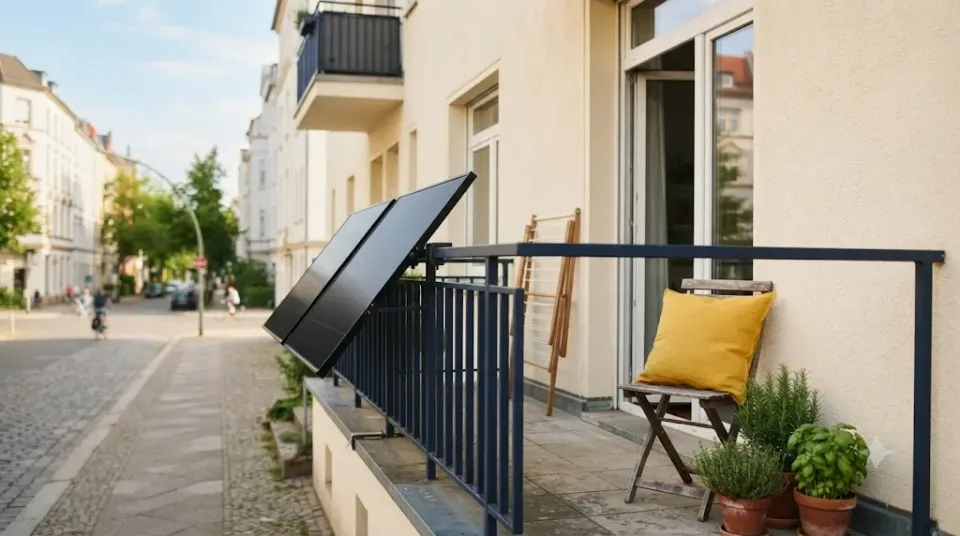
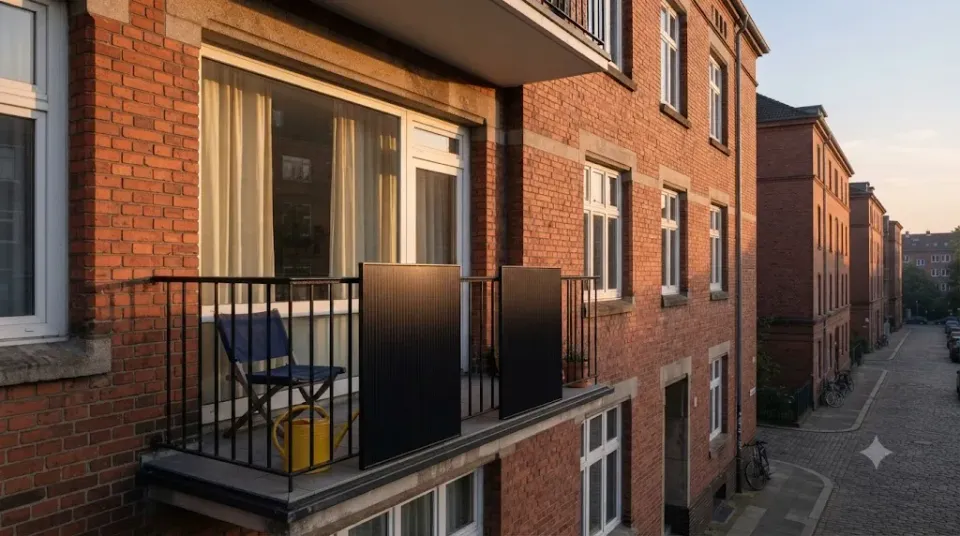
Sabine has an east-facing balcony on the second floor with a solid railing. Her panels hang vertically on the outside of the railing. That is the simplest and most common setup in rented flats, but it is not the best angle. East means her output peaks in the morning, and vertical panels catch much less in summer, when the sun is high.
- Yield: about 600 kWh a year. Hamburg gets a little less sun than southern Germany, and the vertical east mount costs a lot. Our article on east-west vs south explains why.
- Self-consumption: about 30 percent. She leaves at 8:00, just as her panels get going. Her fridge, router and standby devices, a base load of about 70 W, are the main users during the day.
- kWh used herself: 600 x 0.30 = 180 kWh.
- Saving: 180 x 0.37 = about 67 euros a year.
- Payback: 500 / 67 = about 7.5 years.
Seven and a half years sounds long, but panels typically carry long performance warranties and often run 20 years or more. Even in this cautious case, the kit pays back well within its life. After that, every year is a saving.
What Sabine changed
Sabine put her balcony into Sunslot and saw something useful: her output was at its best from 7:00 to 11:00, and she was home for the first hour of it. She moved two habits.
- She set her washing machine's delay timer to finish at 10:00 instead of running it in the evening. A 40 °C wash uses roughly 0.5 to 1 kWh, mostly for heating water.
- On Saturday mornings she runs the dishwasher at 9:00.
Those two changes raised her self-consumption from about 30 to about 38 percent. That is 600 x 0.08 = 48 kWh more, or about 18 euros a year. Her saving goes to about 85 euros, and payback drops from 7.5 to about 5.9 years. No new hardware.
Shelly Plus Plug S
Plugs in between inverter and socket to measure real production, so you can replace estimates with your own numbers. Check that it is rated for your inverter's output.
Check price on Amazon Ad - affiliate link. Prices change; check the listing.Kemal and Julia in Cologne: the middle case
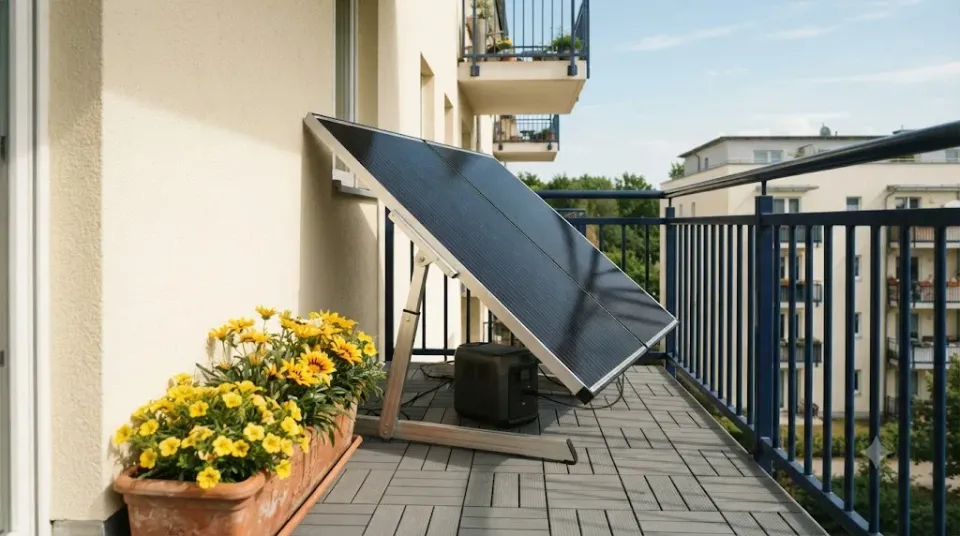
Kemal and Julia have a south-west balcony with a tilted mount on the floor, so the panels lean back at about 30 degrees. Julia works from home three days a week. Their base load is about 120 W, a bit higher than Sabine's, because of a second monitor and an older freezer.
- Yield: about 750 kWh a year. South-west at a good tilt is close to ideal for a balcony.
- Self-consumption: about 40 percent. Julia's home-office days use a lot of midday power; the two office days for both of them use little.
- kWh used themselves: 750 x 0.40 = 300 kWh.
- Saving: 300 x 0.37 = about 111 euros a year.
- Payback: 400 / 111 = about 3.6 years.
What Kemal and Julia changed
Their monitoring app showed that on office days, almost all of the afternoon peak went to the grid. They tried three things:
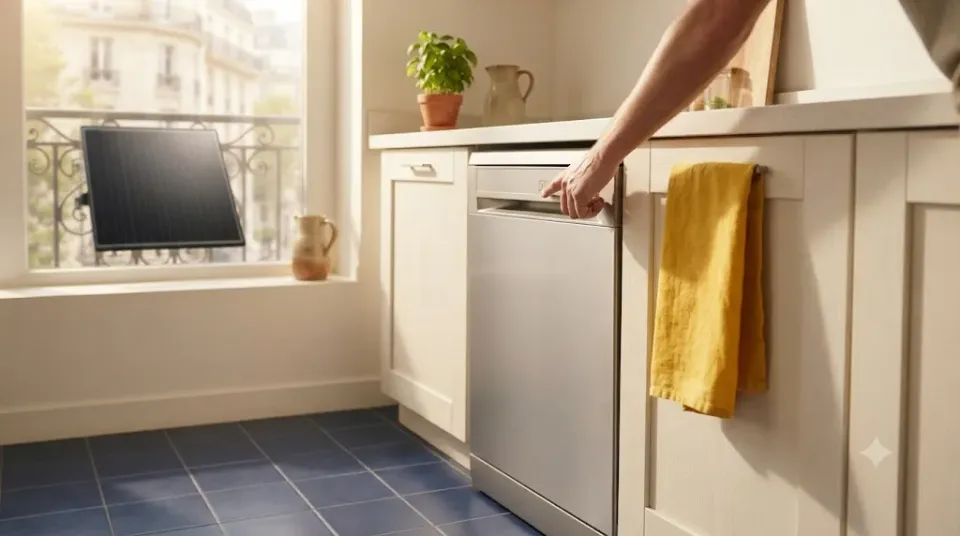
- The dishwasher now runs at 13:00 every day, using its delay timer.
- Laptops, e-bike batteries and the vacuum robot charge in the afternoon, not overnight.
- They replaced the old freezer in the cellar. That was a separate decision, but it cut their base load by about 30 W.
The first two raised self-consumption from 40 to about 50 percent: 75 kWh more, worth about 28 euros a year. Their saving climbs to about 139 euros and payback falls to about 2.9 years.
The freezer is interesting because it works the other way. A lower base load means less of the solar power is used automatically, so self-consumption drops slightly. But they save far more on the night-time electricity the freezer no longer uses: 30 W running all year is about 263 kWh, roughly 97 euros a year. Our article on your base load explains why cutting it is usually the best energy tip of all, solar or not.
The Hoffmanns near Munich: the good case
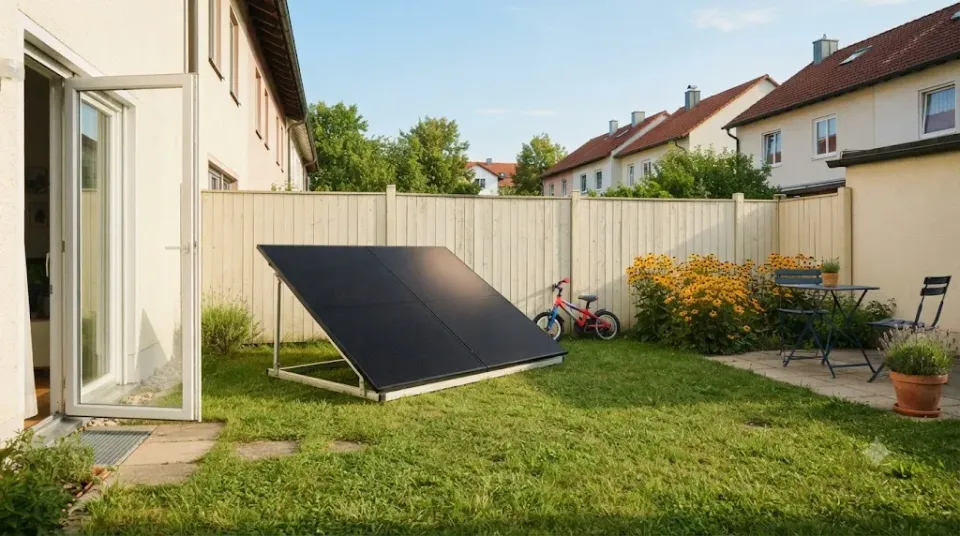
The Hoffmanns live in a terraced house with a small garden. They put the kit on a ground frame facing due south at about 30 degrees, with no shade. Munich gets more sun than Hamburg. With two children, the washing machine and dishwasher run almost every day, and the parents set them to run around midday.
- Yield: about 850 kWh a year.
- Self-consumption: about 50 percent. A family's daytime loads soak up a lot, though at peak summer midday they still export.
- kWh used themselves: 850 x 0.50 = 425 kWh.
- Saving: 425 x 0.37 = about 157 euros a year.
- Payback: 300 / 157 = about 1.9 years.
Their kit was cheap because they bought it in a sale and mounted it themselves on a simple frame. Ground mounts and flat roofs are covered in our article on flat roof, garden or wall.
The three households side by side
| Assumption | Sabine (cautious) | Kemal and Julia (middle) | Hoffmanns (good) |
|---|---|---|---|
| Kit price | 500 € | 400 € | 300 € |
| Annual yield | 600 kWh | 750 kWh | 850 kWh |
| Self-consumption share | 30 % | 40 % | 50 % |
| kWh used yourself | 180 kWh | 300 kWh | 425 kWh |
| Electricity price | 37 ct/kWh | 37 ct/kWh | 37 ct/kWh |
| Saving per year | about 67 € | about 111 € | about 157 € |
| Payback | about 7.5 years | about 3.6 years | about 1.9 years |
| After habit changes | about 5.9 years | about 2.9 years | already good |
Not included: the exported power (worth nothing to you), any installation help, a smart meter or new socket if you need one, and price rises. If electricity gets more expensive, payback gets shorter. If it gets cheaper, longer.
What if the electricity price changes?
Many people pay more or less than 37 ct/kWh. Here is the middle household, Kemal and Julia at 300 kWh used themselves, under different tariffs.
| Price per kWh | Saving per year | Payback on 400 € |
|---|---|---|
| 30 ct | about 90 € | about 4.4 years |
| 34 ct | about 102 € | about 3.9 years |
| 37 ct | about 111 € | about 3.6 years |
| 42 ct | about 126 € | about 3.2 years |
The price matters, but less than habits. Going from 30 to 42 ct moves payback by about 1.2 years. Sabine's two habit changes moved hers by 1.6 years.
Take the working price per kWh from your latest bill. Do not include the monthly base charge, because solar does not change it. If you switch to a cheaper tariff, redo the sum: a cheaper tariff saves you money overall but makes each solar kWh worth a little less.
Anker SOLIX RS40P
A complete 800 W balcony kit with two panels for tilted mounting, the kind of setup behind our middle and good cases. Pricier than budget kits, which lengthens payback unless you catch a sale.
Check price on Amazon Ad - affiliate link. Prices change; check the listing.Beyond payback: what the kit earns over its life
Payback tells you when you break even. It does not tell you how much you end up ahead. For that, look further out. Panels often run 20 years or more, but microinverters may need replacing earlier, and panels lose a little output each year. So let us use a deliberately careful view: 15 years, a yield that drops about 0.5 percent a year, and one inverter replacement at around 150 euros halfway through. Price stays at 37 ct to keep it simple.
| Over 15 years | Sabine (after changes) | Kemal and Julia (after changes) | Hoffmanns |
|---|---|---|---|
| Saving in year 1 | about 85 € | about 139 € | about 157 € |
| Total saving, with slow yield loss | about 1,230 € | about 2,010 € | about 2,270 € |
| Minus kit price | 500 € | 400 € | 300 € |
| Minus one inverter swap | 150 € | 150 € | 150 € |
| Net gain | about 580 € | about 1,460 € | about 1,820 € |
The total saving is the year-one figure times about 14.5, which allows for the yield falling half a percent a year. Even Sabine, with the worst balcony of the three, ends up several hundred euros ahead. And if electricity prices rise over those 15 years, all three numbers grow.
Notice how the gap between the households widens over time. In year one, the Hoffmanns save about 72 euros more than Sabine. Over 15 years, that small yearly gap grows to more than 1,200 euros. Good direction and good habits pay every single year, not just once.
The inverter swap is a cautious assumption, not a promise that yours will fail. Many microinverters come with warranties of ten years or more. But it is honest to plan for one replacement in a long horizon.
When payback can stretch
Three situations make the real payback longer than the sum suggests:
- Moving house early. The kit usually comes with you, but your next balcony may face north. Sabine's 5.9 years assumes she stays.
- A big drop in daytime use. If Julia stops working from home, their self-consumption could fall back toward 35 percent and payback toward four years.
- Shade that grows. A young tree across the courtyard can take a fifth of a balcony's yield within a few years. Check the view, not just the compass.
Where the yield and self-use numbers come from
The yield and the self-consumption share are the two numbers people guess worst. Direction, tilt and shade can change yield by a third or more, and your daily routine sets the share.
- Yield: Sunslot estimates hour-by-hour output for your balcony direction, tilt, shade and city. Add up the year and you have a realistic yield instead of a catalogue figure. Try changing only the tilt from vertical to 30 degrees and watch the summer months jump. Our article on shading explains why a tree or a wall moves the figure so much.
- Self-consumption: Sunslot also shows how much of that output you would use yourself versus export, based on when you use power. Your base load - the fridge, router and standby devices running all day - is the floor.
- After you buy: a smart plug with energy measurement on the inverter cable shows your real production. A modern digital meter shows what you fed into the grid on a separate register. Production minus feed-in is what you used yourself. See reading your output.
What does not change the maths much
A few things people worry about turn out to matter less than expected.
- Bigger panels behind the same inverter. Extra panel watts help in the morning, evening and winter, but the inverter caps output at 800 W. Useful, but the gain is smaller than the label suggests.
- Registration. Registering in the Marktstammdatenregister is free. See registration.
- A battery. It raises self-consumption, but it costs more than the panels. Run the maths separately - does a balcony system need a battery? does exactly that. In Kemal and Julia's case, a 600 euro battery premium would add about 76 euros a year and take about eight years to pay back on its own.
- Small efficiency differences between panels. A panel that is 1 percent more efficient makes a few more kWh a year. Direction and shade matter ten times more.

Common mistakes in payback sums
- Using the full yield as the saving. Only the share you use yourself counts. 750 kWh x 37 ct = 277 euros looks great on an advert, but if you use 40 percent, the real saving is 111 euros.
- Using the catalogue yield. Shop figures often assume south at an ideal tilt with no shade. A vertical railing panel facing east is a different world.
- Including the base charge. Your monthly fixed fee does not shrink with solar. Use the working price only.
- Forgetting extras. A railing mount, a longer cable or a new outdoor socket from an electrician can add 50 to 200 euros. Put them in the kit price.
- Checking once and never again. Tariffs and habits change. Redo the sum once a year with real meter readings.
Brennenstuhl Primera-Line PM 231 E
A plug-in energy meter for tracking down old fridges or always-on devices; cutting base load often saves more than the panels. It measures one device at a time.
Check price on Amazon Ad - affiliate link. Prices change; check the listing.Your own payback in ten minutes
Fill in this table with your numbers. Each row takes a minute.
| Step | Where to find it | Your number |
|---|---|---|
| 1. Kit price, including mount and extras | Order confirmation | ____ € |
| 2. Annual yield | Sunslot estimate, later your app | ____ kWh |
| 3. Self-consumption share | Sunslot estimate, later meter | ____ % |
| 4. kWh used yourself | Row 2 x row 3 | ____ kWh |
| 5. Working price per kWh | Latest electricity bill | ____ ct |
| 6. Saving per year | Row 4 x row 5 / 100 | ____ € |
| 7. Payback in years | Row 1 / row 6 | ____ years |
One last check: redo the sum once a year with your real meter readings and current tariff. Real data beats any estimate, including ours.
Plug in your own four numbers, be honest about your habits, and you have your payback. For most German flats with a reasonably sunny balcony, it is a matter of a few years, not decades. Before you order, our buying checklist covers the twelve things worth checking.
Payback questions
How long does a balcony solar system take to pay for itself in Germany?
Usually a few years. In our examples, from about 1.9 years for a south-facing family setup to about 7.5 years for a vertical east-facing railing kit, at 37 ct/kWh. Your direction, habits and tariff decide where you land.
Do I get paid for the power my balcony system sends to the grid?
Generally no. Balcony systems in Germany usually receive no feed-in compensation, so exported power is worth nothing to you. Only the share you use yourself saves money.
What is a realistic yearly yield for an 800 W balcony kit?
Roughly 600 to 900 kWh a year in Germany facing south at a good tilt, less facing east or west, and noticeably less for panels hanging vertically on a railing.
Does a higher electricity price make balcony solar pay back faster?
Yes. Each kWh you use yourself is worth your working price. In our middle example, payback is about 4.4 years at 30 ct and about 3.2 years at 42 ct.
Should I include the monthly base charge in the calculation?
No. Solar does not change your fixed monthly fee. Use only the working price per kWh from your bill.