

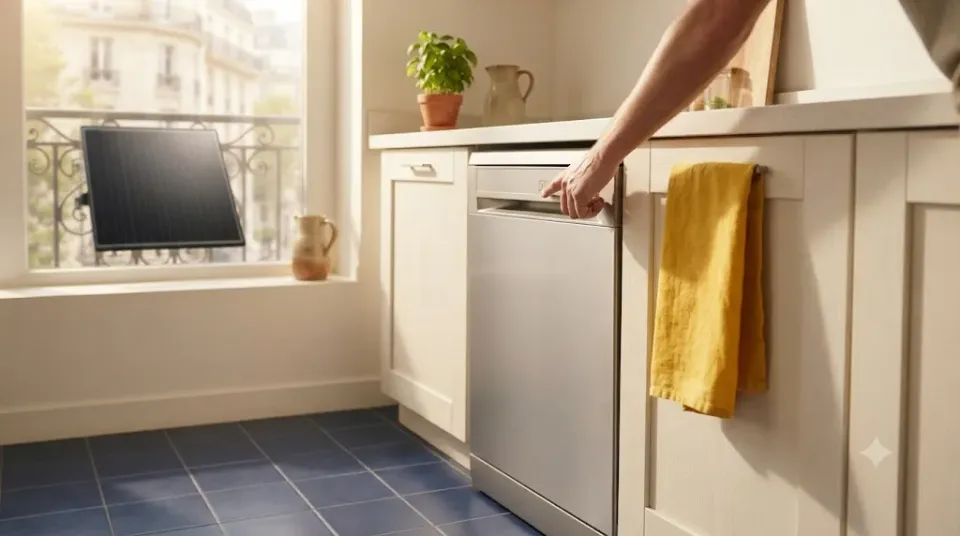
Short answer: for a south-facing kit in Germany, the hours from 09:00 to 16:00 bring in about 78 percent of the whole year's power. The rest of the day is a thin trickle. Which seven hours are yours depends on where your panels face, and that changes when your flat should be busy.
A south balcony kit in June makes some power for up to 16 hours, from early morning to late evening. That long day gives a false sense of how spread out the output is. Most of it arrives in a much shorter block.
The Sunslot model for a typical kit (two 430 Wp panels, south, 35 degree tilt, Berlin, about 844 kWh a year) shows that 78 percent of the year's output arrives between 09:00 and 16:00. Before 09:00 you get about 7 percent. After 18:00, about 3 percent.
The reason is geometry. Panel output rises steeply with how high the sun is and how squarely it hits the glass. In the morning and evening the sun is low, its light passes through more air and lands at a glancing angle. Around midday it is high and nearly square on. A clear hour at 12:30 can easily deliver four to six times as much as a clear hour at 08:00.
Turn the panels and the window slides with them:
- East: 08:00 to 15:00, about 77 percent of the year.
- West: 11:00 to 18:00, about 75 percent, with three times the evening share of a south kit.
- South, vertical on a railing: 09:00 to 16:00, about 82 percent, because the steep angle favours the low winter sun around midday.
Why does it matter? Because a balcony kit only saves money on power you use while it is being made. Power you do not use at that moment flows out to the grid and in practice earns you nothing. So the question is less "how much does my kit make?" and more "what is my flat doing during those seven hours?"
For most homes the honest answer on a weekday is: fridge, router, standby. That is about 100 to 200 W, while the panels make 300 to 600 W. The difference leaves the building. Move one or two machines into the window and you keep a lot more of it.
The good news is that this takes no new hardware. A delay-start button and a little habit are enough. The worked example further down shows the same Berlin flat keeping about 175 kWh more of its own power a year, roughly 65 euros, just by changing when the dishwasher and washing machine run.
Where do the year's kWh actually come from?
Here is the same south kit split by clock hour. Each row is the energy that slice of the day delivers across the whole year.
| Clock hour | kWh per year | Share |
|---|---|---|
| 06:00 to 09:00 | about 60 | about 7 % |
| 09:00 to 12:00 | about 260 | about 31 % |
| 12:00 to 14:00 | about 220 | about 26 % |
| 14:00 to 16:00 | about 180 | about 21 % |
| 16:00 to 18:00 | about 95 | about 11 % |
| after 18:00 | about 28 | about 3 % |
The single best hour is 12:00 to 13:00, closely followed by 13:00 to 14:00. From late March to late October summer time pushes the peak about an hour later on the clock, which is why it can look a little late compared with "noon".
A useful way to read the table: the two hours from 12:00 to 14:00 carry more than a quarter of the year on their own. The three hours from 06:00 to 09:00 carry less than a tenth. If you had to pick one slot for one big machine, early afternoon wins every time.
Our guide on how much power a balcony kit makes has the month-by-month picture to go with this.
Which window is mine if I face east or west?
Same kit, same city, different direction. Sunslot estimates:
| Facing | Year output | Best 7 hours | Share in window | Share after 18:00 |
|---|---|---|---|---|
| South | about 844 kWh | 09:00 to 16:00 | 78 % | 3 % |
| East | about 693 kWh | 08:00 to 15:00 | 77 % | 3 % |
| West | about 693 kWh | 11:00 to 18:00 | 75 % | 9 % |
| South, vertical on railing | about 589 kWh | 09:00 to 16:00 | 82 % | 3 % |
Two things jump out. East and west each make about 18 percent less than south over a year. But west moves three times as much energy into the evening, about 62 kWh after 18:00 against roughly 25 for south. If you are home after work and cook at 18:30, that can matter more than the raw total.
East has its own charm. Its window opens early, so breakfast, a home office morning or a washing machine started at 08:00 all line up nicely. By mid-afternoon it is mostly done.
A vertical railing mount loses a lot in summer, because the high June sun hits it at a steep angle. But it holds up comparatively well in winter, and its output is the most concentrated of all around midday. Our guide to south, east-west or flat has more on each.
Want your exact window? Sunslot draws your balcony's hour-by-hour curve for your city, tilt and shade, and marks the best hours to start appliances.
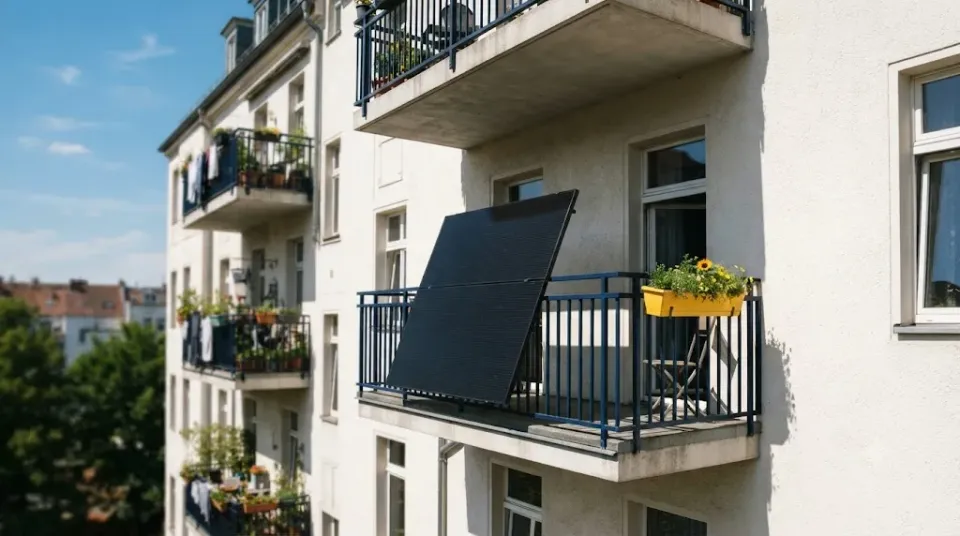
How do I use the window if I am out all day?
You do not need to stay home. You need your flat to be busy while the sun is out. Three tools do almost all of it, ranked by cost.
- Delay-start buttons (free). Most dishwashers and washing machines made in the last ten years have one. Load in the morning, set it to start in three or four hours, leave. Check the manual: some count down to the start, some to the end of the programme.
- A smart plug with a schedule (cheap). For things without a timer: a dehumidifier, a power station, a tool battery charger, an aquarium heater. The plug switches them on at 10:00 and off at 15:00. It also shows what they draw.
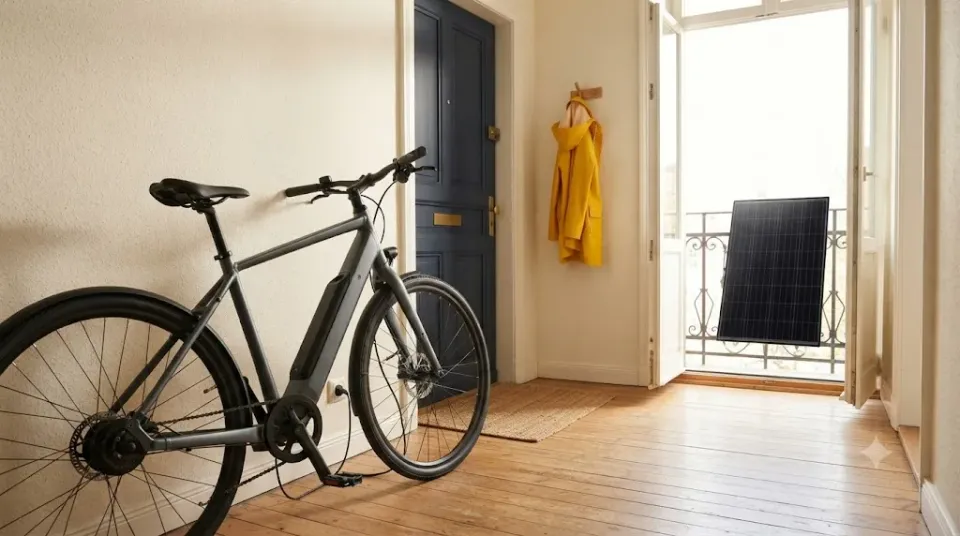
- Batch charging (free). E-bike, laptop, power banks, the cordless vacuum. On a sunny weekend plug them all in at lunchtime instead of spreading them over the evening.
Shelly Plug S Gen3
Switches a plugged-in device on and off on a schedule and shows its power use, good for chargers, dehumidifiers and power stations. Not for devices that need a button press to start after power returns.
Check price on Amazon Ad - affiliate link. Prices change; check the listing.What does not work well: devices that need a button press after power returns. Many washing machines and coffee machines stay off when a smart plug switches them on. Use their own delay timer instead. A heat-pump dryer is fine on a timer if you load it in the morning, though leaving damp laundry in the drum for hours is not ideal in summer.
You are out from 08:00 to 18:00. When should the daily dishwasher run?
For a south kit the hours around midday carry most of the year's output, so a delay-start for about 11:00 lands the whole eco cycle in the sunny window. At 07:30 and 19:30 the panels give very little. Weekend-only runs leave five days a week mostly unused.
How much is the habit worth in euros?
An example household in Berlin with the south kit, base load 150 W, out on weekdays, home mornings and evenings. They run the dishwasher daily (about 1 kWh a cycle) and the washing machine three times a week.
| Habit | Used at home per year | Share of 844 kWh |
|---|---|---|
| Machines run in the evening | about 426 kWh | about 50 % |
| Machines moved into the sunny window | about 601 kWh | about 71 % |
| Difference | about 175 kWh | +21 points |
At about 37 ct/kWh, the BDEW's 2026 average for households, 175 kWh is roughly 65 euros a year. Same panels, nothing bought. On a kit that cost 400 euros, that moves payback from about 2.6 years to about 1.8 years.
Here is where the gain comes from, roughly:
- The dishwasher at 11:00 instead of 20:00: about 110 kWh a year, because it runs every day.
- The washing machine at 10:30 instead of 19:00: about 65 kWh, three times a week.
The daily machine wins because frequency beats size. A small saving repeated 365 times adds up faster than a big one twice a month. The full sum with kit prices is in payback maths.
Does the window still work on cloudy days?
Yes. On a grey day the window does not move, it flattens. Midday output might be 100 to 250 W instead of 400 to 600 W. A dishwasher started at noon still picks up more solar than one started at 19:00, because at 19:00 there is next to nothing.
A quick comparison for the south kit on an overcast June day making about 1.5 kWh in total:
- Dishwasher eco at 12:00: roughly 0.2 kWh of its 0.9 kWh comes from the panels.
- Same programme at 19:00: almost none.
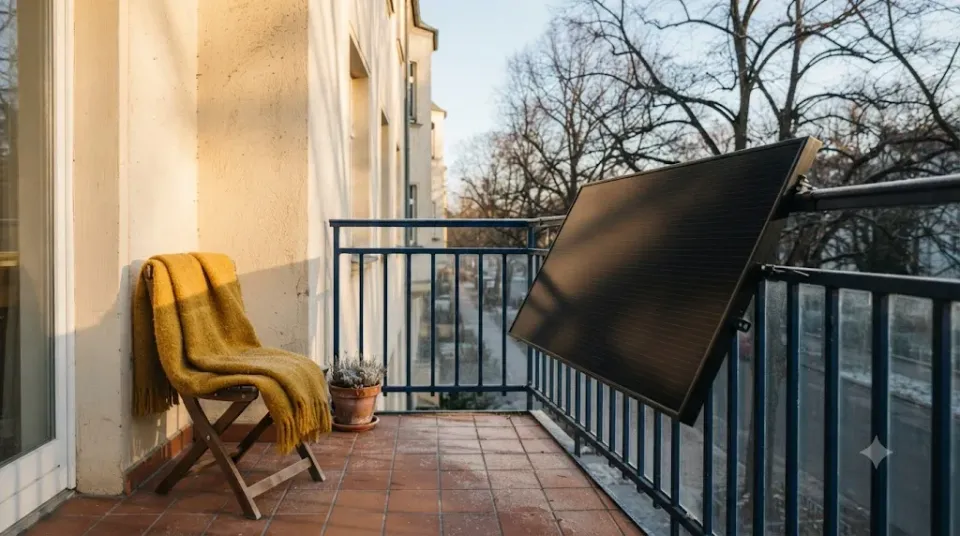
Small on any one day, but it is the same button press, so there is no reason not to. The rule stays simple: if a machine can wait until the middle of the day, let it, whatever the weather.
Light cloud can even produce short spikes above the clear-sky value. When the sun breaks through at the edge of a bright cloud, the panel briefly gets direct light plus reflected light from the cloud. Do not be surprised by a 700 W reading on a patchy day. Our guide to reading your output shows what is normal in the app.
Brennenstuhl Primera-Line PM 231 E
A plug-in energy meter with a display that shows watts and kWh, no app or Wi-Fi needed. It measures but cannot switch on a schedule.
Check price on Amazon Ad - affiliate link. Prices change; check the listing.Does the window change through the year?
It shrinks in winter but stays centred in the same place. For the south kit:
| Month | Useful output | Typical midday power on a clear day |
|---|---|---|
| June | about 08:00 to 18:00 | 500 to 640 W |
| March and September | about 09:00 to 16:00 | 450 to 600 W |
| December | about 10:00 to 14:30 | 200 to 450 W on clear days, far less on grey ones |
March and September surprise people. Cool panels and clear air mean midday power is nearly as high as in summer. The days are simply shorter. December gives roughly a seventh of June's monthly energy, mostly because so many days are grey.
The centre of the window stays near 12:00 to 13:00 all year, give or take the summer-time shift. So one habit works in every season: big machines at about midday. You do not need a summer schedule and a winter schedule. More detail is in winter, snow and heatwaves.
Is it worth chasing the early and late hours?
Mostly no. It is tempting to obsess over sunrise and sunset, especially in June when the panels technically work from 05:30. But for a south kit the hours before 09:00 bring about 7 percent of the year and the hours after 18:00 about 3 percent.
There are two exceptions worth knowing:
- West-facing panels. For a west kit the hours from 16:00 to 19:00 are prime time. Cooking, a dryer or charging after work lines up well.
- Your base load. The fridge and router run anyway. A little evening output covers them without any effort, which is why those 3 percent are not wasted.
One more point for people tempted to buy a battery to "rescue" the evening. For a south kit there is not much left over in the evening to rescue, and the surplus that a battery would store comes from the middle of the day. Using that midday surplus directly, with a timer, is free. A battery only makes sense once you have already moved what you can. The battery decision guide walks through that choice.
The real gains are in the middle of the day. Spend your effort there.
FRITZ! Smart Energy 200
A switchable smart plug with energy metering that pairs with a FRITZ!Box over DECT, so schedules and readings sit in the router you already have. Little point if your router is a different brand.
Check price on Amazon Ad - affiliate link. Prices change; check the listing.What people get wrong
- Starting everything at once. Dishwasher, washing machine and oven together at 12:00 can draw 5,000 W. Your panels cover 400 to 600 W of that. Stagger them.
- Starting eco programmes late. They often run three hours or more. Start at 15:00 and the tail ends after the sun has gone. Start at 10:00 to 11:00.
- Forgetting the base load. The fridge and router already take 100 to 200 W of midday output. What is left for a machine is the rest.
- Only timing at weekends. Five of seven days then go mostly to the grid. The delay-start works on Tuesdays too.
- Assuming east or west is a bad buy. They make less in total, but their window may suit your routine better.
Your next step
- Find your seven hours. Put your balcony into Sunslot, then move the dishwasher slot from 19:00 to 12:00 and watch the self-use share jump.
- Set one delay-start tomorrow. Load after breakfast, start around 11:00.
- Read the two guides behind this. Self-consumption and south vs east-west vs flat.
