

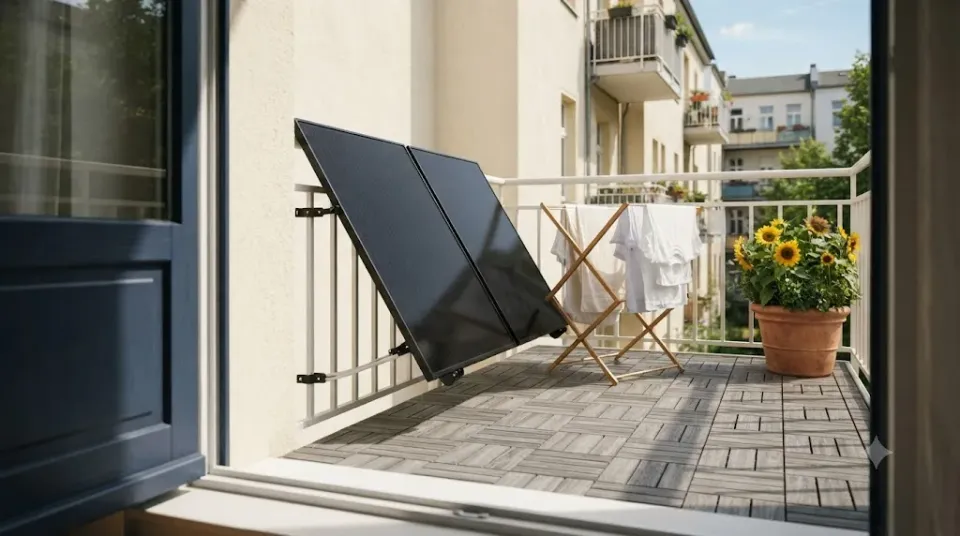
Short version: on a sunny June day an 800 W kit runs your fridge, router, laptops and e-bike charger entirely on sunshine, plus a good part of a washing cycle. It does not run a kettle. The longer version has an hour-by-hour table, a worked Saturday and a few numbers that change how you use the kit.
The 800 W on the box is the legal ceiling for the microinverter (the small box that turns panel power into socket power). Think of it like the top speed printed on a speedometer. Your panels rarely push against it.
Take a typical kit: two 430 Wp panels, facing south, tilted about 35 degrees, in Berlin. On the clearest June afternoon it peaks at about 640 W at the socket. On an average June day, with some cloud passing through, the peak is about 420 W. Over the whole day that adds up to about 5.5 kWh on a clear day and about 3.7 kWh on an average one.
So the useful way to think about it: plan for roughly 400 W for four to five hours around lunchtime, and enjoy it when you get more.
What does 400 W run? Anything that draws less than that, completely. Your fridge, freezer, router and standby load (together often 100 to 200 W) are covered in every sunny hour without you lifting a finger. Add a laptop at 60 W, an e-bike charger at 150 W or a dehumidifier at 200 W, and they still fit. A washing machine at 40 °C heats for about 15 minutes at around 2,000 W, then turns and spins for an hour or more at 200 to 500 W. The panels cover a slice of the heating and most of the long tail.
Big, short loads are a different story. A 2,200 W kettle at 13:00 on a clear day gets 640 W from your panels and 1,560 W from the grid. That is about 29 percent solar at the very best, and close to zero at breakfast and dinner, when most people actually make tea.
Nothing breaks when an appliance asks for more than your panels make. The grid fills the gap automatically and you pay only for the part the grid supplied. So the skill with a balcony kit is matching. Long, moderate loads go in the sunny hours. The kettle can do what it likes.
If you remember one number, make it 400 W. That is your realistic midday budget on a normal June day, minus whatever the fridge and router are already taking.
Why does my app never show 800 W?
Because it is not supposed to. Almost everyone checks the app on the first sunny day, sees 580 W and wonders if something is broken. It is fine.
Panels are rated in Wp (watt-peak), which is what they make under standard lab light: strong sun, square on, and a cell temperature of 25 °C. A real balcony in June gives you none of those three for long.
- Heat. On a June afternoon a dark panel easily runs at 50 to 60 °C. Output drops by roughly 0.35 to 0.4 percent for every degree above 25 °C. At 55 °C that alone costs around 11 percent.
- Angle. The sun is only square to a fixed panel for a short moment, if ever. A steep railing mount sees the high June sun at a glancing angle.
- Small losses. Cable, dust, pollen and the inverter's own conversion each take a few percent.
Stack those and 860 Wp of panels turns into about 640 W at the socket on the best afternoons. Funnily enough, your highest single readings often come in spring, on cool, clear April days, when the panels are cold and the air is clean. June wins on total energy because the days are long. The peaks themselves are no higher.
Our guide on the microinverter explains what the 800 W limit really controls and why it exists.
What does the day look like hour by hour?
Here is what the Sunslot model estimates for the same Berlin kit. Each figure is the average output over that clock hour, in summer time.
| Clock hour | Clear June day | Average June day |
|---|---|---|
| 07:00 to 08:00 | about 145 W | about 110 W |
| 09:00 to 10:00 | about 410 W | about 275 W |
| 11:00 to 12:00 | about 590 W | about 390 W |
| 13:00 to 14:00 | about 635 W | about 420 W |
| 15:00 to 16:00 | about 540 W | about 360 W |
| 17:00 to 18:00 | about 325 W | about 220 W |
| 19:00 to 20:00 | about 75 W | about 60 W |
| Whole day | about 5.5 kWh | about 3.7 kWh |
Three things stand out once you look at it for a moment.
- The peak sits near 13:00, not 12:00. Summer time shifts solar noon by about an hour on the clock. In the far west of Germany it lands even later.
- The shoulders are long and thin. At 07:00 and 19:00 the kit is technically working, but 75 to 145 W does not carry much beyond the fridge and router.
- A grey day is a flatter copy of a sunny one. The shape stays the same and the height drops. That is why timing still pays on cloudy days.
East and west panels shift the whole curve. An east kit peaks around 10:00 to 11:00 and is mostly done by 15:00. A west kit wakes up late and carries on into early evening. Put your own balcony into Sunslot and you get the curve for your city, tilt and shade, with the best start hour for the washing machine marked on it.

Which appliances run fully on solar?
The rule is simple. If an appliance draws less than your panels make at that moment, minus what the fridge and router already use, it runs entirely on your sun. Here is the ranking from "all solar" to "partly solar" on an average June day around midday, with about 270 W spare after a 150 W base load.
| Appliance | Typical draw | Solar share at midday |
|---|---|---|
| Fridge, router, standby | 50 to 300 W | 100 % |
| Laptop and monitor | 50 to 120 W | 100 % |
| E-bike charger | 100 to 250 W | close to 100 % |
| Dehumidifier | about 200 W | close to 100 % |
| Power station charging at a set rate | 200 to 300 W | close to 100 % |
| Heat-pump dryer | 500 to 1,000 W | about a third to a half |
| Washing machine at 30 to 40 °C | 2,000 W heating, then 200 to 500 W | about a third to a half |
| Dishwasher eco programme | 2,000 W heating, then under 100 W | about a quarter to a third |
The washing machine and dishwasher sit lower than people expect. Most of their energy goes into heating water in a short burst. What makes them worth timing is the long tail, and the fact that they run several times a week, so even a third adds up over a year. On a clear day with 640 W at the socket, their shares climb noticeably.
Shelly Plug S Gen3
A smart plug that shows what an appliance draws right now, so you can check whether it fits under your midday solar. Needs Wi-Fi, and is rated for normal household loads only.
Check price on Amazon Ad - affiliate link. Prices change; check the listing.A detail many people miss: eco programmes heat less and run longer. That suits solar very well. A three-hour eco wash started at 10:30 lands its whole tail in the best hours. Start the same programme at 16:00 and the end runs into the evening dip.
If you are not sure what your machine draws, put a plug-in meter between it and the socket for one cycle. Most people find the heating phase is shorter than they thought and the tail is longer. Our guide to running appliances in the sun has the full list with timings.
Sunny Saturday, 11:00. You can run one thing on your panels right now. Which would you pick?
The eco wash heats briefly, then runs for two hours or more at 200 to 500 W, which fits neatly under a June midday output. The kettle and oven draw several times what the panels make, so they get only a slice. Leaving it means most of the surplus goes to the grid unpaid.
What about the kettle, oven and hair dryer?
These are the appliances everyone thinks of first, and the ones solar helps least. They are short and huge.
| Appliance | Draw | Share solar covers at 640 W |
|---|---|---|
| Kettle | 2,000 to 3,000 W | about a fifth to a third |
| Hair dryer | 1,500 to 2,200 W | about a third |
| Oven while heating up | 2,000 to 3,500 W | about a fifth to a third |
| Induction zone on boost | up to 3,500 W | under a fifth |
Here is the kettle worked out properly. A 2,200 W kettle boils a litre in about three minutes and uses about 0.1 kWh. At 13:00 on a clear day your panels contribute 640 W of the 2,200 W, so about 0.03 kWh of that boil is solar. Even if you boiled three litres at peak sun every day of the year, your panels would cover perhaps 30 kWh of the kettle's annual use. At about 37 ct/kWh that is roughly 11 euros a year, and that is the best case.
The oven is a little kinder. It heats at full power for 10 to 15 minutes, then switches on and off to hold the temperature. During that holding phase it averages maybe 800 to 1,200 W, so a Sunday roast at lunchtime does pick up a fair slice. Baking at 13:00 instead of 19:00 is a nice bonus if it suits you. It is not worth rearranging dinner for.
The quiet, always-on loads matter more than the loud ones. Your base load explains why the fridge quietly wins.
How do I plan a sunny Saturday around it?
Here is an example household: two people in a Berlin flat, base load about 150 W, the south kit above, an average June Saturday making about 3.7 kWh.
| Time | What runs | Covered by solar |
|---|---|---|
| 08:00 to 18:00 | Fridge, router, standby at 150 W | about 1.4 kWh |
| 10:30 | Washing machine, 40 °C eco, about 2.5 hours | about 0.4 kWh |
| 10:00 to 16:00 | Laptop at 60 W | about 0.35 kWh |
| 13:00 to 16:00 | E-bike charger at 150 W | about 0.4 kWh |
| 14:00 | Dishwasher eco | about 0.25 kWh |
Add it up and roughly 2.8 of the 3.7 kWh stay in the flat, about three quarters. Without the timed loads, only the base load and the laptop would use the sun, about 1.75 kWh, and the rest would flow to the grid unpaid. Same panels, about 1 kWh more used at home on one Saturday.
Two habits do most of that work:
- Stagger the big machines. Washing machine at 10:30, dishwasher at 14:00. Started together at noon they would draw 4,000 W at once, and the panels would cover a small slice of each.
- Use the delay-start button. You do not have to be home. Load the dishwasher after breakfast, set it to start in four hours and go out.

The same thinking works on weekdays if someone is home or the machines have timers. If nobody is home and nothing has a timer, your fridge and router still use the sun and the rest goes to the grid. The self-consumption guide follows three households with very different routines.
Brennenstuhl Primera-Line PM 231 E
A simple plug-in meter with a display that shows watts and kWh, ideal for timing a washing machine's heating phase and tail. No app, so no history graphs.
Check price on Amazon Ad - affiliate link. Prices change; check the listing.What is a June day worth in euros?
Every kWh you use yourself saves what you would have paid for it. The BDEW (the German energy industry association) puts the average household price at about 37 ct/kWh in 2026. Power a balcony kit sends to the grid earns nothing in practice, so only what you use counts.
| Scenario | Used at home | Worth at 37 ct |
|---|---|---|
| Clear day, good timing | about 4 kWh | about 1.48 euros |
| Average day, good timing | about 2.8 kWh | about 1.04 euros |
| Average day, nothing timed | about 1.75 kWh | about 0.65 euros |
| Whole June, mixed weather, good timing | about 60 to 85 kWh | about 22 to 31 euros |
June is the best month of the year. December gives roughly a seventh of June's output, so do not multiply a June day by 365. Over a full year, a south kit like this makes around 840 kWh in Berlin, and a household using half to two thirds of it saves roughly 155 to 210 euros. Our payback maths guide does the full sum with kit prices.
For your own figure, run Sunslot with your balcony direction and your habits. It shows savings and payback, not only kWh.
Would a power station help me use more of it?
Sometimes, and less than the adverts suggest. The idea: plug a portable power station into a wall socket during the sunny hours, let it charge from the surplus, then run a few small things from it in the evening.
The maths for a 1 kWh unit on a sunny day:
- You charge it at about 300 W for three to four hours and soak up around 1 kWh that would otherwise go to the grid.
- Charging and discharging lose about 10 to 20 percent, so you get back roughly 0.8 to 0.9 kWh in the evening.
- At 37 ct/kWh that is about 30 cents a day, on days with a real surplus.
Over a year with perhaps 150 to 200 good surplus days, that comes to roughly 45 to 65 euros. A good 1 kWh LiFePO4 unit (lithium iron phosphate, the long-lived battery type) costs several hundred euros, so as a pure savings tool it pays back slowly. The real case for one is a second job: backup in a power cut, camping, the allotment. If you would buy one for those reasons anyway, charging it from midday sun is a pleasant bonus.
Anker SOLIX C1000 Gen 2
A 1,024 Wh LiFePO4 power station that can charge from the wall during sunny hours and run small loads in the evening or in a power cut. Heavy at around 11 kg, and conversion losses mean you get back less than you put in.
Check price on Amazon Ad - affiliate link. Prices change; check the listing.Two practical points if you try it. Set a fixed, low charge rate in the app, around 200 to 300 W, so the station takes mostly your surplus and does not pull hard from the grid. And remember the station simply charges from the wall like any other appliance. Nothing is fed back, so there are no extra rules to worry about.
A smaller unit of around 300 Wh is enough to run a router, lamps and phone chargers through an evening and costs a lot less. It also fills completely within a couple of sunny hours, so you rarely waste a day's surplus.
EcoFlow RIVER 3 Plus
A compact LiFePO4 power station of around 286 Wh that fills in a couple of sunny hours and runs a router, lamps and chargers through an evening. Too small for a fridge overnight or anything with a heating element.
Check price on Amazon Ad - affiliate link. Prices change; check the listing.Our battery decision guide covers proper plug-in storage, which works differently from a portable power station.
What people get wrong
- Expecting 800 W. It is a ceiling. 400 to 640 W is a healthy June peak.
- Timing the kettle. It saves a cent or two. Time the washing machine instead.
- Starting everything at noon. Big loads together swamp the panels. Stagger them.
- Calling every dip a fault. A passing cloud does that. A dip at the same time every sunny day is a shadow worth checking.
- Judging the kit by June. June is the best month. Judge it over a year.
Your next step
- See your own curve. Open Sunslot, enter your balcony and find the hour your peak really lands.
- Measure one machine. Put a plug-in meter on the washing machine for one cycle and see how long the tail is.
- Read the two guides that matter most. Which appliances to run in the sun and how much power a balcony kit makes.
