


Short version: yes, it is still worth it, and the fix is smaller than you think. Longer version: on a sunny summer workday more than half your power leaves the flat while you are out, and a couple of timers can win a good part of it back.
Picture a June weekday. You leave at 08:00, the sun gets onto the balcony at 09:00, and your kit gets to work. By the time you are home at 18:00 it has made about 3.7 kWh on an average day. In the Sunslot model, a flat with nobody in and a 120 W base load (fridge, router, standby devices that run around the clock) keeps only about 1.5 kWh of that. The other 2.2 kWh, roughly 60 percent, flows out through your meter.
Electricity takes the shortest path. Your inverter pushes power into your home wiring, and it goes to whatever is switched on at that moment. First your base load. Then anything else running, which in an empty flat is nothing. Then out to the grid, where your neighbours use it. In Germany balcony systems generally get no payment for that surplus. It is not lost to the world, but it does not save you a cent.
Over a year, though, the picture is better than that June day suggests. The model's out-all-day flat uses about 367 of 844 kWh at home - 43 percent. That still saves about 136 euros a year at 37 ct/kWh, so a 400-euro kit pays back in about 3 years. Weekends, cloudy days and winter all help, because on those days your base load uses most of what little the panels make.
The gap to someone working from home is real. A home-office flat with a PC running all day uses about 527 kWh of the same kit, roughly 160 kWh or about 59 euros a year more. Most of that gap can be closed without being home.
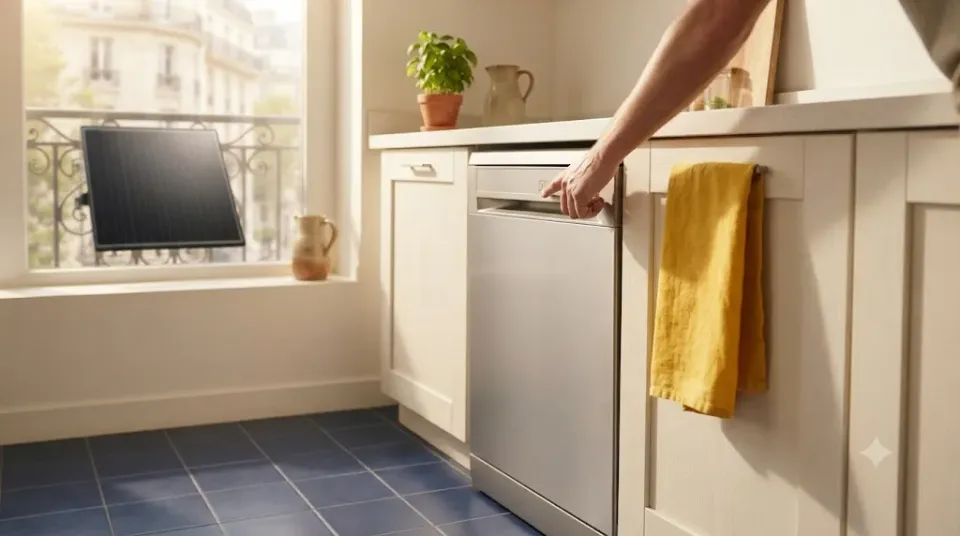
The biggest single lever is boring: delay-start on the dishwasher so it runs around midday. In the model, a daily midday dishwasher run lifted the out-all-day flat from about 367 to 512 kWh a year. That is about 145 kWh, roughly 54 euros, from one button you already own. Chargers on a timer, a washing machine on Saturday morning and, if you want, a battery do the rest. The questions below go through each, with the numbers.
Where exactly does the power go while I am out?
Here is the June workday from the model: Berlin, 2 x 430 Wp south kit, average day.
| Household | Made | Used at home | Sent to grid |
|---|---|---|---|
| Out all day, 120 W base load | about 3.7 kWh | about 1.5 kWh (41 %) | about 2.2 kWh |
| Working from home, +120 W PC 09:00 to 17:00 | about 3.7 kWh | about 2.2 kWh (58 %) | about 1.5 kWh |
The base load gets covered first, every hour the panels make at least 120 W. On a June day that is most hours from mid-morning to late afternoon. Anything above that goes out.
Will my meter run backwards? It should not. Modern meters have a backstop (a lock that stops them counting in reverse), and the surplus is simply not counted. If you still have an old spinning meter, the grid operator must swap it, usually within weeks to a few months of your registration.
Which machines can I safely let run while I am out?
Dishwashers and washing machines are the obvious ones, because they use a lot of energy in a short burst and most have delay-start. Here is how I would rank them for an empty flat:
| Appliance | Energy per run | Run while out? |
|---|---|---|
| Dishwasher, eco programme | about 0.7 to 1 kWh | Yes, the classic. Delay-start to finish by 15:00. |
| Washing machine, 40 degrees | about 0.5 to 1 kWh | Many people do. Check your tenancy rules and use an aqua-stop hose. |
| Tumble dryer | about 1.5 to 4 kWh | Better on a weekend at midday when you are home. |
| E-bike battery | about 0.4 to 0.7 kWh | Yes, on a timer plug, if the charger is in good condition. |
| Robot vacuum | small | Yes, schedule it for midday. |
A word of caution. Some people prefer not to run any machine with nobody home, and that is a reasonable choice. Water leaks and old chargers are the real risks. If that is you, the same tricks still work on home-office days and weekends. Part of the gain still counts.
The dishwasher deserves its spot at the top: it runs daily in many homes, its heating phase lines up well with midday sun, and delay-start is a button you already have. Our 7-step guide to running appliances in the sun has the full timing for each machine.
An example household shows how little it takes. Mira lives alone in Cologne, leaves at 07:45 and is back at 18:15, with a base load of about 100 W. Her three changes:
- Dishwasher on delay-start every other day, finishing by 15:00.
- E-bike on a smart plug, 11:00 to 15:00, twice a week.
- Washing machine on Saturday at 11:00 instead of Sunday evening.
None of it changes her routine. Together they move very roughly 150 kWh a year into her solar hours, about 55 euros at 37 ct/kWh. Her kit's payback drops by most of a year, and she did not buy anything.
Shelly Plug S Gen3
Switch chargers and small devices on during sunny hours while you are out, and measure what your kit makes. Needs Wi-Fi; not for very large loads.
Check price on Amazon Ad - affiliate link. Prices change; check the listing.Do smart plugs actually help?
Yes, for anything that charges. Plug the e-bike, the vacuum, power banks and the laptop dock into a smart plug that switches on at 11:00 and off at 15:00. They charge on your sun, not on evening grid power.
A worked example: an e-bike battery of about 0.5 kWh, charged twice a week, is about 52 kWh a year. Moving it from evening to midday saves very roughly 15 to 19 euros a year once you allow for cloudy days. Small, but the plug costs less than that and you set it once.
What about bigger loads? Most smart plugs are rated around 2,500 to 3,600 W, but for a heater, kettle or dryer use the machine's own timer instead. A plug switching a large load on and off every day wears out faster, and some appliances do not restart properly after a power interruption.
The second use is measurement. A smart plug between the kit and the socket shows you what the panels really make and when. After a week you know your real curve, not the listing's.
You are out 08:00 to 18:00 and about 60 percent of your summer solar leaves unpaid. What do you do first?
In the model, a midday dishwasher run kept about 145 kWh a year, roughly as much as a 1 kWh battery, for nothing. Do the free things first and see what surplus is left before buying storage. Leaving devices on just raises your bill at night too.
Is a battery worth it for someone out all day?
It is the most hands-off option and the most expensive. A balcony battery sits between the panels and the inverter, stores the midday surplus and releases it in the evening when you are home.
The model shows something interesting: the battery helps commuters more than home workers, because commuters have more surplus to store.
| Household, with 1 kWh battery | Self-use before | Self-use after | Gain |
|---|---|---|---|
| Out all day | about 367 kWh | about 504 kWh | +137 kWh, about 51 euros |
| Working from home | about 527 kWh | about 637 kWh | +110 kWh, about 41 euros |
Now compare: the delay-start dishwasher gained about 145 kWh for nothing. A battery gained about 137 kWh for several hundred euros. So do the free things first, then see what surplus is left. If you still send a lot out in summer, a battery starts to make sense, especially if you also want it for other reasons.
Prices and models move fast here. Zendure's SolarFlow 800 Pro has already been followed by a Pro 2, for example, so compare current versions. Before you buy, read does a balcony system need a battery? for the full decision.
One practical point if you do buy one: most balcony batteries let you set a base output for the evening and night, roughly matching your base load. Set it close to what your flat actually draws, often 80 to 150 W. Set it too high and the battery empties into the grid at 02:00; too low and it is still half full when the sun comes back.
What about a power station instead of a battery?
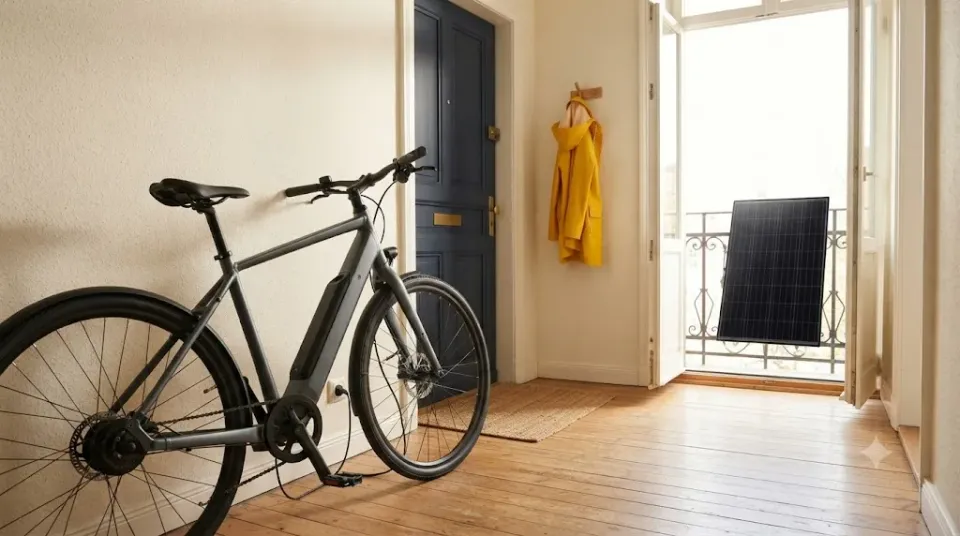
A middle route. Plug a portable power station into a wall socket at midday with its charge rate set to about 300 W. It soaks up surplus that would otherwise leave. In the evening, run the TV, laptop or lights from it.
- Upside: it doubles as outage backup and camping power. You may already own one.
- Downside: you lose about 10 to 15 percent each way in the round trip, and you move plugs by hand. Many units have a scheduled charging setting, which helps.
- The maths: surplus that leaves unpaid is worth nothing to you, so even after losses, stored power is a gain. A 1 kWh unit cycled on about 100 sunny days a year moves very roughly 75 to 85 kWh into the evening.
That is less than a dedicated balcony battery, which works automatically every day. But if outage readiness matters to you anyway, it is a sensible second job for the box.
Zendure SolarFlow 800 Pro 2
A balcony battery system that stores midday surplus for the evening, most useful for households out all day. It costs far more than a basic kit, so try the free timer changes first.
Check price on Amazon Ad - affiliate link. Prices change; check the listing.Would a different panel direction suit a commuter better?
Often, yes. A west-facing panel moves more of its output into late afternoon and early evening, when you are coming home. In the model, west sends about 9 percent of its year after 18:00, against about 3 percent for south.
For someone home from 17:00 or 18:00, splitting the kit - one panel south, one west - can raise self-use without any timers at all. You give up a little total output for a better match with your day. If your balcony faces south-west already, you are in a good spot.
Your own balcony may face whichever way it faces, of course. But if you have a choice of two spots, or a corner balcony, it is worth comparing. Sunslot has a setting for when you are out: enter your work hours and base load, try south against west, and see how much you would keep. The full comparison is in south, east-west or flat.
Does winter change any of this?
Completely. From November to February the balcony makes so little that even an empty flat's base load uses most of it. In the model, December output was about 17 kWh, with about 12 kWh used at home with nobody there. That is about 70 percent self-use without lifting a finger.
| Month | Rough output | Rough share kept, out all day |
|---|---|---|
| June | about 110 kWh | about 40 % |
| March / September | about 70 kWh | about 50 to 55 % |
| December | about 17 kWh | about 70 % |
So the "lost to the grid" problem is mostly a summer one. Your timers and schedules matter most from April to September. In winter, just let the kit do its thing.
Anker SOLIX C1000 Gen 2
Charge it from the wall at midday and use it for evening devices, outages or camping. You move it by hand and lose some energy in the round trip.
Check price on Amazon Ad - affiliate link. Prices change; check the listing.What people get wrong
- Deciding it is not worth it because they are out. It still pays back in about 3 years in the model.
- Buying a battery first. Free changes like delay-start often gain as much as a battery.
- Leaving things on to "use the sun". A higher base load costs you at night too.
- Running the dishwasher at 19:00 out of habit. The same run at noon is close to free in summer.
- Forgetting the weekend. Two days a week at home at midday is a big chunk of the year. Put the washing machine and dryer there.
- Not measuring the base load. It decides how much you keep while out. See base load.
Your next step
- Set the dishwasher to delay-start so it finishes by about 15:00 tomorrow. That is the biggest win and it takes ten seconds.
- Enter your work hours and base load in Sunslot to see your own self-use share, then compare it with your app at the end of the month.
- Read the two guides that go deeper: self-consumption for the full picture and which appliances to run in the sun for timings.
