

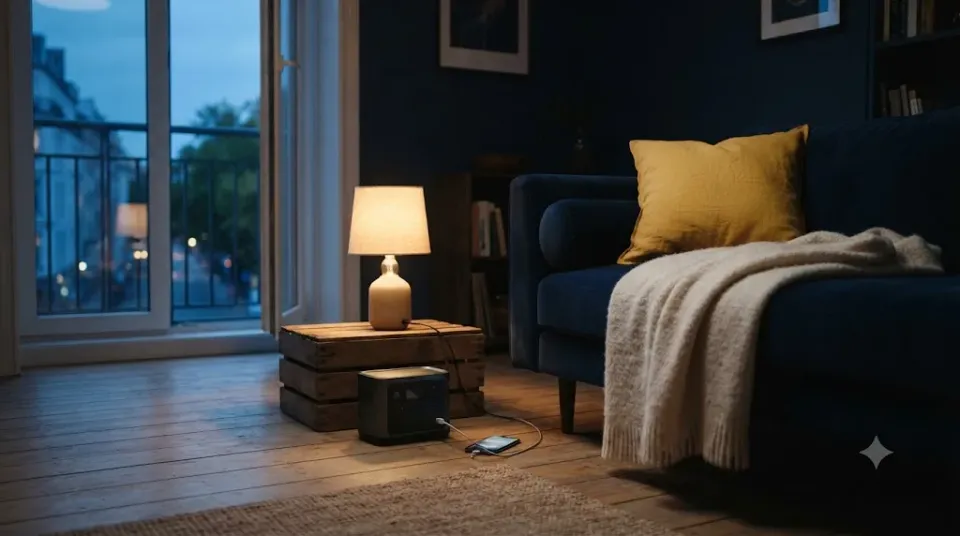
This is a worked example, not a real test. We use typical appliance figures for an example flat to show how the maths works. Your fridge and habits will move the numbers.
Short version: a 1 kWh power station can carry a flat's essentials through a full day, but only just, and only if the kettle mostly stays in the cupboard. The surprise for most people is the balcony kit.
Take an example flat in Hanover: two adults, an electric kitchen, a modern fridge, Wi-Fi and LED lights. The power cut starts at 18:00 on a November evening and lasts 24 hours. The power station is a 1,024 Wh LiFePO4 unit (a long-lived, stable battery type) with a 2,000 W inverter, charged to 100 percent.
First, the honest capacity. A 1,024 Wh battery does not give you 1,024 Wh at the socket. The inverter (the part that makes 230 V for normal plugs) loses roughly 10 to 15 percent as heat. So plan with about 870 Wh usable at 230 V. USB outputs skip the inverter and lose less.
With that budget, the example flat ran the fridge the whole time, the router for most of the day, two LED lamps in the evening, phones and a laptop, and one kettle boil in the morning. It reached hour 24 with about 20 Wh left, roughly 2 percent. That is enough for a lamp for a couple more hours. It is not enough for another night of fridge.
The fridge was the big user: about 400 Wh, nearly half the budget. Everything with a heating element is the enemy. A second kettle boil, a toaster, a hair dryer or an electric heater would have ended the fridge's run early.
Now the part that catches people out. When the grid fails, a balcony microinverter (the box that feeds panel power into your sockets) switches off within a fraction of a second. That is a safety rule: it stops your panels feeding power into lines that workers may be repairing. So in a power cut, a normal balcony kit gives you nothing, even at noon in full sun. To use solar during an outage, panels have to plug straight into the power station's own solar input.
So the answer is yes, a 1 kWh station is the right size for one day of essentials. For two days, you need either a bigger battery, a folding panel to refill it, or a fridge run in blocks. The follow-up questions below go through each.
What ran, hour by hour?
Here is the example day. Watts are typical figures; your own devices will differ.
| Time | What ran | Used | Left (of about 870 Wh) |
|---|---|---|---|
| 18:00 to 22:00 | Router 10 W, two LED lamps 8 W each, fridge, two phone charges | about 200 Wh | about 670 Wh |
| 22:00 to 07:00 | Fridge only; router off overnight | about 150 Wh | about 520 Wh |
| 07:00 to 08:00 | Router, one lamp, fridge, kettle for 1 litre | about 145 Wh | about 375 Wh |
| 08:00 to 13:00 | Fridge, router, laptop on USB-C for 2 hours | about 225 Wh | about 150 Wh |
| 13:00 to 18:00 | Fridge; router for 3 hours; phones topped up | about 130 Wh | about 20 Wh |
Notice how the first four hours used almost a quarter of the battery. Evenings are expensive: lights, router, charging and the fridge working after the door was opened for dinner. The quiet night was cheap. If you want to stretch a battery, the evening is where to be strict.
A useful way to read the table: each row is a choice. Swap the two LED lamps for one and the evening row drops by about 30 Wh. Leave the router on overnight and the night row grows by about 100 Wh. Add a second kettle boil and the morning row nearly doubles. None of these choices is wrong. The table just shows you the price of each one, so you can pick the comforts that matter to you.
Cold flats also shave capacity a little. Batteries deliver slightly less when they are chilly, so keep the power station in a heated room rather than on the balcony or in a cellar.
If those two units still feel slippery, our guide to watts and watt-hours sorts them out in seven short steps.
Why did the balcony kit stop working?
Because it has to. Every grid-connected inverter in Germany, from a balcony kit to a rooftop system, must detect a grid failure and disconnect. The technical name is anti-islanding protection (it stops your home becoming a powered "island" in a dead grid). If it did not, a line worker could touch a cable they believe is dead and find it live from your balcony.
So the kit sees the grid vanish, switches off, and waits. When the grid returns and stays stable, it reconnects by itself. Nothing is broken.
What about plugging the balcony kit into the power station? On most combinations that does not work either. The microinverter needs to see a grid to sync to, and most portable power stations are not designed to be that grid. Some combined balcony battery systems offer an emergency socket, but that is a specific feature you have to buy for, not something a standard kit does.
The working route is simpler: a folding panel, or your balcony panels with the right cable, plugged directly into the power station's solar input (often marked DC or PV, usually an XT60 or similar connector). Our guide to pairing panels with a power station explains the voltage and connector checks.
Anker SOLIX C1000 Gen 2
The 1,024 Wh LiFePO4 class used in this example, with a 2,000 W inverter strong enough for a kettle. About 11 kg, so it is a carry-to-the-kitchen box rather than a backpack item.
Check price on Amazon Ad - affiliate link. Prices change; check the listing.Was it worth keeping the fridge on?
It used about 400 Wh - nearly half the budget - so it is a fair question. The food safety rule of thumb from FoodSafety.gov: a closed fridge keeps food safe for about 4 hours without power, a full freezer about 48 hours (about 24 if half full).
That gives you two strategies:
- Always on. Simple, food stays cold, about 350 to 450 Wh a day for a modern fridge-freezer.
- Block running. One hour on, two hours off, door shut. The compressor catches up during the "on" hour. This roughly halves its share and frees about 200 Wh for lights, the laptop or a second boil.
For one day, always-on is fine with a 1 kWh station. For two days, block running is how a 1 kWh station gets there. A plug-in timer or a smart plug makes it automatic, so you do not need to set an alarm.
A few small habits make block running work better. Fill empty fridge space with bottles of water, because cold mass holds temperature. Keep the freezer shut entirely for the first day. Decide what you need for a meal before you open the door, then open it once.
One warning: older fridges can use twice as much. A fridge-freezer from 2010 using 0.8 kWh a day would have emptied this battery by mid-morning. Measure yours once with a plug-in energy meter over 24 hours. It is the single most useful number for outage planning.
Hour 14 of a power cut, about 40 percent left in your 1 kWh station. What do you cut first?
Block running roughly halves the fridge's share while keeping food safe, and the fridge is by far the biggest user. Cutting the router helps a little, but it is small per hour. Turning the fridge off completely risks the food after about 4 hours.
What should we switch off first?
Rank everything by how much it costs per hour of comfort. Here is how the example flat decided, with typical figures:
| Device | Typical draw | Cost in the example | Decision |
|---|---|---|---|
| Second kettle boil (1 litre) | about 2,000 W for 3 minutes | about 115 Wh with losses | Skipped |
| TV for an evening | about 60 W for 4 hours | about 280 Wh with losses | Skipped, phone instead |
| Router overnight | about 10 W for 9 hours | about 100 Wh with losses | Off, mobile data instead |
| Microwave, 5 minutes | about 1,000 to 1,500 W from the socket | about 100 to 140 Wh | Skipped to keep a margin |
| LED lamp | about 8 W | about 9 Wh per hour | Kept, the cheapest comfort there is |
| Phone charge | about 10 to 15 Wh each | small | Kept, via USB |
The pattern: anything that heats costs the most, screens are in the middle, and light and phones are almost free. A router is small per hour but adds up because it runs all day. Turning it off overnight saved about a tenth of the battery.
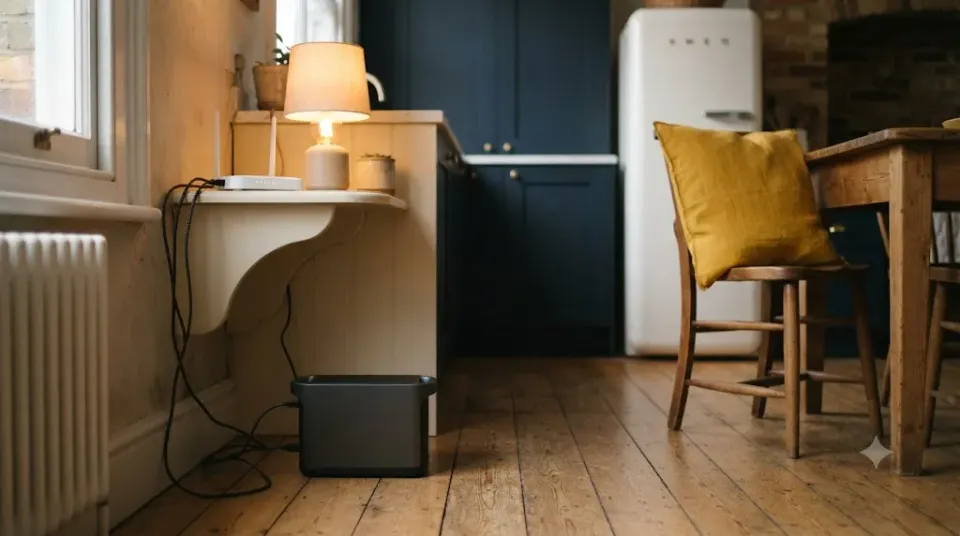
How do we stretch it to 48 hours?
Three routes, from cheapest to most expensive:
- Be stricter. Fridge in blocks, router only for an hour morning and evening, laptop on USB-C, no kettle. A 1 kWh station can reach about 48 hours this way.
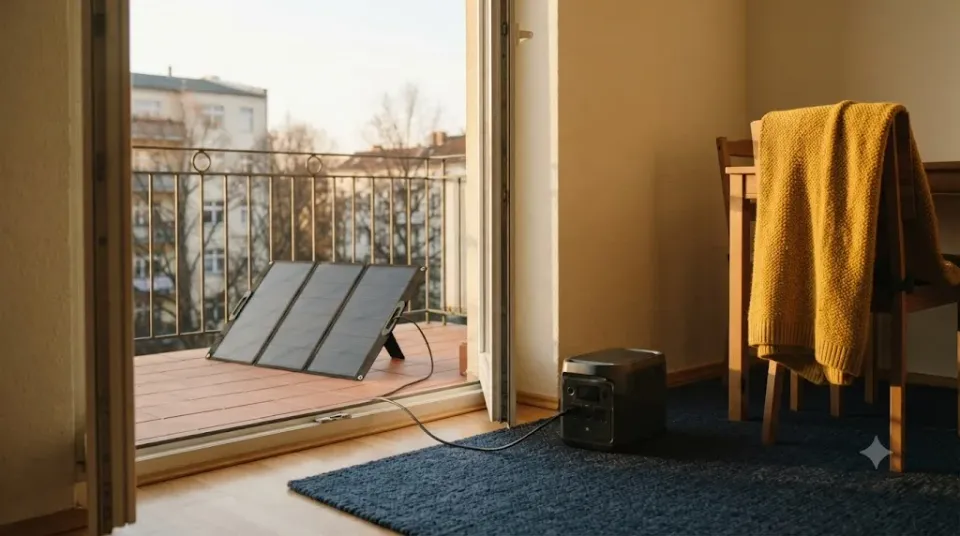
- Add a folding panel. A 200 W class folding panel plugged into the solar input. In November in northern Germany, expect very roughly 150 to 400 Wh on a decent day, much less under thick cloud. Not a full refill, but it can cover the fridge for most of a day.
- Buy more battery. 1.5 to 2 kWh, either a bigger unit or an expansion battery if your model takes one.
| Goal | Rough size |
|---|---|
| Phones, lights, router for 24 hours | about 300 to 500 Wh |
| Add the fridge for 24 hours | about 1 kWh |
| Fridge plus basics for 48 hours | about 1.5 to 2 kWh, or 1 kWh plus a folding panel and block running |
The winter sun is the reality check most people skip. Run Sunslot for November with your balcony direction and see how flat and short the curve is. It shows you how much a panel can realistically put back in a day. Our sizing guide works through the choice device by device.
How do we keep it ready without thinking about it?
A power station sitting at 30 percent in a cupboard is a nice paperweight. Readiness is a habit, and your balcony kit can do most of the work.
- Store it at 50 to 80 percent. LiFePO4 batteries are happiest there. Fill to 100 percent when a storm warning comes.
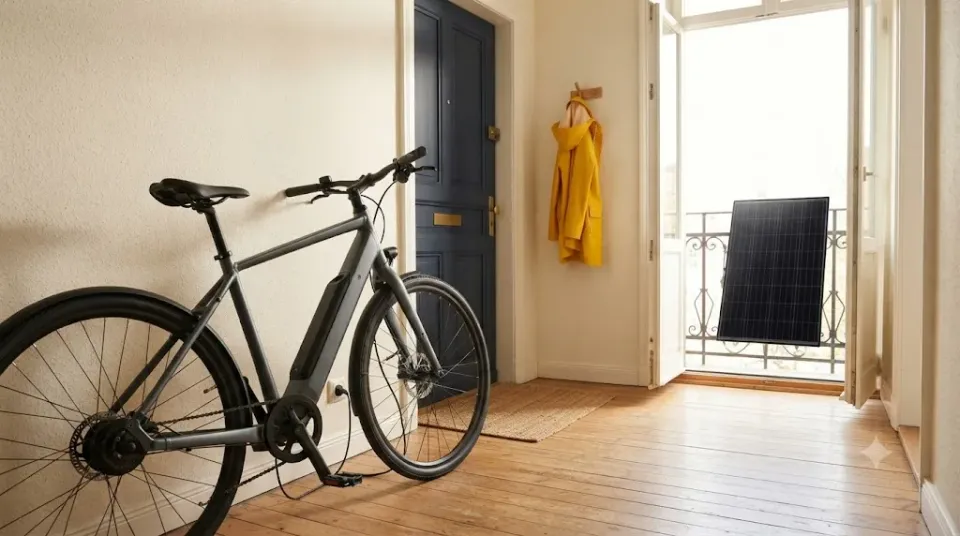
- Top it up from the balcony. Plug the power station into a wall socket at midday with its charge rate set low, around 300 W. It soaks up solar that would otherwise flow out to the grid unpaid.
- Check it monthly. Same day as you check the smoke alarm. Takes ten seconds.
- Keep a printed list. What runs, in order: fridge, lights, phones, router. In a real outage you will not want to do maths.
On a sunny June day a south-facing balcony kit makes more than 300 W for six or more hours. Sunslot shows the exact hours for your balcony, so you can set the charging window once and forget it.
EcoFlow 220W Bifacial Portable Solar Panel
A folding panel you can plug straight into a power station's solar input when the grid is down. Check the power station's solar input voltage and connector first; in November it adds only a modest amount per day.
Check price on Amazon Ad - affiliate link. Prices change; check the listing.What does the example leave out?
Quite a lot, on purpose. A 1 kWh box is for electronics, light and cold food. It is not a home backup for heat, hot water or cooking.
- Heating. Gas boilers usually need power for the pump and controls. A small boiler might run on a power station, but connecting it safely usually needs an electrician-fitted plug, and it would drain a 1 kWh unit fast. Plan on warm clothes and blankets.
- Cooking. A camping stove, used outdoors or with very good ventilation, is the usual answer. Never use gas or charcoal indoors.
- Water. Upper floors in some buildings rely on electric pumps. Keep a few litres stored per person.
- Medical devices. If someone depends on one, size for that first and talk to the supplier.
Our 48-hour power cut plan covers the non-electric side step by step, including a checklist you can print.
Brennenstuhl Primera-Line PM 231 E
Measure your fridge's real daily kWh before an outage so you can plan. It measures only, with no app or history.
Check price on Amazon Ad - affiliate link. Prices change; check the listing.What people get wrong
- Thinking the balcony kit is a backup. It stops in a power cut, by design.
- Counting the full battery size. Plan with about 85 percent at 230 V, a bit more on USB.
- Using the kettle like normal. Every boil costs roughly a tenth of a 1 kWh battery.
- Not knowing the fridge. An old fridge can use double, and blow the whole plan.
- Storing it empty. Half full on the day means half the hours.
- Opening the fridge to "check". Every opening makes the compressor work harder on battery power.
- Buying a panel that does not fit. Check the power station's solar input voltage and connector before you order.
Your next step
- Measure your fridge for 24 hours with a plug-in meter. Write the number on the fridge door.
- Check your winter sun in Sunslot to see whether a folding panel would actually help in November.
- Read the two guides that finish the plan: the 48-hour power cut plan and how big a power station you need.