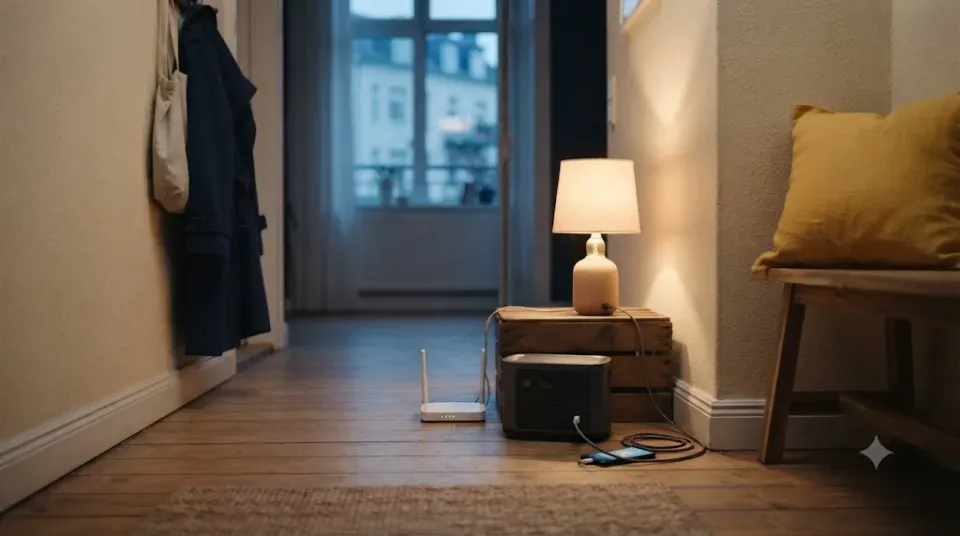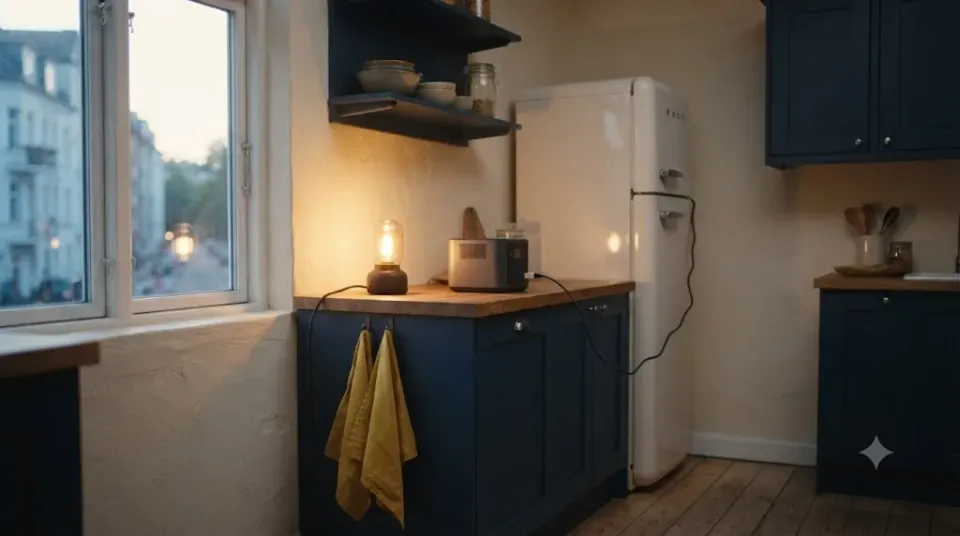
In 2024 the average German household lost power for just 11.7 minutes over the whole year. That is the official figure from the Bundesnetzagentur, and it is one of the best in Europe. So why plan for 48 hours? Because averages hide the bad days. A storm that brings down lines, a flood that swamps a substation or a fire in a cable duct can leave one district dark for a day or two while the rest of the country carries on. When it happens to you, the national average does not help. A plan does, and for a flat it is smaller, cheaper and simpler than most people think.
This guide walks you through it in eight steps. You will end up with a short list of what must keep running, a battery size worked out with real numbers, a way to refill it, and the non-electric basics beside it. Two days without mains power then becomes an inconvenience, not an emergency.
Step 1: Understand what a long cut does to a flat
Most people picture a power cut as "the lights go off". In a flat, much more stops at the same time. Knowing the full list stops you being surprised in hour three.
- Heating. Almost every central heating system needs power for its pump and controls, even when it burns gas or oil. No power usually means no heat after a while, and in winter a flat cools by a few degrees a day.
- Water. In many buildings, especially taller ones, pumps push water to the upper floors. The Federal Office of Civil Protection and Disaster Assistance (BBK) warns that tap water can stop during a longer outage. Hot water from an electric boiler stops at once.
- Cooking. Electric hobs, ovens, microwaves and kettles are out. Gas hobs may still light with a match, but many have electric ignition and safety valves.
- Phone and internet. Your router dies with the mains. Mobile masts have some backup, but it can run out during a long cut, and networks get overloaded.
- Money and shopping. Card terminals and cash machines stop. The BBK recommends keeping some cash at home for exactly this reason.
- Lifts, door buzzers and garage doors. Older or less mobile neighbours can get stuck upstairs.
None of this is a reason to panic. It is a reason to separate the problem into two parts: what a battery can solve (light, contact, food, medical devices) and what it cannot (heating a flat, cooking every meal, pumping water). Your plan needs both parts.
Step 2: Make a short list of what must keep running
Start with a short list, not a wish list. In a power cut you want four things: light, contact with the outside world, food that does not spoil and, for some people, medical devices. Everything else is optional.
Write your list in two columns: the device and its power draw in watts (W - how hard it pulls at any moment). The label on the plug or the back of the device usually tells you. If it does not, a cheap plug-in energy meter will. Plug the device through the meter for a day and it shows both the watts right now and the energy used so far.
| Device | Typical draw | Use over 48 h | Energy needed |
|---|---|---|---|
| Fridge (modern) | runs on and off | 48 h | about 0.6 - 1.6 kWh |
| Wi-Fi router | about 10 W | 24 h | about 240 Wh |
| Two LED lamps | 5 - 10 W each | 10 h | 100 - 200 Wh |
| Two phones | - | 4 charges | about 60 - 80 Wh |
| Laptop | - | 2 charges | about 100 - 150 Wh |
| CPAP machine (if needed) | 30 - 60 W | 16 h | 500 - 1,000 Wh |
Those are ranges, not promises. Your fridge may be thriftier or hungrier. For a fridge, the label watts are misleading because the compressor switches on and off. The better number is the yearly energy figure on the EU energy label: divide the kWh per year by 365 and you have the daily use. A fridge rated at 150 kWh a year uses about 0.4 kWh a day, so about 0.8 kWh over 48 hours.
If watts and watt-hours still blur together, our guide to watts vs watt-hours clears it up in five minutes. The short version: watts are speed, watt-hours are distance. A 10 W router running for 24 hours covers 240 Wh.
Step 3: Add it up and size the battery
Without the CPAP, the list above lands somewhere between 1.1 and 2.3 kWh (kilowatt-hours - one kWh is 1,000 W running for one hour) for two days. That tells you something useful. A portable power station of around 1 to 2 kWh can carry a careful flat through 48 hours. A 500 Wh unit can keep phones, light and the router going, but not the fridge as well.
Two things shrink the real usable figure. First, the inverter (the part that turns battery power into 230 V mains power) loses some energy, often 10 to 15 percent. Second, you should not plan to run any battery to zero. So divide your total by about 0.85 before you shop. Our power station size guide walks through the same sum in more detail, and what is a power station covers the basics.
A worked example
Take an example flat: two adults on the third floor in Leipzig, a modern fridge rated at 150 kWh a year, a router, two phones, one laptop and two LED lamps. No medical devices.
| Item | Sum | 48 hours |
|---|---|---|
| Fridge | 150 kWh / 365 x 2 days | about 820 Wh |
| Router, 12 h a day | 10 W x 12 h x 2 days | 240 Wh |
| Two LED lamps, 5 h each evening | 2 x 8 W x 10 h | 160 Wh |
| Phones, 4 charges | 4 x 17 Wh | about 70 Wh |
| Laptop, 2 charges | 2 x 60 Wh | 120 Wh |
| Total | about 1,410 Wh | |
| Divide by 0.85 | losses and reserve | about 1,660 Wh |
So this flat needs about 1.7 kWh of rated battery to run everything straight through. A 1 kWh station falls short on paper. But read on: with the fridge trick in Step 4, the fridge share drops to roughly 400 to 500 Wh, the total lands near 1,100 Wh, and a 1 kWh-class station with a little care does the job.
Check the second number on the box too: the inverter output in watts. It decides what you can run at once. A fridge compressor can briefly pull two to three times its running power when it starts. Most 1 kWh stations handle that easily. A kettle at 2,000 W is a different story, and it is a poor use of a small battery anyway.
EcoFlow DELTA 2
A 1 kWh-class LiFePO4 station that can run a modern fridge, router, lights and phones for a careful two days. At around 12 kg it is carriable but not light.
Check price on Amazon Ad - affiliate link. Prices change; check the listing.Step 4: Stretch the battery with simple habits
How you use the battery matters as much as how big it is. These habits cost nothing and can almost double how long a battery lasts.
- Cycle the fridge. A full fridge with the door shut stays cold for hours. Run it from the battery for an hour, then switch it off for two or three. You cut its energy use roughly in half and the food stays safe.
- Use the freezer as an ice pack. Keep the freezer closed. A full freezer holds its temperature much longer than a half-empty one. Move one frozen item into the fridge each morning to help keep it cool.
- Run the router only at set times. Switch it on for 15 minutes every few hours to check news and messages, then off. That turns 240 Wh into 50 Wh. If the mobile network is up, your phone may do the job alone.
- Charge from the USB ports, not the 230 V socket. The station's USB and 12 V outputs skip the inverter, so they waste less energy. Plugging a phone charger into the station's mains socket loses power twice.
- Switch the inverter off when you do not need it. Many stations draw a few watts just by keeping the 230 V side awake. Over 48 hours, 10 W of idle draw is about 0.5 kWh gone.
- Use one room. Gather everyone in one room with one lamp. It saves light, and it is warmer too.
Step 5: Plan how to refill the battery
A battery is a tank. Two days is fine, but a longer cut needs a way to refill it. You have three options in a flat:
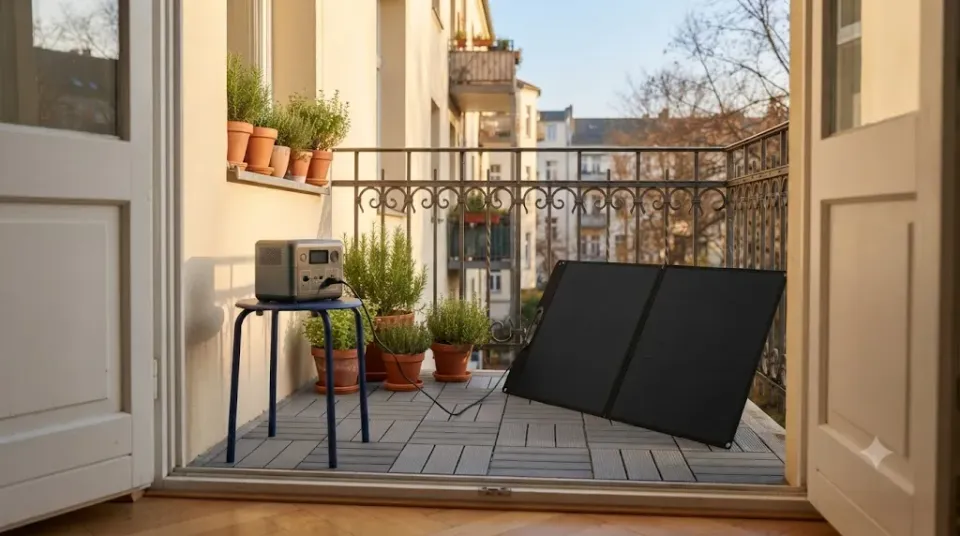
- Solar panels. A folding panel of 100 to 400 W on a balcony can put back several hundred watt-hours on a bright day, far less on a grey winter one. See pairing panels with a power station before you buy one.
- The car. A 12 V car socket usually gives around 100 to 120 W. Slow, but it adds up over a few hours of driving. Do not idle a car in a closed garage to charge anything.
- A friend's socket. If the cut is local, the next district may have power. Take the battery with you.
How much can a folding panel really do? It depends hugely on the season and the balcony. A 200 W panel set up well in summer might give 600 to 1,000 Wh over a long sunny day. In December the same panel on the same balcony may give a quarter of that or less, and on a grey day almost nothing. That is why a solar panel is a bonus in a winter outage, not the plan. Put your own balcony into Sunslot and look at a December day: you will see how few hours of usable sun reach it, and when the building opposite takes them away.
One important point about balcony solar. A normal plug-in system with a microinverter switches off when the grid goes down. That is a safety feature, not a fault: it stops power flowing back into lines that engineers may be working on. So a balcony kit alone will not keep your lights on in a power cut. Only a power station, or a battery system built for backup, can do that. Many balcony batteries cannot either, which we cover in does a balcony system need a battery?
What refilling looks like in numbers
| Source | Typical power | Realistic refill per day | Limits |
|---|---|---|---|
| 200 W folding panel, summer | up to about 150 W in good sun | 600 - 1,000 Wh | Needs a sunny balcony and turning the panel |
| 200 W folding panel, winter | well below rating | 150 - 250 Wh or less | Short days, low sun, cloud |
| Car 12 V socket | 100 - 120 W | about 300 Wh per 3 h drive | Only while driving |
| Socket elsewhere | full charge speed | full battery in a few hours | Only if the cut is local |
Look back at the Leipzig flat. With the fridge trick it uses about 550 Wh a day. A summer panel more than covers that. A winter panel covers a third of it. Three hours in the car covers half. So in winter, plan to combine two sources, or plan to leave if the cut lasts beyond three days.
EcoFlow 220W Bifacial Portable Solar Panel
A folding panel for topping up a power station during a longer cut or on camping trips. In winter it brings back only a fraction of its summer output.
Check price on Amazon Ad - affiliate link. Prices change; check the listing.Step 6: Cover the no-battery basics
Some of the best preparation costs almost nothing and has nothing to do with electricity. The BBK's advice guide recommends keeping supplies for several days at home. Its checklist is built around ten days without shopping, and it suggests about two litres of water per person per day for drinking and cooking. For a 48-hour plan, start with these:
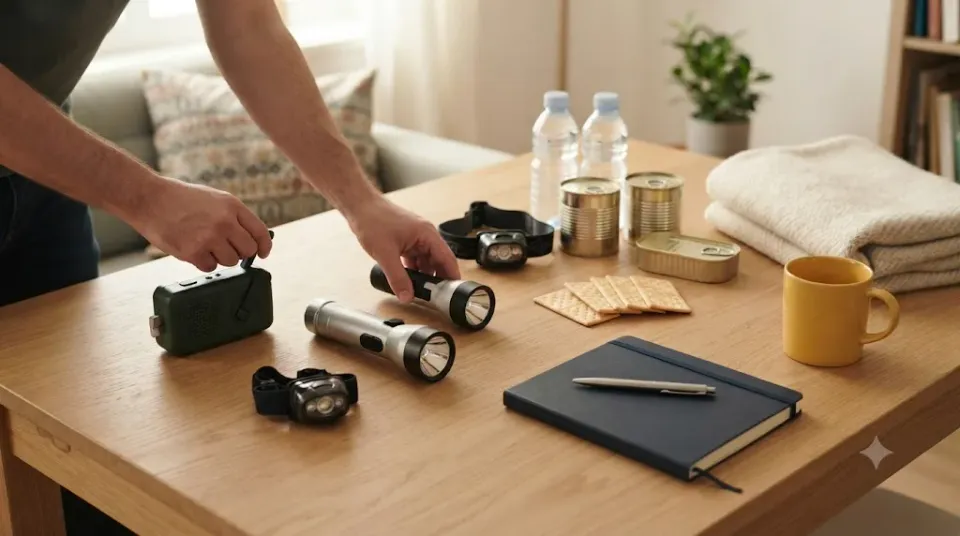
- A battery or wind-up radio for news. The BBK recommends one specifically for long outages, when the internet and mobile networks may be down.
- Torches and a headlamp, with spare batteries. Candles are a last resort: never near curtains, never unattended, and air the room regularly.
- Food that needs no cooking, and drinking water for each person. Bread, crackers, tins that taste fine cold, nuts, dried fruit.
- A small power bank per person, kept charged.
- Some cash, in small notes.
- Printed phone numbers for family, your landlord and the grid operator. Your phone's contact list does not help if the phone is flat.
- Warm layers and blankets. Most flat heating needs power for its pump or controls, even with gas. Keep the doors of one room shut to hold the heat, and air it briefly from time to time.
- A carbon monoxide alarm (battery powered) if you have any fuel-burning appliance in the flat. The BBK suggests one as a basic safety step.
Never use a camping gas stove, a charcoal barbecue or a petrol generator indoors or on an enclosed balcony. The BBK is blunt about it: do not barbecue inside the flat or house, because there is a risk of suffocation. Carbon monoxide has no smell, and it kills. A camping stove belongs outdoors or on an open balcony with clear air around it.
Step 7: Plan for medical devices and special cases
If someone in the flat relies on a powered medical device, the plan changes from "nice to have" to essential. Do this step first if it applies to you.
- CPAP machines. A CPAP (a machine that keeps airways open during sleep) typically draws 30 to 60 W without its humidifier, and much more with it. Two nights of 8 hours each come to about 500 to 1,000 Wh. Many models can run from a 12 V lead, which avoids the inverter losses. Ask your supplier whether yours can, and whether the humidifier can be switched off safely.
- Oxygen concentrators. These can draw hundreds of watts. A typical 1 kWh station may only last a few hours. Talk to your doctor or supplier about backup cylinders or a plan to move to somewhere with power.
- Medicines that need cooling. Insulin and some other medicines must stay cool. Keep a small cool bag and cold packs ready, and check the storage advice on the pack.
- Stair-lifts and electric wheelchairs. Keep them charged at all times, and know how a neighbour could help if the lift stops.
For anyone in this group, size the battery for the medical device first, then add everything else on top. Test it at home on a normal night, plugged into the station, before you ever need it. And tell your local electricity network operator if you depend on such a device: some keep contact lists, and it never hurts for them to know.
Step 8: Test the plan and keep the battery ready
Do a dry run on a weekend. Unplug the fridge from the wall, plug it into the power station and see how long the battery lasts. Charge the phones from it. Use the lamps you would actually use. You will learn more in one afternoon than from any spec sheet.
Then set a reminder every three months to top up the battery. A power station left in a cupboard slowly loses charge, and a flat battery is no help when the lights go out. Store it somewhere cool and dry, around 50 to 80 percent charged if the maker suggests it, and fill it fully when a storm is forecast.
A word on chemistry. Most current power stations use LiFePO4 (lithium iron phosphate) cells, which typically handle thousands of full cycles and age slowly in storage. Older or lighter designs use NMC (nickel manganese cobalt) cells, which last fewer cycles. For a box that sits in a cupboard for years and only gets used now and then, LiFePO4 is the calmer choice. Our LiFePO4 vs NMC article explains why.
Already have a balcony solar system? Use it to keep the station topped up on normal days. Charge it from a socket during sunny hours, when your panels cover most of that power. Sunslot shows which hours your balcony produces most, so you can time the top-up for those hours instead of the evening.
Brennenstuhl Primera-Line PM 231 E
A simple plug-in energy meter to find out what your fridge and router really use before you size a battery. It measures one device at a time and has no app.
Check price on Amazon Ad - affiliate link. Prices change; check the listing.Your 48-hour checklist
Print this and tick it off. Once everything has a tick, you are better prepared than most households.
| Item | Why | Done? |
|---|---|---|
| Device list with watts and hours | The basis for sizing | [ ] |
| Power station of the right size, fully charged | Light, contact, food | [ ] |
| Fridge thermometer | Know when food is safe | [ ] |
| Battery or wind-up radio | News when networks fail | [ ] |
| Torches, headlamp, spare batteries | Safe light without flames | [ ] |
| Power bank per person | Phones without the big battery | [ ] |
| Water, about 2 litres per person per day | Taps may stop | [ ] |
| Food that needs no cooking | No hob, no oven | [ ] |
| Cash in small notes | Card terminals stop | [ ] |
| Printed phone numbers | Flat phone, lost contacts | [ ] |
| Blankets and warm layers | Heating needs power | [ ] |
| CO alarm if you burn any fuel | Invisible danger | [ ] |
| Medical device plan and test night | Non-negotiable if needed | [ ] |
| Recharge plan (panel, car, elsewhere) | For cuts beyond 2 days | [ ] |
| Reminder every 3 months to top up | A flat battery helps no one | [ ] |
Outage kit mistakes
These errors come up again and again in outage kits.
- Buying by the biggest number on the box. A 3 kWh station sounds safe, but at 30 kg it is hard to carry to a friend's socket, and it costs far more. Size it from your list.
- Forgetting the inverter's own draw. Leaving the 230 V output on all night to power one phone charger can waste more energy than the phone uses.
- Counting on balcony solar. A standard plug-in kit switches off when the grid fails. It is a money saver, not a backup.
- Letting the battery sit empty. The most common failure is simply a flat battery on the day. Set the reminder.
- Planning the electricity and forgetting the water. In an upper-floor flat, the taps can stop. Two litres per person per day is a small crate.
- Using gas or charcoal indoors to stay warm or cook. It is the one mistake in this list that can kill. Blankets and one closed room are safer.
- Never testing. A plan that has never been tried is a guess. One afternoon fixes that.
That is the whole plan: a short list, a sum, a battery of the right size, a way to refill it, and the simple non-electric basics beside it. Most of it costs little, and the battery doubles as a camping companion for the rest of the year. Our article on power for camping and campervans shows how the same box earns its keep on weekends away.
Power cut questions
How long will a 1 kWh power station run a fridge?
A modern fridge uses roughly 0.3 to 0.8 kWh a day. After inverter losses, a 1 kWh station runs it for about one to two and a half days on its own. Cycling the fridge an hour on, two or three off, can stretch that further.
Will my balcony solar system keep working in a power cut?
No. A standard plug-in system's microinverter switches off when the grid goes down, so no power flows back into lines that engineers may be working on. Only a power station or a battery system built for backup can supply power during an outage.
Can I charge a power station from my car during an outage?
Yes, from the 12 V socket while driving, usually at about 100 to 120 W. Three hours of driving adds roughly 300 Wh. Never run the engine in a closed garage to charge.
Is it safe to keep a power station indoors?
Yes, that is what they are made for. Keep it somewhere cool and dry, away from heaters and direct sun, and do not cover its vents while it is charging or working hard.
How much water should I store for a power cut?
The BBK suggests about two litres per person per day for drinking and cooking. For a 48-hour plan for two people, that is at least eight litres, plus some extra for washing.