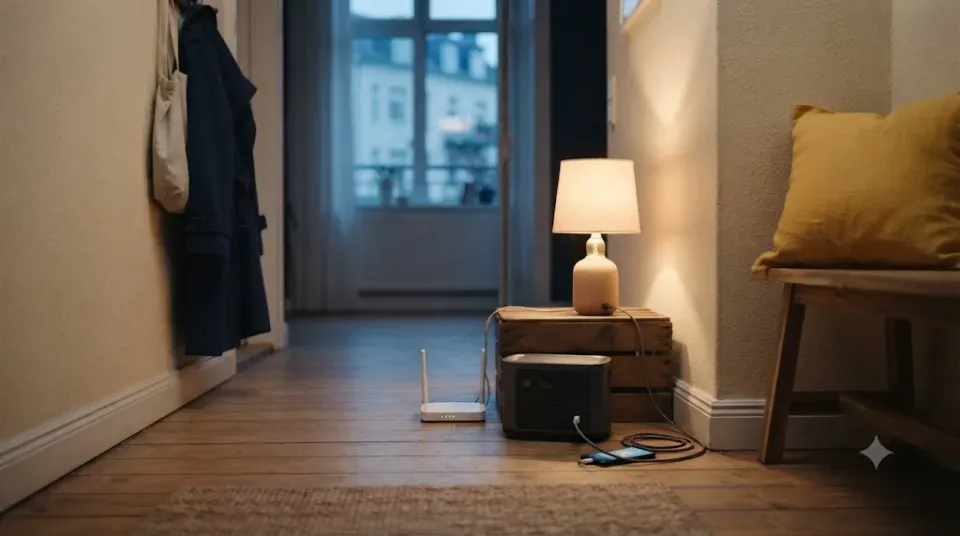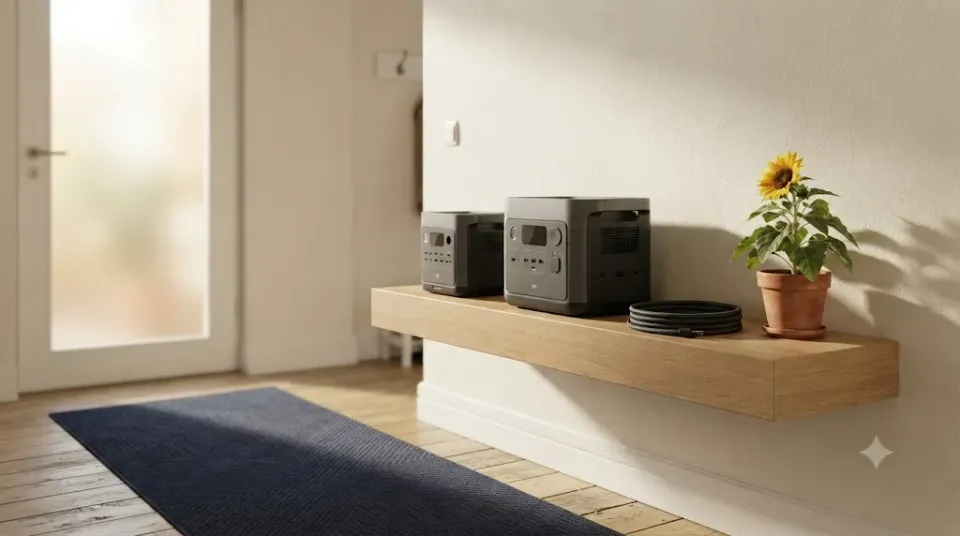
Boiling one litre of water in an electric kettle uses about 100 Wh. That sounds tiny until you notice it is a fifth of what a small power station holds, gone in four minutes. Most camping power problems start right there: not with the wrong battery, but with the wrong idea of what eats energy. A phone charge barely registers. A cool box quietly decides your whole trip. A kettle, a hair dryer or a coffee machine can empty a battery before breakfast is over.
So instead of a generic sizing table, this article follows three example households (clearly hypothetical, but built on real device figures) through a trip each. A couple in a tent at the Baltic, a family in a converted van in Bavaria, and a remote worker living in a van through a Dutch and German spring. You will see what each one uses, what they bought, how they refill it, and what went wrong. Then you can find yourself among them.
Meet the three example households
Campers fall into roughly three groups, and each needs a very different amount of energy. Our three examples sit one in each group.
| Lena and Tom | The Bauer family | Mira | |
|---|---|---|---|
| Trip | Weekend tent, Rügen, June | Ten days in a van, Allgäu, August | Van as a home, six weeks, March to April |
| Group | Weekend tent | Van with a cool box | Van as a home |
| Typical daily use | under 200 Wh | 400 - 900 Wh | 1.5 kWh or more |
| Hook-up | None | Every third night | Rarely |
| Main question | Do we need a power station at all? | How big, and how to refill? | Can solar carry a working day? |
Be honest about which group you are in. Most people overestimate how much they will use on a weekend and underestimate it on a two-week trip. Watts (W) tell you how hard a device pulls at one moment. Watt-hours (Wh) tell you how much energy it uses over time - the number that empties a battery. If that distinction is new, watts vs watt-hours explains it in a few minutes.
Lena and Tom: a weekend in a tent
Lena and Tom drive to a simple campsite on Rügen for two nights, with a tent pitch and no electric hook-up. They want phones charged, light in the evening, a small fan for a warm night and music by the fire.
| Device | Typical draw | Use per day | Energy per day |
|---|---|---|---|
| Two phones | - | 1 charge each | 30 - 40 Wh |
| LED lantern and headlamps | 5 W | 4 h | about 20 Wh |
| USB fan | 5 - 10 W | 5 h at night | 25 - 50 Wh |
| Bluetooth speaker | - | 1 recharge | about 10 - 20 Wh |
| Total | about 85 - 130 Wh |
Over two days that is roughly 170 to 260 Wh. Their first instinct was a 1 kWh power station "to be safe". It would have weighed 10 to 12 kg and cost several hundred euros to carry around mostly full.
What they actually did: a 300 Wh-class power station, or even two large power banks, covers the weekend with room to spare. A 300 Wh unit at 85 percent usable gives about 255 Wh, which matches two days of their highest estimate. If they camp more often, a small folding panel of 60 to 100 W tops it up during the day.
Lena and Tom's lesson was simple. Their list had no heat, no cooling and no motor. Small loads stay small, even over a long weekend.
The Bauer family: ten days in a van with a cool box
The Bauers are two adults and two children in a converted panel van. They spend ten days in the Allgäu in August, mixing free spots near hiking trails with a campsite with hook-up every third night. The cool box is the heart of their trip: milk, cheese, sausages and the children's yoghurts.
Here is their typical van day, with ranges because real devices vary.
| Device | Typical draw | Hours per day | Energy per day |
|---|---|---|---|
| Compressor cool box | 40 - 60 W while running | runs about a third of the time | 300 - 500 Wh |
| LED string and reading light | 5 - 15 W | 5 h | 25 - 75 Wh |
| Four phones and a tablet | - | 1 charge each | about 80 - 100 Wh |
| Laptop for evening films | - | 1 - 2 charges | 50 - 150 Wh |
| 12 V fan | 10 - 30 W | 4 h | 40 - 120 Wh |
| Total | about 500 - 950 Wh |
The cool box alone is around half their budget. That is the pattern for almost every van: cooling decides the size. The Bauers chose a compressor cool box rather than a cheaper thermoelectric one (the type that hums constantly and can only cool a set amount below the outside air). On a 30 °C day in a parked van, a thermoelectric box struggles and runs non-stop. A compressor box reaches fridge temperature and then rests.
Dometic CFX3 25
A 25-litre compressor cool box that runs on 12 V or 230 V and rests once it is cold, so it suits a power station far better than a thermoelectric box. Too small for a family's food for more than a couple of days.
Check price on Amazon Ad - affiliate link. Prices change; check the listing.Sizing their battery
Take the middle of their range, about 700 Wh a day. They want to last two full days between hook-ups, with a little help from driving. Two days is 1,400 Wh. Divide by about 0.85 for inverter losses and a reserve, and they need around 1,650 Wh of rated capacity if nothing refills it. Our power station size guide shows the same sum step by step.
They bought a power station of about 1 kWh, not 1.7 kWh. Here is why that still works:
- They drive about two hours most days between trailheads. The 12 V socket adds roughly 200 Wh.
- They added a 200 W folding panel, which on a clear August day in the mountains can bring 600 Wh or more, if someone turns it toward the sun twice a day.
- They run the cool box straight from the station's 12 V output, skipping the inverter (the part that converts battery power to 230 V) and its losses.
Their daily energy in and out then looks like this on a sunny day: about 700 Wh used, about 200 Wh from driving and 600 Wh from the panel. Positive. On a rainy day the panel brings perhaps 100 to 200 Wh, so they end the day 300 to 400 Wh down. Two rainy days in a row, and they head for a campsite a day early. That happened once in ten days. Before a trip like this, it helps to check how much sun a panel really gets in your destination month: Sunslot is built for balconies, but setting a south direction and a steep tilt for a nearby city gives a fair feel for the hour-by-hour curve a propped-up folding panel will see.
The hook-up night, in numbers
On their campsite nights, the Bauers plug the station into the pitch's 230 V pillar. Their site allows 6 A per pitch. At 230 V that is about 1,380 W in total (watts = volts x amps). The station on fast charge can pull close to 1,000 W or more by itself. Add the van's own charger and someone's hair dryer, and the breaker at the pillar trips. Many stations let you set a lower charge rate in the app or with a switch. The Bauers set theirs to about 500 W: a full battery in roughly two to three hours, and nobody has to walk to reception in the dark to reset the breaker.
What went wrong
On day four, Mr Bauer plugged a 2,000 W kettle into the station for morning tea. The station shut off: its inverter could only deliver about 1,800 W. Even when a bigger station can deliver it, these items empty a battery fast. A daily kettle, toaster and coffee routine for four people could easily cost 300 to 500 Wh, nearly half their budget. They went back to the gas stove outdoors, which is still the practical choice for cooking on most trips.
Mira: six weeks living and working in a van
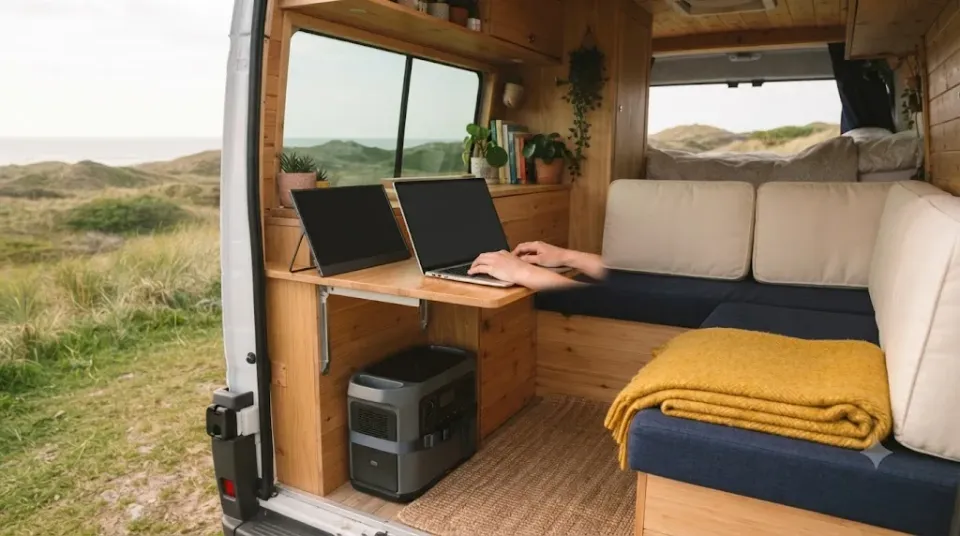
Mira works remotely as a designer. She spends six weeks of spring in her van, moving slowly from Zeeland in the Netherlands into northern Germany. She needs a working day of laptop and monitor, a phone hotspot, a compressor fridge, light, and she would love her small coffee machine.
| Device | Typical draw | Use per day | Energy per day |
|---|---|---|---|
| Compressor fridge (built in) | 40 - 60 W while running | runs about a third of the time | 350 - 500 Wh |
| Laptop, working day | 40 - 60 W | 7 h | 280 - 420 Wh |
| Portable monitor | 10 - 20 W | 7 h | 70 - 140 Wh |
| Phone as hotspot | - | 2 charges | about 35 Wh |
| Lights | 10 W | 5 h | 50 Wh |
| Coffee machine, 2 cups | about 1,200 W | about 10 min | about 200 Wh |
| Total | about 1,000 - 1,350 Wh |
Her real figures, measured with the station's own display over the first week, averaged about 1.2 kWh. So her question is not really "how big a battery" but "how much can I put back each day without hook-up?"
Mira's refill plan
You have four ways to refill a van battery, and most van dwellers use two or three of them.
- Campsite hook-up. Plug into the 230 V pillar and charge at full speed. Check the site's amp limit - some pitches only allow a few amps before the breaker trips.
- Driving. The 12 V socket usually gives around 100 to 120 W. Three hours of driving adds roughly 300 Wh. Some stations accept faster charging from a dedicated DC-DC charger (a device that charges a second battery from the van's alternator at a controlled rate) wired to the van's starter battery.
- Folding solar. A 200 W folding panel might give 600 to 1,000 Wh on a long, bright summer day if you keep it facing the sun. In spring and autumn expect much less, and on cloudy days a fraction of that. Read pairing panels with a power station before connecting anything.
- Roof panels. Fixed panels on a van roof work all day without being set up, though lying flat they catch less than a tilted panel.
Mira has 400 W of panels flat on her roof and a 2 kWh-class power station, with a DC-DC charger fitted by a van workshop. In March in northern Germany, lying flat, her roof gave her roughly 400 to 900 Wh on most days and far less in rain. By mid-April it was closer to 1 to 1.5 kWh on good days. Driving twice a week through the DC-DC charger, which can push a few hundred watts, filled the gaps.
Why does flat roof solar do so poorly in March? The sun sits low in the sky, so a panel lying flat meets its light at a shallow angle and catches only part of it. A folding panel propped up toward the south at a steep angle can beat a flat roof panel of the same rating on a spring morning. Mira now carries a 100 W folding panel as well, and sets it up whenever she stays two nights in one place. On a clear day it adds another 250 to 400 Wh, enough to cover her laptop.
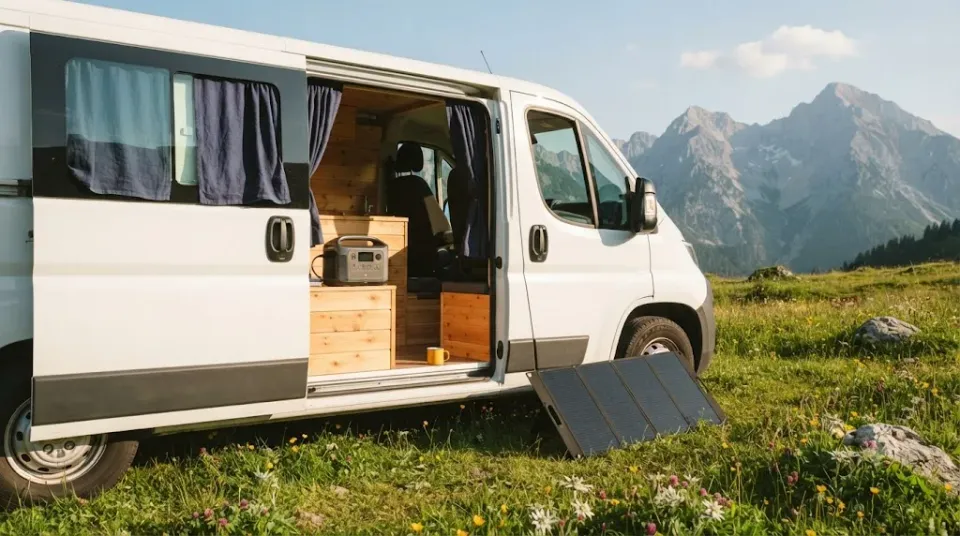
Spring is the hard part. In March she needed a hook-up night roughly every four to five days. By late April she could go a week or more. If she does the same trip in June, roof solar alone will very likely carry her.
Victron Energy Orion-Tr Smart 12/12-30
A DC-DC charger that charges a leisure battery from the van's alternator while driving, much faster than a 12 V socket. It needs proper wiring and fusing, so have a van workshop or electrician fit it.
Check price on Amazon Ad - affiliate link. Prices change; check the listing.The coffee machine compromise
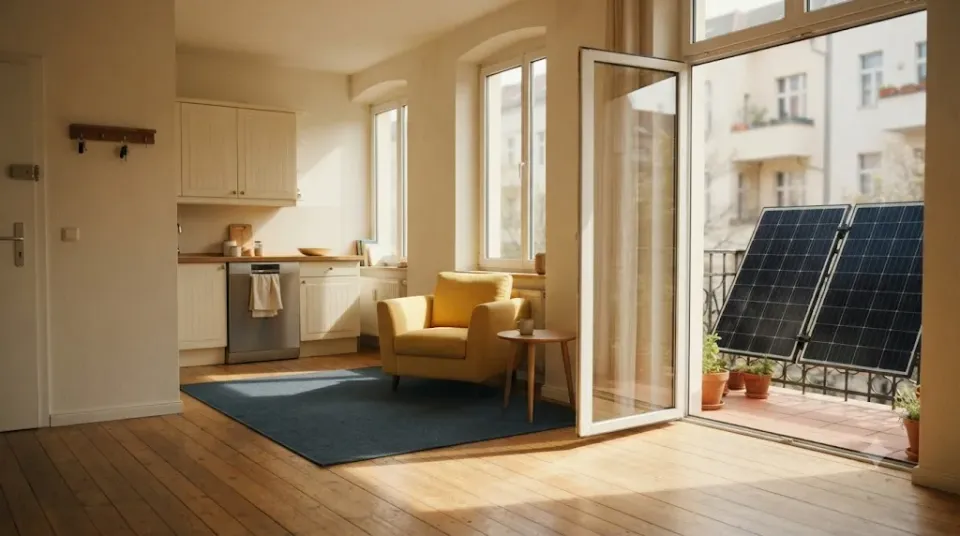
Mira kept the coffee machine but moved it. She makes coffee at noon on sunny days, when the roof is producing most, rather than at 7:00 when the battery is at its lowest after the night. Same habit, different hour. It is the same idea as running a dishwasher at midday with balcony solar at home, which which appliances to run in the sun explains. If you want to see how strongly the hour matters, put a south-facing setup into Sunslot for your home city in March and look at how quickly output falls after 15:00.
What the three households have in common
Put the three side by side, and the same rules keep showing up.
| Rule | Lena and Tom | Bauers | Mira |
|---|---|---|---|
| Biggest single load | Fan | Cool box | Fridge and laptop |
| Battery chosen | about 300 Wh | about 1 kWh | about 2 kWh |
| Main refill | None needed | Driving and folding panel | Roof solar and DC-DC |
| Hook-up needed | No | Every third night | Every 4 - 7 days in spring |
| Mistake avoided or made | Avoided buying too big | Kettle tripped the inverter | Coffee at the wrong hour |
A simple rule: if your daily budget is under what you can reliably put back, you can stay off-grid as long as the weather holds. If not, plan a campsite night every few days.
Why the battery chemistry matters on the road
Most current power stations use LiFePO4 (lithium iron phosphate) cells, which typically last thousands of full cycles. Older or lighter designs use NMC (nickel manganese cobalt) cells, which are lighter for their size but usually last fewer cycles. Mira cycles her battery almost every day for six weeks a year, so LiFePO4 makes sense for her. Lena and Tom use theirs a few weekends a year, so weight matters more than cycle life. Our LiFePO4 vs NMC article compares them.
Safety and care on the road
- Keep the station out of direct sun inside a parked van. Interiors get very hot in summer, and batteries do not like heat. Under a seat or in a shaded cupboard with some airflow is better than the dashboard.
- Most batteries should not be charged below freezing. In winter, keep the unit inside the warm part of the van overnight. Some stations have built-in heating; check the manual.
- Secure it while driving. A loose 10 to 20 kg box is a hazard in a sudden stop. Use a strap to a fixed point, not a bungee to a door handle.
- Use cables and plugs rated for the current. Thin, cheap 12 V leads get warm and waste energy. A 12 V device pulling 5 A loses noticeably more power through a long, thin lead than a short, thick one.
- Leave DC-DC chargers and anything wired to the starter battery to a van workshop or an electrician unless you know what you are doing. A wrongly fused cable near a fuel line is a fire risk.
- Never run petrol generators or gas heaters inside a closed van or tent. Carbon monoxide has no smell.
Jackery Explorer 1000 v2
A 1 kWh-class LiFePO4 station that covers a cool box, lights and phones for about a day and charges from 230 V, 12 V or solar. For more than a day off-grid you still need a way to refill it.
Check price on Amazon Ad - affiliate link. Prices change; check the listing.Which household are you? What I would buy
Here is how I would set up each type of trip, as a neighbour who spends a lot of time with batteries.
- Weekend tent, no cooling: a large power bank per person, or a 300 Wh-class station if you want a 230 V socket for a fan or a camera charger. Skip the solar panel at first.
- Van or car camping with a compressor cool box: a 1 kWh-class LiFePO4 station, a 200 W folding panel, and the cool box run from the 12 V output. Plan a hook-up every two to three nights in poor weather.
- Living or working in a van: a 2 kWh-class station or a fixed leisure battery, 300 to 400 W of roof panels, and a DC-DC charger fitted by a professional. Leave room in your budget for a hook-up night per week in spring and autumn.
Whatever you choose, use the station at home for a weekend first. Run the cool box from it for 24 hours and read the display. Ten minutes of real data beats a page of estimates. And the box does not have to sit idle between trips: it is also the core of a 48-hour power cut plan for your flat.
Match the battery to the trip, keep an eye on the big-wattage items, and plan at least one reliable way to recharge. Then the power simply works and you can get on with the holiday.
Camping and van questions
How big a power station do I need for a compressor cool box?
A compressor cool box typically uses 300 to 500 Wh a day in summer. A 1 kWh-class station covers one to two days on its own after losses. For longer trips, add a folding panel, charge while driving, or plan hook-up nights.
Can I charge a power station while driving?
Yes. The 12 V socket usually gives about 100 to 120 W, so three hours of driving adds roughly 300 Wh. A DC-DC charger wired to the starter battery can be much faster, but should be fitted by someone who knows vehicle wiring.
Will a 200 W folding panel keep my battery full?
On a long, bright summer day, if you keep turning it to the sun, it might bring 600 to 1,000 Wh. In spring, autumn or cloudy weather it brings much less, so treat it as a top-up, not a guarantee.
Can I use a kettle or hair dryer on a power station?
Only if the station's inverter is rated above the device, often 1,500 to 2,500 W. Even then, a litre of boiled water costs about 100 Wh. On most trips a gas stove outdoors is the better choice for heat.
Is it safe to leave a power station in a hot van?
Avoid it where you can. Parked van interiors get very hot in summer, and heat shortens battery life. Keep it shaded, low down and ventilated, and never on the dashboard.