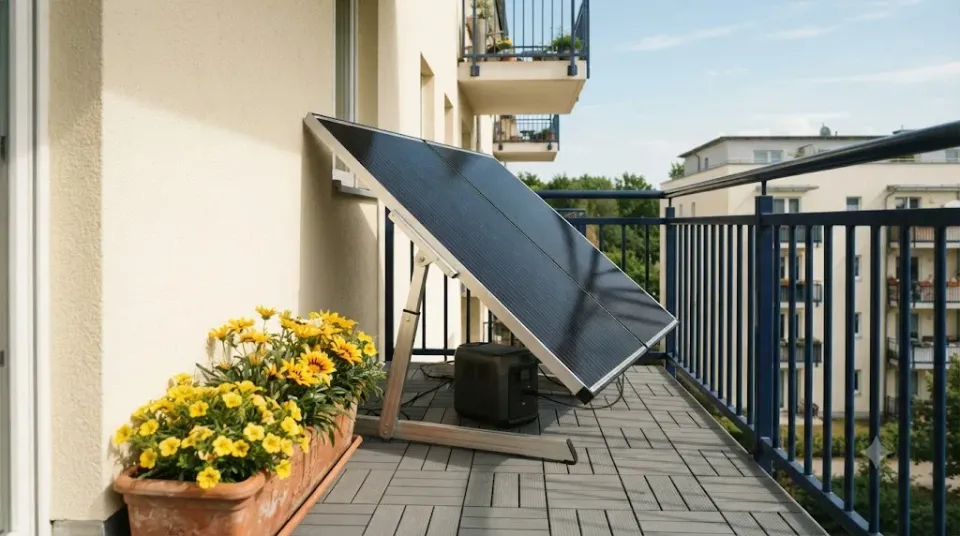


Here is a mistake that costs many balcony owners 30 to 50 € a year: they start the washing machine and the dishwasher together at 9:00 on a sunny Saturday. Both heat water at once, the flat pulls around 4,000 W, the panels supply maybe 400 W of it, and the rest comes from the grid. Two hours later, at peak sun, nothing is running and the panels export their power for nothing. Same appliances, same day, wrong order.
This guide fixes that in seven steps. You will learn which appliances suit solar hours, how to find your own best hours, and how to build a simple daily routine around an 800 W balcony. No new gadgets needed, though a cheap energy meter helps. Each step ends with something you can do today.
Step 1: Know your ceiling - 800 W at best
In Germany a plug-in system may feed up to 800 W into your home. That is the limit of the microinverter (the box that turns the panels' DC power into 230 V AC for your sockets). In practice you get close to 800 W only near midday on a clear day with well-aimed panels. Morning, evening and winter output is often 100 to 400 W.
That is your budget. Think of it like a tap that runs at a certain flow. Anything your flat uses up to that flow comes from your panels. Anything above it comes from the grid.
Two quick numbers to keep in mind:
- Power, in watts (W), is how fast something uses energy right now. A kettle is 2,000 W or more.
- Energy, in kilowatt-hours (kWh), is power multiplied by time. That is what you pay for. A 500 W dryer running for two hours uses 1 kWh.
If this is new, our article on watts vs watt-hours explains it in five minutes, and how much power balcony solar makes shows typical daily curves.
Do today: open your inverter app at 9:00, 12:00 and 16:00 and write down the watts. That is your first rough curve.
Step 2: Sort your appliances into good, partial and poor matches
The best match for solar is an appliance with a moderate draw over a long time. A huge draw for a few minutes barely benefits, because your panels cover only a slice of it. Here is the sorting table.
| Appliance | Typical draw | Match with solar | Why |
|---|---|---|---|
| Dishwasher | 1,800 - 2,200 W heating, low otherwise | Good | Heats briefly, then runs on little power for an hour or more |
| Washing machine (30 - 40 °C) | about 2,000 W heating, 200 - 500 W washing | Good | Short heating phase, long low-power phase |
| Heat pump dryer | about 500 - 1,000 W | Good | Moderate draw over 2 - 3 hours |
| E-bike, laptop, tool chargers | 50 - 200 W | Very good | Small, steady loads that fit inside the solar supply |
| Power station charging | 200 - 800 W adjustable | Very good | Many let you set the charge rate |
| Dehumidifier | about 200 - 400 W | Good | Steady, can run for hours |
| Kettle, toaster, hair dryer | 1,500 - 3,000 W | Poor | Huge draw for minutes - solar covers only a slice |
| Oven | 2,000 - 3,500 W | Partial | Long run helps, but most of it comes from the grid |
| Induction hob | 1,000 - 3,500 W per zone | Partial | Lower settings fit better than boiling at full power |
| Fridge, router, standby | about 50 - 150 W together | Automatic | Runs all day, covered without you doing anything |
The wattages are typical ranges. Your own appliance may differ. A plug-in energy meter tells you the truth in a minute.
A word on the "automatic" row. Your base load (the power your flat draws around the clock) gets covered by solar every sunny hour without any effort. Our article on your base load shows how to measure it. Everything in this guide is about what comes on top.
Do today: mark the three "good" or "very good" appliances you use most often. Those are your targets.
Step 3: Measure what your own appliances really draw
Datasheets give maximum ratings. What matters for solar is the shape of a whole cycle. A washing machine on eco 40 might pull around 2,000 W for 10 to 20 minutes while it heats, then 100 to 300 W for over an hour while it turns and spins. That long tail is perfect solar territory.
Here is how to measure it:
- Plug a metering smart plug or a plug-in energy meter between the socket and the appliance. Check the meter is rated for the appliance's maximum power (most are rated to around 3,500 W or 16 A).
- Run one normal cycle on the programme you usually use.
- Note three things: the peak watts, how long the peak lasts, and the total kWh at the end.
- Repeat with the eco programme if you normally use a shorter one.
Brennenstuhl Primera-Line PM 231 E
A simple plug-in energy meter with a display - no app, no Wi-Fi, just plug in and read watts and kWh. Great for finding standby hogs; the limitation is that you have to read it on the spot rather than see history on your phone.
Check price on Amazon Ad - affiliate link. Prices change; check the listing.An example result from a typical dishwasher might look like this: eco programme, 3 hours 40 minutes, peak about 2,000 W for around 15 minutes, total about 0.85 kWh. The quick programme on the same machine: 1 hour, peak about 2,100 W for 25 minutes, total about 1.1 kWh. The eco cycle uses less energy and spreads it out, so far more of it can come from your panels.
The power station trick
If you own a portable power station, it can act as a small, flexible load. Many models let you set the AC charging rate, for example to 300 or 400 W. Plug it in at the start of your sunny window with the rate set below your typical output, and it fills from your panels instead of the grid. A 1 kWh unit charged this way from solar a few times a month moves a few dozen kWh a year onto your own sun. It also means the unit is full if the power goes out. Note that a standard balcony inverter switches off in a power cut, so the station must be charged before, not during. Our power cut plan covers this.
Do today: measure one cycle of your dishwasher. It is the easiest appliance to move.
Step 4: Find your real best hours
The best time depends on which way your panels face. Rough guides:
| Panel direction | Strongest window (summer, rough) | Notes |
|---|---|---|
| South | about 11:00 - 15:00 | High midday peak, easy to waste if nothing runs |
| East | about 8:00 - 12:00 | Suits a morning wash before work |
| West | about 13:00 - 18:00 | Suits after-school and early evening jobs |
| East + west split | morning and afternoon, flatter peak | Less total, but easier to use |
| Vertical on a railing | flatter all day | In winter the low sun can suit a steep panel |
These are rough. Times shift with the season and with daylight saving time: in summer, solar noon in Germany falls roughly between 13:00 and 13:45 on the clock, depending on how far east or west you live. And your shade matters most. A building opposite might block the sun until 13:00. A balcony above might cut the high summer sun at midday. Our article on shading covers the effect.
Sunslot takes the guesswork out. It estimates hour-by-hour output for your balcony direction, tilt, shade and city, then tells you which hours to run which appliance. Put your own balcony in and look for the dip: if a neighbouring roof shades you at 14:00, you will see it, and you will know not to start the dryer then.
Do today: write down your best three-hour window for a sunny summer day and a sunny spring day.
Step 5: Build a one-at-a-time schedule
The golden rule: run heating appliances one after another, not together. Two heating phases at once far exceed 800 W, and most of the extra comes from the grid. Spread them out and each one gets closer to what the panels cover.
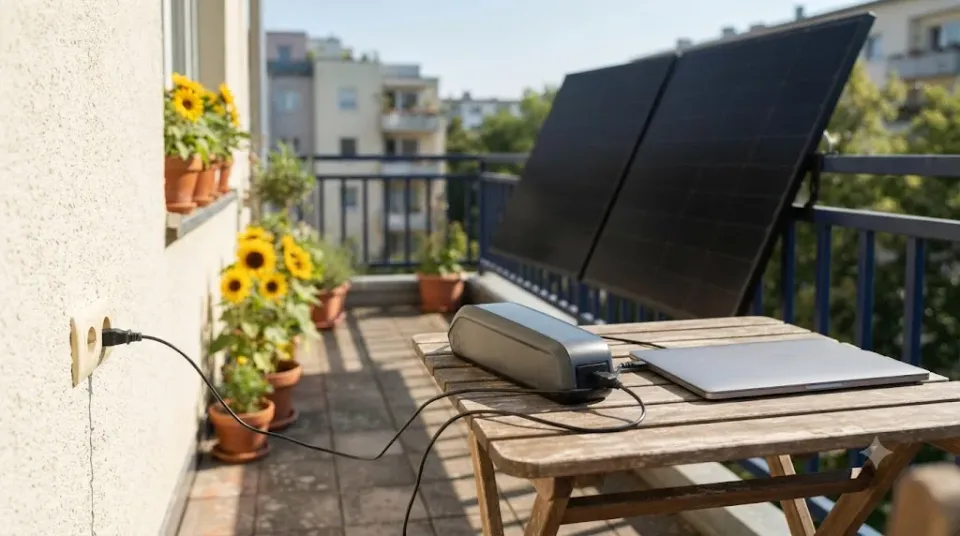
Here is a sample sunny day for a household with a south-facing 800 W system:
- 10:30 - washing machine on eco 40. The heating phase overlaps with rising solar.
- 12:30 - washing done. Start the dishwasher on eco.
- 13:00 - e-bike battery and laptop on charge. Small loads fit alongside the dishwasher's low phase.
- 14:30 - heat pump dryer if needed.
- Evening - kettle, oven and TV run on grid power as usual.
Not home at midday? Use delay timers. Most dishwashers and washing machines have a "start in X hours" button. Load in the morning, set the delay, leave. Our example household Jonas in the self-consumption case study gained about 29 € a year doing exactly that.
Here is how the schedule shifts by panel direction:
| Job | South | East | West |
|---|---|---|---|
| Washing machine | 10:30 | 8:30 | 13:30 |
| Dishwasher | 12:30 | 10:30 | 15:30 |
| Chargers | 13:00 - 15:00 | 9:00 - 12:00 | 14:00 - 18:00 |
| Dryer | 14:30 | 11:00 | 16:00 |
All times are rough summer examples. Adjust them to your shade and season.
A worked example: an east balcony in Cologne
Take an example household: Anna, who lives on the fourth floor in Cologne with two panels on an east-facing railing. She works in an office from 8:30, so she leaves at 8:00. On a clear June morning her panels climb past 300 W at around 7:30 and peak at roughly 550 to 650 W between 9:00 and 11:00. By 13:00 the sun has moved round and output falls below 200 W.
Anna's old routine: dishwasher at 20:00, laundry on Sunday evening. Almost none of it came from her panels. Her new routine:
- 7:15 - load the dishwasher, set eco with a two-hour delay. It starts at 9:15, heats while output is strong, and finishes early afternoon.
- Saturday 8:30 - washing machine on eco 40. Done by about 11:00.
- Saturday 11:00 - second load, or the e-bike battery and laptop on charge.
- Weekday mornings - nothing else. Her fridge and router soak up the rest.
Rough maths for this example: if the dishwasher gets about 0.4 kWh more from solar on around 150 sunny-ish mornings, that is 60 kWh. Weekend laundry adds maybe 30 kWh. Total about 90 kWh, or about 33 € a year at 37 ct/kWh. Not a fortune, but it costs her two button presses.
Anna's lesson: on an east balcony, "midday" is the wrong advice. Her window closes by lunchtime. A west-facing neighbour across the courtyard would do the opposite: laundry after 14:00, and the dishwasher started on a long delay so it heats around 15:00 to 16:00.
Do today: write your own four-line schedule on a sticky note and put it on the dishwasher.
Step 6: Adjust for weather and season
On a bright summer day, rearranging pays. On a grey November day, the gain is small. Output on a cloudy day might be 50 to 150 W, barely enough to cover the fridge and router. Do not bend your life around it.
A simple rule set:
- Clear sky, April to September: follow your schedule.
- Bright but hazy: check the app first. If output is above about 300 W, go ahead.
- Overcast: run things when it suits you. Maybe still prefer midday for chargers.
- Winter: on bright days, the low sun can still give decent output on steep or vertical panels for a few hours. A single dishwasher run in that window is worth it. See winter, snow and heat.
Look at the weather forecast the evening before. If tomorrow is clear, load the dishwasher and washing machine and set the timers. If not, run them whenever.
Do today: nothing - just check tomorrow's forecast tonight.
Step 7: Check the result and work out what it is worth
After a month, compare. Your inverter app shows total production. If you have a smart meter or a meter that records exported power, you can see how much left the flat. Otherwise, compare your grid consumption with the same month last year, allowing for weather and habits.
Here is a rough example, with assumptions stated. Say timing your laundry and dishwasher to the sun moves about 150 kWh a year from grid power to solar power. At 37 ct/kWh, close to the average for new German household contracts in 2026, that is about 55 € a year. Your figure depends on your appliances and habits, but it is real money for no outlay.
How the 150 kWh adds up, roughly:
- Dishwasher: about 200 sunny-ish runs a year x about 0.4 kWh extra covered by solar = 80 kWh
- Washing machine: about 100 runs x about 0.4 kWh = 40 kWh
- Chargers and dryer: about 30 kWh
For the bigger picture, see self-consumption and payback maths.

Shelly Plug S Gen3
A Wi-Fi smart plug with power metering that shows live watts and kWh per appliance in an app, ideal for learning what your washing machine or dishwasher really draws. Its maximum load is lower than a wall socket, so check the rating before using it on heaters, kettles or other high-draw appliances.
Check price on Amazon Ad - affiliate link. Prices change; check the listing.Your checklist
Print this, or copy it into your phone notes.
| Check | Done when |
|---|---|
| I know my ceiling | I have seen my peak watts on a clear day in the app |
| I know my window | I have written down my best three hours, summer and spring |
| I have measured one appliance | I know its peak watts, peak length and total kWh |
| I use eco programmes | Eco is the default on dishwasher and washing machine |
| I run one heater at a time | Washing machine and dishwasher never heat together |
| Delay timers are set | I load in the morning and the machine starts in my window |
| Chargers move to midday | E-bike, laptop, tools and power station charge in sun hours |
| I check the forecast | On clear days I plan, on grey days I do not bother |
| I review after a month | I have compared production and grid use |
Timing mistakes
- Starting everything at once. The most common and most expensive one. Two heating phases together can draw 4,000 W. Stagger them by at least an hour.
- Timing the kettle. Boiling water at noon saves a few cents a year. A 2,000 W kettle for three minutes uses 0.1 kWh, and your panels cover only a slice. Not worth thinking about.
- Using the quick programme "to finish before the sun goes". Quick programmes pull high power for longer. Eco is better almost every time.
- Plugging appliances into a power strip with the balcony system. The balcony system should go straight into a fixed wall socket, never a power strip or extension. Your appliances go wherever they normally do.
- Running a dryer you do not need. Using a tumble dryer on a sunny day instead of the clothes line costs more than it saves. Shift what you already do. Do not invent loads.
- Assuming the window never changes. In March, a south balcony's useful window is shorter and later than in June. Revisit your times each season.
- Ignoring the oven. A long, slow roast at midday on a weekend can take a meaningful bite from your solar - the oven cycles on and off once hot, and during the off times the panels cover the rest of the flat. Not the best match, but not useless.
EcoFlow RIVER 2 Pro
A 768 Wh LiFePO4 portable power station with adjustable AC charging, so you can fill it from your balcony surplus and have power ready for a cut. It is too small to run a household for long - think fridge, router, lights and phones.
Check price on Amazon Ad - affiliate link. Prices change; check the listing.What I'd do first
If you only do one thing, move the dishwasher. Load it after breakfast, set the delay timer to start in your best window, use the eco programme. It runs almost every day, it fits solar well, and it needs no habit change beyond pressing one button.
Then add laundry on weekends, two hours apart from the dishwasher. Then charge things at midday. Within a month you will know your balcony better than any datasheet. And if you want to see your hours before you change anything, put your balcony into Sunslot and let it suggest the slots. Watch your monitoring app to see the effect.
Appliance timing questions
What is the best appliance to run on balcony solar?
The dishwasher on eco. It heats briefly and then runs for an hour or more on little power, it runs most days, and it has a delay timer. Chargers for e-bikes and laptops are also excellent matches.
Can my balcony system run a kettle or a hair dryer?
Partly. They draw 1,500 to 3,000 W, so your panels cover up to 800 W of that and the grid supplies the rest. Because they run only for minutes, timing them gains almost nothing.
Should I run the washing machine and dishwasher together at noon?
No. Two heating phases together can draw around 4,000 W. Run one, then the other an hour or two later, so each gets more of its power from your panels.
What time is best for a west-facing balcony?
Roughly 13:00 to 18:00 in summer, depending on shade. Afternoon laundry and after-school charging suit it well. Check your exact hours with an hour-by-hour estimate.
Is it worth timing appliances in winter?
On bright winter days, a little. Output is much lower, so one dishwasher run around midday is about as much as it is worth shifting. On grey days, do not bother.