Every November the same message lands in balcony solar forums: "My system made 0.4 kWh today. Is it broken?" Almost always, it is not. A sunny June day in Germany can give you eight to ten times more energy than a grey December day. That gap is normal physics, not a fault. And the reverse surprise comes in July, when a blazing afternoon produces less than a cool, bright morning in April.
Seasons change your output more than any panel label. Most of what people believe about cold, snow and heat is half right at best. Below are eight common myths, what is actually true, and the numbers that prove it, so you know what to expect, what to ignore and what is worth doing.
Myth 1: "Solar panels barely work in winter, so the system is pointless half the year"
What is true: winter output is low, but it is not zero, and the year is carried by the other months. Plan for the year, not for December.
Here is a rough guide for an 800 Wp system facing south in central Germany. Treat these as ballpark figures, not promises. Your city, tilt and shade will move them.
| Month | Typical energy per day | Share of the year |
|---|---|---|
| June | 3 to 4.5 kWh | About 13 % |
| March / September | 1.8 to 2.8 kWh | About 8 to 9 % |
| December | 0.3 to 0.6 kWh | About 2 % |
The proof is in the shares. December gives you about 2 percent of the year. The six months from April to September together give you roughly three quarters. So a dead December costs you very little of the annual total, and it does not change the payback much.
Why is winter so weak? Three reasons stack up:
- Short days. In central Germany a December day has about eight hours of daylight against about sixteen in June.
- Low sun. At a low angle, sunlight passes through much more air and cloud before it reaches you. Less of it arrives.
- Grey skies. From November to February the sky over most of Germany is often overcast for days at a time.
Even small winter numbers have value, though. Half a kilowatt-hour on a grey day still covers a good part of your fridge and router running in the background. Our guide to your base load shows why those always-on watts are the first thing solar eats.
Myth 2: "Cold weather lowers solar output"
What is true: cold makes solar cells work better, not worse. Winter output is low because of light, not temperature.
A solar cell's voltage rises as its temperature falls. Panel ratings are measured with the cells at 25 °C. On a bright, frosty morning the cells may sit well below that, so for a short spell a panel can make close to its rated power, sometimes slightly above it.
The proof is the temperature coefficient (how much output changes per degree away from 25 °C), printed on every panel data sheet. For most modern panels it is around minus 0.3 to 0.4 percent per degree. The minus sign works both ways. Above 25 °C you lose that much per degree. Below 25 °C you gain it.
A cell at 0 °C is 25 degrees below the test temperature. 25 times 0.35 percent is about 9 percent more power than at 25 °C, for the same light.
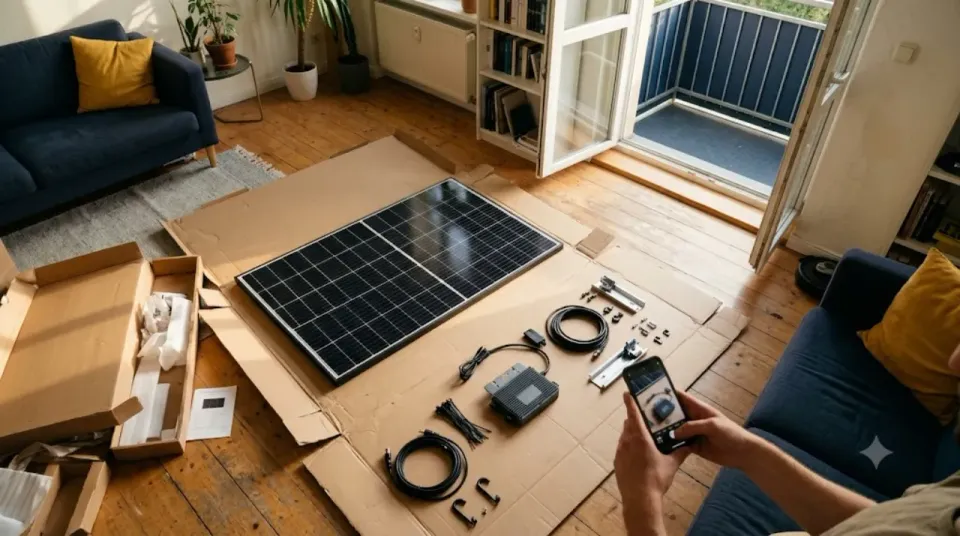
There is one thing to check. Higher voltage in the cold must stay within your microinverter's input limit (the microinverter is the small box that turns the panels' direct current into household alternating current). A kit sold as a matched set is designed for this. If you mix panels and inverter yourself, check the panel's open-circuit voltage at the coldest temperature you expect against the inverter's maximum input voltage. Our guide to volts, amps and MPPT explains how.
Myth 3: "Snow on the panels means zero power until spring"
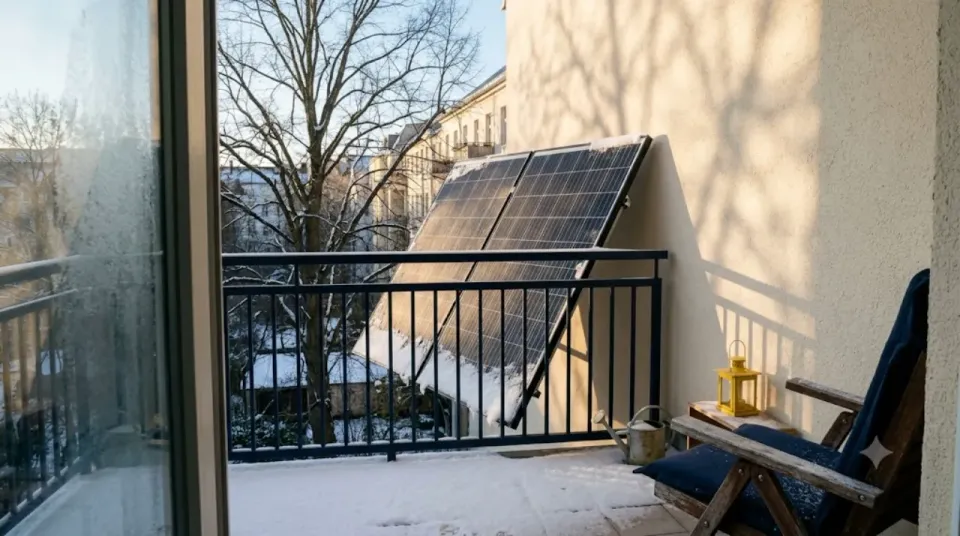
What is true: thin snow blocks less than you think, and steep balcony panels usually clear themselves within hours or days.
A light dusting lets some light through. The dark glass absorbs that light, warms up a little, and the snow starts to slide. A thick layer does stop output completely, but only until it melts or slips off.
On a balcony, gravity is on your side. Panels hanging vertically or at a steep angle shed snow much faster than flat ones on a roof. A vertical panel on a railing often never holds much snow in the first place.
Here is how the angle changes things:
| Panel angle | What snow usually does | Do you need to act? |
|---|---|---|
| Vertical (90°) on a railing | Rarely sticks; slides off fast | No |
| Steep (60 to 70°) | Slides off once the sun warms the glass | Rarely |
| Medium (30 to 35°) | Can sit a day or two after heavy snow | Usually no |
| Flat or nearly flat (0 to 15°) | Can stay for days or weeks | Only if you can reach it safely |
And remember the scale. Even a week of snow-covered panels in January costs you a few kWh at most, because January output is small anyway. At 35 cents per kWh, five lost kWh is under two euros.
Shelly Plug S Gen3
Logs what your inverter feeds day by day, so you can compare a grey week with a clear one instead of guessing. It measures only the socket it sits in.
Check price on Amazon Ad - affiliate link. Prices change; check the listing.Myth 4: "You should clear snow off straight away, with whatever is to hand"
What is true: most of the time you should leave it. When you do clear it, the wrong method can cost you a panel or a fall.
These are the rules I follow:
- Do not climb or lean out to clear snow. No few cents of power are worth a fall from a balcony.
- Do not use hot water. Cold glass hit by hot water can crack from the sudden temperature change.
- Do not scrape. Metal scrapers and stiff brushes scratch the anti-reflective coating, and scratches cost output for the rest of the panel's life.
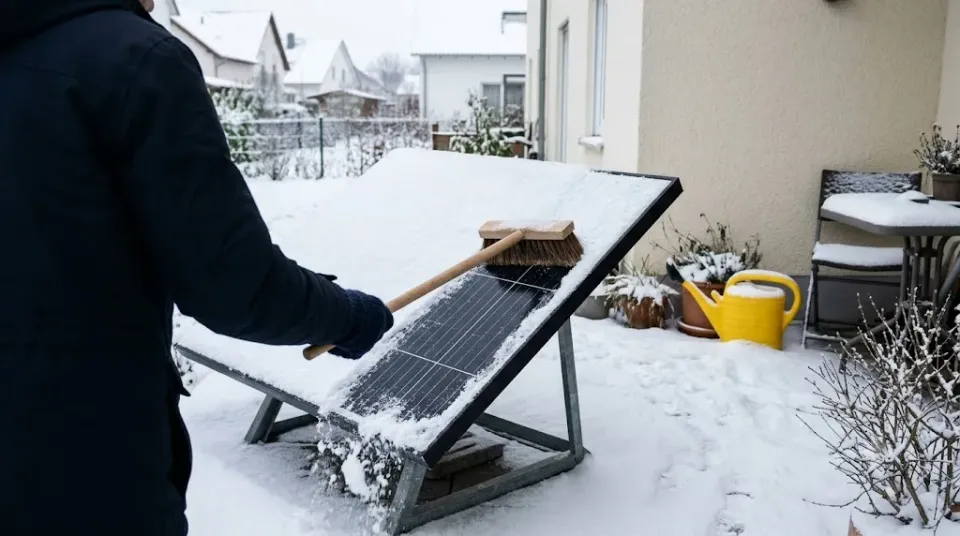
- A soft broom from inside is fine. If you can reach the panel safely without leaning over the railing, sweep gently downwards.
- Check the mount after heavy snow. Wet snow is heavy. Make sure brackets, clamps and cable ties are still tight once it has gone.
The proof that patience works: a cleared panel in January gains you a fraction of a kilowatt-hour per day. A cracked panel costs you its whole output for every remaining year. The trade is not close.
Myth 5: "Hot, sunny days are the best days for solar"
What is true: bright days are best, hot ones are not. On a blazing July afternoon your panels make noticeably less than their rating.
In direct sun on a hot day, the cells inside a panel reach 60 to 70 °C, far above the 25 °C used for the rating. The temperature coefficient now works against you. Here is the maths for a cell at 65 °C:
- 65 °C minus 25 °C is 40 degrees.
- 40 times 0.35 percent is 14 percent.
- An 800 Wp system then peaks around 690 W instead of 800 W, before any other losses.
That is why people often see their best peak watts in April or May, on cool, clear days, rather than in a July heatwave. Your total summer energy is still high, because the days are long. You simply lose a slice in the middle of the day.
Under current German rules a plug-in system may have up to 960 Wp of panels on a normal household plug, while the inverter feeds in at most 800 W. Slightly more panel power than inverter power helps fill that midday heat gap. It also lifts output in the mornings, evenings and on hazy days. Our 800 W rules guide explains the limits.
Myth 6: "Nothing can be done about heat losses"
What is true: airflow behind the panel makes a real difference, and on a balcony it is often the easiest fix there is.
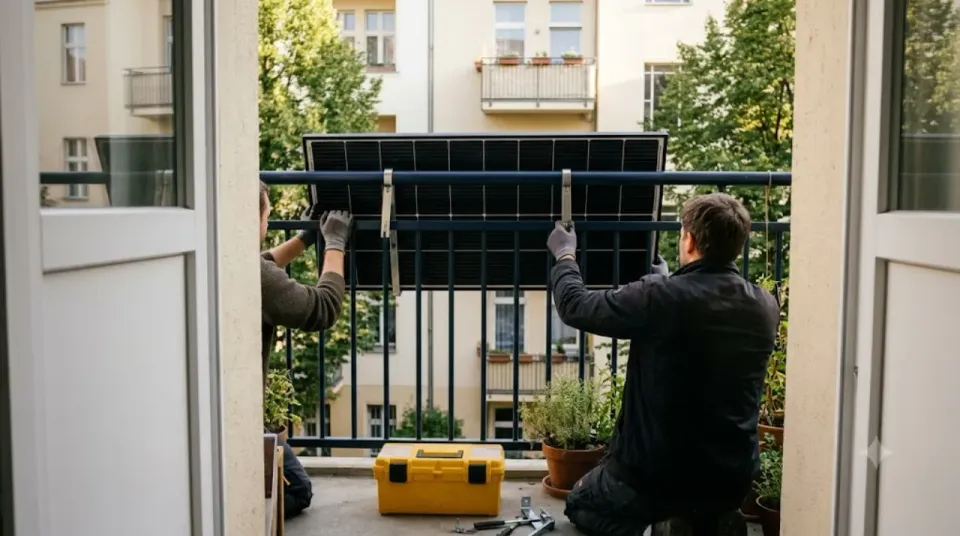
A panel cools itself by letting air move across both faces. Pressed flat against a sun-baked wall, the back cannot shed heat, so the cells run hotter. Even a few centimetres of gap helps. A panel mounted out from the wall at an angle, with air flowing behind, runs noticeably cooler than one clamped flush to dark render.

How much is it worth? Say good airflow keeps your cells 10 °C cooler on a hot afternoon. 10 times 0.35 percent is 3.5 percent more power in those hours. On a hot day where the system would make 600 W, that is about 20 W extra. It is not huge, but it costs nothing if you plan it at mounting time.
A few more heat habits:
- Choose a mount with a gap rather than one that pins the panel to the wall. Our railing mounting guide shows the options.
- Keep the inverter in shade if you can. Microinverters reduce output to protect themselves when they get very hot. Tucking it behind the panel, out of direct sun, helps.
- Do not block the vents on the inverter with cable ties or covers.
Solarway Balkonkraftwerk Halterung
An adjustable mount that sets a steeper winter-friendly angle and leaves an air gap behind the panel. Check the rated panel size and weight, and that it suits your railing or surface.
Check price on Amazon Ad - affiliate link. Prices change; check the listing.Myth 7: "The best panel angle is the same all year"
What is true: steep panels favour winter, flatter panels favour summer and the year total. On a balcony, your fixed angle decides which season you are strongest in.
In summer the sun climbs high, so a panel tilted back at 30 to 35 degrees faces it almost head-on at midday. In winter the sun stays low, so a steep panel at 60 to 70 degrees, or even vertical, catches it better.
| Tilt | Strong season | Typical place |
|---|---|---|
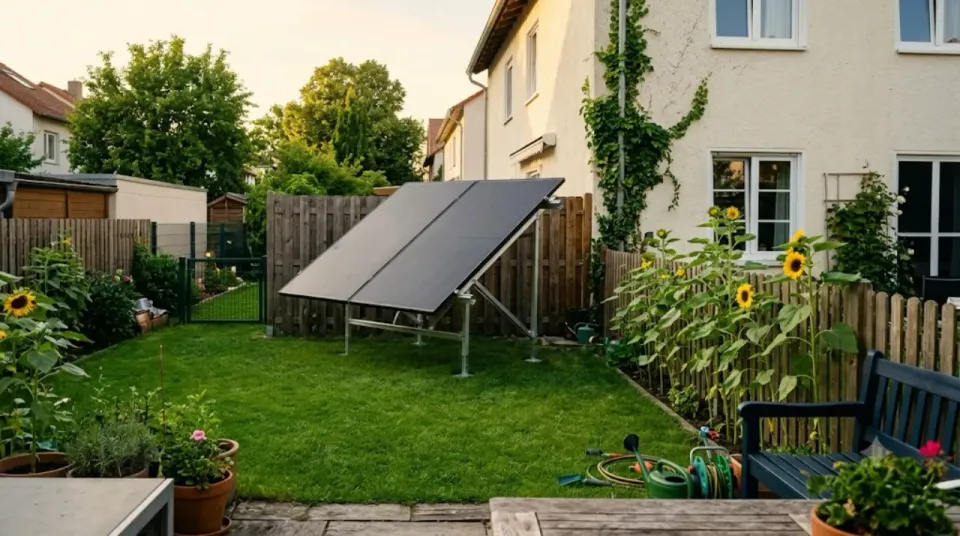
| 30 to 35° | Best year total, strong summer | Flat roof frame, garden stand |
| 60 to 70° | Favours spring, autumn and winter | Angled railing mount |
| 90° (vertical) | Weaker summer, comparatively good winter, flatter curve | Panel hanging flat on a railing |
A vertical south panel loses a fair share of its summer output. But in winter it does comparatively well, because the low sun hits it almost straight on, and snow slides off. Many rented balconies end up vertical anyway, so it helps to know you are giving up summer peaks, not winter ones.
Direction matters too. East and west panels miss the midday peak but stretch output into the morning or evening. See east-west versus south for the full comparison. If you want to see how your fixed angle plays out month by month, put your balcony into Sunslot. Enter the tilt you actually have, then flip between a June day and a December day and look at the shape of the curve.
Myth 8: "A bad week means something is wrong"
What is true: weather swings are large, and a grey fortnight in January says nothing about your system. Judge it by comparing like with like.
Two days in the same week can differ by a factor of five or more. A run of fog in November can push daily output close to zero for days. That is normal.
Here is how to tell a real fault from weather:
- Compare with a sunny day in the same month. If a clear day in January gives you a sensible figure, the system works.
- Compare month to month, year to year. This January against last January is a fair test. This January against last June is not.
- Look for a sudden drop on a clear day. That is worth checking. Common causes are a loose plug, an inverter that has dropped off the Wi-Fi, new shade, or a panel that is covered.
- Check the inverter status light or app. Most show an error code if something is genuinely wrong.
A smart plug that logs daily kWh makes this easy. Our guide to apps, smart plugs and your meter shows how to read the numbers.
GARDENA Cleansystem Handbürste M soft
A soft hand brush that can also connect to a garden hose, for rinsing pollen and dust off glass without scratching the coating. Use it only where you can reach safely without leaning over a railing.
Check price on Amazon Ad - affiliate link. Prices change; check the listing.What actually helps through the year
Once the myths are out of the way, the useful habits are short. The trick is to match your big loads to the hours you actually make power. In summer that window is wide, roughly from mid-morning to late afternoon. In winter it may be only three or four hours around midday.
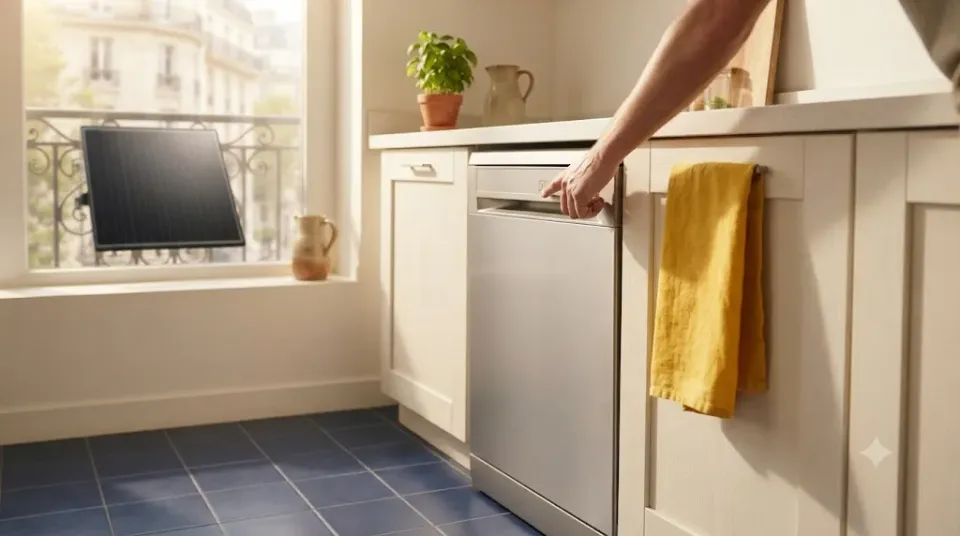
- Move big loads to the sunny window. Run the washing machine or dishwasher when the panels are producing. Our guide to which appliances to run in the sun has the details.
- Re-check your timing in October and March. The best hours shift as the sun drops and climbs. Sunslot estimates output hour by hour for your direction, tilt, shade and city, and suggests which hours suit the washing machine. Run it again each season, because the 11:00 start that works in May may be too early in November.
- Clean twice a year with plain water and a soft cloth, once in spring and once in autumn. Pollen, dust and bird droppings cost more than snow ever will.
- Watch for new shade. Bare trees in winter let light through. But a low sun throws long shadows from buildings and balconies above that never shaded you in summer. Read our shading guide.
- Check the mount twice a year, after the autumn storms and after the last snow.
If you want energy for winter evenings, a small battery can shift some of your midday surplus. But in December there is very little surplus to shift. Read our battery guide first, and do the sums in payback maths before you buy.
An example year: Lena's south balcony in Kassel
To put it together, here is one example household, clearly hypothetical. Lena has two 400 Wp panels hanging steeply on a south railing in Kassel, with good airflow behind them.
- December: she sees 0.2 to 0.6 kWh on most days, and almost nothing on two foggy weeks. A snowfall covers the panels for one morning before sliding off. Her monthly total is around 2 percent of the year. She does nothing.
- A frosty clear day in February: her smart plug shows a short peak close to the inverter limit around noon. Cold cells, low sun, steep panel - everything lines up.
- April: the best peak watts of her year, on cool, clear days.
- A July heatwave: her daily total is high, but the noon peak sits well below April's. She is not worried, because she knows the 14 percent heat loss is normal.
- October: she re-runs her timings and moves the dishwasher from 10:00 to 11:30.
Over the full year her two panels make roughly 600 to 700 kWh, depending on the weather. If she uses about two thirds of that herself, that is around 430 kWh. At 35 cents per kWh, that is about 150 euros a year. December contributes a few euros of that. July contributes several times more, even with the heat loss.
Nothing broke. Nothing needed fixing. She simply knew what normal looks like.
Weather questions
Should I change the panel angle for winter?
If your mount allows it safely and easily, a steeper angle from November to February gains a little. On most balconies it is not worth the effort or the risk. Set a sensible angle once and leave it.
Can frost or ice damage the panels?
Panels are built and tested for freezing temperatures and hail. Frost on the glass melts off once the sun reaches it. What can cause damage is hot water poured on cold glass, or scraping with hard tools.
Does my system switch off when it gets too hot?
The microinverter may reduce its output when it gets very hot, to protect itself. It does not usually switch off completely. Keeping it in the shade with free airflow avoids most of this.
Is it worth buying a bigger system to make up for winter?
Usually not. Extra panels add a little in winter but much more in summer, when you may already have surplus. Under current German rules the inverter limit stays at 800 W anyway. Size for what you can use, not for December.
Does a cloudy day mean no power at all?
No. Panels still work on diffuse light (light scattered by clouds rather than direct sun). On a bright overcast day you might see a quarter or a third of a clear-day figure. Under thick, dark cloud or fog it can drop to almost nothing. Both are normal.
Why does my output drop on a sunny autumn afternoon?
Usually because of shade. A low autumn sun throws long shadows from neighbouring buildings, balconies above you and railings. Check where the shadow falls at the time of the drop.