A bifacial panel can make 20 percent more power than a standard one. It can also make almost exactly the same. Same panel, same price, same sun. The only difference is what sits behind it. Most people pay the premium for the first number and get the second, because they bolt a two-sided panel flat against a solid balcony wall.
This comparison puts the three panel types you will see on every listing side by side: standard glass-foil, glass-glass, and bifacial glass-glass. Then it runs the numbers for three example balconies and gives a plain verdict for each type of reader.
The three panel types, side by side
Start here. If you only read one section, read this table. The figures are typical ranges, not promises for any single model. Always check the data sheet of the panel you are actually buying.
| Glass-foil (standard) | Glass-glass, one-sided | Bifacial glass-glass | |
|---|---|---|---|
| Build | Glass front, plastic backsheet | Glass front and back, opaque rear layer | Glass front and back, clear rear |
| Collects light from the back | No | No | Yes |
| Weight for the same size | Lightest | Usually a few kg heavier | Usually a few kg heavier |
| Extra output on a typical railing | - | None | About 0 to 5 % |
| Extra output raised over light ground | - | None | About 5 to 10 %, more over snow |
| Typical performance warranty | Often 25 years | Often 25 to 30 years | Often 25 to 30 years |
| Yearly output loss with age | Standard | Often 0.1 to 0.2 % lower per year | Often 0.1 to 0.2 % lower per year |
| Frame | Full aluminium frame | Thin frame or frameless | Thin frame or frameless |
| Best spot | Railings, walls, tight budgets | Exposed, damp or long-term spots | Raised, open, bright surroundings |
Notice what the table does not say. It does not say any type is better in general. Each one wins somewhere. The trick is matching the panel to the spot.
What each label actually means
Listings mix these words freely, so it helps to pin them down once.
A glass-foil panel (glass on top, a plastic backsheet underneath) is the classic build. The backsheet is usually white or black. It is light, cheap to make and well proven. A good one lasts for decades, and it is still the most common panel on German balconies.
A glass-glass panel (glass on the front and the back, with the cells sealed in between) is about build quality. The second sheet of glass replaces the plastic. That keeps moisture out better and makes the whole panel stiffer. It says nothing about whether the back collects light.
A bifacial panel (a panel whose cells can turn light into power on both sides) needs a see-through back, which in practice means a clear glass rear. So almost every bifacial panel is glass-glass. But not every glass-glass panel is bifacial. Some have a dark or white layer on the rear and only work from the front.
Two more terms come up on data sheets:
- Bifaciality (how strong the back is compared with the front). A figure of 70 to 80 percent is common for modern cells. It means the rear makes that share of what the front would make under the same light. It does not mean you get 70 percent more power. The rear rarely sees much light.
- Wp (watt-peak, the output under standard test light on the front only). Bifacial panels are rated on the front alone. Any rear gain comes on top, if your spot allows it.
Where the rear bonus comes from
The back of a bifacial panel lives on reflected light. How much it gets depends on two things: how bright the surface behind and below is, and how much open space lies between that surface and the panel.
The brightness part is called albedo (the share of light a surface bounces back). Here is a rough guide:
| Surface | How much light it reflects | What it means for the rear |
|---|---|---|
| Fresh snow | Very high | Best case, but only a few weeks a year |
| White gravel, white roof membrane | High | Good for flat roofs |
| Light concrete, pale tiles | Medium | Some gain if the panel is raised |
| Grass | Low to medium | Small gain in gardens |
| Dark tiles, red brick, dark decking | Low | Very little |
The space part matters just as much. Fraunhofer ISE studies quoted by trade press put the gain under ideal conditions at 5 to 30 percent. Those ideal conditions mean a panel raised well above a bright surface, with nothing blocking the back. Experts often recommend at least 20 to 30 cm of clearance behind the panel before the rear can do much. On a balcony that gap is often a few centimetres, or zero.
So the realistic picture by mounting spot looks like this:
| Mounting situation | Likely rear gain | Worth paying extra? |
|---|---|---|
| Flat on a railing, solid wall or slab behind | Close to 0 % | No |
| Railing with open bars, light floor below | About 2 to 5 % | Only if the price gap is small |
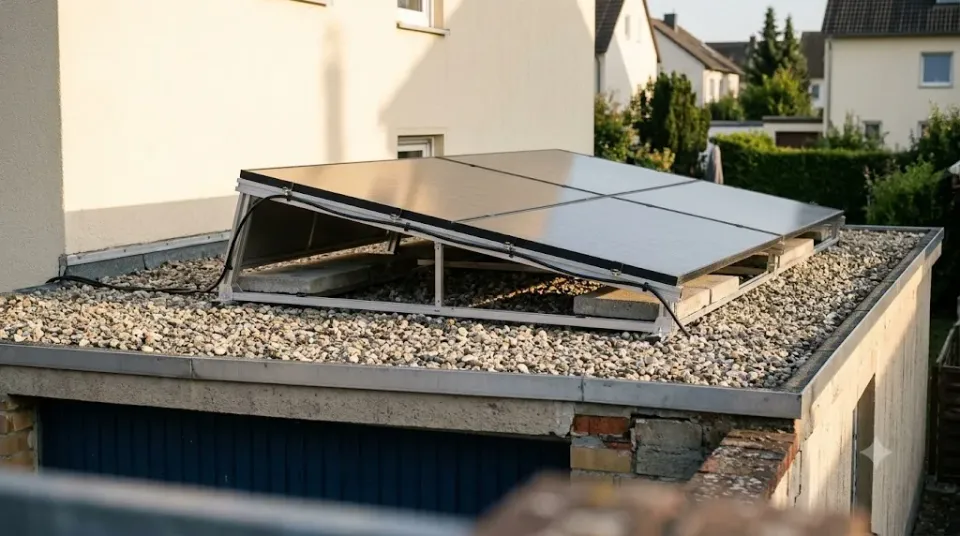
| Free-standing on a flat roof or garden, raised, light gravel | About 5 to 10 % | Often yes |
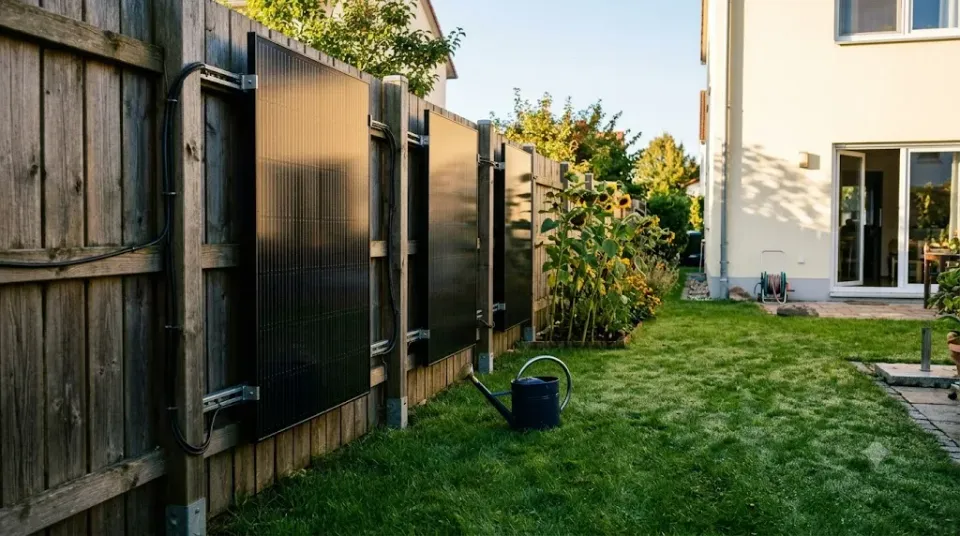
| Vertical fence or pergola, open on both sides | Can be higher | Yes, this is where bifacial shines |
Solakon 500W bifazial Glas-Glas Solarmodul
A bifacial glass-glass panel that suits flat roofs, gardens and fences where the back can see light. Heavier than a glass-foil panel, so check your railing and mount before using it on a balcony.
Check price on Amazon Ad - affiliate link. Prices change; check the listing.The maths on three example balconies
Percentages are easy to misread, so here are three example households, clearly hypothetical, with the sums written out. All three pay 35 cents per kWh. All three use a 400 Wp panel as the reference, and the bifacial version costs 30 euros more per panel.
Anna's east balcony in Cologne
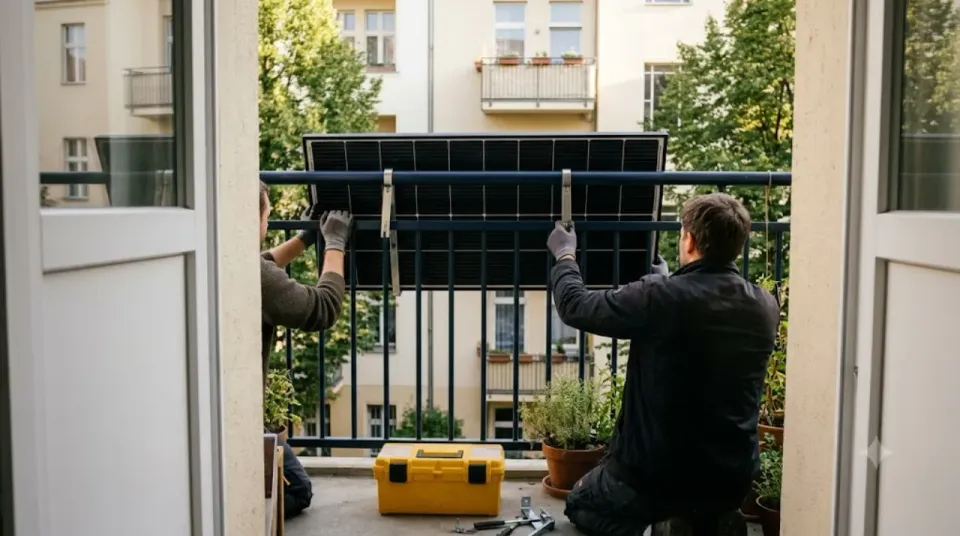
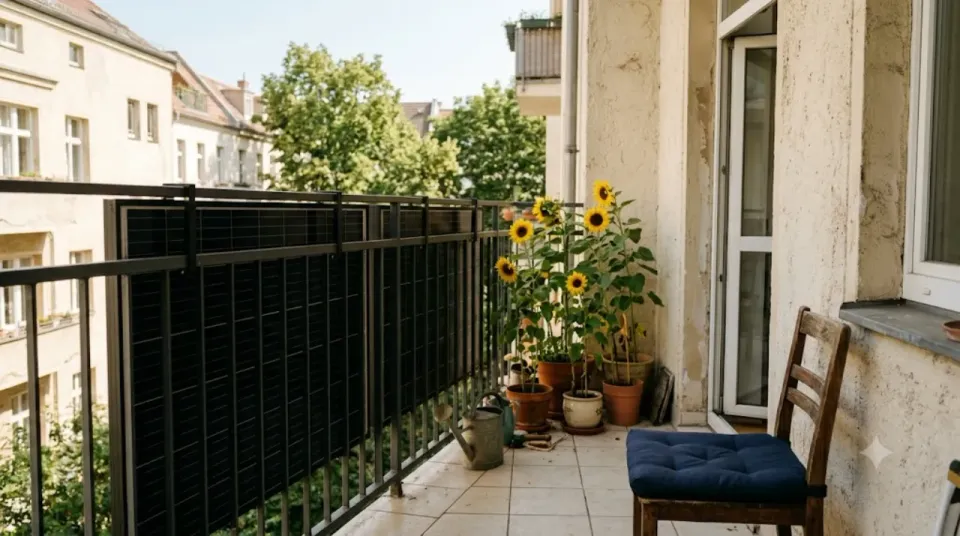
Anna rents a third-floor flat. Her balcony faces east and has a solid concrete parapet. She plans two panels hanging on the outside of the railing, pressed against the concrete.
- Expected yield per panel: about 300 kWh a year (east costs her some output compared with south).
- Rear gain: close to zero. The back faces grey concrete a few centimetres away.
- Extra euros per year: about 0.
- Payback on the 60 euros extra for two panels: never.
For Anna the right buy is a good glass-foil panel. The money is better spent on a mount that tilts the panel out a little, or on a smart plug to time her dishwasher. If she wants to see how much the east direction costs her by hour, she can put her balcony into Sunslot and watch the output fade after about 13:00.
Jonas's flat roof in Leipzig
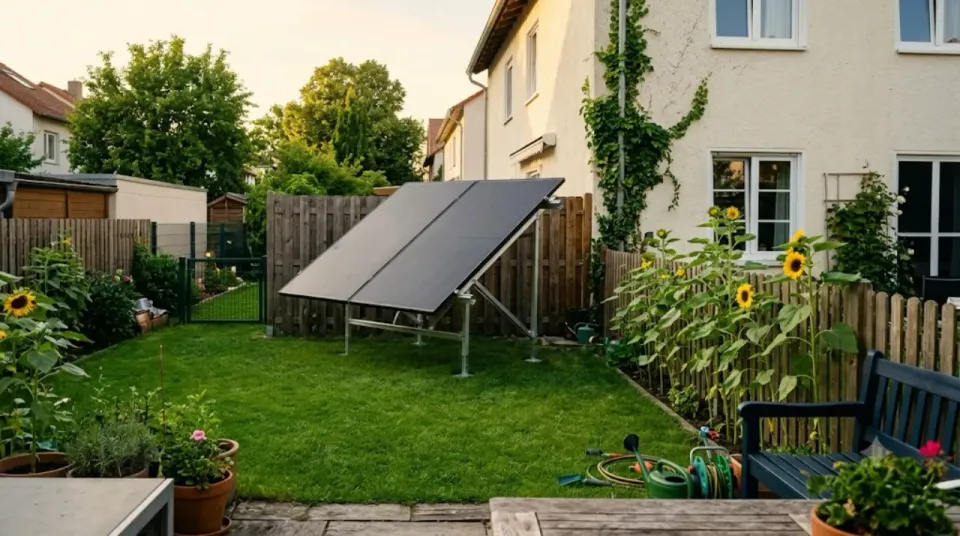
Jonas owns a top-floor flat with access to a flat garage roof covered in pale gravel. He can set two panels on a frame, raised about 40 cm, tilted south.
- Expected yield per panel: about 400 kWh a year at a good tilt.
- Rear gain: a realistic 6 percent, so about 24 kWh per panel per year.
- If he uses all of it himself: 24 kWh times 0.35 euros is about 8.40 euros per panel per year.
- Payback on 30 euros extra per panel: about 3.6 years.
One catch. With an 800 W inverter, extra panel output only helps in hours when the inverter is not already at its limit. At noon in June, two 500 Wp panels may already be capped. The rear gain then counts mostly in the morning, evening and on hazy days. That still helps, but the real figure may land a little below the simple maths.
Mira's garden fence near Freiburg
Mira has a terraced house with a garden. She wants panels mounted vertically along a fence that runs north-south, so one face looks east and the other looks west.
- A one-sided panel there gets direct sun for only half the day.
- A bifacial panel catches morning sun on one face and afternoon sun on the other.
- The gain over a one-sided panel in the same spot can be large, because the rear is not living on reflections alone. It gets direct light.
This is the one setup where bifacial is the obvious choice. The output curve also comes out flatter, with two smaller peaks instead of one big one. That suits a household that runs appliances across the day.
Durability: the real case for glass-glass
Forget the rear for a moment. The stronger argument for glass-glass is that it tends to last longer and lose output more slowly. That matters on a balcony you plan to keep for 20 years or more.
Here is why the build helps:
- Less moisture. Glass lets almost no water vapour through. A plastic backsheet lets in a little over the years. Moisture is one of the main drivers of slow ageing.
- Fewer microcracks (hairline cracks in the cells that cut output over time). With glass on both sides, the cells sit near the middle of a stiff sandwich and bend less in wind and snow.
- No backsheet to fail. Some older plastic backsheets have cracked or yellowed in the sun. Glass does not.
The result shows in the paperwork. Many makers give glass-glass panels a 25 to 30-year performance warranty instead of 25. Some also quote a lower degradation rate (the yearly drop in output as the panel ages), often 0.1 to 0.2 percent per year less than their glass-foil range.
What does that add up to? Take a 400 Wp panel making 380 kWh in year one.
| Loses 0.5 % per year | Loses 0.35 % per year | |
|---|---|---|
| Output in year 25 | About 335 kWh | About 349 kWh |
| Total over 25 years | About 8,960 kWh | About 9,130 kWh |
| Difference | About 170 kWh, worth about 60 euros at 35 cents if used yourself | |
Not a fortune, but on its own it roughly covers a 30-euro price gap. Add a longer warranty and a stiffer panel and glass-glass looks sensible for anyone staying put. If you rent and expect to move in three years, the long-term argument weakens.
Solarway Balkonkraftwerk Halterung
An adjustable aluminium mount that lifts panels off a flat surface, which is what gives a bifacial rear room to work. Confirm it is rated for your panel size, weight and clamp type.
Check price on Amazon Ad - affiliate link. Prices change; check the listing.Weight and mounting: the cost nobody lists
Glass-glass panels are heavier. For the same size, the second sheet of glass usually adds a few kilograms per panel. On a garden frame nobody cares. On a balcony railing it matters for three reasons.
- Railing load. Every railing has a limit, and older ones may be weaker than they look. Two heavier panels plus wind load can push a light railing too far. Our railing mounting guide covers how to check.
- Mount rating. Brackets are rated for a maximum panel weight and size. Check that number against the data sheet of the exact panel.
- Handling. Lifting a heavy panel over a railing on the fourth floor is a two-person job. Never do it alone.
Then there is the frame. Many glass-glass panels have a slim frame or none at all. Frameless glass needs clamps made for it, usually with rubber pads and a wider grip. A clamp designed for a thick aluminium frame can put a point load on bare glass and crack it, sometimes weeks later on a cold night.
Also check the new product norm for plug-in solar. Since December 2025, mounting systems are expected to state which surfaces they suit. Our guide to Germany's 800 W rules explains what that means for your kit.
Verdict by reader type
Here is the short answer for the most common situations.
You rent and the panels hang on a solid railing
Buy glass-foil. The rear gain is near zero, the extra weight works against you, and you may move before the durability pays off. A well-made standard panel at a sensible angle is the best value.
You rent and the railing is open bars over a pale floor
Buy bifacial only if the price gap is small, roughly 10 to 15 euros per panel or less. You might see 2 to 5 percent extra. Check the railing can take the weight.
You own a flat roof, garage roof or garden
Buy bifacial glass-glass and raise it. Leave 30 cm or more under the low edge, and put pale gravel or a light mat below if you can. This is where the extra money comes back in three to five years.
You plan a vertical fence, pergola or carport side
Bifacial, no question. Both faces see sky. An east-west fence gets direct sun on both sides through the day.
You live somewhere with a lot of snow
Glass-glass is worth a look for its stiffness under snow load. Bifacial adds a small winter bonus when snow covers the ground. Just do not expect it to change your yearly total much, because winter makes only a small share of the year's output anyway. Our winter, snow and heat guide has the month-by-month picture.
You are on a tight budget
Glass-foil, and spend the difference on placement. A better tilt, less shade, or a smart plug to move loads into sunny hours will pay back faster than any label.
Solarway 500W bifazial Solarmodul 2er Set
Two bifacial panels that pair with an 800 W microinverter and stay within common panel limits. On a solid railing you will see little of the rear gain, so it fits best where the back is open.
Check price on Amazon Ad - affiliate link. Prices change; check the listing.Where panel buyers go wrong
- Trusting the headline gain. "Up to 30 percent more" is a field figure. On a balcony, plan for zero to five unless your spot is open.
- Mounting bifacial flush to a wall. You pay for the clear back and then cover it. If you cannot leave a gap, do not pay for bifacial.
- Ignoring the 800 W cap. Extra panel watts at noon in summer may simply be clipped (cut off at the inverter limit). The gain counts most in weaker hours.
- Using the wrong clamps. Frameless glass needs approved clamps. Check the panel manual for the allowed clamping zones.
- Forgetting the weight. Add up panels, mount and a wind margin before you choose. If the railing is old, ask your landlord or a specialist.
- Comparing labels instead of warranties. A glass-glass panel with the same warranty as a cheap glass-foil one gives you less reason to pay more.
- Chasing a few percent while ignoring shade. A railing post shadow or a neighbour's balcony can cost far more than any rear gain. See our shading guide.
What I'd do
If I were hanging panels on a typical rented balcony, I would buy two good glass-foil panels with a full frame, a sturdy railing mount and a smart plug. I would put the money I saved into getting the tilt right and moving the washing machine to midday.
Shelly Plug S Gen3
A smart plug that shows what your panels actually feed, so you can check whether a premium panel earns its keep. It measures one socket only, not your whole home.
Check price on Amazon Ad - affiliate link. Prices change; check the listing.If I had a flat roof or a garden, I would buy bifacial glass-glass without thinking twice, raise it at least 30 cm, and put something pale underneath. I would also check the panel's clamping zones before I touched a spanner.
Whichever you choose, run your exact spot through Sunslot before you order. It shows the hour-by-hour output for your direction, tilt, shade and city. If it says your inverter is already capped for most of a summer day, the extra watts from a pricier panel will mostly fall on hours that are already full. If it shows long weak mornings, a few percent more may be worth having. Our buying checklist covers the remaining points, and east-west versus south shows how direction changes the picture far more than the back sheet does.
Panel type questions
Can I mount a bifacial panel the wrong way round?
Do not. The front is the rated side, with the official Wp figure. The junction box and cables are designed for the front to face the sun. Mount it as the manual shows.
Do bifacial panels work with any microinverter?
Usually yes, but check the current. On a bright day the rear adds current, so make sure the panel's maximum current, including the rear gain, stays within the inverter's input limit. The inverter data sheet lists the maximum input current per channel.
Are glass-glass panels safer if they break?
Both types use toughened glass that breaks into small blunt pieces. A glass-glass panel tends to hold together better because the cells are sealed between two sheets. Either way, a cracked panel should be disconnected and replaced.
Is bifacial worth it with snow on the ground?
Snow is the best reflector there is, so the rear does gain in those weeks. But winter makes only a small part of your yearly total, so the effect on the full year is modest. It helps most where snow lies for long periods and the panel is raised.
How do I check whether my bifacial panel is earning anything extra?
Compare it with a known figure. Put a smart plug on the inverter and note the daily kWh on a few clear days. Then hang a dark cloth behind the panel for one similar clear day and compare. The difference is your rear gain, roughly. If it is within a few percent, that matches what most balconies see.
Does a black backsheet panel count as bifacial?
No. An all-black panel with an opaque back is glass-foil or one-sided glass-glass. It only collects light on the front, whatever it looks like.