

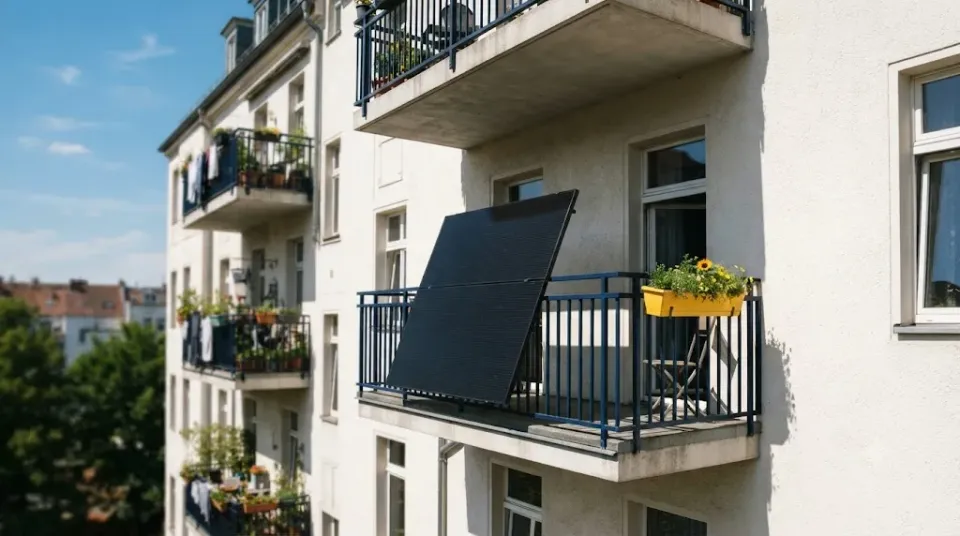
Short answer: shade in the evening barely matters, shade at midday matters a lot. In the Sunslot model, a south kit that sits in full shade from 10:00 to 14:00 every day loses about a third of its year. The same four hours of shade after 18:00 cost almost nothing. So it is less about how much shade you have and more about when it lands.
Most people worry about the wrong shadow. The tree that shades the balcony at 19:00 in July looks dramatic, and it costs very little. The quiet shadow from the balcony slab above, which sits on a steep railing panel from late morning to early afternoon all summer, is the expensive one.
Here is why. A balcony kit makes most of its energy in a short block around midday. For a typical south kit (two 430 Wp panels, 35 degree tilt, Berlin, about 844 kWh a year) about 78 percent of the year arrives between 09:00 and 16:00. Shade inside that block takes a big bite. Shade outside it nibbles at the edges.
In the Sunslot model, the same kit with direct sun blocked every day from 10:00 to 14:00 drops to about 541 kWh. That is a loss of about 36 percent. Block the sun only from 14:00 to 18:00 instead and the loss is about 23 percent. Shade only before 10:00 or after 18:00 costs a south kit very little, because those hours carry roughly a tenth of the year between them.
The model keeps diffuse light (the light from the whole bright sky, not the sun's disc) reaching the panel, which is why the loss is a third and not more. That matches real life on most balconies: an open sky still lights a shaded panel, just weakly.
There is one more twist that makes small shadows hurt more than you would guess. Panels are built from strings of cells, and a shaded cell slows its whole string. Most panels have three bypass diodes (little switches that let current skip a shaded section). A thin shadow across the bottom row of cells can switch off a third of a panel or more, even if it covers a narrow strip.
So the practical rule is short. Protect the hours your panel does its best work. For south, that is roughly 10:00 to 15:00. For east, the morning. For west, the afternoon. And before buying, spend five minutes looking at where shadows fall at 11:00, 13:00 and 15:00. That check is worth more than the difference between any two panel brands.
What usually causes midday shade?
On a balcony, the midday culprits are almost always part of the building, which is why people overlook them. They have been there all along.
- The balcony above. In June the sun stands about 60 degrees high at midday in Germany. A deep slab above a low-mounted panel throws its shadow straight down onto it, exactly in the best hours. This is the single most common cause.
- A parapet. A solid balcony wall shades the bottom of a panel set behind it, especially in winter when the sun is low.
- Side walls and privacy screens. A wall on the south side of the balcony, or a neighbour's screen, cuts off late morning or early afternoon depending on which side it is.
- Awnings. Yours or the neighbour's. They come out on precisely the sunny days you care about.
- Plants. A climbing plant or tall pot on the railing grows into the panel's view over a summer without anyone noticing.
Trees and the building opposite matter too, but mostly in winter. In June they usually cast short midday shadows. In December, with the sun only about 14 degrees high at noon, a building across the street can shade a low balcony for the whole day. Our guide to shade on a balcony follows three homes through both seasons.
How much does shade at each hour cost?
Same 2 x 430 Wp south kit in Berlin, about 844 kWh a year unshaded. Sunslot estimates with direct sunlight blocked in one time band, every day of the year:
| Shade pattern | Year output | Loss |
|---|---|---|
| No shade | about 844 kWh | - |
| Shade only before 10:00, or only after 18:00 | about 800 kWh | about 5 % |
| Half shaded 14:00 to 18:00 | about 748 kWh | about 11 % |
| Half shaded 10:00 to 14:00 | about 698 kWh | about 17 % |
| Fully shaded 14:00 to 18:00 | about 647 kWh | about 23 % |
| Fully shaded 10:00 to 14:00 | about 541 kWh | about 36 % |
Four hours of midday shade cost more than three times as much as shade outside the main window, and about one and a half times as much as four afternoon hours. Real balconies vary, of course. A shadow that only covers the panels from May to August is kinder than one that sits there all year.
Set your own shade hours in Sunslot to see what your overhang or wall actually costs. It takes a minute and gives you a number you can act on.
Why does a thin shadow cost so much?
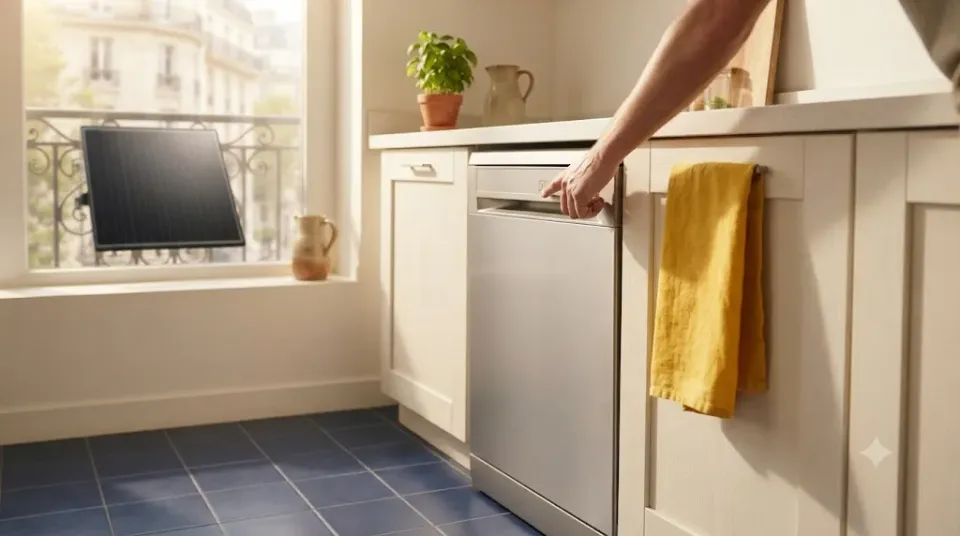
This is the part that surprises people most. You see a shadow covering a tenth of the panel and the app shows a third less power. It feels wrong. It is how panels are wired.
A standard panel has 108 or 120 half-cells connected in a row and split into three sections. Each section has a bypass diode. When one cell in a section is shaded, it limits the current for its whole section. The diode then lets the current skip that section, which protects the panel, and that section's output is lost while the shadow sits there.
| Shadow shape | What happens | Rough loss on that panel |
|---|---|---|
| Leaf or bird dropping on one cell | One section limited | up to a third |
| Strip along the short bottom edge | All three sections touched | can approach the whole panel |
| Strip along one long side | One section shaded | about a third |
| Thin cable or railing bar | Partial, light shade | small to moderate |
Which edge matters depends on how the sections run in your panel, and that is in its datasheet. In many panels mounted in portrait, the three sections run top to bottom side by side, so a shadow creeping up from the bottom edge touches all three at once. That is the parapet case, and it is why a shadow only 10 centimetres high can cost so much.
Your second panel would sit in the balcony shadow from 11:00 to 14:00 all summer. What would you do?
With two separate inputs on the inverter, each panel works on its own, so the panel in the sunny spot is not dragged down by the shaded one. A pricier panel does not fix shade. Giving up is premature, since even a midday-shaded kit usually pays back in about four years.
How do I check my balcony in five minutes?
You do not need tools. You need a sunny day and your phone.
- Look at 11:00, 13:00 and 15:00. Stand where the panel will go, or hold up a piece of cardboard the same size. Photograph where the shadows fall each time.
- Think about the other season. In summer, overhangs cast the deepest shadows. In winter, low sun means the building opposite and bare trees matter more. If it is summer now, imagine the sun about 45 degrees lower at noon in December.
- Check the parapet line. If the panel sits behind a solid wall, look at whether its bottom edge stays in sun at midday.
- After installing, watch the app. A sudden dip at the same time on every sunny day is a shadow, not a fault. A random dip is a cloud.
Shelly Plug S Gen3
Placed between inverter and socket it logs your output, so a shadow shows up as a dip at the same time each sunny day. Rated for normal household loads only.
Check price on Amazon Ad - affiliate link. Prices change; check the listing.One more trick for the planning stage: on a sunny day, hold your phone camera where the middle of the panel will sit and look up. If you can see the underside of the balcony above blocking a big chunk of the southern sky, expect midday shade in summer. If you see open sky from left to right, you are in good shape.
A plug-in meter or smart plug between the inverter and the socket helps if your inverter has no app of its own. A week of curves tells you more than any amount of squinting at the balcony.
What can I do about it, cheapest first?
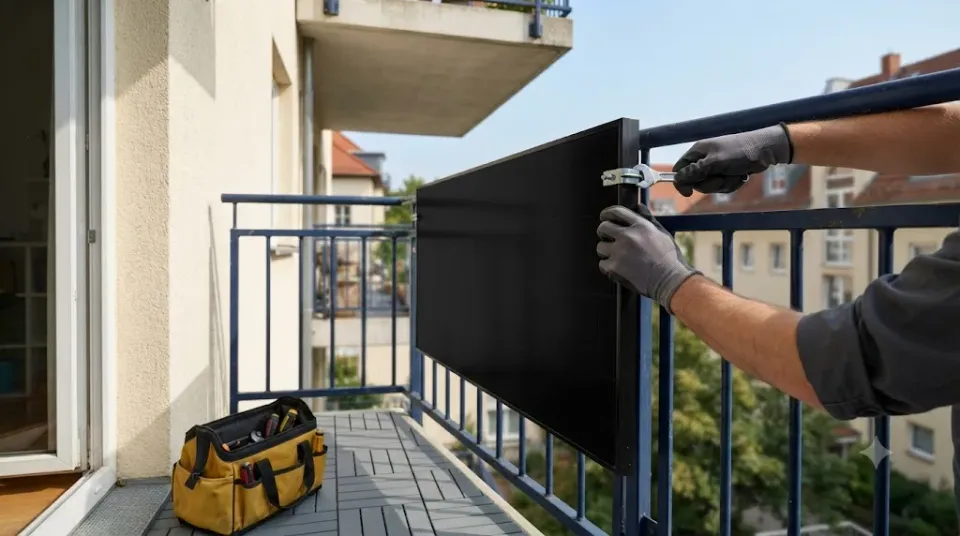
- Move the panel up or out (free to cheap). On a railing, mounting at the top of the outside face often clears the overhang shadow for an extra hour or two each side of noon. Check your mount's rating and your landlord's agreement first.
- Change the tilt (cheap). Under a deep overhang, a steeper panel can stay in light longer. On a sunny parapet, lifting the panel's bottom edge clears the wall's shadow. See south, east-west or flat.
- Split the panels (cheap). If one spot is shaded at midday and another in the afternoon, two panels in two spots can beat two side by side in the worse one. Most 800 W microinverters have two separate inputs, so each panel works on its own.
- Use one panel instead of two (saves money). If the second panel would sit in midday shade all year, it adds little. A single good panel in the sunny spot may be the smarter buy.
- Move the kit somewhere else. A garden fence, a shed roof or a flat roof can beat a shaded balcony by a wide margin. Our guide to other places that work has ideas.
Hoymiles HMS-800W-2T
An 800 W microinverter with two separate inputs, so a shaded panel does not drag down the other. It is a component, so check it matches your panels and plug setup before buying.
Check price on Amazon Ad - affiliate link. Prices change; check the listing.Which shade can I safely ignore?
Not all shade is worth a fight with the neighbour or an hour with a drill.
- Early morning shade on a south or west kit. Before 10:00 a south kit makes a small slice of its year.
- Evening shade on a south or east kit. After 18:00 a south kit makes about 3 percent of its year.
- Brief passing shadows. A flagpole or lamp post shadow that sweeps across in 20 minutes costs little.
- Light, thin shade. A single slim railing bar or cable usually matters less than a solid shadow across a row of cells.
The direction rule flips for other orientations. For east-facing panels, morning shade is the expensive kind: about 16 percent of an east kit's year arrives before 09:00. For west, the late afternoon is precious. Protect whatever hours your panel does its best work.
Is a shaded kit still worth buying?
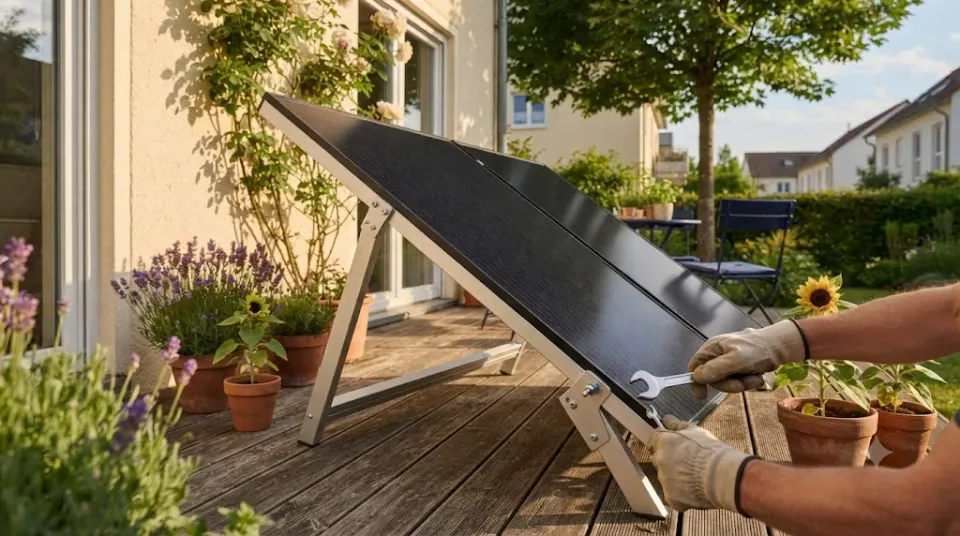
Usually yes, with realistic expectations. Here is an example: a kit costing 400 euros, a household using about half its output, power at about 37 ct/kWh (the BDEW's 2026 household average).
| Situation | Year output | Saved per year | Payback |
|---|---|---|---|
| Unshaded | about 844 kWh | about 156 euros | about 2.6 years |
| Afternoon shade | about 647 kWh | about 120 euros | about 3.3 years |
| Midday shade | about 541 kWh | about 100 euros | about 4 years |
A shaded kit can even keep a higher share of its output at home, because less power arrives at once. That softens the hit a little. Where it stops making sense is a balcony shaded most of the day all year, say a north-facing one hemmed in by buildings. Then a cheaper single panel, or a different spot entirely, is the better plan. Our payback maths guide has the full sum.
Bosch Professional GIM 60 L
A digital level that reads angles to a tenth of a degree, handy when you are adjusting tilt to clear a parapet or overhang shadow. A free phone level app is close enough for most balconies.
Check price on Amazon Ad - affiliate link. Prices change; check the listing.What people get wrong
- "Diffuse light means shade does not matter." It helps, which is why the loss is a third and not more. Direct sun still does most of the work.
- "Half shade means half output." Because of the wiring, a shadow on one strip can cost a third of a panel or more.
- "Summer and winter shade are the same." Low winter sun throws long shadows from buildings and trees that do not exist in June.
- "A better panel fixes shade." A good spot beats an expensive panel nearly every time.
- "The evening tree is the problem." Look up at the balcony above first.
Your next step
- Price your shadow. Enter your balcony and shade hours in Sunslot and compare two possible spots over a year.
- Take three photos on the next sunny day at 11:00, 13:00 and 15:00.
- Read the two guides behind this. Shade on a balcony and mounting panels on a railing safely.