

This is general information, not legal advice. Rules change, so check the current wording before you rely on it.
Short version: four quiet numbers decide whether a kit is legal on your plug, fits your balcony and reaches your socket. The loud ones in the title mostly do not. Two minutes with the datasheet saves the most common return.
Here are the four, in the order I would check them.
- Inverter output: 800 W (or 800 VA). The microinverter (the box that turns panel power into socket power) is the bottleneck. In Germany a plug-in system may feed at most 800 W into your home, however many panels sit behind it. The Federal Network Agency counts the highest output the inverter can be set to, so a bigger inverter "limited in the app" may not be enough.
- Total panel power in Wp, matched to your plug. Wp means watt-peak, the panel's output under standard lab light. Since the product norm DIN VDE V 0126-95 (late 2025), a kit on a normal household Schuko plug may have up to 960 Wp of panels. With a special energy socket (Wieland type) or a fixed connection, up to 2,000 Wp is allowed. The 800 W feed-in cap is the same either way.
- Panel size and weight. A 430 to 450 Wp panel is often around 1.7 m x 1.1 m and 20 kg or more. Two panels need about 2.3 m of railing side by side in portrait, and with a mount the pair can top 45 kg.
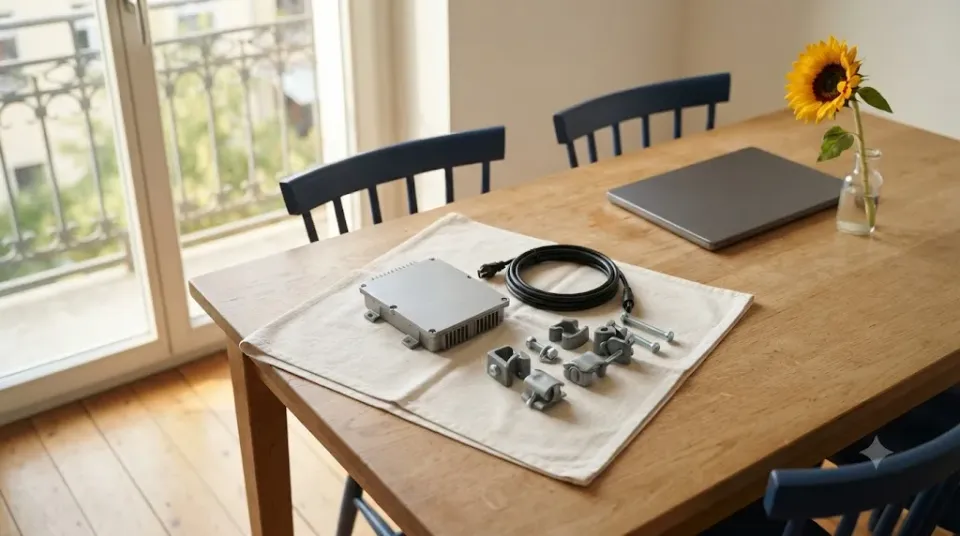
- AC cable: from the maker, at least 5 m. Under the norm, the cable must come from the manufacturer and be at least five metres long. Multi-socket strips are not allowed. Measure from where the inverter will sit to your socket.
If a kit passes all four, it fits the rules for your plug, fits your balcony and reaches power. Everything else is about how much it makes and how long it lasts, which is where the headline numbers come in, and they need a pinch of salt.
"2,000 W" in a title is usually panel Wp, not output. "Up to 30 percent more with bifacial" is a ground-mounted best case; on a balcony 3 to 5 percent is realistic. "1,000 kWh a year" depends entirely on direction, tilt, shade and city. A vertical south kit in Berlin makes nearer 590 kWh.
Write the four numbers for each kit in a note on your phone. It turns three pages of marketing into twelve lines you can compare in a minute.
Where do I find these numbers on a listing?
Rarely in the title. Scroll past the photos to the technical details table or open the datasheet (Datenblatt). On German shops the words you are looking for are:
| Number | German label | What good looks like |
|---|---|---|
| Inverter output | max. AC-Ausgangsleistung, Nennleistung Wechselrichter | 800 W or 800 VA |
| Panel power | Nennleistung, Modulleistung (Wp) | Total 960 Wp or less for Schuko |
| Size and weight | Abmessungen, Gewicht | Fits your railing; weight written down |
| Cable | Lieferumfang, Anschlusskabel | Maker's cable, 5 m or more |
| Inputs | MPPT-Tracker, Eingänge | 2 inputs, one per panel |
The cable is the one most often missing. It tends to be hidden in the scope of delivery (Lieferumfang). If you cannot find a number, message the seller and keep the answer. A seller who replies clearly and quickly is a decent sign about the after-sales service too.
While you are on the datasheet, two more lines are worth a glance. Two inputs (often called 2 MPPT, short for maximum power point tracking) means each panel is managed separately, so shade on one panel does not drag the other down. And a monitoring app or local readout lets you see what the kit makes, which is the only way to know it is working well. Our guide to apps, smart plugs and your meter compares the options.
Why does my plug decide how many panels I can have?
Because of touch safety. A Schuko plug has exposed pins. If you pull it out while the panels are making power, a badly designed inverter could leave a voltage on those pins for a moment. The norm handles this with extra protection in the device and a cap on panel power for the Schuko route.
| Connection | Max. panel power | Max. feed-in | Who fits it |
|---|---|---|---|
| Normal Schuko socket | 960 Wp | 800 W | You, into an existing socket |
| Special energy socket (Wieland type) | 2,000 Wp | 800 W | An electrician |
| Fixed connection | 2,000 Wp | 800 W | An electrician |
So the popular "four panels, 2,000 W" kits are fine, but only with an electrician-fitted socket. Two panels of about 430 to 480 Wp each fit the Schuko route.
Why would anyone want more panels than the inverter can feed? Because 800 W is a peak. More panels reach the cap earlier in the morning and hold it later in the afternoon, and they make more on cloudy days and in winter. Our Schuko or Wieland guide runs the numbers on whether the extra panels and the electrician pay off.
Hoymiles HMS-800W-2T
An 800 W microinverter with two separate inputs - the reference point for number 1. Bought alone it needs matching panels, cable and mount.
Check price on Amazon Ad - affiliate link. Prices change; check the listing.How do I check the kit fits my balcony?
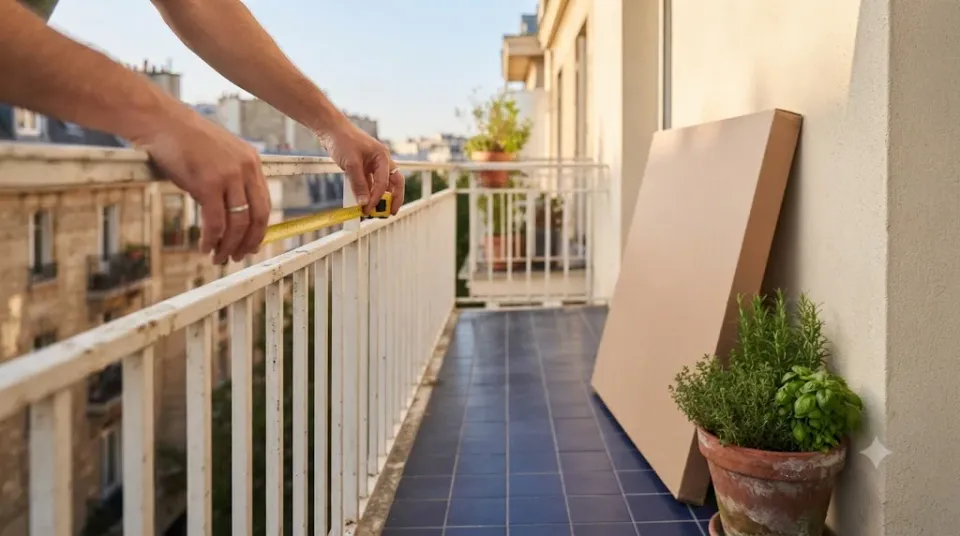
Get the tape measure out before the credit card. Three measurements:
- Railing length. Two standard panels side by side in portrait need about 2.3 m. In landscape, about 3.4 m.
- Railing height. Most railings are about 1 m. A 1.7 m panel in portrait sticks up 70 cm above it, which landlords and neighbours notice. Landscape keeps it at railing height but needs more length.
- Socket distance. From where the inverter will sit (usually clipped behind a panel) to the socket. The 5 m cable needs to reach without strain.
A worked example: a 2.4 m railing, 1 m high. Two 1.72 x 1.13 m panels in portrait fit side by side (2.26 m) but stick up well above the rail. In landscape they need 3.44 m, which does not fit. Options: portrait with landlord approval, two smaller panels of around 1.1 x 1.0 m (often about 200 to 300 Wp each), or one large panel in landscape and one on a floor stand.
Here is how three typical listings look once you write the four numbers down for that 2.4 m railing with a Schuko socket:
| Kit | Inverter | Panels | Size each | Cable | Verdict |
|---|---|---|---|---|---|
| A | 800 W, 2 inputs | 2 x 445 Wp = 890 Wp | 1.72 x 1.13 m | 5 m, maker's | Fits the rules; portrait only, ask landlord about height |
| B | 800 W, 2 inputs | 4 x 500 Wp = 2,000 Wp | 1.95 x 1.13 m | 3 m Schuko | No: too many Wp for Schuko, cable too short, does not fit |
| C | 800 W, 2 inputs | 2 x 300 Wp = 600 Wp | 1.25 x 1.05 m | 5 m, maker's | Fits everything; less output but sits at railing height |
Kit B has the biggest numbers in its title and fails on three of four checks. That happens more often than you would think.
Smaller panels mean fewer Wp, but on a narrow balcony a kit that fits beats a kit that does not. Our guide to mounting on a railing safely shows the common layouts.
What about the cable if I have no outdoor socket?
This comes up a lot in older flats. The rules want the kit plugged straight into a fixed socket: no multi-socket strips. In practice extension leads are a bad idea too, for the same safety reasons. Your options:
- A socket just inside the balcony door. Run the maker's cable through the door gap. Some kits sell a flat window feed-through cable for this.
- An electrician fits an outdoor socket on the balcony. Often a few hundred euros, sometimes less if a cable already runs nearby. If an electrician is coming anyway, ask about a special energy socket at the same time.
- Check the circuit. Avoid a socket on a circuit shared with a heater or the washing machine if the wiring is old. If anything feels warm or looks damaged, have it checked first.
You have a normal Schuko balcony socket. A four-panel 2,000 Wp kit is on offer for 50 euros more than a two-panel 860 Wp kit. What would you do?
On a normal Schuko socket the norm allows up to 960 Wp, so the two-panel kit is the one that fits your connection. Four panels with a special socket can make sense, but the electrician usually costs far more than 50 euros, so check the maths first. Leaving panels unconnected wastes money and invites confusion later.
Which listing numbers can I mostly ignore?
Not ignore exactly. Just weigh them for what they are.
| Listing says | Reality |
|---|---|
| "2,000 W system" | Usually panel Wp. Output is still capped at 800 W. |
| "Up to 30 % more with bifacial" | On a balcony with a dark floor, about 3 to 5 % is realistic. See bifacial panels. |
| "Panel efficiency 22.5 %" | Tells you how big a panel is for its Wp. A few percent between decent panels. It does not change output per Wp. |
| "Makes 1,000 kWh a year" | Best case: south, ideal tilt, no shade, sunny city. Vertical on a railing is often 30 to 40 % lower. |
| "Plug and play in 5 minutes" | The plugging takes 5 minutes. The mounting takes an afternoon. |
The yearly kWh claim is the one worth testing yourself. Put the kit's panel Wp into Sunslot with your balcony's direction, tilt and shade and compare the honest figure with the listing's. The gap is often the most useful thing you learn all day.

Are there red flags that mean skip the listing?
Yes, five that I would treat as a firm no unless the seller clears them up in writing:
- Three or four panels with only a Schuko plug and no mention of a special socket. Above 960 Wp the norm expects a different connection.
- An inverter rated above 800 W "throttled by app", with no statement that it meets the German rules. The authorities count the highest output it can be set to.
- No conformity paperwork. Ask for the datasheet and the declaration of conformity. A real product has both.
- No mount in the box on a "complete kit". The mount is often the hardest part to get right on a balcony.
- No clear warranty terms. Panels commonly carry 10 to 25 years, inverters often around 10 years or more. A seller who cannot tell you is a seller to skip.
One more quiet check: glass-glass panels (glass on both sides) usually last longer and handle weather better than glass-foil panels, at the cost of a few extra kilos.
Shelly Plug S Gen3
After you buy, it shows what the kit really delivers so you can compare with the listing. Rated for normal household loads and needs Wi-Fi.
Check price on Amazon Ad - affiliate link. Prices change; check the listing.How much difference does the right kit make in money?
Bigger than most people think, and almost none of it comes from the headline numbers. An example with the same 2 x 430 Wp kit for about 400 euros, in Berlin, with about half the power used at home at about 37 ct/kWh:
| Same kit, mounted | Yearly output | Yearly saving | Payback |
|---|---|---|---|
| South, tilted at 35 degrees | about 844 kWh | about 156 euros | under 3 years |
| South, vertical on the railing | about 590 kWh | about 109 euros | about 3.7 years |
| Vertical with some shade | about 500 kWh | about 93 euros | 4 to 5 years |
Same listing, very different value. Direction, tilt and shade move the result far more than a percent of panel efficiency ever will. Sunslot runs this payback maths for your actual balcony. The full method, including how self-use changes it, is in payback maths.
Brennenstuhl Primera-Line PM 231 E
Measure what your fridge and standby devices use, which decides how much of the kit's output you keep. It measures only, with no app or history.
Check price on Amazon Ad - affiliate link. Prices change; check the listing.What people get wrong
- Reading "2,000 W" as output. It is almost always panel Wp, and output stops at 800 W.
- Buying four panels for a Schuko socket. Above 960 Wp you need a special socket from an electrician.
- Not measuring the railing. The panel that does not fit is the most common return.
- Trusting the yearly kWh claim. It assumes a perfect roof, not your balcony.
- Paying extra for bifacial on a balcony. A few percent at best on a railing.
- Planning on an extension lead. Multi-socket strips are not allowed; plan a fixed socket.
- Forgetting the weight. Your railing and your landlord will both ask.
Your next step
- Measure railing length, railing height and the distance to your socket. Write them down.
- Test the yearly claim for each kit in Sunslot with your direction and shade.
- Read the two guides that finish the decision: the 12-point buying checklist and Schuko or Wieland if you are tempted by more panels.