


Short version: no, it is almost certainly not broken. Winter at 52 degrees north is simply that dark. Longer version is worth reading, because there are a couple of real faults that look like winter, and a few things you can still do.
The numbers first. In the Sunslot model, a south-facing 2 x 430 Wp kit in Berlin at 35 degrees tilt makes about 112 kWh in June and about 17 kWh in December. That is roughly one seventh. On an average December day that comes to about 0.55 kWh, with a midday peak of only around 120 W.
| Month | Output | Per day, on average | Share of year |
|---|---|---|---|
| October | about 53 kWh | about 1.7 kWh | about 6 % |
| November | about 26 kWh | about 0.9 kWh | about 3 % |
| December | about 17 kWh | about 0.55 kWh | about 2 % |
| January | about 21 kWh | about 0.7 kWh | about 2.5 % |
| February | about 36 kWh | about 1.3 kWh | about 4 % |
| June, for comparison | about 112 kWh | about 3.7 kWh | about 13 % |
November to February together give about 100 kWh, roughly 12 percent of the whole year. So if your app looks sad right now, it is behaving exactly as expected.
Three things cause it. Short days: about 7.5 hours of daylight in Berlin at the winter solstice, against more than 16 in June. Low sun: at noon in December the sun is only about 14 degrees above the horizon in Berlin, so its light crosses far more air and hits the panel at a shallow angle. And cloud: November to February are the greyest months in most of Germany.
Cold is not the problem, by the way. Solar cells work slightly better when cold. A frosty, clear morning can give surprisingly good output.
Here is the twist that makes winter less bad than it looks. Because output is so small, your fridge, router and standby devices swallow almost all of it. In June about half of a south kit's output goes to the grid unpaid. In December only about a third does. Winter's savings shrink less than its output.
That is the reassurance. Now the follow-up questions, including how to tell winter from a real fault.
How do I know if it is winter or an actual fault?
Compare like with like. December against what December should be, never against June.
A quick check you can do on any day:
| What you see | Likely cause | What to do |
|---|---|---|
| Low output, but rises and falls smoothly with the sun | Normal winter | Nothing |
| Zero all day, even on a clear day | Inverter off, plug out, or app lost connection | Check the plug and the inverter light; reconnect the app |
| One panel's reading far below the other on a clear day | Shade on one panel, loose connector, or snow on one | Look at both panels at noon |
| Output stops at the same hour each day | A building or tree shades the low winter sun | Normal for the season; shade moves in spring |
| Flat line at an odd cap, like 300 W, on a bright day | Inverter limit set too low in the app | Check the power limit setting |
The most useful single test: wait for a clear, sunny winter day, then look at the noon reading. A south kit at 35 degrees in Berlin should reach roughly 300 W on a clear December day. If it does, your system is healthy. If it stays at 50 W in full sun, look closer.
Most microinverters show each panel separately in the app. That is the fastest way to spot a problem. Two panels side by side should read close to each other. Our guide to reading your output explains what each number in the app means.
Shelly Plug S Gen3
Logs your kit's output so you can compare months and spot a fault early. Rated for normal household loads only.
Check price on Amazon Ad - affiliate link. Prices change; check the listing.Why is a grey day so much worse than a clear one?
Because in winter almost all useful energy comes from direct sun, and grey skies take it away.
| December day type | Peak around noon | Whole day |
|---|---|---|
| Thick grey cloud, fog | about 20 to 50 W | about 0.1 to 0.2 kWh |
| Average December day | about 120 W | about 0.55 kWh |
| Clear December day | about 310 W | about 1.4 kWh |
A clear winter day gives two to three times an average one, and up to ten times a foggy one. That is why your app looks so jumpy. One sunny day can make more than the whole previous week.
Fog is the real villain in some places. River valleys and lowlands, think parts of the Rhine, Elbe or Danube, can sit under fog for days while hills nearby are in sunshine. If you live in one of those spots, your winter will undershoot any model.
When a clear day does come, use it. That is your day to run the washing machine or dishwasher at noon. More on timing in which appliances to run in the sun.
Does it matter which way my panels face in winter?
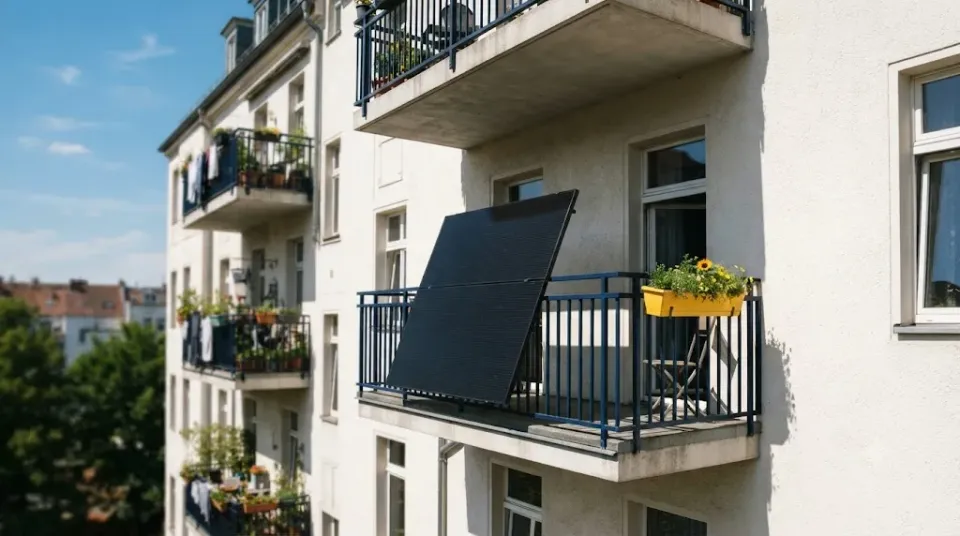
Much more than in summer. The low winter sun stays in the southern part of the sky all day, so south-facing panels catch it and east or west ones barely do.
| Setup, Berlin | December | Whole year |
|---|---|---|
| South, 35 degrees | about 17 kWh | about 844 kWh |
| South, vertical railing | about 17 kWh | about 589 kWh |
| West, 35 degrees | about 10 kWh | about 693 kWh |
Two things stand out. First, east and west kits make only about 10 kWh in December, so if yours faces east or west and the grey-day reading is near zero, that is normal. Second, a vertical south railing kit holds up very well in winter. The low sun hits it almost head-on. Its weakness is summer, when the sun is high.
Shade also gets worse in winter. A building across the street that never touched your panels in June can block the sun for hours in December, because the sun now skims the rooftops. If your output stops at 13:30 every day, check what is to your south-west. Our guide to shade on a balcony covers this hour by hour.
Want to see your own winter curve? Pick December in Sunslot, set your direction, tilt and city, and you will see exactly how short and flat it is.
It is a clear, sunny day in mid-December. What is the smartest use of it?
A clear winter day can give two to three times an average one, and running a machine at noon puts that rare output to work. The panels and inverter are built for frost, and re-tilting gains only about 2 kWh in December while risking a big summer loss if you forget to change it back.
Is it worth anything at all in euros?
Yes, a little. Less than summer, but more than the output suggests.
Here is how self-use changes through the year for the same example kit and a flat with a steady base load of about 150 W:
| Month | Made | Used at home | Share used |
|---|---|---|---|
| June | about 112 kWh | about 54 kWh | about 48 % |
| December | about 17 kWh | about 12 kWh | about 71 % |
The reason is simple. On a winter day, your kit rarely makes more than your fridge, router and standby devices draw. So almost every watt is used in the flat. In summer, the kit often makes four times the base load at noon, and the rest flows out.
In money: November to February, roughly 65 kWh used at home. At the 2026 average of about 37 ct/kWh, that is about 24 euros. March to October, the same kit saves about 130 euros. So winter is roughly a sixth of the year's savings, from an eighth of the output.
A worked example for one December day. Your flat's base load is about 150 W, around the clock. On an average December day the kit peaks at about 120 W around noon and makes about 0.55 kWh in total. For most of the day, every watt it makes is below your base load, so all of it goes straight into the fridge, router and standby devices. On a clear day it peaks at about 310 W. For an hour or two around noon it now makes more than the base load, and that surplus flows out unless a machine is running. That is why the clear days are the ones to plan around: they are the only winter days when anything is left to catch.
Payback is a summer story. Winter just keeps the meter ticking slowly in your favour. Our payback maths uses the whole-year figure for exactly this reason. Judging a kit by its December is like judging an ice-cream stand by its January.
Brennenstuhl PM 231 E
A plug-in energy meter to find the 24/7 devices that eat your winter output. Shows one device at a time, no app.
Check price on Amazon Ad - affiliate link. Prices change; check the listing.Should I change the tilt for winter?
Probably not. Steeper panels help a little in winter but cost a lot more in summer.
| Tilt | December | June | Whole year |
|---|---|---|---|
| 20 degrees | about 15 kWh | about 116 kWh | about 829 kWh |
| 35 degrees | about 17 kWh | about 112 kWh | about 844 kWh |
| 60 degrees | about 19 kWh | about 94 kWh | about 785 kWh |
| 90 degrees (vertical) | about 17 kWh | about 61 kWh | about 589 kWh |
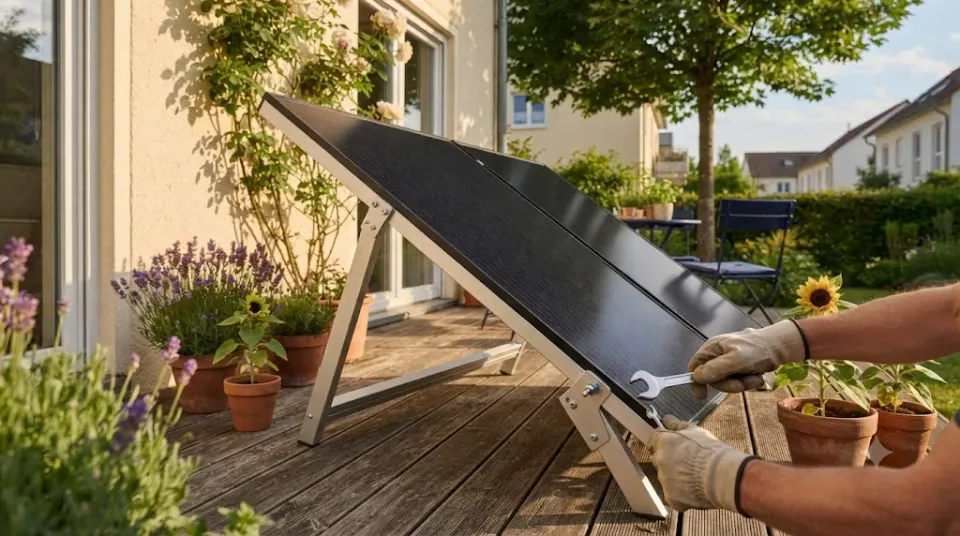
Going from 35 to 60 degrees gains about 2 kWh in December. Worth about 70 cents. And if you forget to change it back, you lose 18 kWh in June alone. Seasonal adjustment also means leaning over a railing twice a year, which is not worth the risk on an upper floor.
The bigger lesson in that table is the bottom row. A vertical railing kit loses nothing in winter but almost half its June output. If yours hangs straight down, the upgrade worth thinking about is a modest tilt for the whole year, not a winter tweak. We worked that out in the cheapest upgrade: tilting your panels.
What about snow?
Let it slide. Panels are built for it, and it usually clears itself faster than you think.
- A thin dusting melts or slides off within hours, especially on steep or vertical panels. Dark glass warms in even weak sun.
- A thick layer stops output until it goes. On a vertical railing kit it rarely sticks for long.
- Never lean over a railing to clear snow, never pour hot water on cold glass, never scrape with anything hard. A cracked panel costs far more than a few lost snowy days.
Wet, heavy snow and winter storms are the real test for the mount. Check the brackets and cable ties after a big storm. A loose clamp is easy to fix in March and dangerous to ignore. More in winter, snow and heatwaves.
What should I actually do over the winter?
Very little. That is the nice part.
- Leave it switched on. It still covers part of your fridge, router and standby, every day. Taking it down gains nothing.
- Use the rare clear days. Check the forecast, and on a bright day run the washing machine or dishwasher around noon.
- Check the mount and cables once after the first big storm and once in late winter.
- Look at your base load. In winter, your kit mostly feeds the 24/7 devices. Cutting standby from 150 W to 100 W means a bigger share of your day runs on sun. See the base load guide.
- Plan for spring. February already makes twice what December does, and March roughly doubles again. Use the quiet months to set up smart plugs and timers for the sunny season.
Avoltik Balkonkraftwerk Halterung
An aluminium mount with adjustable tilt for flat roofs, terraces or the ground, so you can set a good year-round angle. Check the wind rating and your landlord's agreement before angling panels out from a railing.
Check price on Amazon Ad - affiliate link. Prices change; check the listing.One honest caveat on all these numbers: they are typical-year figures. A sunny winter can beat them, a grey one can fall well short, and a foggy valley can wipe out whole weeks. Munich's model December, for comparison, is about 31 kWh, nearly double Berlin's, thanks to more sun and a higher sun angle.
What people get wrong
- Comparing December with June. Compare with last December, or with the expected winter figures.
- Blaming the cold. Cold helps solar cells. Short, grey days are the cause.
- Taking the panels down. They are built for frost and snow and still save something every day.
- Clearing snow by hand over a railing. Not worth the risk. It slides off on its own.
- Re-tilting for winter. The gain is tiny and the summer loss if you forget is large.
Your next step
- On the next clear day, check your noon reading. Around 300 W for a south kit at a decent tilt means all is well.
- Open Sunslot and pick December for your city and direction, so you know what normal looks like for your balcony.
- Then read winter, snow and heatwaves and how much power a balcony kit makes to see your winter in the context of a whole year.
