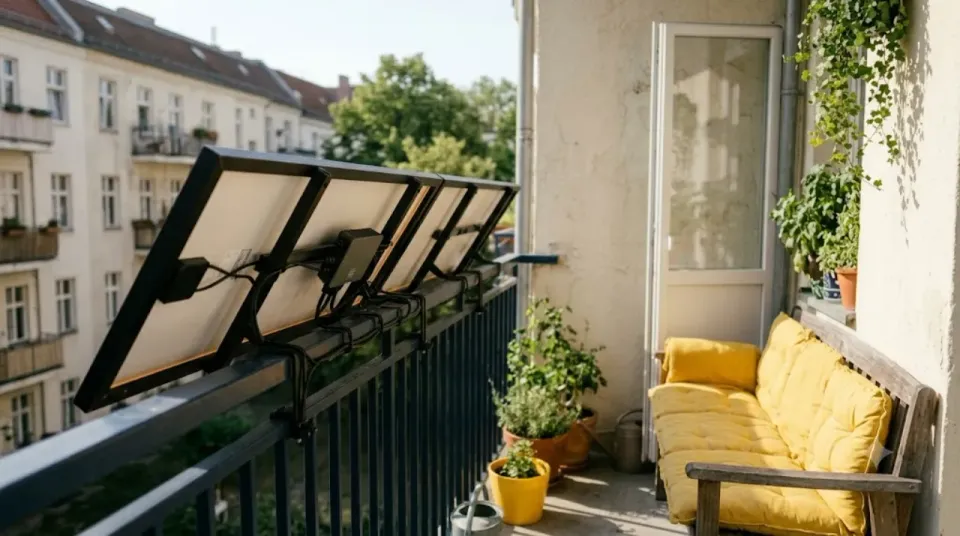

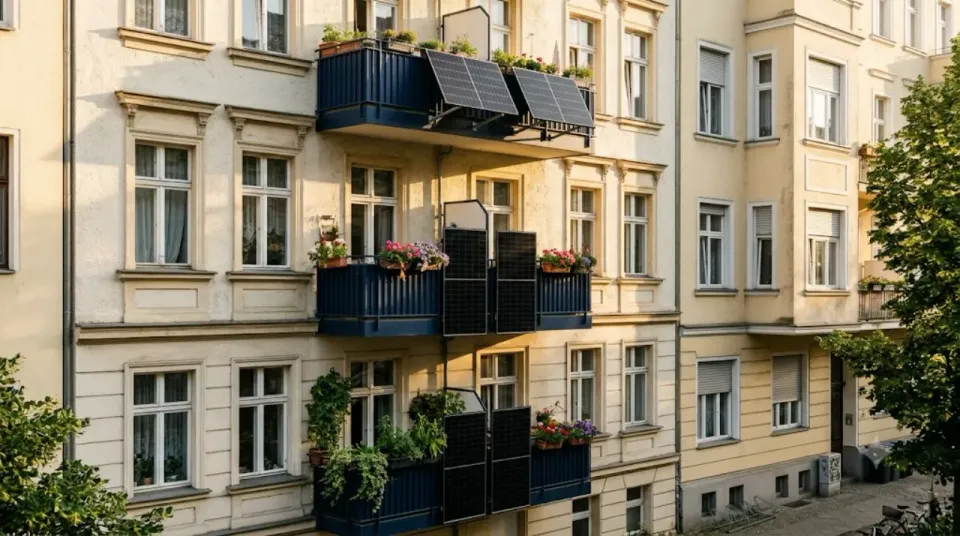
Two neighbours buy the same 860 Wp balcony kit from the same shop on the same day. A year later one has made 870 kWh and the other 430 kWh - half as much, from identical hardware. Nothing was broken. One balcony faced south with a clear view; the other faced east, hung its panels straight down the railing and lost the afternoon to the building opposite. How much power a balcony kit makes is a question about your balcony, not about the box. So instead of one average number, this article follows three example households through a full year, with their numbers shown at every step.
Meet the three example households
All three are hypothetical, but built from typical German figures. All three bought the most common kit on the market: 2 x 430 Wp panels (Wp is watt-peak, a panel's output under standard lab sunlight) and an 800 W microinverter with two MPPT inputs (separate tuning for each panel). All three pay 37 ct per kWh, close to the BDEW average for new household contracts in 2026.
| Jonas in Munich | Anna in Cologne | The Petersens in Hamburg | |
|---|---|---|---|
| Home | 3rd floor, top balcony | 2nd floor, balcony above hers | Ground floor with small garden |
| Direction | South | East | West wall plus garden |
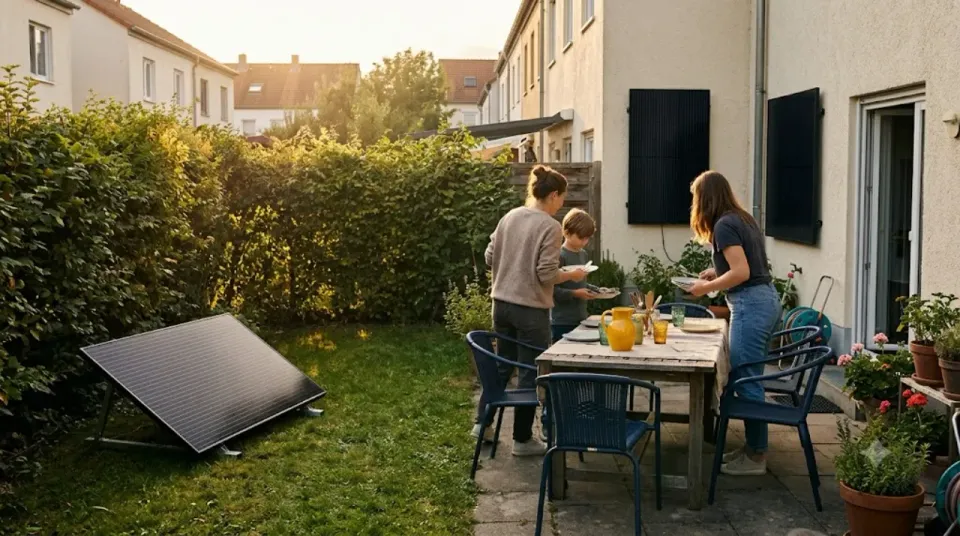
| Mounting | Railing, tilted out to about 35 degrees | Railing, vertical (90 degrees) | One panel on a garden frame at 30 degrees, one vertical on the wall |
| Shade | Almost none | Building opposite after about 13:00 (irrelevant for east), balcony above in summer | Hedge in winter mornings |
| Daytime life | Works from home 3 days a week | Out 8:00 to 17:30 | Family of four, one parent part-time |
| Base load (24/7 draw) | about 120 W | about 70 W | about 180 W |
Base load means the power your flat draws every hour, day and night: fridge, router, standby devices. It matters because it soaks up solar power automatically. More in Your base load.
Step one: the best-case number for each city
Every estimate starts from the ideal: panels facing south, tilted about 30 degrees, no shade. In Germany, that ideal produces roughly 950 to 1,100 kWh (kilowatt-hours, the unit on your bill) per year for every kWp (kilowatt-peak, 1,000 W of panel rating). The south of the country gets more sun than the north, so the figure moves with your city.
The kit is 860 Wp, or 0.86 kWp. So the best case for each household is:
- Jonas, Munich (southern, sunny): 0.86 x about 1,100 = about 950 kWh
- Anna, Cologne (west, middle): 0.86 x about 1,000 = about 860 kWh
- The Petersens, Hamburg (northern): 0.86 x about 950 = about 820 kWh
The 800 W inverter cap trims a little off the brightest summer middays. Over a year that loss is small, because panels rarely reach their full rating in real life - they get warm, the light is hazy, the angle is off. The Verbraucherzentrale (consumer advice centre) puts one ideally placed 400 Wp panel at around 400 kWh a year, which matches this ballpark.
Notice that the city only moves the best case by about 15%. That is smaller than what comes next.
Step two: direction and tilt cut each number down
Very few balconies are the ideal. Here are typical shares of the best case in Germany:
| Direction and tilt | Share of best case |
|---|---|
| South, 30 degrees | 100% |
| South-east or south-west, 30 degrees | about 95% |
| East or west, 30 degrees | about 80-85% |
| South, vertical (90 degrees) | about 70% |
| North, 30 degrees | about 50-60% |
| East or west, vertical | often around 50% |
Now apply it to our households.
Jonas tilted his railing panels out to about 35 degrees with an adjustable bracket. South at 35 degrees is close enough to ideal: call it 98%. 950 x 0.98 = about 930 kWh.
Anna hangs her panels flat against an east-facing railing. East and vertical: about 52%. 860 x 0.52 = about 450 kWh.
The Petersens split their kit. One panel sits on a garden frame facing west at 30 degrees (about 82%), the other hangs vertical on the west wall (about 50%). Each panel is half the kit, so: 410 x 0.82 + 410 x 0.50 = 336 + 205 = about 540 kWh.
Jonas's tilt bracket is the single best upgrade in this whole article. Hanging his panels vertical would have cost him about 280 kWh a year (950 x 0.70 = 665 kWh instead of 930). At 37 ct and his self-use share, that bracket is worth far more than any panel upgrade. Before you copy him, check that a tilted mount is allowed on your railing and rated for wind - see Mounting panels on a balcony railing safely.
Shelly Plug S Gen3
A metering smart plug that logs consumption of an appliance and works locally without a cloud account. It is an indoor plug, so it is not for an outdoor balcony socket, and it must never be combined with a socket strip.
Check price on Amazon Ad - affiliate link. Prices change; check the listing.Step three: shade takes its bite, hour by hour
Shade is not a fixed percentage. It depends on the hour and the season. A shadow across part of one panel can switch off a whole group of cells, because panels have bypass diodes (small electronic switches that let current skip a shaded group) - usually three per panel. Hard shadows from a railing bar or a balcony slab hurt most. Full details in Shade on a balcony.
Jonas has a clear view. His only issue is a satellite dish on the next balcony that clips one panel for about an hour on winter mornings. Call it 2%. 930 x 0.98 = about 910 kWh.
Anna is luckier than she thought. The building opposite only shades her after 13:00, and her east panels have little sun left by then anyway. The balcony above her shades the top of the panels around late morning in high summer, when the sun climbs steeply. Call it 5%. 450 x 0.95 = about 430 kWh.
The Petersens lose the first hour or two of winter sun to the hedge, but winter mornings on a west setup make very little anyway. Call it 3%. 540 x 0.97 = about 520 kWh.
The year's verdict, from the same 860 Wp kit:
| Household | Best case | After direction and tilt | After shade |
|---|---|---|---|
| Jonas, Munich, south tilted | 950 kWh | 930 kWh | 910 kWh |
| Anna, Cologne, east vertical | 860 kWh | 450 kWh | 430 kWh |
| Petersens, Hamburg, west split | 820 kWh | 540 kWh | 520 kWh |
Step four: what a single day looks like
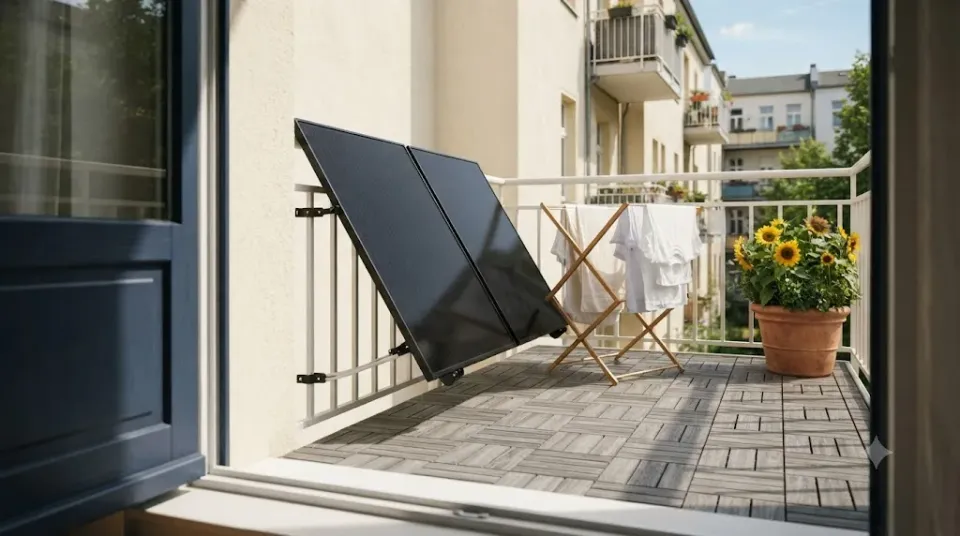
Yearly totals hide the most useful fact for daily life: most of each day's energy arrives in a few hours, and when those hours fall decides whether you can use it.
Here is a clear day in early June, roughly, for each household:
| Time | Jonas (south, tilted) | Anna (east, vertical) | Petersens (west split) |
|---|---|---|---|
| 07:00 | about 60 W | about 280 W | about 40 W |
| 09:00 | about 330 W | about 350 W | about 110 W |
| 11:00 | about 600 W | about 200 W | about 220 W |
| 13:00 | about 690 W | about 90 W | about 340 W |
| 15:00 | about 560 W | about 70 W | about 400 W |
| 17:00 | about 260 W | about 50 W | about 370 W |
| 19:00 | about 50 W | about 20 W | about 200 W |
| Day total | about 4.8 kWh | about 2.3 kWh | about 3.3 kWh |
Jonas gets a tall midday hill that touches the 800 W cap only on the very best days. Anna gets an early-morning bump that is mostly over before 11:00. The Petersens get a slow afternoon that runs well into the evening - exactly when the family is home cooking.
On a cloudy June day, all three drop to roughly a third or less, with output jumping up and down. On a clear December day, Jonas makes under 1 kWh spread across about six usable hours; Anna and the Petersens make well under that. Vertical panels do relatively better in winter (the low sun hits them more squarely) and worse in summer, which flattens their year a little.
Step five: how the year splits by month
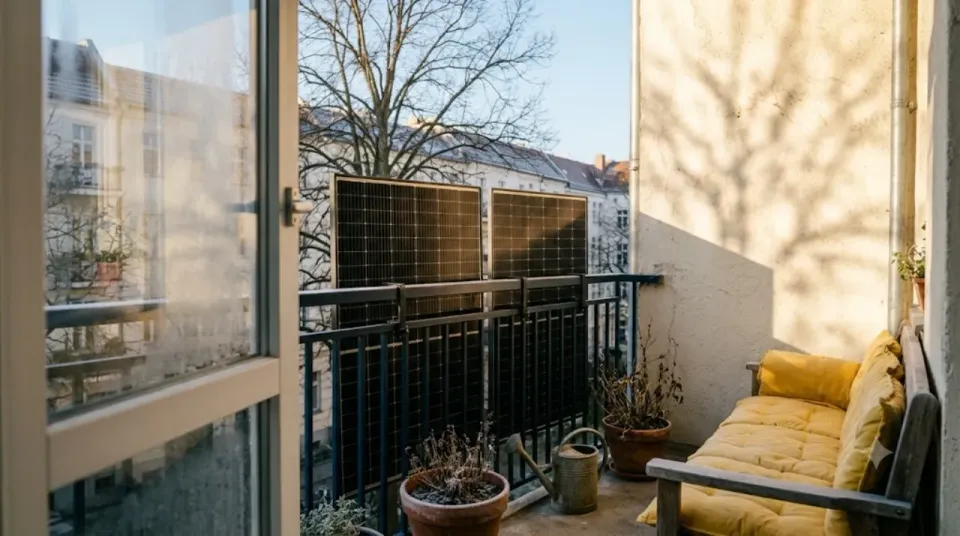
Most of the energy lands between April and September. A rough monthly split for a south-facing kit in Germany looks like this - vertical and east or west setups are a bit flatter, but the shape is the same:
| Months | Share of the year | Jonas (910 kWh) | Anna (430 kWh) |
|---|---|---|---|
| Nov, Dec, Jan | about 6-8% | about 60 kWh | about 30 kWh |
| Feb, Mar, Oct | about 17-19% | about 165 kWh | about 80 kWh |
| Apr, May, Aug, Sep | about 45-47% | about 420 kWh | about 200 kWh |
| Jun, Jul | about 28-30% | about 265 kWh | about 120 kWh |
Two practical lessons. Do not judge your kit in November; a weak first month is normal. And snow or a dirty panel in January costs you very little - in winter the real enemy is the short, low day, not the panel. See Winter, snow and heatwaves for what happens in extreme weather.
Hoymiles HMS-800W-2T
An 800 W microinverter with two MPPT inputs and built-in Wi-Fi, widely used in German balcony kits. Its app works best with a stable Wi-Fi signal on the balcony, so check reception first.
Check price on Amazon Ad - affiliate link. Prices change; check the listing.Step six: from kWh to euros, household by household
Only the power you use yourself saves money. Power you push to the grid is normally unpaid in Germany. So the honest maths has three steps: yield, times self-consumption share (the part you use at the moment it is made), times your price.
Jonas. His big midday peak meets a home office three days a week and a dishwasher he now starts at 11:00. He uses about 50% of his output. 910 x 0.50 = 455 kWh. 455 x 0.37 EUR = about 168 EUR a year.
Anna. Her morning bump arrives while she is getting ready and leaving. After 8:00 only her 70 W base load and the fridge cycling use it. She uses about 40% - a fairly good share given her small output, because the output is small enough that her base load catches a lot of it. 430 x 0.40 = 172 kWh. 172 x 0.37 = about 64 EUR a year.
The Petersens. Their afternoon output lands on homework laptops, a 180 W base load and an early dinner. They use about 60%. 520 x 0.60 = 312 kWh. 312 x 0.37 = about 115 EUR a year.
| Household | Yield | Self-use | kWh used | Saving per year | Payback on a 400 EUR kit |
|---|---|---|---|---|---|
| Jonas | 910 kWh | 50% | 455 kWh | about 168 EUR | about 2.4 years |
| Anna | 430 kWh | 40% | 172 kWh | about 64 EUR | about 6.3 years |
| Petersens | 520 kWh | 60% | 312 kWh | about 115 EUR | about 3.5 years |
Look at the Petersens. They make only 57% of Jonas's energy but save 68% of his money, because more of their power lands when they need it. That is why we keep saying the timing of your day matters as much as the yield. The full method is in Payback maths, and ways to lift the share are in Self-consumption explained.
What each household could do next
Every example household has a different best next step. None of them involves buying better panels.
Jonas: shift, do not add. On sunny days his output often exceeds what the flat uses around 13:00. Moving the washing machine from the evening to late morning, and charging his e-bike battery at midday, could lift his self-use from 50% to about 58%. 910 x 0.08 = 73 kWh x 0.37 = about 27 EUR more a year, for nothing. Our guide Which appliances to run in the sun has the list.
Anna: tilt and timers. Two cheap changes. First, ask her landlord whether a bracket that tilts the panels out by 20 to 30 degrees is acceptable; east at 30 degrees could lift her yield from about 430 to about 650 kWh. Second, set the dishwasher's delay timer so it runs at 7:00 instead of 21:00. Together, roughly 650 x 0.42 = 273 kWh used, about 101 EUR a year - up from 64. If tilting is not allowed, the timer alone still helps. Her case is a good example for South, east-west or flat.
The Petersens: consider more panels. In Germany a plug-in system may have up to 2,000 Wp behind the 800 W inverter. Their west setup rarely gets near the cap, so a third or fourth panel would fill more afternoon hours. The catch: above 960 Wp the current norm (DIN VDE V 0126-95) asks for a special energy socket fitted by an electrician instead of a household plug. They should cost that against the extra yield - see Schuko or Wieland? and What the microinverter does. This is general information, not legal advice; check the current rules before changing your system.
Brennenstuhl Primera-Line Energiemessgerät PM 231 E
A simple plug-in meter to find what your fridge, router and standby really draw before you buy panels. It has no app, so you read the display by hand and note the numbers yourself.
Check price on Amazon Ad - affiliate link. Prices change; check the listing.How to check your own kit is on track
Once your kit is running, compare real numbers with the estimate. A big gap usually has a simple cause.
- Read the inverter app weekly. Most microinverters report daily and total kWh. Write down the monthly total. See Reading your output.
- Compare month by month, not day by day. One grey week means nothing. Compare a month against the typical share in the table above.
- Look at the shape of a sunny day. If one panel's curve has a hole at the same hour every day, that is shade. If both panels are low all day, check the cables and the inverter settings.
- Check the 800 W setting. Some inverters ship at 600 W and need a firmware setting from the maker. If you change it, update your entry in the Marktstammdatenregister.
- Clean only when it is obviously dirty. Rain does most of the work on tilted panels. Bird droppings act like a tiny hard shadow and are worth wiping off.
A worked check for Anna: her estimate is about 430 kWh a year, and the monthly table says roughly 45-47% of that should arrive across April, May, August and September - about 200 kWh, or 50 kWh a month. If her app shows 48 kWh in May, she is on track. If it shows 25 kWh, something is wrong: a panel unplugged, a setting stuck at a lower limit, or a new shadow she has not noticed, like a neighbour's new awning.
If your first full year lands within 10 to 15% of your estimate, your kit is doing exactly what it should. Weather varies from year to year by roughly that much on its own.
What I would take from these three households
If I were standing on your balcony with a compass app, here is what I would tell you, in order of importance:
- Tilt beats brand. Getting a south or east panel off the vertical can be worth 20 to 40% more energy. Panel brands differ by a few percent.
- Shade is hourly. A shadow at 7:00 on a west balcony costs almost nothing; the same shadow at 13:00 on a south balcony costs a lot.
- Timing is free money. The Petersens beat their yield with their habits. Anyone can do that.
- Your number is your number. Ignore the "up to 900 kWh" on the box. Run your own spot through Sunslot, check the hourly curve against your day, and decide from that.
Shelly Pro 3EM
Measures your whole flat's consumption and export at the distribution board, so you see self-use instead of guessing. It must be installed in the fuse box by a qualified electrician.
Check price on Amazon Ad - affiliate link. Prices change; check the listing.More about output and yield
How many kWh does an 800 W balcony kit make per year?
In Germany, typically about 400 to 900 kWh for a common 2 x 430 Wp kit. An open, tilted, south-facing spot sits at the top; an east or west panel hanging vertical with some shade sits near the bottom. The "800 W" is the inverter limit, not the yearly output.
How much does a balcony kit make on a sunny day?
A south-facing 860 Wp kit makes about 4 to 5 kWh on a clear June day, often 1 to 2 kWh on a cloudy one, and often under 1 kWh on a clear December day. East or west setups make less per day but spread it over the morning or the afternoon.
Does the 800 W limit waste a lot of energy?
Usually not. With 860 Wp of panels, the cap only trims the peak on the brightest middays, which is a small share of the year. With much larger panel setups, clipping (the inverter capping output) grows, but the extra panels also lift mornings, evenings and cloudy hours.
Why is my output lower than the box promised?
Box figures assume ideal direction, tilt and no shade. A vertical railing, an east or west orientation, a shadow from the balcony above, or simply a dull year can each take 10 to 50% off. Check the shape of a sunny day in your inverter app to spot shade.
Is a north-facing balcony worth it?
Rarely. North at 30 degrees gives about 50 to 60% of the ideal, and north and vertical much less. If you have any other spot - a garden, a shed roof, a south wall - use it. If not, run the numbers before buying, and expect a slow payback.