This is general information, not legal advice. Rules change, so check the current wording before you rely on it.
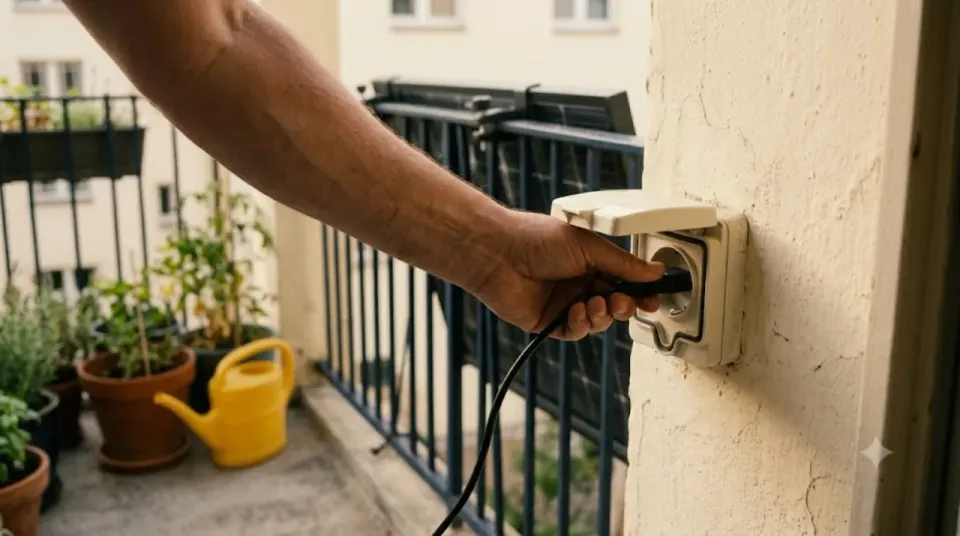
Two neighbours buy the same 800 W balcony kit. One plugs it into the outdoor socket in ten seconds. The other pays an electrician to fit a special socket first. Since December 2025, both can be doing it by the book. The difference is not the 800 W - that is the same for everyone. The difference is how many panels you may put behind it: 960 Wp on a normal plug, up to 2,000 Wp on a special energy plug. For most balconies that gap is worth nothing. For a garden fence or a garage roof it can be worth a lot. This article shows you which side you are on, with the numbers.
Side by side: the two connections at a glance
Here is the whole comparison in one table. The rest of the article explains each row and turns it into a decision.
| Schuko plug (normal household plug) | Special energy plug (Wieland type) | |
|---|---|---|
| Max. panel power under DIN VDE V 0126-95 | 960 Wp | 2,000 Wp |
| Max. inverter feed-in | 800 W | 800 W |
| Socket | Your existing normal socket | A dedicated socket fitted by an electrician |
| Touch protection | Must be added: pin cover, disconnect switch in the plug, or equivalent protection in the inverter | Built into the connector design |
| Connection cable | From the manufacturer, at least 5 m | From the manufacturer, at least 5 m |
| Extension cables or multi-socket strips | Not allowed | Not allowed |
| Extra cost | None beyond the kit | Socket plus an electrician's visit |
| Who it suits | Most rented balconies with two panels | Gardens, fences, flat roofs, larger panel arrays, long-term fixed setups |
Wp (watt-peak) is a panel's output under standard test light. W is what the inverter actually pushes into your home wiring at any moment. Mixing those two up is the root of most confusion about balcony solar. Our guide to Germany's 800 W rules separates them in detail, and watts vs watt-hours covers the units.
What each plug actually is
The Schuko plug
A Schuko plug (short for Schutzkontakt, "protective contact") is the round German household plug with two earthing clips on the sides. It is on your kettle, your vacuum cleaner and your TV. It fits every normal socket in Germany and in much of Europe.
Its weak point for solar is simple. A normal plug has bare metal pins. When you pull it out of the socket, those pins are exposed. On a kettle that is harmless, because the power comes from the wall. On a solar kit the power comes from the other end - the panels. So the question is: what stops the pins from carrying voltage after you unplug?
The special energy plug
The "Wieland plug" is a nickname. Wieland Electric is one well-known maker of a connector system called RST, and the name stuck. In the norms, this kind of connection falls under DIN VDE V 0628-1 (a standard for energy plug connections). Other makers build compatible connectors too.
The design answers the bare-pin problem at the hardware level. The contacts are recessed, so a finger cannot touch them, and the connector is built for power flowing in either direction. The catch: you cannot just plug it into your wall. An electrician installs a matching socket, usually on its own protected circuit or at least after checking the existing one.
Why the plug was argued about for years
To understand why the rules ended up the way they did, it helps to know the old fight.
Every grid-connected inverter must switch off when it loses the grid. That function is called anti-islanding (the inverter refusing to run on its own when there is no mains voltage). A good microinverter cuts out within a fraction of a second after you pull the plug, so the pins are dead before your fingers get near them. Our microinverter guide explains how it detects that.
Critics said that relying on electronics alone was not enough. What if the inverter fails? What if the plug is half pulled? Supporters pointed out that thousands of systems had been running on Schuko plugs across Europe without a pattern of accidents. For years the result was a grey zone: Schuko was widely used, widely sold, and officially frowned on.
That changed in steps. Schuko connections were tolerated from spring 2024, as the ADAC summarises it. Then the product norm DIN VDE V 0126-95 was published in December 2025 and has applied since 1 December 2025. It made the Schuko route standards-compliant, as long as the kit adds protection against touching live pins.
Two things are worth knowing about that norm:
- A norm is a technical standard, not a law. It is the reference that manufacturers build to and that insurers and courts look to when something goes wrong. The legal limits - 800 W feed-in and 2,000 Wp of panels for a simplified plug-in system - sit in energy law and stay the same.
- Older systems are generally not affected. Systems installed before the norm that met the rules at the time generally keep their protection. You do not need to rip out a working system.
What 960 Wp versus 2,000 Wp is worth in kWh
Here is the part most comparisons skip. Does the extra panel allowance actually give you more electricity? With an 800 W cap on the inverter, the answer is "sometimes, and less than you think."
Panels rarely produce their full rating. On a good summer day, two 430 Wp panels might peak around 600 to 700 W. So more panel area does not raise the ceiling - the inverter still clips (cuts off) everything above 800 W. What it does is fill the inverter for more hours: earlier in the morning, later in the evening, and on cloudy days.
A rough rule for Germany: a south-facing system at about 30 degrees makes around 950 to 1,100 kWh per year for each kWp (1,000 Wp) of panels. Railings and east or west faces make less. Our output guide has the full table. Using 1,000 kWh per kWp as a middle figure:
| Setup | Panel power | Rough yield per year | Connection needed |
|---|---|---|---|
| 2 panels, vertical on a south railing (about 70 % of best case) | 860 Wp | about 600 kWh | Schuko |
| 2 panels, 30 degrees on a south flat roof | 960 Wp | about 900 kWh | Schuko |
| 4 panels, 30 degrees on a south flat roof, inverter clips at 800 W | 1,800 Wp | roughly 1,200 to 1,400 kWh | Special energy plug |
| 4 panels, east-west on a garden fence | 1,800 Wp | roughly 1,000 to 1,200 kWh | Special energy plug |
The 1,800 Wp rows are estimates. Clipping costs most on bright summer middays, and how much depends on direction and tilt. East-west layouts clip less, because the two sides peak at different times.
Now turn kWh into money. Balcony systems in Germany generally get no payment for power sent to the grid, so only what you use yourself counts. Using an electricity price of 37 ct/kWh:
- Flat roof, 960 Wp: 900 kWh x 40 % self-use = 360 kWh x 0.37 € = about 133 € a year.
- Flat roof, 1,800 Wp: 1,300 kWh x 35 % self-use = 455 kWh x 0.37 € = about 168 € a year.
Self-use drops a little as yield rises, because more of the extra output arrives when you already cover your needs. So the bigger array earns roughly 35 € more a year in this example. If the socket, the electrician and two extra panels cost you 400 €, that extra spend pays back in a bit over 11 years. If the panels are cheap and the electrician is coming anyway, much faster. If your daytime use is high - a home office, a heat pump dryer - the gain is bigger.
The honest takeaway: the special plug pays off when you have the space for real extra panels and use power during the day. Put your own address, direction and tilt into Sunslot and compare 960 Wp with 1,800 Wp hour by hour. You will see exactly where the inverter clips at noon and how much the extra panels add in the morning and late afternoon.
Hoymiles HMS-800W-2T
A widely used 800 W microinverter for two panels, which suits a typical Schuko balcony setup. Check that the version and cable you buy come with the documents for the current norm.
Check price on Amazon Ad - affiliate link. Prices change; check the listing.
What the Schuko route requires
If you go with a normal plug, the norm asks the kit - not you - to solve the bare-pin problem. It accepts three ways:
- A protective cover over the pins that closes when the plug leaves the socket.
- A disconnect switch built into the plug that cuts the line before the pins are exposed.
- An inverter with equivalent internal protection that makes the pins safe by design.
On top of that:
- Panel limit 960 Wp. Two panels of up to 480 Wp each fit. Three 430 Wp panels (1,290 Wp) do not.
- Cable from the manufacturer, at least 5 m. The length is a safety point: it lets the inverter sit outside while the plug reaches an indoor or outdoor socket without adapters.
- No extension cables and no multi-socket strips. Plug the kit straight into a wall socket.
- One system per household. The consumer advice centre in Lower Saxony lists this alongside the plug rules.
What you do on your side: check that the socket is in good shape, ideally on a circuit without other heavy loads, and that the wiring behind it is not decades old and patched. That is not a rule in the norm. It is common sense, and the one thing an electrician would look at first.
What the Wieland route involves
The special energy plug is not a product you just buy and plug in. Here is what actually happens:
- The electrician checks your circuit. Cable type, cross-section, fuse rating and residual-current protection (the RCD, or FI-Schalter, that trips on earth faults).
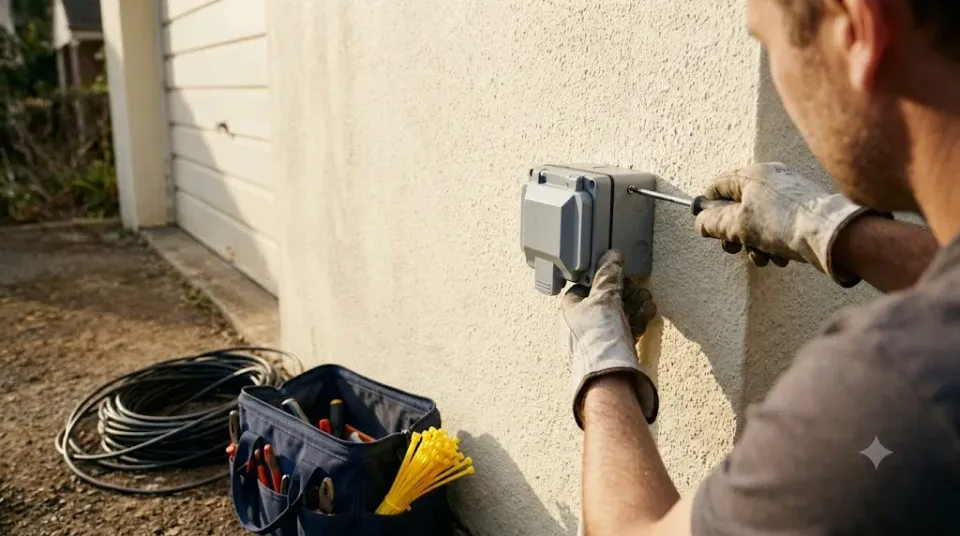
- They fit the socket. Surface-mounted or flush, indoors or outdoors with a suitable protection rating for weather. Sometimes on a new dedicated circuit.
- Your kit needs the matching plug. Many kits sell a version with an energy-plug cable, or the maker supplies one. Do not cut off a Schuko plug and fit a different one yourself - you would be altering a certified product.
- You register as normal. The plug type does not change the registration. See registration.
Cost depends on your building and region. A simple job on a sound existing circuit is often an hour or two of work plus parts. A new circuit run from the fuse box costs more. Ask for a written quote that lists the socket, the cable work and any circuit protection separately.
What you get for that money: a tidy, permanent connection, touch protection designed into the hardware, a professional check of the wiring, and the right to connect up to 2,000 Wp. For a system you plan to keep for 20 years, many people find that worth it on its own.
Three example balconies
These are example households, not real people. The numbers are rough but realistic.
Anna's east balcony in Cologne
Anna rents a third-floor flat. Her balcony faces east, and the railing takes two panels hanging vertically. That is 2 x 430 Wp = 860 Wp. Vertical on an east railing, she can expect something like half of the best case: around 400 to 450 kWh a year.
There is no room for more panels. So the 2,000 Wp allowance is worth exactly nothing to her. A kit with a norm-compliant Schuko plug, plugged into her existing balcony socket, is the right call. The money she saves on an electrician is better spent on a solid railing mount - see mounting on a railing.
Before she buys, she puts her balcony into Sunslot and sees that her output peaks around 9:00 to 11:00 and falls away after lunch. That tells her to run the dishwasher in the morning, not the evening.
Jonas's garage roof in Freiburg
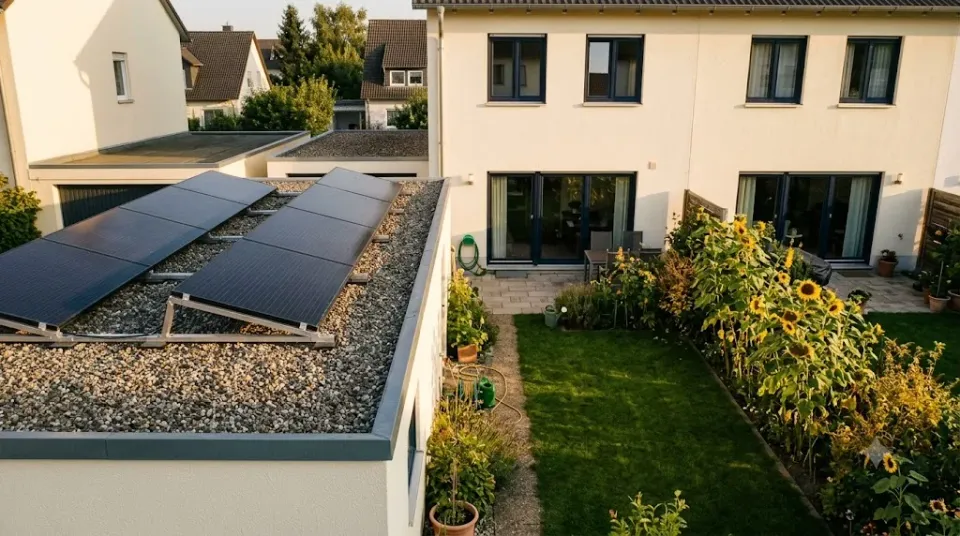
Jonas owns a terraced house with a flat garage roof facing south. He has room for four panels at about 30 degrees: 4 x 450 Wp = 1,800 Wp. Freiburg is one of the sunniest corners of Germany.
With a Schuko plug he would be limited to two of those panels. With a special energy socket he can use all four. He works from home three days a week, so a good share of the extra morning and afternoon output gets used. For him, the electrician's visit is clearly worth it, and the electrician can check the 1970s garage wiring at the same time.
The Leipzig old-building flat
An example couple in a Leipzig Altbau (an older, pre-war building) want two panels on a south balcony. The outdoor socket was added by a previous tenant, and nobody knows what is behind it.
Legally, a Schuko kit would be fine. Practically, the unknown wiring is the real risk. They book an electrician to check the circuit. Since the electrician is there anyway, they ask for a quote on an energy socket too. If the extra cost is small, they take it - it keeps the door open for a third and fourth panel on the balcony wall later.
Wieland gesis RST20i3 Einspeisesteckdose
The classic special energy socket for systems above 960 Wp. It must be installed by a qualified electrician, and your kit needs a matching plug cable.
Check price on Amazon Ad - affiliate link. Prices change; check the listing.Verdict by reader type
| If you are... | Choose | Why |
|---|---|---|
| Renting, two panels on a railing | Schuko (norm-compliant kit) | No room for more than 960 Wp; no extra cost; easy to take with you when you move |
| Renting, unsure about old wiring | Schuko, after an electrician checks the circuit | The wiring matters more than the plug |
| Owner with a garden, fence or flat roof | Special energy plug | You can use up to 2,000 Wp and the extra panels actually fit |
| Home all day or working from home | Special energy plug, if space allows | More of the extra morning and afternoon output gets used |
| Away all day, low base load | Schuko | Extra panels mostly feed the grid unpaid |
| Already running an older system | Keep it | Systems that met the rules when installed are generally protected |
| Planning a battery with your kit | Check the maker's compliance statement | The norm does not yet cover combinations with storage; separate rules are planned |
If you want one sentence: two panels, Schuko; more panels and somewhere to put them, special energy plug.
Plug mistakes
- Buying three or four panels for a Schuko kit. Above 960 Wp the Schuko route is outside the norm. If you want more panels, plan the special socket first.
- Using an extension cable or socket strip. Not allowed, and a real overheating risk. If the cable does not reach, the socket is in the wrong place - not the cable too short.
- Swapping plugs yourself. Cutting off the supplied plug changes a tested product. Use the maker's cable or an electrician.
- Assuming the plug protects you from bad wiring. It does not. A special socket comes with a wiring check; a Schuko plug does not. If in doubt, get the check anyway.
- Thinking the energy plug raises the 800 W limit. It does not. It only allows more panel power behind the same 800 W.
- Forgetting the paperwork. Whatever the plug, register within a month and tell your insurers. See insurance and liability.
What to check before you order
- Norm reference. Look for DIN VDE V 0126-95 in the product documents for new kits.
- Panel total. Schuko: 960 Wp or less. Energy plug: up to 2,000 Wp.
- Inverter limit. The inverter must limit feed-in to 800 W.
- Touch protection on Schuko kits. Pin cover, disconnect switch or inverter protection - the documents should say which.
- Cable. Supplied by the maker, at least 5 m, no adapters.
- Mount. The maker must state which surfaces their mounting system suits. Match it to your railing or roof.
- Permission. Renters and flat owners need consent first. Our landlord letter helps.
- Registration and insurance. One form in the register, one email to your insurers.
Our full buying checklist goes through the rest, from panel type to warranty. And if you are still deciding how many panels make sense, run your balcony through Sunslot before you pick a plug - the hour-by-hour curve shows whether a bigger array would mostly feed your flat or the grid.
Shelly Plug S Gen3
Use it on appliances like the dishwasher to see how much daytime use you have before deciding on extra panels. Do not put it between the solar kit and the wall socket.
Check price on Amazon Ad - affiliate link. Prices change; check the listing.Plug and socket questions
Is a Schuko plug now officially allowed for balcony solar?
Yes, within limits. Under DIN VDE V 0126-95, which has applied since December 2025, a kit may use a normal Schuko plug for up to 960 Wp of panels and 800 W feed-in, provided it has protection against touching live pins and a manufacturer cable of at least 5 m.
Do I need an electrician for a Wieland socket?
Yes. The special energy socket has to be installed by a qualified electrician. That visit usually includes a check of the circuit, which is useful in older buildings anyway.
Does the special energy plug let me feed in more than 800 W?
No. The 800 W feed-in limit is the same for both connections. The special plug only allows more panel power, up to 2,000 Wp, behind the same 800 W inverter.
My system is from 2024 and uses a plain Schuko plug. Do I have to change it?
Generally no. Systems that met the rules when they were installed generally keep their protection. If your wiring or plug shows damage, fix that regardless.
Can I use a smart plug or adapter between the kit and the socket?
Extension cables and multi-socket strips are not allowed, and the norm expects the manufacturer's cable to go straight into a wall socket. Measure your output with the inverter's app or a meter instead. See reading your output.