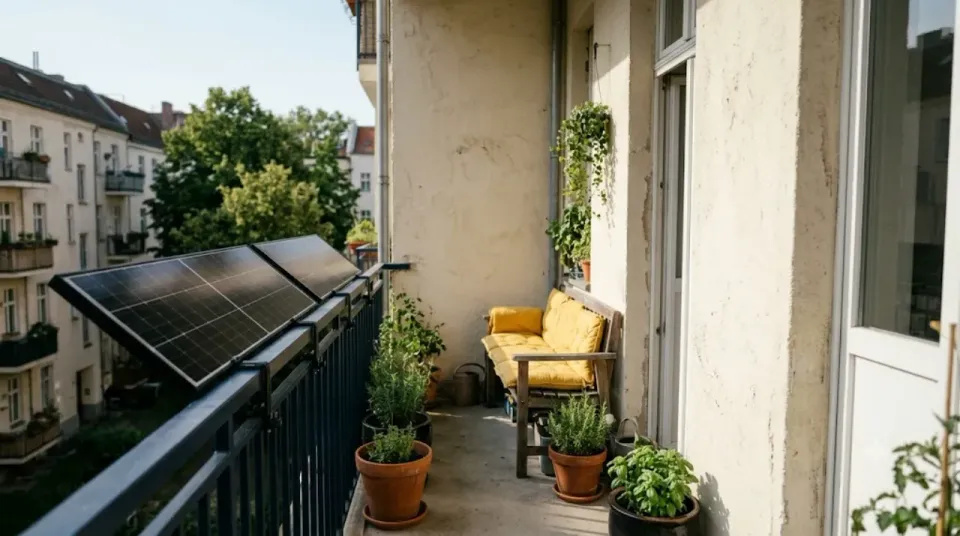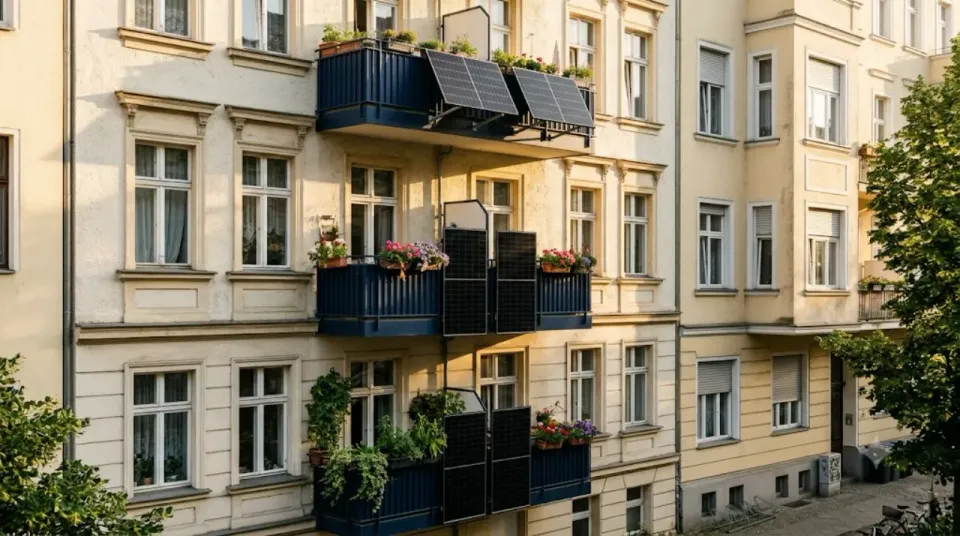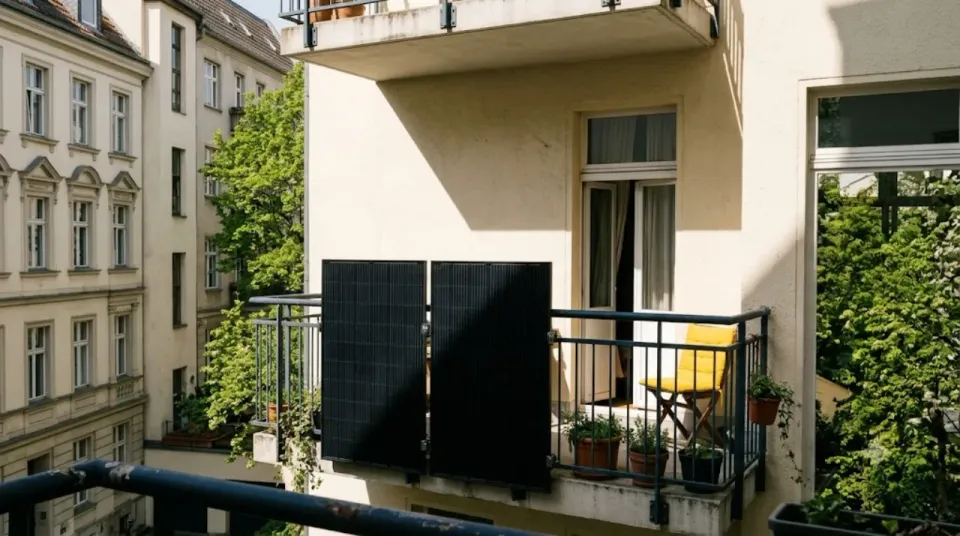
A shadow the width of a broom handle can take a third of a solar panel's output. Not a third of the shaded strip - a third of the whole panel. That is why two neighbours with the same kit, on the same street, can end up with yearly totals that differ by 150 kWh or more. One of them checked where the shadows fall before drilling a single bracket. The other trusted the brochure.
This article follows three example households - made up, but built from typical German balconies and real sun angles - from their first shadow check to their final yearly number. You will see what shade cost each of them, hour by hour and season by season, which fixes paid off, and which did not. Then you can do the same for your own balcony in a weekend.
Meet the three example households
All three bought the same kind of kit: two 430 W panels (860 Wp, watt-peak, the panel rating under standard test light) and an 800 W microinverter with two MPPT inputs (MPPT means maximum power point tracking - each input tunes one panel on its own). All three pay around 37 ct per kWh, close to the BDEW's 2026 household average. What differs is the balcony.
| Example household | Balcony | Main shade source | When it bites |
|---|---|---|---|
| Jonas and Mira, Leipzig, 3rd floor | South, panels vertical on the railing | The balcony slab of the flat above | Around midday, spring to autumn |
| Anna, Cologne, 2nd floor | East, panels vertical on the railing | A lime tree to the east and a side wall | Early mornings in summer; late morning on one panel |
| Mr Weber, Munich, ground floor | South, panels vertical on the railing | A taller building across the street | All day, mid-October to end of February |
Before we follow them, one piece of background that explains almost everything that happens next.
Why a small shadow does big damage
A solar panel is a chain of cells, usually split into three groups. Current flows through the whole chain, so the weakest cell sets the pace for its group - like a garden hose with someone standing on one spot. Each group has a bypass diode (a small electronic switch that lets current skip a shaded group). When one cell in a group is shaded hard, the diode switches that whole group out. One shaded cell, one third of the panel gone.
How the groups are laid out decides how a shadow hurts:
- The three groups run along the long side of the panel. So a shadow along the short edge touches all three groups at once. In portrait position (long side vertical) that is the bottom or top edge.
- Many modern panels use half-cut cells (cells cut in two, with the panel wired as a top half and a bottom half that work side by side). On these, a shadow along the bottom edge in portrait mostly takes out the bottom half, and the top half keeps working. Better, but still a big loss.
- In landscape position (long side horizontal) the groups run across. A shadow coming down from above, such as the edge of a balcony slab, covers the top group first and leaves the other two working for longer.
Two practical rules follow. Hard shadows (sharp ones from a rail, pole or slab edge) hurt far more than soft, diffuse shade on a grey day, which affects all panels evenly. And each panel should have its own MPPT input, so a shaded panel does not drag the sunny one down. More on that in the microinverter.
Jonas and Mira: the midday slab shadow
Jonas and Mira have the balcony everyone wants: south-facing, third floor, nothing across the street. They hung both panels vertically on the outside of the railing and expected the textbook figure. A south-facing vertical panel makes about 70% of an ideally tilted one, so for 860 Wp in Leipzig they pencilled in roughly 600 kWh a year.
The catch is the balcony above them. Its concrete slab sticks out about 1.4 metres. In summer, around midday, the sun is high - in Leipzig it reaches about 62 degrees above the horizon in late June - and the slab's shadow slides down over the top of their panels. In portrait, with standard cells, that top-edge shadow touched all three groups.
Here is a clear spring day, as an illustrative example:
| Time | No shade | With slab shadow | Lost |
|---|---|---|---|
| 9:00 | about 300 W | about 300 W | none |
| 11:00 | about 520 W | about 380 W | about 140 W |
| 13:00 | about 560 W | about 300 W | about 260 W |
| 15:00 | about 450 W | about 350 W | about 100 W |
| 17:00 | about 200 W | about 200 W | none |
Over that day they lose roughly a quarter - and it falls exactly in the strongest hours, when Mira works from home and the dishwasher runs. Across the year it is a bit less, because in winter the sun is low and slips under the slab. Their first-year estimate came out at about 480 kWh instead of 600.
What they changed
They tried three things, in order of effort:
- Turned both panels to landscape. Now the slab shadow first covers only the top group. Output at 13:00 on a similar day rose from about 300 W to about 420 W. Cost: one afternoon and new brackets.
- Tilted the bottom edge outwards on a tilt mount, staying within the maker's angle limit for wind. Tilting moves the top edge closer to the railing and lifts the face of the panel towards the sun, so the shadow line arrives later and leaves earlier.
- Checked the result in the app's per-panel view, which showed both panels now tracking each other closely around midday.
Their new estimate: about 600 kWh a year. Now the money, with the maths shown. They use about 60% of what the panels make themselves (their self-consumption share); the rest flows to the grid unpaid.
- Before: 480 kWh x 60% = 288 kWh used x 0.37 EUR = about 107 EUR a year.
- After: 600 kWh x 60% = 360 kWh used x 0.37 EUR = about 133 EUR a year.
- Difference: about 26 EUR a year, for a one-off cost of a tilt mount.
That may not sound like much. But over a 20-year panel life it is around 500 EUR - more than the whole kit cost them. Shade fixes are rarely glamorous, but they compound.
Hoymiles HMS-800W-2T
An 800 W microinverter with two separate inputs, so a shaded panel does not pull down the sunny one, and built-in Wi-Fi for per-panel monitoring. It is a bare inverter, so you still need panels, cable and mount.
Check price on Amazon Ad - affiliate link. Prices change; check the listing.Anna: the east balcony with a tree and a wall
Anna's balcony in Cologne faces east. East-facing vertical panels start low anyway - often around half of the best case - so a typical 860 Wp kit there makes something like 430 kWh a year before any shade. Anna's balcony has two extra problems.
First, a lime tree stands across the courtyard to the east. In summer, when the sun rises in the north-east and climbs slowly, the tree blocks direct sun until roughly 9:30. Second, a side wall (the divider to the neighbour's balcony) sits to the south. From about 11:00 its shadow creeps across the panel nearest to it.
She mapped it like this, on a clear June day:
| Time | Panel by the wall | Panel on the outer side | What is happening |
|---|---|---|---|
| 7:00 | about 40 W | about 60 W | Tree filters the low sun |
| 9:00 | about 120 W | about 170 W | Sun climbing past the treetop |
| 10:00 | about 230 W | about 240 W | Both in full sun - the best hour |
| 11:30 | about 60 W | about 190 W | Wall shadow on the inner panel |
| 13:00 | about 50 W | about 90 W | Sun now south; east panels on diffuse light |
Two observations. The tree matters less than it looks, because early-morning sun on an east wall is weak anyway. The wall matters more, because it cuts the inner panel during the hours where it should still be making good power.
What she changed
- Moved the inner panel 60 cm outwards along the railing, as far from the divider as the railing allowed. The wall shadow now arrives about 40 minutes later.
- Kept portrait. Her shadow comes from the side, not from above. In portrait, a side shadow creeps across one long edge, so it takes one cell group first rather than all three.
- Left the tree alone. It is not hers, it shades her flat in August, and the maths said it costs her only about 15 to 20 kWh a year.
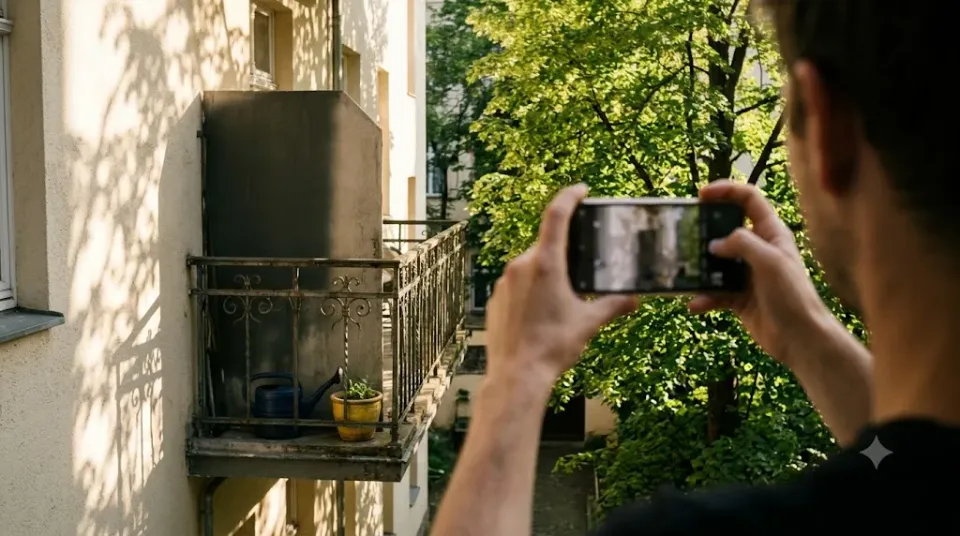
Her estimate went from about 370 kWh to about 400 kWh a year. Here is where her balcony quietly wins: most of her power arrives between 7:00 and 12:00, when she has breakfast, the coffee machine runs, and she works from home three days a week. She uses about 75% of it herself. So 400 kWh x 75% = 300 kWh x 0.37 EUR = about 111 EUR a year - more than Jonas and Mira saved before their fix, from a balcony that makes far less. Timing beats totals. The full story of why is in Self-consumption.
Mr Weber: the building that only matters in winter
Mr Weber looked at his ground-floor balcony in Munich in June and saw sun all day. He bought his kit in July and was delighted until October, when his output dropped to almost nothing on clear days. The reason was across the street.
The two-number shadow test
You can check this yourself with two numbers: how much higher the obstacle is than your panels, and how far away it is. Divide height by distance, and the table below tells you the sun angle the obstacle blocks.
| Height difference : distance | Blocks the sun below about |
|---|---|
| 1 : 4 (for example 5 m higher, 20 m away) | 14 degrees |
| 1 : 2 (10 m higher, 20 m away) | 27 degrees |
| 3 : 4 (15 m higher, 20 m away) | 37 degrees |
| 1 : 1 (20 m higher, 20 m away) | 45 degrees |
Now compare with how high the sun climbs at midday. That depends on how far north you live:
| City | Late December | March and September | Late June |
|---|---|---|---|
| Hamburg | about 13 degrees | about 36 degrees | about 60 degrees |
| Cologne | about 16 degrees | about 39 degrees | about 62 degrees |
| Munich | about 18 degrees | about 42 degrees | about 65 degrees |
The building opposite Mr Weber is about 15 metres higher than his panels and 20 metres away: a 3 : 4 ratio, so it blocks sun below about 37 degrees. In June the Munich sun peaks at 65 degrees - no contest. But the midday sun drops below 37 degrees from around mid-October to the end of February. For those four and a half months, his panels sit in shadow even at noon and only see diffuse light.
What it cost, and what he did
The good news for him: the winter months make only a small slice of a year's solar energy. For a south-facing vertical kit, November to February together might be around 15% of the yearly total. His loss works out at roughly 70 to 80 kWh a year from about 600 - painful in a dark month, modest over a year.
He could not move the building, so he did two sensible things. He stopped worrying about winter numbers. And he made sure he used every summer kilowatt-hour, by moving his washing machine to late morning. His self-consumption rose from about 50% to 60%: 525 kWh x 60% = 315 kWh x 0.37 EUR = about 117 EUR a year.
How each household mapped its shadows
None of them used special tools. Here is the method they shared, and the one we suggest.
- Take a photo every two hours on a sunny day, from where the panels will hang. Note the time on each one. Repeat once in a different season if you can.
- List the usual suspects: the balcony slab above you, side walls and dividers, trees, the building across the street, satellite dishes, flower boxes, a parasol you always open.
- Measure the big obstacles. Count floors (about 3 metres each) and pace out or laser-measure the distance. Then use the ratio table above.
- Mark the clear zone. Usually the outer end of the railing, away from side walls, gets the most hours.
- Write down hours, not feelings. "Panel A shaded 11:00-14:00 from April to August" is useful. "Quite shady at times" is not.
Then turn those hours into a number. Sunslot takes your city, direction, tilt and the shaded hours, and shows the hour-by-hour output with and without them - plus how much of it you would use yourself. That last part is what told Anna her east balcony was worth it.
Solarway Balkonkraftwerk Halterung für 2 Solarmodule
An aluminium mount with adjustable tilt for balcony, facade or flat roof, useful when a tilt clears a shadow. Check the clamp range fits your railing and stay within the stated angle and wind limits.
Check price on Amazon Ad - affiliate link. Prices change; check the listing.Fixes ranked by what they returned
Across the three households, here is how the usual fixes compared. The gains are rough and depend entirely on your shade pattern.
| Fix | Effort and cost | Typical gain when it fits | Best when |
|---|---|---|---|
| Move a panel along the railing | Low | Small to large | A side wall or divider shades one end |
| Switch portrait to landscape | Low to medium | Medium | The shadow comes from above (slab, awning) |
| Tilt the bottom edge out | Medium; check wind limits | Medium to large | South-facing balcony with a deep slab above |
| Split panels between two spots | Medium | Medium | One spot is sunny mornings, another afternoons |
| Trim plants, move pots | Very low | Small to medium | Climbers or tall plants along the railing |
| Clean the panels | Very low | Small | Bird droppings or leaves on low-tilt panels |
| Buy "shade-tolerant" panels | High | Small | Rarely the answer on its own |
Two notes on that table. Mounting changes (tilt, outside the railing) need the same care as the first install - see Mounting panels on a balcony railing. And module-level optimisers (small boxes that tune each panel separately) add little on a balcony kit that already has one MPPT input per panel. With two panels and two inputs, you already have most of the benefit.
Common shading mistakes
- Checking in summer only. Mr Weber's mistake. Winter shadows are longer, often by a factor of three or four.
- Putting both panels on one MPPT input when one of them is regularly shaded. The shaded panel then limits the pair.
- Ignoring the railing itself. A thick top rail or crossbar right in front of the bottom cells casts a hard line of shadow every day. Hang the panel so its cells sit clear of the bars.
- Judging by the panel area in sun. "90% of the glass is in sun" can still mean a third of the output gone, if the 10% covers the wrong cells.
- Using the brochure yield for payback. Use your shaded estimate, then run payback maths.
- Chasing winter output. Effort spent on December rarely pays. Effort spent on April to September usually does.
When shade means it is not worth it
If your balcony is in full shadow most of the day all year, a kit will struggle. A rough rule: if the panels would get fewer than three or four hours of direct sun on a summer day, look for another spot before you buy - a garden, a shed roof or a sunny wall (see Flat roof, garden or wall).
Run a quick sanity check with your own numbers. Say your shaded estimate is 250 kWh a year and you would use 60% of it: 250 x 0.6 = 150 kWh x 0.37 EUR = about 55 EUR a year. A 400 EUR kit then takes over seven years to pay back - still worth it for some, but not the three to five years people expect from brochures. If your estimate falls below about 200 kWh, the case gets thin.
And if you are deciding between two balconies or two railings, model both. A slightly worse direction with no shade often beats a perfect direction with a midday shadow. Anna's east balcony out-saved Jonas and Mira's shaded south balcony for exactly that reason.
Bosch Zamo Laser-Entfernungsmesser
Handy for measuring the distance to a building or tree so you can work out the shadow angle. It measures distance only, not height, so count floors for that.
Check price on Amazon Ad - affiliate link. Prices change; check the listing.What I'd do on your balcony
If I were standing on your balcony with you, this is the order I would go in:
- Photograph it every two hours on one sunny day, and note the big obstacles with their height and distance.
- Use the ratio table to check winter. If a building blocks below 30 degrees, expect weak months from November to February and plan around them.
- Pick the panel spots with the most clear hours between 10:00 and 16:00 from April to September.
- Choose portrait or landscape by where the shadow comes from: above means landscape, side means portrait.
- Make sure each panel has its own MPPT input.
- Model it in Sunslot, then check your real numbers against the estimate after a month using the app's per-panel view (see Reading your output).
Shade questions
How much output does a small shadow really cost?
It depends on which cells it covers. A hard shadow across one cell group switches that group off, which is about a third of the panel. A shadow along the short edge in portrait can affect all three groups at once. Soft, diffuse shade costs far less.
Is landscape or portrait better for shade?
If the shadow comes from above, such as a balcony slab, landscape usually loses less. If it comes from the side, such as a wall or divider, portrait usually loses less. Panels with half-cut cells soften the difference but do not remove it.
Do I need optimisers on a shaded balcony?
Usually not. A balcony inverter with one MPPT input per panel already tunes each panel separately. Optimisers help mostly in larger systems where many panels share one input.
Will shade damage my panels?
Normal shade from buildings and trees does not. Bypass diodes exist to protect shaded cells from overheating. Permanent spot shading from dirt or droppings is worth cleaning off, both for output and to avoid local hot spots.
How many hours of sun does a balcony need to be worth it?
As a rough rule, at least three to four hours of direct sun on a summer day on the panel face. Below that, compare with another spot and do the payback maths with your shaded estimate.