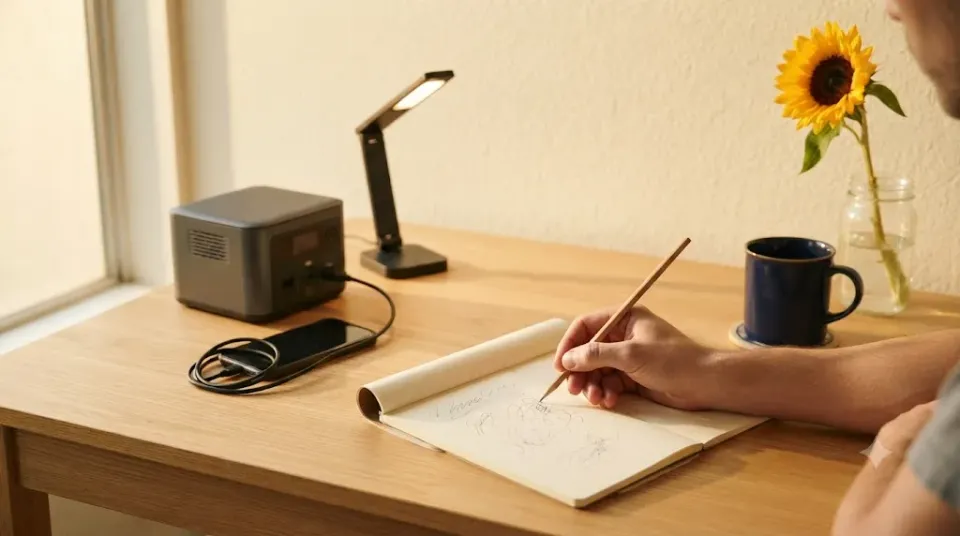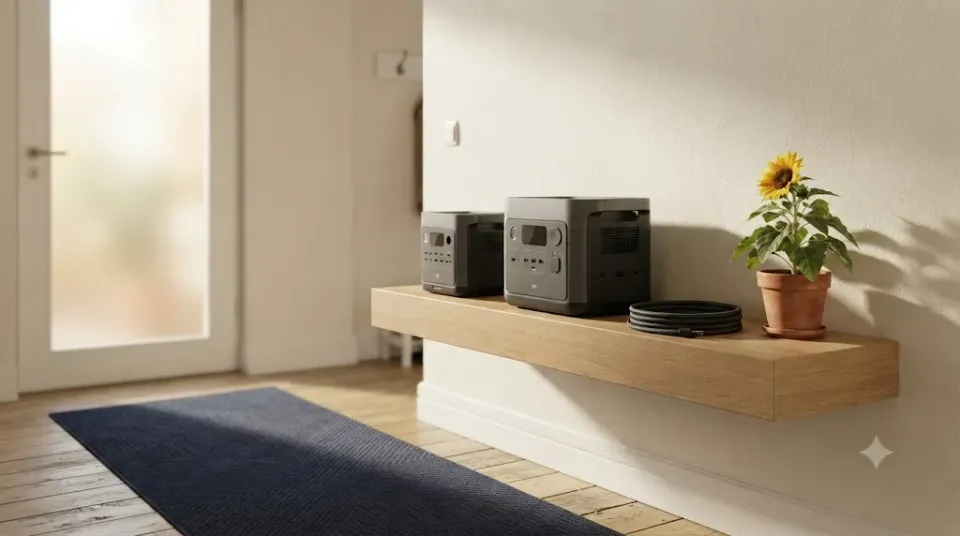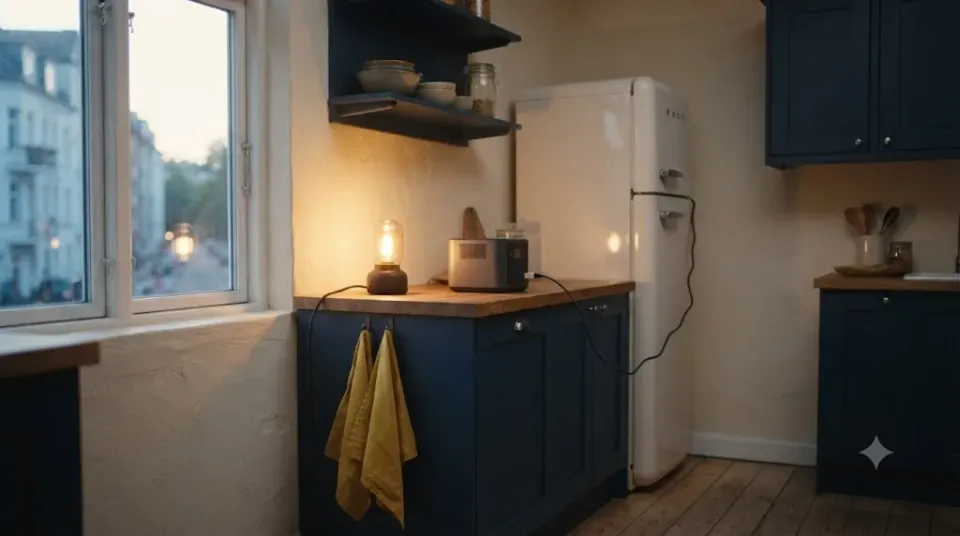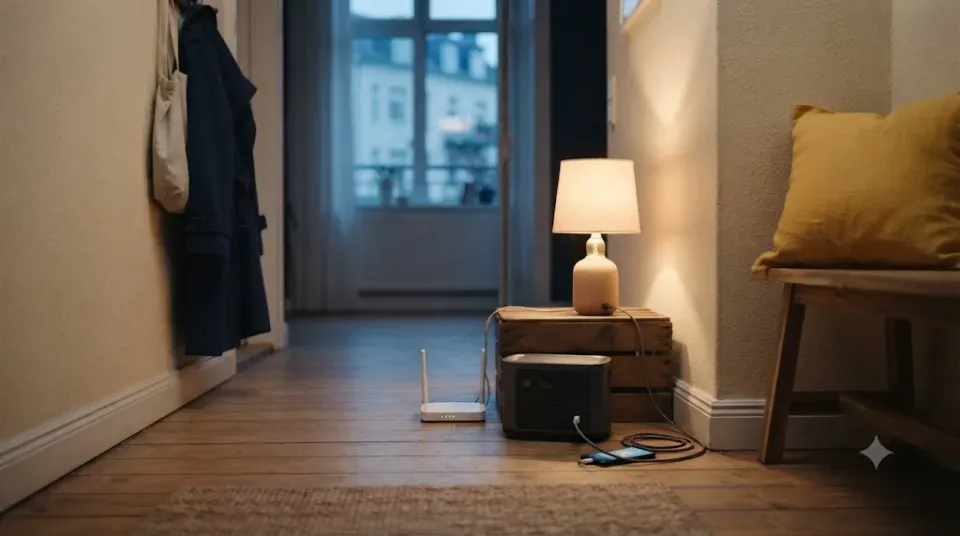
A 1,000 Wh power station sounds like a lot. It will run a 2,000 W kettle for about 25 minutes - and then it is empty. The same box will keep a Wi-Fi router alive for three days. Both facts are true, and the gap between them is where most disappointment comes from. A portable power station is a large rechargeable battery in a box with sockets on the front: no fuel, no fumes, no engine noise. It is a genuinely useful tool. But it is surrounded by myths, many of them helped along by adverts. Here are eight common ones, what is actually true, and how to check it yourself.
First, what is inside the box
Before the myths, a two-minute tour. Every power station, whatever the brand, has the same five parts:
| Part | What it does | The number to read |
|---|---|---|
| Battery pack | Stores the energy | Capacity in Wh (watt-hours): how much energy, so how long |
| Inverter | Turns the battery's direct current into the 230 V alternating current your sockets use | Output in W (watts): how much power at once, so what you can run |
| Charge controller | Manages charging from wall, car or solar; most use MPPT (maximum power point tracking, which squeezes the most out of solar panels as the light changes) | Max solar input in W and its voltage range |
| BMS (battery management system) | Protects the cells from overcharging, overheating and deep discharge | Usually not listed - but it is why a good unit is safe |
| Outputs | 230 V sockets, USB-A, USB-C, 12 V car socket | USB-C wattage, number of sockets |
Two numbers decide almost everything: Wh for how long, W for what. If those terms are new, watts vs watt-hours explains them in five minutes. Keep them in mind - nearly every myth below is a mix-up of the two.
Myth 1: "1,000 Wh means I get 1,000 Wh"
What is true: you typically get around 80 percent of the label figure out of the 230 V sockets, sometimes less.
The proof: two losses stack up. First, many makers keep a reserve at the top and bottom of the battery to protect the cells, so not every watt-hour on the label is usable. Second, the inverter that makes 230 V runs at around 90 percent efficiency, so about a tenth of the energy turns into heat. Put the two together and a common estimate is 0.9 x 0.9 = 0.81, or roughly 810 Wh delivered from a 1,000 Wh unit.
Cold makes it worse, and so does age. A battery at 80 percent health delivers proportionally less again.
You can check your own unit in an afternoon. Charge it to 100 percent. Plug a steady load of around 100 W into a 230 V socket through a plug-in energy meter - a desk lamp plus a fan, or an old TV, works well. Avoid heaters, which run the test too fast to be useful. Note the time. When the station shuts off, read the meter's kWh figure. A 1,000 Wh unit that delivers 820 Wh is doing fine. One that delivers 600 Wh when new is not, and worth a word with the seller within the return period.
What to do: when you plan, multiply the label capacity by 0.8. Or, the other way round, divide what you need by 0.8 to find the size to buy. Our size guide uses exactly that rule.
Myth 2: "A big battery can run anything"
What is true: the inverter decides what you can run. The battery only decides for how long.
The proof: imagine a unit with a huge 2,000 Wh battery but a 600 W inverter. Plug in a 2,000 W kettle and it shuts off instantly, because the inverter cannot deliver 2,000 W - no matter how full the battery is. Now flip it: a 2,000 W inverter with a small 500 Wh battery boils the kettle, but only a handful of times before it is empty.
Motors add a twist. Fridges, pumps and power tools draw a short surge (a start-up burst) of two to three times their running power. Inverters list a surge or peak rating for a second or two. Check it covers the biggest motor you want to start.
Some newer units offer a mode that lets a heating device run on a smaller inverter by lowering the voltage. A kettle then works, but slowly. It is a handy trick, not a way round physics.
What to do: list the devices you might run at the same time, add their watts, and make sure the inverter beats that total with room to spare.
EcoFlow RIVER 3 Plus
A compact LiFePO4 unit for laptops, phones, a router and lights in a short power cut or a weekend away. Its capacity is small, so it will not keep a fridge going for long.
Check price on Amazon Ad - affiliate link. Prices change; check the listing.Myth 3: "It can back up my whole flat"
What is true: a portable unit powers selected devices you plug into it. It does not power your home wiring, and it cannot run heating or cooking for long.
The proof: look at what a German flat uses. A modern fridge needs roughly 300 to 500 Wh a day. A router about 240 Wh. Lights, phones and a laptop a few hundred more. That essentials list fits a 1,000 to 1,500 Wh unit for a day. Now add an electric oven (2,000 to 3,500 W), an instant water heater (often 18,000 W or more) or electric heating (1,000 to 2,000 W per room, for hours). A typical portable unit runs out in under an hour, if it can start them at all.
| Device | Typical power | Hours on a 1,000 Wh unit (about 800 Wh usable) |
|---|---|---|
| Wi-Fi router | 10 W | about 80 hours |
| Three LED lamps | 24 W | about 33 hours |
| Laptop | 50 W | about 16 hours |
| Modern fridge (averaged over a day) | about 15 to 20 W average | about 40 to 50 hours |
| Fan heater | 2,000 W | about 24 minutes (needs a 2,000 W+ inverter) |
| Electric kettle | 2,000 W | about 24 minutes, or about 5 kettles |
The fridge line uses its daily energy, not its label wattage, because a fridge cycles on and off. The point stands: essentials, yes; the whole home, no.
What to do: plan for the four things that matter in a power cut - light, contact, cold food and any medical device. Our 48-hour power cut plan builds that list with real numbers.
Myth 4: "It's the same as a UPS"
What is true: some power stations can act like one, many cannot, and the switchover time is the detail that matters.
The proof: a UPS (uninterruptible power supply) sits between the wall and your computer. When the mains fails, it takes over in a few milliseconds, so the computer does not notice. A power station used as a pass-through (plugged into the wall with devices plugged into it) has to detect the failure and switch to battery. Many current models advertise a switchover of around 10 to 30 milliseconds. Others take longer, and a desktop PC or a network storage box may restart in that gap.
Laptops, phones and routers usually do not care, because they have their own battery or ride through short gaps. Desktop PCs, aquarium pumps and some medical devices might.
What to do: if seamless switchover matters, look for a stated switchover time in the spec sheet, not just the word "UPS" in the advert. Then test it: plug the station into the wall, connect the device, flip the fuse or pull the wall plug, and see what happens. Do this before you rely on it, never during an emergency.
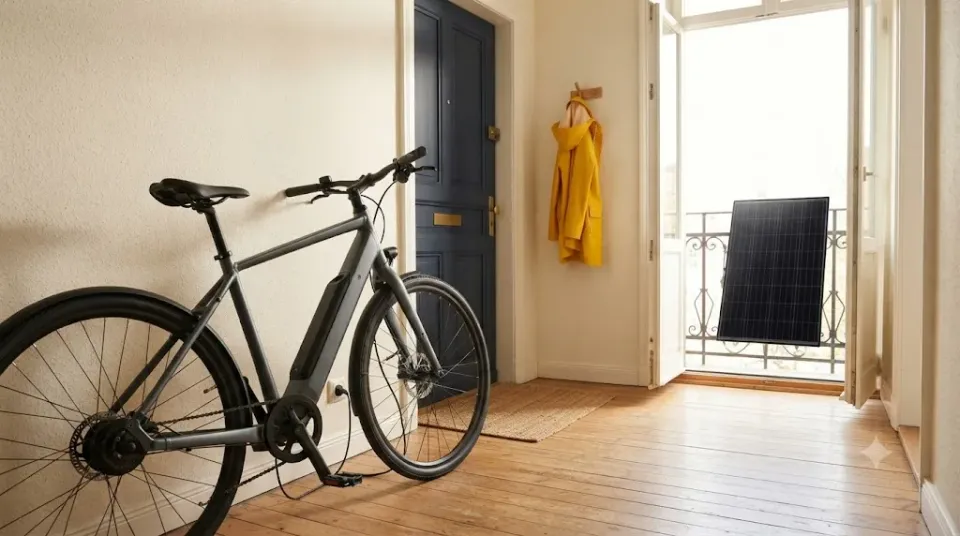
Myth 5: "It's a balcony solar system in a box"
What is true: most portable power stations do not feed power into your home wiring at all. They only power what is plugged into them.
The proof: a balcony solar system has a grid-tied microinverter that pushes up to 800 W into your sockets, where your fridge, router and TV use it automatically. A portable power station has an off-grid inverter that powers its own sockets only. Charge it from panels at noon, and in the evening you have to physically plug devices into it. Nothing flows into your flat's wiring.
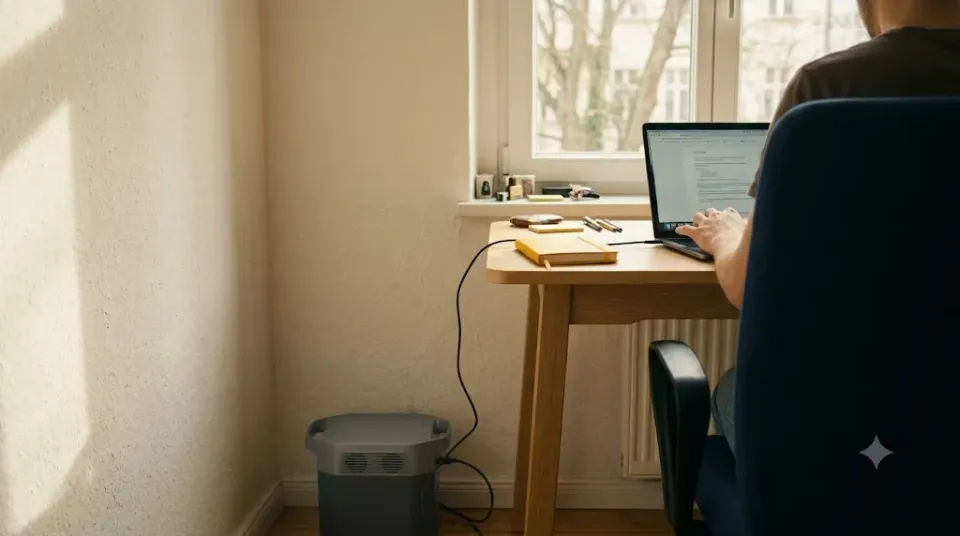
That is not a flaw - it is just a different job. Some people do use a power station as a manual store for balcony solar: panels charge it during the day, a laptop and lamp run from it at night. See pairing panels with a power station. But it does not replace a grid-tied kit, and units sold to feed into home wiring fall under different rules entirely. If you want sunshine to lower your bill automatically, start with what plug-in solar is.
Myth 6: "It will cut my electricity bill"
What is true: charging from the wall and using the energy later saves nothing - it costs a little. Charging from solar can save money, but slowly.
The proof: charge 1 kWh from the wall at 37 ct, lose around 15 to 20 percent on the way in and out, and you get back roughly 0.8 kWh. You paid 37 ct for 80 percent of the energy - a loss.
Now the solar case. Say you have a balcony kit making surplus at noon, and you use a 1,000 Wh power station to catch some of it. On a good summer day you might store 800 Wh and use about 650 Wh in the evening after losses. That is worth 0.65 x 0.37 = about 24 ct. If you managed that 150 days a year, it adds up to about 36 euros. A 1,000 Wh LiFePO4 unit costs several hundred euros, so the pure savings payback is long - often around ten years or more. In winter, your balcony kit may make no surplus at all.
Before you count on surplus, check how much you actually have. Sunslot shows your balcony's output hour by hour against a typical household's use, so you can see whether there is anything left at 14:00 to store, or whether your fridge and router already soak it up.
There is one money case that does work: avoiding a loss. If a three-day outage would spoil a full freezer, cost you work days without internet, or leave a CPAP machine without power, the value of a power station is not in kWh at all. It is in what you do not lose. That is a fair reason to buy one - just be honest that it is insurance, not savings.
What to do: buy a power station for what it does well - power cuts, camping, outdoor work. Treat any bill savings as a bonus. If saving money is the main goal, look at a balcony kit first and read payback maths.
Anker SOLIX C1000
A 1 kWh class LiFePO4 station that suits a family's power-cut essentials or a van weekend. It weighs over 10 kg, so it is a carry-to-the-car unit, not a hiking one.
Check price on Amazon Ad - affiliate link. Prices change; check the listing.Myth 7: "Indoors is dangerous, just like a generator"
What is true: a power station has no engine and no exhaust, so you can use it indoors. A petrol generator must never run inside.
The proof: petrol and diesel generators produce carbon monoxide, an odourless gas that kills in enclosed spaces. That is why they belong outdoors, well away from windows. A battery power station produces no exhaust at all. That is its biggest safety advantage, and the reason it suits a flat.
That does not mean "anywhere, anyhow." Any lithium battery stores a lot of energy. Stiftung Warentest's safety advice on power stations comes down to a few rules: do not exceed the rated power, keep the unit away from extreme heat, moisture and direct sunlight, protect it from hard knocks, and keep it away from flammable materials.
- Charge it on a hard surface - a tiled floor or a table, not a bed or sofa - with space around the vents.
- Do not cover it while charging or under heavy load.
- Keep it out of a hot car in summer and away from heaters.
- Stop using a unit that is swollen, cracked or smells odd. Take it to a battery collection point.
Chemistry matters here. LiFePO4 cells (lithium iron phosphate) are far harder to push into overheating than NMC cells. Most current power stations use LiFePO4. See LiFePO4 vs NMC for the details.
Myth 8: "Buy the biggest you can afford"
What is true: the right size is the one that matches your list. Bigger means heavier, slower to refill and more expensive - and an oversized unit mostly sits half full in a cupboard.
The proof: units around 1,000 Wh often weigh 10 to 15 kg. Bigger ones weigh much more. A 2,000 Wh unit with only 200 W of solar input needs about ten hours of strong sun to fill - more than a German winter day offers. If you only ever need 400 Wh for a weekend tent, you are carrying three times the weight for nothing.
Refill time is the hidden cost of size. Rough figures for a full charge from empty, ignoring losses:
| Capacity | From a 100 W panel in good sun | From a 400 W solar input in good sun | From a fast wall charger |
|---|---|---|---|
| 300 Wh | about 4 to 5 hours | about 1 hour (if the unit accepts it) | often around 1 hour |
| 1,000 Wh | about 13 to 15 hours - more than one day | about 3 to 4 hours | often around 1 hour |
| 2,000 Wh | several days | about 6 to 8 hours | 1 to 2 hours |
Panels rarely give their full rating, which is why the solar column assumes about 70 to 80 percent of it. In November, halve those solar figures again or worse.
Here are three example households and what actually suits them:
Mia, a student in Berlin
Mia wants her laptop, phone and a lamp to keep going in a power cut, and a speaker for the park. About 250 Wh a day. A small unit of around 300 Wh weighing a few kilos does it all and fits on a shelf.
The Weber family in Hanover
An example family of four want the fridge, router, lights and phones covered through a 24-hour cut. About 900 Wh, divided by 0.8 is about 1,100 Wh. A unit of around 1,000 to 1,200 Wh with an inverter of at least 1,000 W covers it, including the fridge's start-up surge.
Thomas, a van weekender from Stuttgart
Thomas runs a compressor cool box, lights, a laptop and phones for two days: around 600 Wh a day, or about 1,500 Wh for the weekend after margin. With a 200 W panel on the roof topping it up, a 1,000 Wh unit is enough in summer. See camping and van power.
What to do: list what you want to run, for how long, and how you will recharge. Then size it with our size guide.
So, do you need one?
Three questions settle it:
- What do I want to run? Write each device and its watts. If the list is only phones and a lamp, a large power bank may be enough.
- For how long? A two-hour cut, a weekend trip and a week off-grid need very different sizes.
- How will I recharge it? Wall only, car, or solar too? If solar, how much sun does your spot get in the months you care about? Sunslot estimates that for your balcony direction and city, so you know whether a panel can really refill the unit in October.

If the answers point to a clear job - backup for essentials, camping, outdoor work - a power station quietly earns its place. If the answer is "I want to save on my bill," a balcony kit is the better first step.
Jackery Explorer 1000 v2
Another 1 kWh class LiFePO4 unit for home backup and camping. Compare its solar input and switchover details with the Anker before you choose.
Check price on Amazon Ad - affiliate link. Prices change; check the listing.Power station basics, answered
Can I use a power station indoors?
Yes. It has no engine and no exhaust, so unlike a petrol generator it is safe to use inside. Charge it on a hard surface, keep the vents clear and keep it away from heat and direct sun.
How long does a 1,000 Wh power station last?
It depends on what you run. Plan with about 800 Wh usable from the 230 V sockets. That is roughly 80 hours for a 10 W router, 16 hours for a 50 W laptop, or about 24 minutes for a 2,000 W kettle.
Can a power station run a fridge?
Usually yes, if the inverter can handle the fridge's start-up surge. A modern fridge uses roughly 300 to 500 Wh a day, so a 1,000 Wh unit can keep it going for around a day and a half to two days.
Can I plug a power station into a wall socket to power my flat?
No. Never connect a portable power station's output to your home wiring through a socket. It is not designed for that, and it can endanger you, your neighbours and grid workers. Plug devices directly into the station.
Does a power station work as a UPS for my computer?
Some do. Check the stated switchover time and test it with your device before you rely on it. Laptops are rarely a problem; desktop PCs may restart if the switchover is too slow.