Ask ten neighbours about balcony solar and you will hear ten different stories. "It is illegal." "It halves your bill." "The meter spins backwards." "It keeps the lights on in a blackout." Most of these are wrong, and the wrong ones cost money both ways: some people never buy a system that would have paid back in four years, others buy a battery or a giant panel set they did not need. Here are the most common myths, each with what is actually true in Germany today and the proof behind it.
Rules content in this article is a practical summary, not legal advice. Numbers use 37 ct/kWh, close to the BDEW average for new household electricity contracts in August 2026.
Myth 1: "It is illegal, needs an electrician, and my landlord can say no"
Three rule myths, one answer: the rules got much simpler in 2024 and 2025.
Legal, and no electrician for a standard kit
What is true: plug-in systems are legal in Germany, and for a standard kit you do not need an electrician.
The proof: the rules were simplified in 2024 with the "Solarpaket I". A system may feed up to 800 W into your home through its inverter (the box that converts panel DC power into 230 V mains power). You register it in the Marktstammdatenregister, the federal energy register. It is free and takes a few minutes. A separate notice to your grid operator is no longer needed.
The product standard DIN VDE V 0126-95, which has applied since 1 December 2025, settled the plug question. It allows a normal Schuko plug (the standard German wall plug) for systems with up to 960 W of panels, provided the plug, an isolating switch or the inverter has the required protection features. Larger panel totals up to 2,000 W are meant for a special feed-in socket, which an electrician installs. The standard also asks for a cable at least 5 m long and rules out power strips.
You should still make sure the wall socket and its circuit are in good condition. If the socket is loose, scorched or very old, have it checked. See Germany 800 W rules, Schuko vs Wieland and registration.
The landlord: needs a good reason to refuse
What is true: since 2024, a landlord or owners' association can no longer refuse without a good reason. But you still have to ask.
The proof: balcony solar now counts as a privileged measure in German tenancy and condominium law. That means a tenant or flat owner has a claim to consent. The landlord or association can set reasonable conditions on how and where it is mounted - for example, that it is fixed securely, protected against falling and against wind and snow loads, and that the facade is not damaged.
In practice: write a short request with a photo or sketch, name the mount, say it can be removed without damage, and offer to share the product datasheets. Our landlord permission guide has a template approach.
Myth 2: "I get paid for exports, and it halves my bill"
Two money myths that usually travel together. Both are wrong, and both are easy to check.
Exports: generally no payment
What is true: generally, no. Balcony systems in Germany receive no feed-in payment for power sent to the grid.
The proof: power you do not use at the moment it is made flows out through your meter unpaid. That is the trade-off for the simple registration. It is why the share you use yourself matters so much. That share is called self-consumption (solar power used in your home at the moment it is made).
Here is what it means in euros. Say your system makes 750 kWh a year:
- At 30 % self-consumption you use 225 kWh = about 83 € saved.
- At 60 % self-consumption you use 450 kWh = about 167 € saved.
Same panels, double the saving. See self-consumption for three worked household examples.
The bill: think 10 to 15 percent, not half
What is true: a saving of around 10 to 15 percent of the bill is more realistic for a typical household.
The proof: an 800 W system might make around 750 kWh a year. If you use 40 percent yourself, that is 300 kWh. At 37 ct/kWh you save about 111 € a year. A household using 2,500 kWh a year pays roughly 900 € or more for energy alone, before the fixed monthly charge. So:
- 111 € / about 925 € = about 12 % of the energy part of the bill.
Not half. But on a kit costing around 250 to 500 euros, 111 € a year still pays back within a few years, and the panels keep working long after. See payback maths.
Myth 3: "Bigger panels mean twice the savings"
What is true: extra panel watts help, but much less than the label suggests.
The proof: the inverter caps output at 800 W. On a bright summer noon, any panel power above that is simply cut off. Extra panels help in the morning, evening, on cloudy days and in winter, when the panels make less than 800 W anyway.
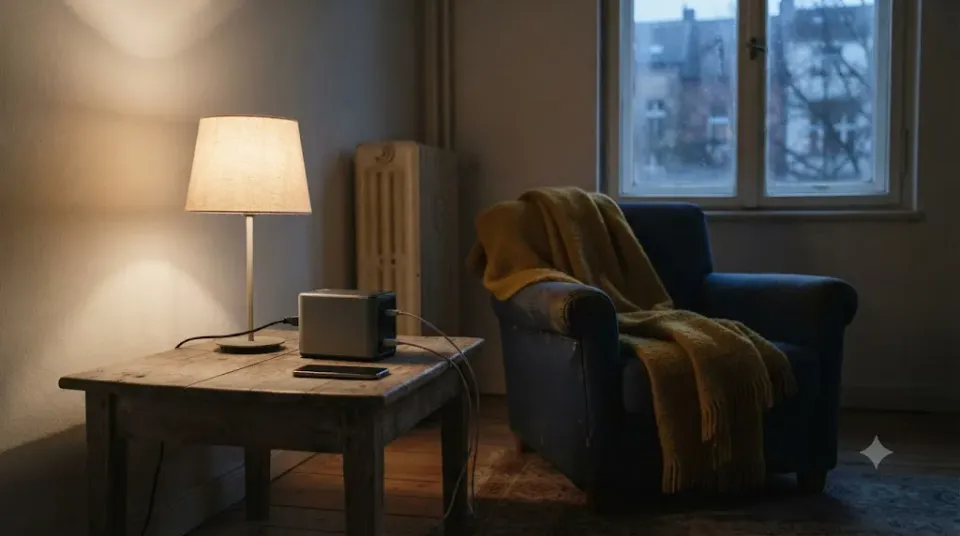
A rough illustration. Two 430 W panels (860 W) versus four panels (about 1,700 W) on the same 800 W inverter, south-facing, in a German city:
| Setup (illustrative) | Yearly yield (rough) | Plug route | Typical extra cost |
|---|---|---|---|
| 2 panels, about 860 W | about 750 kWh | Schuko possible | - |
| 4 panels, about 1,700 W | noticeably more, but well under double | Special feed-in socket | Extra panels, mount and electrician |
And remember: extra yield only saves money if you use it. If your self-consumption is already low, more midday power mostly means more export for nothing. Bigger arrays make most sense together with a battery or a big daytime load. See how much power balcony solar makes.
Myth 4: "My meter will spin backwards"
What is true: not with a modern meter.
The proof: digital meters and smart meters do not run backwards. Exported power is simply not counted as consumption, and some meters record it separately. Older Ferraris meters (with a spinning disc) without a backstop could run backwards, which is why grid operators replace them when a plug-in system is registered. You do not need to arrange that yourself, and in the meantime it is a matter for the grid operator. Our article on the monitoring app and meter covers what you will see on yours.
EcoFlow RIVER 2 Pro
A 768 Wh LiFePO4 portable power station with adjustable AC charging, so you can fill it from your balcony surplus and have power ready for a cut. It is too small to run a household for long - think fridge, router, lights and phones.
Check price on Amazon Ad - affiliate link. Prices change; check the listing.
Myth 5: "It keeps my lights on in a power cut"
What is true: no. A standard balcony system switches off within moments when the grid goes down.
The proof: this is a deliberate safety feature of every grid-tied inverter. It stops power flowing into lines that engineers may be repairing. Even in bright sunshine, your sockets go dead. Some balcony batteries offer a separate emergency socket, but that only powers what is plugged into it, and only if the product is built for it - check the datasheet.
If backup power matters to you, the simplest option is a portable power station (a battery box with sockets) that you keep charged. Our example: a 1 kWh power station can run a fridge for a good part of a day, or a router and lights for much longer. See what is a power station and a 48-hour power cut plan.
Myth 6: "North-facing balconies are useless"
What is true: they produce noticeably less - often around half of a south balcony - but not nothing.
The proof: on a north balcony, panels catch mostly diffuse light (light scattered by the sky and clouds rather than direct sun). In summer, the sun rises in the north-east and sets in the north-west, so a north balcony can get some direct morning and evening sun.
Rough maths for an example north balcony making about 375 kWh a year, half of a 750 kWh south system. With a high self-consumption of 60 % - easy, because output is low and spread out - that is 225 kWh used at home, about 83 € a year. On a 350 € kit, payback is about 4 years. Not bad at all. On a 600 € kit it is over 7 years. The answer depends on price and shade.
Run your own spot with Sunslot before deciding. It estimates hour-by-hour output for your direction, tilt, shade and city, and shows the payback that follows. Put a north balcony in and you may be surprised how much the summer evenings add.
Myth 7: "You always need a battery to make it worthwhile"
What is true: most flats do fine without one. A battery adds savings, but often pays back slowly.
The proof: in 2026, basic 800 W kits without storage typically cost around 250 to 500 euros, and sets with storage around 800 to 1,200 euros. So storage adds very roughly 500 to 700 euros.
A rough example. A household at 45 % self-consumption with a 750 kWh system adds a battery and reaches about 70 %:
- Extra used: 25 % of 750 = 188 kWh
- Minus about 10 % storage losses: about 169 kWh
- Extra saving: 169 x 0.37 € = about 63 € a year
- Payback on 600 € extra: about 9 to 10 years
That can work if the battery lasts, if electricity prices rise, or if you have a larger panel array or big evening use. But for most first-time buyers, panels first and a year of habit changes is the better order. See does a balcony system need a battery?
Anker SOLIX Solarbank 2 E1600 Pro
A 1.6 kWh balcony battery that stores midday surplus for the evening and can be extended later. Worth it mainly with a larger panel array or big evening use; for most first-time buyers the payback is slow, so measure for a year first.
Check price on Amazon Ad - affiliate link. Prices change; check the listing.Myth 8: "Cheap kits are all the same"
What is true: the panels may be similar, but inverters, mounts and support vary a lot - and those are what cause problems.
The proof: the things that differ between a good and a bad kit are mostly invisible in the photos:
- Inverter certification. It must be limited to 800 W and meet the German grid requirements. An uncertified unit is a problem for registration and insurance.
- The mount. Under the new standard, manufacturers must say which situations their mounts suit, and the mount must handle the wind and snow loads at your site. A cheap bracket on a high, windy balcony is a real risk.
- Monitoring. A working app teaches you when to run appliances. Without it, you are guessing.
- Warranty and support. An EU contact and clear claims process matter when something fails in year three.
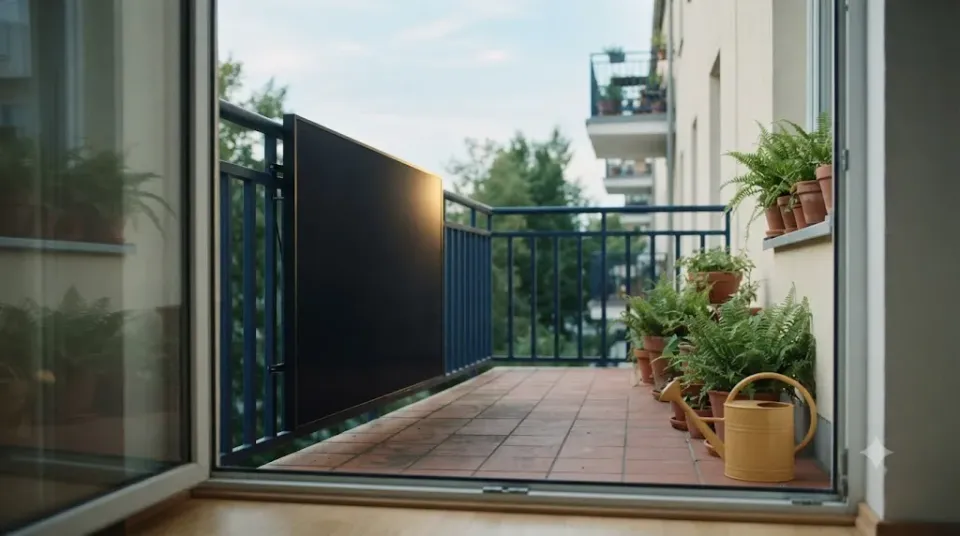
Price is not a guarantee in either direction. A mid-priced kit from an established maker with a clear datasheet usually beats both the cheapest and the most expensive. Our buying checklist has the twelve checks.
What is actually true
Half-truths worth knowing
Not everything is a clear myth. These sit in between.
"Panels do not work in winter." They work, but much less. In December a German balcony system might make a small fraction of its June output. Cold actually helps panel efficiency; short days and low sun are the problem. Snow sliding off steep panels clears them quickly. See winter, snow and heat.
"Insurance covers it automatically." Often it does, through household contents or liability insurance, but not always, and some insurers want to be told. A two-minute email saves arguments later. See insurance for balcony solar.
"It pays back in two years." Possible with a cheap kit, a south balcony and high self-consumption. For most flats, three to six years is a more honest range. The maths depends on your kit price, your yield and your habits.
"It overloads my wiring." Mostly a misunderstanding. A typical German socket circuit is protected for 16 A, which is about 3,680 W at 230 V. A balcony system adds up to 800 W, but it adds it as supply, not demand. The theoretical worry is a circuit where heavy loads run on the same cable while the solar feeds in, so the cable carries more than the breaker can see. That is why the standard limits output to 800 W, rules out power strips and asks for a sound fixed socket. If your wiring is very old, or the socket shows heat marks, have an electrician look at it before you plug anything in. That is good advice with or without solar.
Shelly Plug S Gen3
A Wi-Fi smart plug with power metering that shows live watts and kWh per appliance in an app, ideal for learning what your washing machine or dishwasher really draws. Its maximum load is lower than a wall socket, so check the rating before using it on heaters, kettles or other high-draw appliances.
Check price on Amazon Ad - affiliate link. Prices change; check the listing.All the myths in one table
| Myth | Reality in Germany, late 2026 |
|---|---|
| Illegal, needs an electrician | Legal; Schuko plug allowed up to 960 W of panels and 800 W output |
| Landlord can refuse | Needs a good reason; you must still ask |
| Paid for exports | Generally no feed-in payment |
| Halves the bill | Around 10 - 15 % for a typical household |
| Bigger panels, double savings | Inverter caps at 800 W; gains are smaller |
| Meter spins backwards | Not with digital or smart meters |
| Works in a power cut | Switches off for safety |
| North is useless | Often about half of south; can still pay back |
| Battery is essential | Optional; often slow payback |
| Cheap kits are all the same | Inverter, mount and support differ a lot |
One example household, before and after the myths
Here is how the myths play out for one example household: Paul and Sara, a couple in a rented flat in Frankfurt with a south-west balcony on the second floor.
What they believed at first: they needed an electrician, the landlord would refuse, a battery was essential, and the system would halve their 1,000 € yearly bill. With those beliefs, they priced it at about 1,500 € for a kit with storage plus an electrician, expected 500 € a year in savings, and thought "three years, fine". They nearly ordered a 2,000 W panel set with a battery.
What they found after checking:
- A two-panel kit with a Schuko plug, within 960 W of panels and 800 W output, needs no electrician. Cost: about 420 €.
- The landlord agreed within two weeks, on condition that the mount clamps onto the railing without drilling.
- Their yield estimate for south-west, little shade: about 720 kWh a year.
- Sara works from home two days a week. With timed laundry and dishwasher, they estimate about 50 % self-consumption: 360 kWh = about 133 € a year.
- Payback: 420 / 133 = about 3.2 years.
Their realistic saving is about a quarter of what they first imagined - but their outlay is less than a third. The payback is about the same, and they avoided spending over 1,000 € on things they did not need yet. They plan to look at a battery again after a year of real data from their inverter app.
What I'd tell a neighbour
Strip away the myths and plug-in solar is simple. It is legal, quick to register, and cuts part of your bill, mostly the part your flat uses during daylight. It works best when you use the power as it is made. It does not make you independent of the grid, and it does not pay you for exports. For most German flats with some sun, it pays for itself in a few years and keeps working long after.
If you are curious, do three things. Measure your base load one evening (see your base load). Put your balcony into Sunslot to see your hour-by-hour output and payback. Then read what is plug-in solar and the buying checklist. That is about an hour of reading for a decision that lasts twenty years.
Other things people wonder
Is balcony solar allowed in Germany?
Yes. Systems may feed up to 800 W through the inverter and must be registered in the Marktstammdatenregister. A Schuko plug is allowed for systems with up to 960 W of panels that meet the protection requirements. This is not legal advice.
Will my balcony system work during a blackout?
No. Standard grid-tied inverters switch off when the grid fails, as a safety feature. For backup, use a portable power station or a product specifically built for emergency power.
How much can a balcony system really save?
For a typical 800 W system making 750 kWh a year, around 100 to 180 € a year at 37 ct/kWh, depending on how much you use yourself. That is roughly 10 to 15 percent of a typical household bill.
Is a north-facing balcony worth it?
Sometimes. Output is often around half of a south balcony. With a low kit price and high self-consumption, payback can still be around four to seven years. Run the numbers for your spot first.
Do I get money for power I send to the grid?
Generally no. Balcony systems in Germany receive no feed-in payment. Use as much as you can while it is made - timing your dishwasher and laundry is the easiest way.